Physical Address
304 North Cardinal St.
Dorchester Center, MA 02124
Physical Address
304 North Cardinal St.
Dorchester Center, MA 02124

The rain starts. The park plans are cancelled. And suddenly you have one, two, three children with nowhere to go and more energy than a thunderstorm. If you have been there — and almost every parent has — you know exactly how quickly a rainy day can tip from cosy to chaotic.
Here is the thing, though. Rainy days do not have to mean screen time marathons, cabin fever, and children bouncing off the walls in the worst possible way. With the right ideas, an indoor rainy day can actually be one of the most active, imaginative, and memorable days your kids have had in weeks.
Indoor games that keep kids active on rainy days are not complicated. Most of them require nothing more than a cleared living room floor, a few cushions, and a willingness to get a little silly. No specialist equipment. No expensive toys. Just movement, imagination, and a bit of energy from the adults in the room.
This guide covers more than 40 indoor games that keep kids active on rainy days, organised by age group, energy level, and what you have available at home. Whether you have a toddler, a ten-year-old, or a whole mixed-age group to entertain, you will find ideas here that actually work — and that children will actually want to do.
Let’s make rain days something to look forward to.
It might be tempting to think of rainy day indoor activity as just filling time. But there is a solid case for why keeping kids moving on days they cannot go outside matters more than most parents realise.
The World Health Organization recommends that children aged 5 to 17 get at least 60 minutes of moderate to vigorous physical activity every single day. Not five days a week. Every day. When outdoor time disappears because of bad weather, that daily movement needs to happen somewhere — and indoor games are the answer.
What happens when children do not get enough physical activity? They sleep worse, concentrate less, get more irritable, and paradoxically have more trouble settling down. The energy does not disappear just because the sun has gone behind the clouds. It needs an outlet. Indoor games that keep kids active on rainy days provide exactly that outlet in a way that is safe, supervised, and fun.
Research from the University of Illinois found that physically active children show greater attention, faster cognitive processing, and better academic performance than sedentary children. Physical activity is not just good for the body — it is directly beneficial for the brain. Games that require coordination, strategy, and fast reactions are literally building neural pathways while children play. A rainy afternoon of active indoor games is not just burning energy — it is supporting cognitive development.
Jumping, crawling, balancing, throwing, catching, spinning — all of these movements contribute to the development of gross motor skills that children need throughout their lives. Children who get varied physical movement indoors and outdoors are better at all physical tasks and more confident in their bodies. Indoor games that keep kids active on rainy days, when chosen well, give children exposure to a wide variety of movement patterns that develop motor skill and coordination.
The best way to reduce screen time is not to restrict it with rules — it is to make something else more appealing. Indoor games that keep kids active on rainy days do this naturally. When children are engaged in a fun physical game, they are not thinking about their tablet or the television. The activity fills the time, meets the need for stimulation and movement, and the screen simply becomes less interesting by comparison.
Ask adults about their favourite childhood memories and a disproportionate number involve rainy days. The indoor obstacle course, the living room fort, the rainy day dance party. These improvised, slightly chaotic indoor play sessions stick in children’s memories precisely because they were unexpected and fully engaged. Indoor games that keep kids active on rainy days are not just about physical health — they are about building the kind of family memories that last.
Toddlers are simultaneously the easiest and the hardest age group to entertain on rainy days. Easiest because almost anything involving movement, colour, or novelty captivates them. Hardest because their attention spans are short and their energy is essentially limitless. These indoor games are specifically designed for the toddler age group and require minimal setup.
| Sock Sliding | Ages 2+ | No equipment needed Clear a section of hallway or smooth floor. Put socks on and slide. That is genuinely all this activity is, and toddlers will do it for a surprisingly long time. Add a start and finish line with masking tape to make it more structured. This improves balance, builds core stability, and produces enormous amounts of laughter. |
| Floor Shape Hopscotch | Ages 2+ | Masking tape needed Use masking tape to create a series of shapes on a hard floor — circle, square, triangle, rectangle. Call out a shape and watch your toddler sprint to it. This game builds colour and shape recognition, improves coordination and listening skills, and burns a remarkable amount of energy in a small space. Change the difficulty by making the shapes smaller or further apart. |
| Animal Movement Game | Ages 2+ | No equipment needed Call out an animal and everyone moves like that animal across the room. Hop like a frog, slither like a snake, stomp like an elephant, tiptoe like a cat. This game requires no materials at all and can go for as long as you have animal ideas. It builds imaginative play, gross motor skills, and body awareness — and toddlers find it absolutely hilarious. |
| Balloon Tap Keep-Up | Ages 2+ | One balloon needed Blow up a balloon and the rule is simple: do not let it touch the floor. Tap it up, bat it away, chase it across the room. Toddlers will run, jump, stretch, and throw themselves around trying to keep a balloon in the air for genuinely impressive amounts of time. The unpredictable movement of a balloon makes it endlessly surprising. |
| Cushion Island Jumping | Ages 2+ | Cushions and pillows needed Scatter cushions across the floor and tell your toddler the floor is made of lava. They can only travel by jumping from cushion to cushion. This builds jumping confidence, balance, and spatial awareness. Place the cushions close together at first and gradually space them wider apart as their confidence grows. Watch them choose routes and problem-solve their path. |
| Drum the Pillows March | Ages 2+ | Pillows and music needed Line up pillows and cushions on the floor as stepping stones. Put on a marching song and march along the pillow path. When the music stops, everyone freezes. When it starts again, march. This combines freeze game mechanics with music, movement, and the physical challenge of stepping on an uneven surface. |
| Toddler tip: Keep sessions short — 10 to 15 minutes — and transition smoothly from one activity to the next. Toddlers do not have long attention spans but they will stay active all day if you keep switching things up. |
Children in this age group are ready for simple rules, a bit of competition, and games that require some skill. They love challenges, rewards, and the chance to show off what they can do. These indoor games that keep kids active on rainy days are perfectly pitched for the 4 to 7 age range.
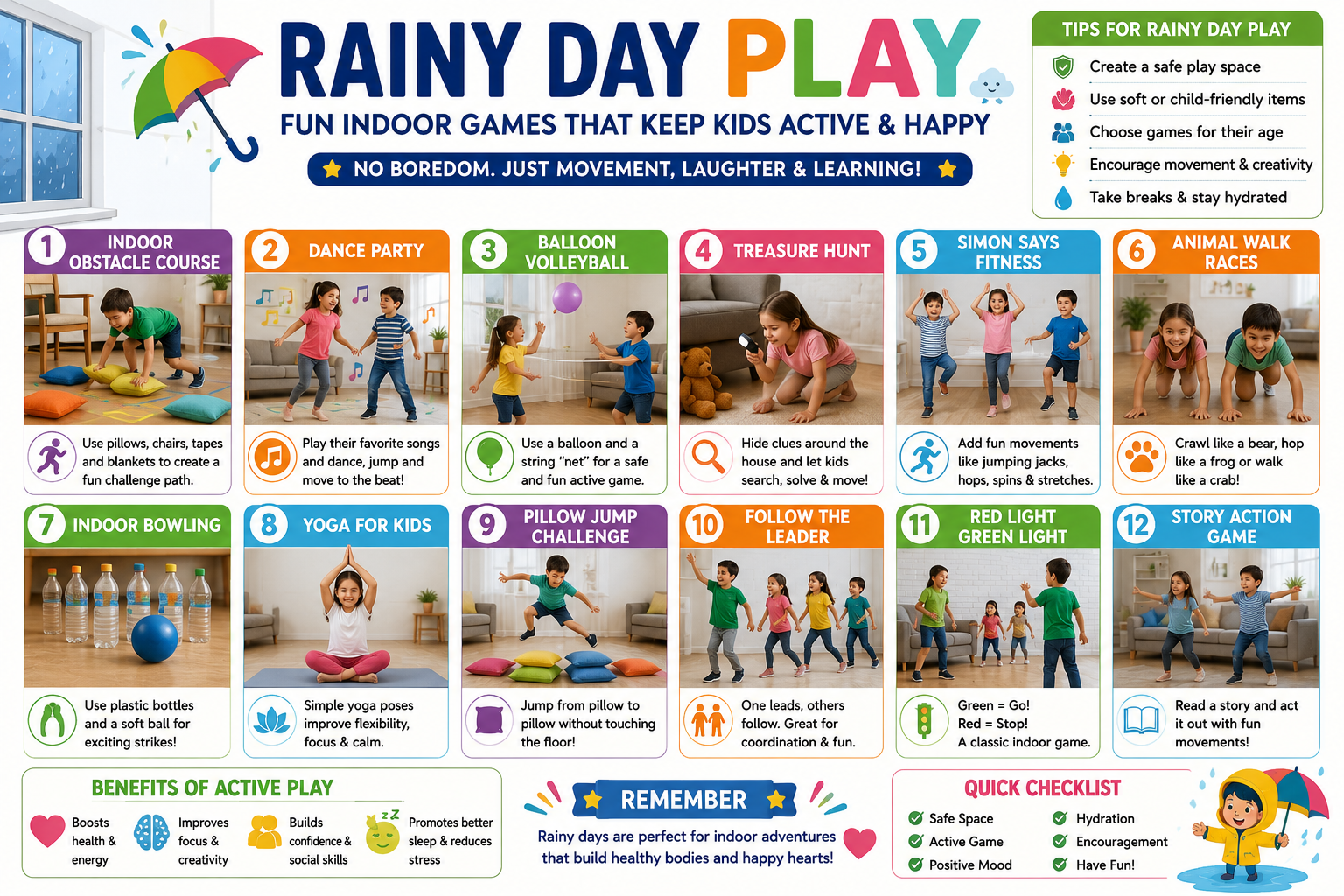
| Living Room Obstacle Course | Ages 4+ | Household furniture needed This is the gold standard of indoor games that keep kids active on rainy days, and for good reason. Use chairs, cushions, blankets, hula hoops, pillows, and tape to build a course through the living room. Include crawling under a table draped with a blanket, jumping over a line of books, balancing along a strip of tape, spinning three times at a marker, and climbing over a cushion stack. Time children and challenge them to beat their own record. Once they master the course, let them redesign it themselves. |
| Freeze Dance | Ages 4+ | Music needed Play music and dance freely. When the music stops — everyone freezes completely still. Anyone who moves is out. Last one standing wins. This is one of the most beloved indoor games for active play on rainy days because it requires no equipment, works for any number of players, and produces an intense combination of aerobic dancing and focused stillness. Add a rule that each freeze must hold a specific pose — superhero, sleeping, statue of liberty — to make it even more entertaining. |
| Hot Lava Floor | Ages 4+ | Cushions and towels needed The entire floor is molten lava and nobody can touch it. Scatter cushions, pillows, small rugs, and folded towels as safe islands. The goal is to travel from one end of the room to the other without touching the floor. This game builds spatial reasoning, jumping skills, and creative problem-solving as children work out routes and step carefully from island to island. |
| Toilet Roll Bowling | Ages 4+ | Toilet rolls and a soft ball Stack toilet roll tubes into a pyramid at one end of the hallway. Each player gets two rolls to knock them all down. Keep score across multiple rounds. This classic works every time for this age group — it satisfies the deep human urge to knock things over, builds aiming and throwing skills, and requires genuinely no special equipment. Replace toilet rolls with plastic bottles filled with a little water if you want more stable pins. |
| Simon Says Movement Edition | Ages 4+ | No equipment needed Simon Says with a physical twist — every command is a movement. Simon says jump ten times. Simon says spin around twice. Simon says touch your toes three times and clap. The person without ‘Simon says’ before the command is out. This game builds listening skills, body awareness, and number recognition while keeping children continuously active. Let children take turns being Simon — they love the power of it. |
| Indoor Hopscotch | Ages 4+ | Masking tape needed Create a traditional hopscotch grid on your hallway or kitchen floor using masking tape. Instead of numbers in the squares, write movement challenges — hop five times, do three star jumps, spin around, clap your hands. Traditional hopscotch alone is good exercise, but challenge-based hopscotch keeps children jumping, spinning, and moving continuously for much longer. |
| 💡 Parent tip for this age group: children aged 4–7 respond brilliantly to a simple points system or a sticker for completing a challenge. A little bit of gamification goes a long way toward keeping engagement high for longer sessions. |
Older primary school children need more of a challenge. They want to develop skill, keep score, compete, and feel genuinely accomplished. These indoor games are physically demanding enough to give real exercise and interesting enough to hold attention for longer sessions.
| Indoor Circuit Training Challenge | Ages 7+ | Timer needed Design a five-station circuit together: 20 jumping jacks, 10 push-ups, 15 squats, 30-second plank, 20 high knees. Set a timer for 45 seconds at each station with 15 seconds to move between. Do three rounds. Let children design their own stations in the second session. This teaches children what structured exercise looks and feels like while being challenging enough to produce real effort. Put on a playlist and make it feel like a proper workout. |
| Balloon Volleyball With a Net | Ages 7+ | Balloon and string needed Tie a piece of string or rope across a doorway at chest height and play volleyball with a balloon. No letting it touch the floor, no double hits, serve from behind the line. Keep score and play to 21. This game requires genuine athletic effort and coordination, and the balloon’s slow movement gives children time to react and develop control. Doubles and singles versions both work well. |
| Skipping Rope Challenges | Ages 7+ | Skipping rope needed Skipping rope is one of the best cardiovascular exercises available and children in this age group are typically skilled enough to make it genuinely demanding. Set timed challenges: most skips in 60 seconds, longest continuous skip, double-unders, cross-arm skipping. Create a personal record chart on the fridge. Skipping with a rope indoors requires only a hallway with reasonable ceiling height and is a phenomenal physical workout. |
| Hallway Bowling Tournament | Ages 7+ | Bottles and a ball needed Set up six to ten plastic bottles filled with a small amount of water at the end of the hallway. Run a proper tournament — everyone bowls two frames per round, keep cumulative scores, have knockout rounds. The competitive structure keeps older children engaged for much longer than a simple knockdown game. Award a silly trophy or the first choice of snack to the winner. |
| Yoga Challenge and Flow | Ages 7+ | Yoga mat optional Look up a 20-minute kids’ yoga video on YouTube and do it together as a family. Yoga for this age group builds flexibility, balance, core strength, and body awareness — all things that benefit from regular practice. Partner yoga poses add a cooperative and often hilarious dimension. Challenge children to hold specific poses for increasing lengths of time and track their improvement across multiple rainy days. |
| Newspaper Runway Dance-Off | Ages 7+ | Old newspapers needed Lay a long path of newspaper pages end-to-end down the hallway. Children must walk, hop, skip, or dance down the runway to music. When the music stops, they must freeze on the paper. Every round, fold each sheet in half — making the safe zones smaller and the challenge harder. This game builds balance, coordination, and hilarity in equal measure. |
| Indoor Treasure Hunt With Physical Challenges | Ages 7+ | Clue cards needed Hide clue cards around the house, but make each clue require completing a physical challenge to earn the next clue. Twenty star jumps at the first clue. Crawl to the kitchen and back. Five push-ups at the hallway mirror. Balance on one leg for 30 seconds. This turns a passive treasure hunt into a high-energy indoor fitness course that children find deeply motivating because the treasure at the end drives the effort throughout. |
| Challenge tip: children aged 7–11 are motivated by personal records and visible progress. Keep a rainy day record board on the fridge — most skips in a minute, fastest obstacle course time, longest plank hold — and update it on each rainy day session. The competition with their own past performance is often more motivating than competing with others. |
Some of the best indoor games that keep kids active on rainy days are ones where parents and siblings of different ages can all participate. These games work across a wide age range and create shared family experiences that children remember long after the rainy day has passed.
| Family Obstacle Course Championship | All ages | Household items Build the most epic obstacle course your living room has ever seen. Involve everyone in the design phase. Then run it as a family championship — time each person, award handicap seconds for younger children, and crown a family champion with a silly trophy (a kitchen spoon wrapped in foil works brilliantly). Redesign the course between rounds to keep it fresh. This is consistently the most-requested indoor rainy day activity across all age groups. |
| Tug of War | All ages | Rope or strong towel Knot a long towel or length of rope and play tug of war in a hallway or large room. Divide teams to balance strength — adults on one side, all children on the other, or a parent and toddler vs two older children. Tug of war works the whole body, produces enormous effort and laughter, and is genuinely one of the most physically demanding simple games you can play indoors. Mark a centre line with tape and the rules are set. |
| Whole Family Freeze Dance | All ages | Music needed Freeze dance with the whole family is different to freeze dance with just children — because watching a parent freeze in a ridiculous pose is an enormous source of delight for children of all ages. Take turns being the music controller. Add themed rounds where everyone must freeze in a specific type of pose — an animal, a superhero, asleep, scared. The combination of continuous dancing and sudden frozen absurdity makes this one of the most reliably fun indoor games for all ages. |
| Indoor Mini Olympics | All ages | Various household items Design a series of mini events: paper aeroplane throw for distance, sock toss into a bucket, longest plank hold, most hops on one foot, fastest floor puzzle, highest jump marked on a doorframe. Create a simple score sheet and run the Olympics as a family event complete with a podium ceremony using stacked books or a staircase. Indoor Olympics keeps everyone moving, creates genuine competition across different ages, and can fill an entire rainy afternoon easily. |
| Crab Walk Relay | All ages | No equipment needed Get into crab position — hands and feet on the floor, tummy facing up — and race from one end of the room to the other. Run relays, races, and challenge courses in crab walk only. Crab walking is surprisingly demanding on the arms, shoulders, and core, and is absolutely hilarious to watch across all ages. Even toddlers can participate in a simplified version on their own course. |
| The Floor is Lava — Family Edition | All ages | Cushions and furniture A whole-house version of the classic game. Set a route from one end of the house to the other using only designated safe zones. Include furniture as platforms, cushions as stepping stones, rugs as safe ground, and doors as gateways. The whole family must navigate the route without touching the floor. Parents make it harder by timing the run and taking away one safe zone each round until the route becomes genuinely challenging. |
Sometimes you do not have balloons, you have run out of masking tape, or you simply need something to start right now with absolutely nothing to hand. These indoor games that keep kids active on rainy days require nothing except space and energy.
One person stands at the end of the room facing away. When they shout green light, everyone runs toward them. When they shout red light, everyone must freeze instantly. Anyone caught still moving goes back to the start. The first person to touch the caller wins the round. Simple, fast-moving, and reliably exhausting — children can play this for much longer than seems possible.
One child stands at one end of the room as Mr Wolf, facing the wall. Everyone else stands at the other end. Players call out ‘what time is it Mr Wolf?’ and Mr Wolf calls back a time — three o’clock means take three steps forward. When Mr Wolf shouts ‘dinner time!’ they turn and chase everyone back to the starting wall. Anyone caught becomes the next Mr Wolf. This game involves running, freezing, tension, and laughter in a combination that children find irresistible.
For younger children especially, action songs and stories with physical movements — We’re Going on a Bear Hunt, Head Shoulders Knees and Toes, The Hokey Cokey — provide genuine movement without any equipment at all. Children who know these songs will perform the actions with genuine physical enthusiasm and can be kept moving for 20 to 30 minutes through a sequence of action songs with nothing but your voice.
Instead of tagging a person, you step on their shadow. This only works with a sunny window or a strong lamp, but when the light is right it is a brilliant chasing game. Children have to move fast and cleverly to keep their shadow out of reach. The twist is that standing against a wall makes your shadow disappear — a legitimate defensive strategy that adds a whole new tactical dimension to the game.
Against a soft wall or sofa, children can practise handstands and cartwheels with no equipment needed beyond a cleared floor and a soft landing spot. Older children who are learning these skills will happily spend extended periods working on them. Even very young children will attempt to kick their feet up and find enormous satisfaction in the effort. This is movement that develops shoulder and core strength, spatial awareness, and confidence in physical challenge.
Not all indoor games that keep kids active on rainy days are structured. Some of the most physically intensive indoor play is also the most creative. These ideas blend imagination with movement in ways that children often sustain independently for long periods.
Building a den or fort out of cushions, blankets, chairs, and pillows is one of those classic indoor activities that requires genuine physical effort — lifting, carrying, arranging, climbing — and then becomes an imaginative play base that drives further active play. Children crawling in and out, defending from imaginary attackers, rebuilding after collapses, and fetching supplies from other rooms are moving constantly even when they do not realise it.
Clear the living room and turn it into a pirate island. Cushions are rocks, the sofa is the ship, the rug is the sea that nobody can step in. Create a loose story framework and let children develop it. The movement that emerges from this kind of imaginative play — jumping, climbing, crawling, rolling — is among the most varied and physically beneficial that children engage in. And because it is self-directed, children sustain it for far longer than adult-led activities.
Put on a favourite song and challenge children to create a full choreographed routine to perform at the end of the afternoon. The process of creating choreography — trying movements, repeating sequences, teaching each other, running through the full routine repeatedly — is genuinely high-intensity physical activity. The performance at the end of the session, watched by parents and captured on a phone, provides a motivating goal that keeps children working hard throughout.
Create a superhero training programme: agility drills through cushion obstacles, strength training with pillow carries, speed training in the hallway, balance training on the sofa edge, and a final skills test. Give children superhero names, award badges made from sticker stars, and maintain the fiction throughout. The imaginative framing transforms physical challenges into missions, and children who would resist a straightforward exercise session will enthusiastically push their limits when there is a story wrapped around it.
Having a list of great indoor games is one thing. Making rainy days consistently active and fun without it becoming a logistical nightmare is another. Here is practical guidance for making indoor active play work in real family life.
Keep a dedicated box or basket with rainy day supplies — a balloon or two, a roll of masking tape, a soft ball, some chalk, a skipping rope, a deck of cards with physical challenge ideas written on them. When rainy days arrive, the box comes out and children can choose their own activities. The act of having a dedicated box signals that rainy days are special rather than disappointing, which shifts children’s mindset significantly.
The single biggest barrier to active indoor play is a cluttered floor. Before you begin, do a five-minute clear-up together. Move the coffee table, push the sofa back, roll up the rug if it needs moving. Children can and should help with this process — and they will, if you frame it as setting up the arena rather than tidying the room. A clear floor transforms what is possible and signals to children that something fun is about to happen.
Get children into comfortable clothes they can move in. This sounds obvious but it makes a genuine difference. Children in their regular clothes are slightly less likely to throw themselves into physical play than children who are in shorts and a t-shirt or a tracksuit. The change of clothes also acts as a psychological signal that the rules of normal indoor behaviour are temporarily relaxed.
Attention spans vary by age, but as a general rule, switching activity every 20 to 30 minutes maintains enthusiasm and energy far better than staying with one game until everyone is bored. Plan three or four different indoor games before the rainy day begins and transition between them before interest flags. Ending an activity while children are still enjoying it leaves them wanting more — always a better outcome than milking it until everyone is fed up.
High-intensity indoor games that keep kids active on rainy days need to be balanced with lower-key periods. After a circuit training session or an obstacle course championship, a 15-minute period of colouring, a board game, or a snack break allows physical recovery and cognitive reset before the next active session. This rhythm — active, rest, active, rest — is how children naturally regulate their energy and is also a healthy pattern to teach.
Once you have introduced a few ideas, step back and let children take ownership of the games. Let them modify the rules, redesign the obstacle course, choose the music, and decide who goes next. Child-led play tends to be more sustained and more energetic than adult-directed play because children are inherently more motivated when they feel in control. Your role shifts from activity director to enthusiastic participant and safety guardian.
Not every home has a large open living room. Here are the best indoor games that keep kids active on rainy days matched to the space you actually have.
Hallways are more useful than most parents realise. Hallway bowling with plastic bottles, skipping rope challenges, relay races end to end, balloon tap in a narrow channel, and sock sliding are all excellent hallway-only active games. A hallway also makes a perfect running lane for speed challenges and timing games.
A single cleared living room opens up obstacle courses, freeze dance, balloon volleyball, floor lava, circuit training, and family games like tug of war. Pushing furniture to the edges creates a surprising amount of usable space. A cleared living room with a soft floor is genuinely enough for an entire afternoon of high-energy indoor play.
Multiple rooms plus a staircase exponentially expand the possibilities. Whole-house treasure hunts with physical challenges at each station, whole-house floor-is-lava routes, and multi-room relay races are all possible. A staircase adds stair climbing challenges, counting games, and a natural starting block for hallway races. Use the whole space and the whole afternoon stretches open.
The most universally effective indoor active games for rainy days are the living room obstacle course, freeze dance, floor is lava, balloon volleyball, and family circuit training. These work across age groups, require minimal equipment, and produce genuine physical activity. For toddlers specifically, sock sliding, animal movements, and balloon keep-up are ideal. For older children, skipping rope challenges, indoor mini Olympics, and physical treasure hunts provide more structured challenge.
Many of the best indoor active games require nothing at all. Red Light Green Light, What Time Is It Mr Wolf, Simon Says movement edition, freeze dance, animal movement games, and crab walk races all require zero equipment. The living room floor, a cleared hallway, and some imagination are genuinely all you need. Having a rainy day box with a few inexpensive items — a balloon, masking tape, a soft ball — expands your options significantly for a very small investment.
The WHO recommends 60 minutes of moderate to vigorous physical activity for children every day. On rainy days when outdoor play is not possible, the goal is to reach that daily target through indoor games and activities. This does not have to happen in one block — three 20-minute sessions of active play spread across the day achieves the same result. The key is that movement happens regularly throughout the day rather than in one burst.
Yes, and they are particularly important for toddlers. Young children are developing gross motor skills rapidly and need varied, repeated physical movement to do so effectively. Indoor games like animal movement, balloon tap, cushion island jumping, and floor hopscotch all contribute directly to motor development, coordination, balance, and body awareness. The fact that toddlers experience these games as pure play rather than exercise is exactly why they are so effective — children who are having fun move more, and movement builds the skills.
The key is not to pitch it as exercise. Lead with the fun and the story. ‘The living room is a volcano island and we need to escape without touching the lava’ is far more engaging than ‘let’s do some jumping activities.’ Participate yourself with real enthusiasm — children are much more likely to join in when an adult is genuinely playing rather than supervising. For older reluctant children, a competitive challenge with visible scoring tends to be more motivating than group participation activities.
Mixed-age family games work best when the rules can flex to accommodate different abilities. The living room obstacle course, family freeze dance, floor is lava, indoor mini Olympics, and family tug of war all work well across a range of ages because they can be adjusted for age and size. Give younger siblings shorter distances, fewer repetitions, or easier sections. The goal is everyone participating and everyone succeeding at a level appropriate to their age, not everyone doing exactly the same thing.
Set clear physical boundaries before you start — define the playing area and what is out of bounds. Remove breakable items from the play space before beginning. Establish one simple safety rule that applies to all games: no climbing above sofa height, no running after the count of three, no pushing. Keep one adult in the play space as a participant-supervisor rather than an observer. The activity being physical does not mean it needs to be unsafe — structure and boundaries actually allow children to play more freely and more actively than completely open-ended chaos.
For the purposes of meeting daily physical activity recommendations, yes — well-designed indoor active games can provide equivalent levels of physical effort to outdoor play. Research suggests that children can reach the same heart rate and energy expenditure through indoor circuit training, obstacle courses, and vigorous games as they do through outdoor running and play. The developmental benefits are broadly similar. Where indoor play differs is in the specific benefits of outdoor and nature exposure, but on a rainy day, high-quality indoor active play is an excellent substitute.
Freeze dance is probably the single easiest indoor active game to set up on a rainy day. All you need is music — any device with a speaker — and a clear space. Start the music, dance, stop the music, freeze. It requires no preparation, no equipment, and no explanation beyond those three instructions. It works for children from about two upwards, it is genuinely physically demanding, and it produces immediate laughter and engagement. When all else fails, freeze dance is always the answer.
The key is building a rainy day ritual that children associate with specific fun activities that only happen when it rains. A dedicated rainy day box of activities, a special rainy day snack, a particular playlist that only comes out for indoor play sessions — these rituals create positive anticipation rather than disappointment when the weather turns. Children who grow up with active, fun indoor rainy day routines often genuinely look forward to bad weather. The goal is to make rain feel like an invitation rather than a disappointment.
Rain is not actually the enemy of a good day with children. Boredom is. And boredom is entirely solvable.
Every single indoor game in this guide has been done by real families on real rainy days. None of them require anything money cannot solve cheaply, anything expertise cannot handle easily, or anything a reasonably energetic parent cannot pull off even on a tired weekday afternoon. The ideas are simple. The execution is simple. The results — tired, happy children who sleep well and remember the day fondly — are anything but simple in their value.
Indoor games that keep kids active on rainy days are not a compromise on outdoor play. For many families, they are actually more connected, more imaginative, and more memorable than the average trip to the park. Because when space is limited and everyone is together, the games become more creative, the laughter becomes louder, and the memories stick harder.
Next time the rain hits, do not reach for the remote. Reach for this guide instead. The living room is waiting. The kids are waiting. Let’s play.