Physical Address
304 North Cardinal St.
Dorchester Center, MA 02124
Physical Address
304 North Cardinal St.
Dorchester Center, MA 02124

Every parent knows the feeling. You look up from the kitchen and your child has been sitting in the same spot for two hours. The show is still going. The tablet is still glowing. The body that is supposed to be running and jumping and climbing is completely, utterly still.
It is not a moral failure. It is modern life. Screens are designed by the smartest engineers in the world to keep children — and adults — exactly where they are. Sedentary habits have never been easier to fall into and never been harder to break.
But here is what we know: children need to move. Not just for their physical health, but for their emotional wellbeing, their concentration, their sleep, their social development, and their mental health. Movement is not optional for a developing child. It is as fundamental as food and sleep.
The question is not whether to get kids moving more every day — it is how to do it in a way that actually fits into real family life, without constant battles, without expensive equipment, and without making every day feel like a negotiation.
This guide gives you more than 35 practical, research-backed strategies for how to get kids moving more every day. These are ideas that work across different ages, different personalities, different family setups, and different amounts of available time. Some will click immediately. Others will suit your family better as your children grow. All of them are grounded in how children actually behave — not how we wish they would.
| Only 1 in 4 children worldwide meets the daily physical activity guidelines. World Health Organization — Global Report on Physical Activity 2022 |
That statistic is striking. Three out of four children are not moving enough. And the consequences go far beyond weight or fitness levels. Here is what the research actually shows:
Children who get adequate daily physical activity have stronger bones, healthier hearts, better lung function, and significantly lower risk of developing type 2 diabetes and other chronic conditions later in life. Getting kids moving more every day is one of the most powerful preventive health interventions available to any parent.
Physical activity triggers the release of endorphins, reduces cortisol, and improves serotonin and dopamine regulation. Children who are regularly physically active show lower rates of anxiety, better emotional regulation, greater resilience, and higher overall mood. In a period when children’s mental health challenges are increasing significantly, daily movement is one of the best protective factors parents can build into a child’s life.
| Children who are physically active are 40% less likely to suffer from depression compared to sedentary peers. Journal of Pediatrics, 2020 |
Physical activity increases blood flow to the brain, stimulates the release of BDNF — essentially a growth fertiliser for brain cells — and improves attention, memory, and executive function. A 20-minute walk before a test produces measurably better results than 20 additional minutes of studying. Getting kids moving more every day is literally good for their brains.
Physically active children fall asleep faster, sleep more deeply, and wake up more refreshed than sedentary children. Better sleep produces better mood, better concentration, and more energy — which makes children more likely to be active the following day. This positive cycle begins with daily movement.
Active play — running, chasing, team games, climbing — builds social skills that sedentary activities simply cannot replicate. Children learn to negotiate, take turns, read social cues, and collaborate through physical play in ways that form the foundation of their social lives. Getting kids moving more every day, particularly in group play settings, is one of the most effective ways to support healthy social development.
| Age Group | Daily Activity Target | Type of Activity |
| Under 5 — Toddlers | 3 hours total across the day | Light and energetic active play — no long sedentary periods |
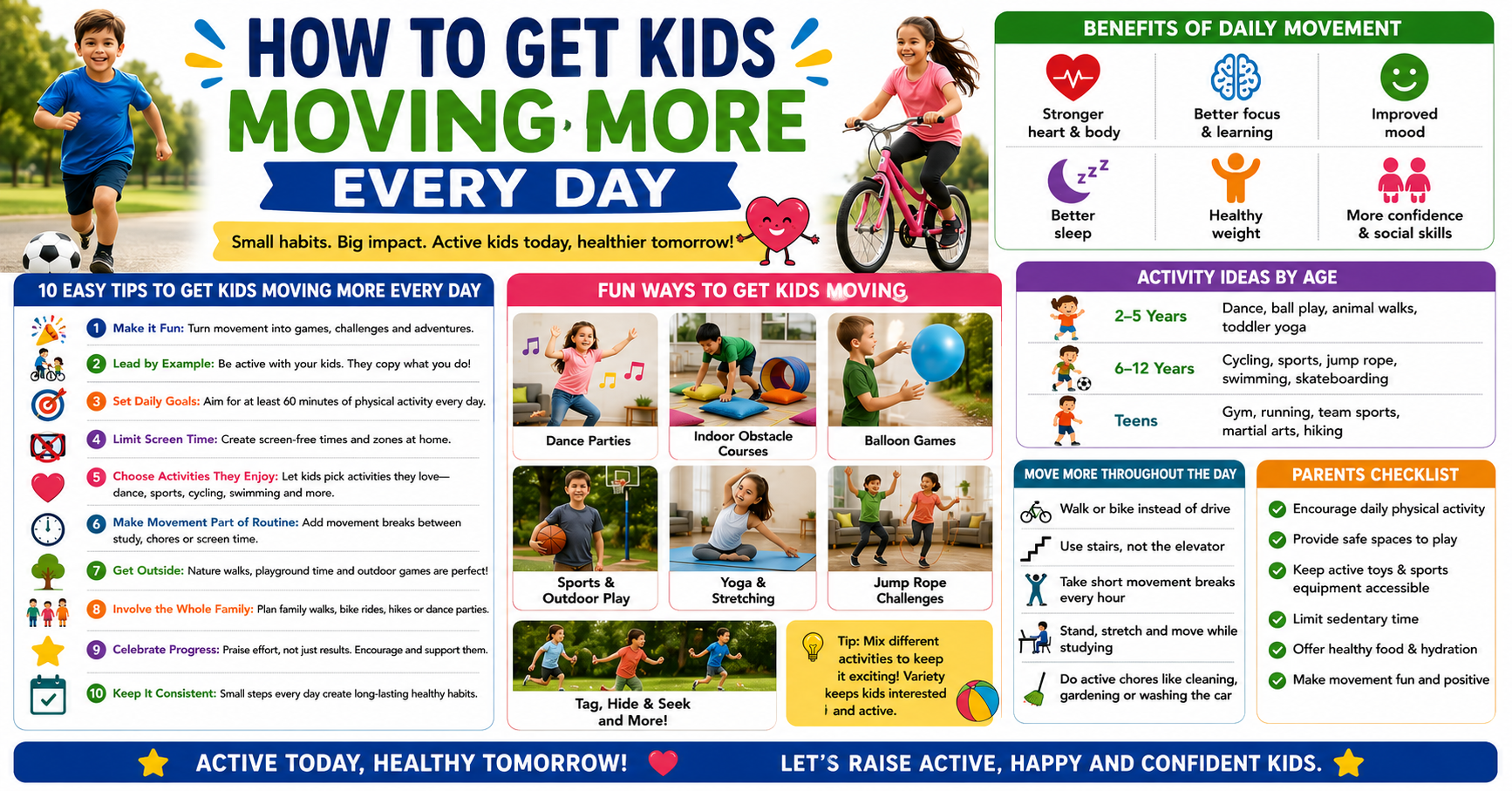
| Ages 5–17 | 60 minutes moderate to vigorous daily | Mix of aerobic activity plus muscle and bone strengthening 3x per week |
| All children | Break up sitting regularly | Movement break every 30–60 minutes of sedentary time |
These guidelines come from the World Health Organization and are supported by major paediatric health organisations worldwide. The 60 minutes does not need to happen in one block — shorter bursts accumulated across the day count equally toward the daily target.
How a child starts the morning sets the tone for the whole day. Even ten minutes of physical movement in the morning primes the brain for learning, sets a positive energy level, and reduces the sedentary drift that happens when children wake straight into screen time.
| 01 | The 5-Minute Morning Movement Ritual Ages 3+ Create a simple five-minute morning routine that happens before screens are allowed. Arm circles, ten jumping jacks, touching toes, jumping up and down. Keep it the same each day so it becomes automatic. Children who resist at first often come to find it comforting because it is a predictable ritual. Five minutes of morning movement shifts the whole day’s energy. |
| 02 | Walk or Cycle to School Ages 4+ Children who walk to school arrive with elevated mood, better concentration, and a head start on their daily activity target. Even walking part of the route — parking ten minutes away — makes a real difference. Over a full school year, children who walk to school accumulate weeks of additional physical activity compared to those who travel entirely by car. |
| 03 | Active Before Breakfast Ages 5+ Get children doing a simple physical task before sitting down to eat. Five jumps before breakfast, a quick sprint to the end of the garden and back, carrying their bag to the door. Small movement anchors at the start of the day begin to embed physical activity as a natural part of morning flow rather than something separate from daily life. |
| Morning Movement Mindset The goal of morning movement is not a workout. It is a signal — to the body and the brain — that today is an active day. Even two minutes of jumping or stretching shifts a child’s physical and mental state measurably. Start small and make it non-negotiable. |
Parents often feel they have limited influence over how active children are during school hours. But there are several strategies that extend parental influence across the full school day and build movement habits strong enough to persist in all environments.
| 04 | Champion Scooters for the School Commute Ages 5+ A scooter commute is faster than walking, requires genuine physical effort especially uphill, and children love the independence of it. If you live too far to walk the whole way, a park-and-scooter approach gives children meaningful daily exercise that fits easily into a busy school morning. |
| 05 | Arrive Early and Let Them Run All ages Arriving at school five minutes early and letting children run freely before the bell rings adds to their daily movement total without requiring any additional planning. Similarly, allowing children to play actively in the school grounds or a nearby park for 15 minutes at pick-up produces significant additional movement and helps children decompress after a structured school day. |
| 06 | Talk About Active Break Times Ages 5+ Ask children what they do at break and lunchtime. Children who play actively at school recess are significantly more active overall than those who stand and chat. Encourage active play with friends, suggest games they could try, and celebrate when they tell you about active lunchtime sessions. Parental interest and encouragement about physical activity at school matters more than most parents realise. |
| 07 | Choose at Least One Structured Physical Activity All ages Children who participate in at least one structured physical activity per week — swimming, dance, gymnastics, football, martial arts, athletics — are significantly more active overall and more likely to continue being active into adulthood. It does not have to be competitive sport. It just needs to involve sustained regular physical movement. |
The hours between the end of school and bedtime are the period when most children’s physical activity either happens or does not. This window — typically three to five hours — is often dominated by homework, screens, and passive relaxation. It does not have to be.
| 08 | Active Before Homework Rule Ages 6+ Establish a non-negotiable sequence: 30 minutes of physical activity before homework begins. The research supports this practically. Children who move before studying concentrate better, retain information more effectively, and complete homework faster than those who go straight from school bag to desk. Framing it as ‘this makes your brain work better’ lands better with older children than ‘this is good for you’. |
| 09 | The Daily Outdoor Window All ages A daily outdoor window of 30 to 60 minutes after school — a park trip, the garden, a walk — provides the most consistent and reliable way to get kids moving more every day. Make it a household routine rather than a weather-permitting option. Children in appropriate clothing are fine in most weather. The habit matters more than the conditions. |
| 10 | Screen Time After Activity Only Ages 5+ Link screen time to prior physical activity. Children can access screens after they have completed their daily movement target — not before. Children who know that outdoor play comes first and screens follow adjust to this structure remarkably quickly, often with less resistance than parents expect. It is sequencing, not deprivation. |
| 11 | Active Chores as Movement Credit Ages 5+ Vacuuming, carrying shopping, hanging laundry, raking leaves, washing the car — household tasks involving physical effort count as movement. Age-appropriate active chores add meaningful physical activity to children’s days while building responsibility and family contribution simultaneously. |
| 12 | Dog Walking as a Daily Movement Anchor Ages 6+ Families with dogs have a built-in daily movement anchor. Children who take responsibility for a dog’s daily walk build a movement habit that is externally motivated — the dog needs to go — and highly consistent. The responsibility creates daily movement that requires no parental negotiation. |
Every hour spent on screens is an hour not spent on physical activity. For children who are already meeting their daily movement targets, moderate screen time is not a significant problem. For the majority who are not meeting those targets, reducing screen time is the most direct route to increasing movement.
Build movement breaks into screen sessions. Every 30 minutes of screen time earns a 5-minute movement break — ten jumping jacks, a run to the letterbox, five minutes of dancing. This reduces total sedentary time even when screens are present and models healthy screen habits that children will carry forward.
| Screen Time and Movement Research from the American Academy of Pediatrics shows that children with consistent screen-time limits move significantly more than those with unrestricted access. Making movement the default and screens the reward — rather than the other way around — is the structural change that produces the biggest results. |
Not all screen time is equivalent. Educational documentaries that spark outdoor curiosity, and active video games — Nintendo Switch Sports, Just Dance, Ring Fit Adventure — turn screen time itself into movement time. Curating children’s media toward content that stimulates curiosity or movement is a small change with meaningful impact.
Night-time device use disrupts children’s sleep. Poor sleep leads to reduced physical activity the following day. Charging all devices outside bedrooms overnight — a simple household rule — improves sleep quality, morning energy, and next-day activity levels. This single structural change has cascading positive effects across the entire day.
At this age, movement is play. The strategies for toddlers are about creating environments where active play is natural and unrestricted. Give toddlers large open spaces — gardens, parks, community play areas. Minimise unnecessary time in buggies and car seats. Let them climb within safe limits, explore physical space, and move freely. Structured activity matters less than unstructured free physical play at this age. Your role is to provide the space, the time, and your enthusiastic participation.
This is the golden age for building physical activity habits. Children in this range can participate in organised sports, develop genuine skill in specific activities, and begin to feel real pride in physical achievement. At least one structured physical activity per week, daily outdoor play, a clear screen time structure that prioritises movement first, and regular family physical activity that models an active lifestyle — these are the four pillars for this age group.
Physical activity rates drop most sharply in this window — particularly for girls. Peer influence becomes dominant: teenagers who have active friends are far more likely to be active. Individual activities that teenagers choose themselves — gym, running, martial arts, dance, skateboarding, climbing — work better than parent-imposed activities. Give teenagers agency over what physical activity looks like for them and support whatever they choose, even if it does not look like traditional exercise.
| The Teenage Drop-Off Physical activity rates drop by up to 50% between ages 11 and 15. The single most important thing parents can do during this period is keep the conversation going — not as a lecture about health, but as genuine curiosity about what the teenager enjoys and wants to do. Teenagers who feel supported in choosing their own form of movement are significantly more likely to stay active. |
Environment shapes behaviour more powerfully than willpower or motivation. If you want to get kids moving more every day, design an environment where movement is the path of least resistance.
| 13 | Keep Equipment Visible and Accessible All ages Bikes in the hall rather than locked in a shed. A basketball hoop in the driveway. A skipping rope by the back door. A football in the garden. Equipment that is visible and immediately available gets used. The extra thirty seconds of retrieval time is enough friction to prevent casual, spontaneous active play. Remove that friction. |
| 14 | Create Active Spaces in the Home All ages A cleared area of living room floor with an exercise mat. A pull-up bar in a doorframe. Small environmental signals that physical activity is welcome in the home encourage spontaneous movement. The message the physical environment sends — this is a place where we move — matters as much as any planned activity. |
| 15 | Replace Car Journeys With Active Travel Where Possible All ages Make a list of nearby destinations your family typically drives to and commit to walking or cycling to them. Children who regularly travel actively to ordinary destinations develop a relationship with their body and their neighbourhood that pays dividends throughout their lives. Even replacing one car journey per week with active travel adds up meaningfully over a school year. |
| 16 | Model Active Behaviour Consistently All ages Children pay attention to what adults do far more than what adults say. A parent who talks about the importance of exercise from the sofa is far less influential than one who visibly chooses to walk, stretch, and play. You do not need to be a fitness enthusiast. You just need to make active choices in front of your children regularly. These visible choices are absorbed deeply and shape their own relationship with movement. |
Children do not move for health reasons. They move because moving is fun. The moment physical activity becomes associated with obligation or performance pressure, it loses its appeal. Talk about active play in terms of fun, adventure, skill, and feeling good — never in terms of exercise, calories, or health outcomes. The same activity, described differently, has a completely different emotional charge for a child.
‘You kept going even when it got hard’ builds resilience and a growth mindset around physical activity. ‘You’re so fast’ builds performance anxiety. Children who develop a growth mindset about physical ability — who see themselves as someone who can always get better — are significantly more likely to persevere through difficulty and develop lifelong active habits.
Children who have genuine choice over what physical activity they participate in are far more likely to sustain it. If your child is passionate about dance but you enrolled them in football, you will fight the battle every week. Find out what genuinely excites them and support that enthusiasm, even if it is not what you imagined for them.
For most children, especially as they get older, activity is most sustainable when it is social. Active playdates, team sports, group classes, and family outdoor adventures all harness social motivation. These social-physical combinations are among the most powerful ways to build lasting activity habits.
A simple fridge chart, a step counter, a star system for active days, a family challenge board — any visible positive record of physical activity motivates children to maintain and build on what they are doing. The tracking does not need to be sophisticated. It just needs to make the behaviour visible and acknowledge it positively.
Here is a practical reference list of 35 specific, actionable ideas you can implement right now without any major planning or expenditure:
Stop calling it exercise. Children who resist ‘exercise’ often enthusiastically participate in active play, physical games, and movement challenges. Frame everything as an adventure, a challenge, or a game. Let children choose the activity. Participate yourself with genuine enthusiasm. Remove the health-framing entirely and replace it with fun, skill, and shared experience. Children who are having fun will move for hours without prompting.
The World Health Organization recommends at least 60 minutes of moderate to vigorous physical activity every day for children aged 5 to 17. For toddlers under five, the recommendation is three hours of physical activity spread across the day at any intensity. This does not need to happen in one continuous block — shorter bursts accumulated across the day count equally.
The easiest changes are structural ones: walking to school instead of driving, screen time after physical activity only, active chores as a daily routine, outdoor play before homework, and keeping active equipment visible and accessible. These changes require no additional planning once established as habits and simply restructure the existing daily routine to make movement the default.
Start by observing what your child enjoys — then look for physical activities connected to those interests. A child who loves animals might be motivated by nature trail walking. A child interested in superheroes might respond to a superhero training challenge. A child who loves music will often engage readily with dance. The bridge between the child’s existing passions and physical movement is always there — you just have to find it.
The most effective approach is sequencing rather than restricting. Physical activity comes first, screens come after. Set a daily activity target appropriate for your child’s age and make screen access contingent on completing that movement. Children adjust to this structure quickly and with less resistance than most parents expect.
Organised sports are valuable but not sufficient alone. Sports sessions typically happen two or three times per week. Daily movement targets require activity every day, which means sport needs to be supplemented with active play, family activity, and everyday movement habits. The best approach combines organised sport with informal daily active play.
Give them genuine autonomy over what the activity is. Teenagers who choose their own form of movement — gym workouts, running, skateboarding, martial arts, dance, rock climbing — are far more likely to sustain it than those pushed into parent-chosen activities. Stay curious about what physical experiences appeal to them without making it about health.
Yes, for many children especially younger ones, free play — running, chasing, climbing, jumping — provides more than adequate physical activity. The challenge is that modern children have significantly less free play time than previous generations. Ensuring children have daily outdoor free play time with minimal adult direction is one of the most effective ways to meet daily movement targets naturally.
Common signs include difficulty falling asleep, irritability that improves with outdoor play, difficulty concentrating, excess restless energy in the evenings, and generally low daytime energy levels. Children who move adequately tend to sleep better, regulate their emotions more steadily, and have more stable energy throughout the day.
Some benefits are immediate — better sleep within days, improved mood within a week, better concentration within a fortnight. Other benefits build over months and years — stronger fitness, stronger bones, established active habits. The short-term benefits are real and noticeable quickly, which means you do not have to wait for long-term outcomes to feel that the effort is worthwhile.
Getting kids moving more every day is not a project with a start and end date. It is a culture — a set of values, habits, and environmental choices that accumulate over months and years into the way your family lives.
No single strategy in this guide will transform your child’s activity levels overnight. But two or three implemented consistently — adapted to your family’s specific rhythm and your children’s specific personalities — will make a genuine difference over time. The habits that take root in childhood are the ones that travel into adulthood.
The child who learns to love movement, to choose it naturally, to associate physical activity with fun and family and skill — that child carries a gift that will support their health and happiness for the rest of their life.
Start with one thing. The smallest, most manageable change from this guide. Do it tomorrow. Then do it again the day after. That is how culture is built — one small, consistent choice at a time. Your children do not need a fitness programme. They need a family that moves.