Physical Address
304 North Cardinal St.
Dorchester Center, MA 02124
Physical Address
304 North Cardinal St.
Dorchester Center, MA 02124

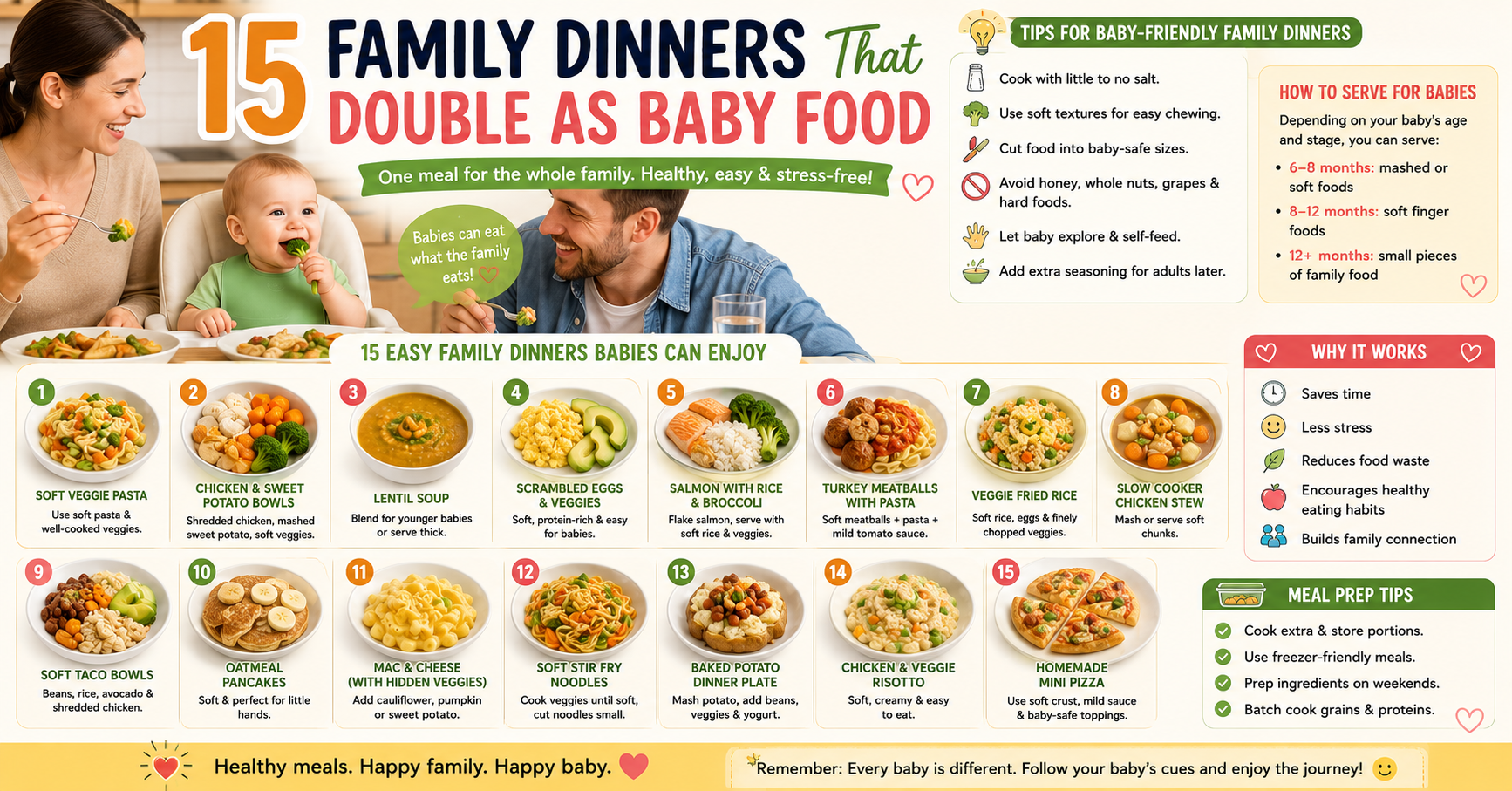
It’s 5:30pm. You’ve got chicken thighs in the oven for the family. Your baby is in the high chair, starting to fuss. And somewhere in the back of your mind, you’re already mentally cooking a second, separate, baby-specific meal — the pureed sweet potato, the little steamed carrot batons — while also trying to finish the adult dinner before it goes cold.
Here’s the truth nobody puts on the front page: you do not have to cook two dinners. These family dinners that double as baby food are exactly what they sound like — one pot, one oven tray, one meal that everyone at the table eats. Your baby gets theirs adapted by age. You get yours with the seasoning you actually want. Nobody cooks twice.
This guide gives you 15 tested, weeknight-realistic dinners — with a simple 4-step system for adapting any of them for your baby, serving notes by age (6 months, 9 months, 12 months), a sodium guide, allergen flags, and freezer tips. These are family meals baby can eat too — not watered-down baby recipes that the adults politely tolerate.
The idea that babies need completely separate “baby food” at every meal is mostly a habit — not a nutritional requirement. By 6 months, most babies are ready to eat real food in adapted form. By 9–10 months, the difference between baby’s plate and yours is mostly texture and salt level, not ingredients.
Eating the same food as the family — at the same table, at the same time — is genuinely good for your baby. Research from the American Academy of Pediatrics consistently shows that babies who eat with their families develop broader food acceptance, better eating habits, and stronger language skills from the social exposure of shared mealtimes.
There is also the practical reality. When your baby sees you eating the same food they are eating, they are far more likely to accept it. When they eat alone from a pouch while you eat something different, you are teaching them — without meaning to — that their food and your food are different things. Starting shared mealtimes early matters.
✅ The one-meal rule, simply stated:
Cook one dinner for the whole family. Before you add salt, seasoning, or sauce — scoop out the baby’s portion. Adapt by texture for their age. Season the rest for the adults. Done.
That rule is simple. But making it actually work on a Tuesday night after work takes knowing which family dinners translate well and exactly how to serve them by age. That’s what this guide gives you.
Before we get to the 15 family dinners that double as baby food, here is the system every recipe in this guide uses. Give it five minutes now and you will save hours every week.
Use this for every dinner on this list. Four steps. Every time.
That is all there is to it. The key habit to build is scoop first, season second. Once it becomes automatic — and it usually takes about a week — shared family mealtimes become genuinely easy.
Whether you are doing baby-led weaning, spoon feeding purees, or the combination approach, never leave your baby alone with food. This applies to all 15 dinners on this list regardless of how soft the food is.
Before any food goes on your baby’s tray as a finger food, squish it between your finger and thumb. If it doesn’t squash easily, it is not ready for baby. Cook vegetables longer, shred meat finer, mash legumes more thoroughly. Every piece, every time.
When you first start solids, introduce new ingredients one at a time with 3–5 days between introductions. This makes it easy to spot an allergic reaction. Once your baby has been exposed to all the main ingredients in a recipe, you can start the full one-meal system without worrying.
⚠️ Foods to always keep off the baby plate:
Honey (botulism risk under 12 months), whole grapes, whole cherry tomatoes, whole nuts, raw hard vegetables, popcorn, large globs of nut butter straight from a spoon, high-sodium sauces (soy sauce, fish sauce, Worcestershire), and any drink other than breastmilk, formula, or small amounts of water.
The biggest practical hurdle with family meals baby can eat is salt. Adults need it; babies genuinely don’t — and too much sodium is hard on developing kidneys. But “skip the salt” is not enough guidance when you’re trying to cook one meal that tastes good for everyone. Here is a practical breakdown.
Babies aged 7–12 months have an adequate daily intake of 370mg of sodium from all sources combined. A single family dinner served to a baby should ideally contribute no more than 100–150mg of that. For reference, one teaspoon of standard table salt contains around 2,300mg. Even a small pinch added to baby’s portion is a significant hit. (NHS Foods to Avoid for Babies )
| Seasoning | Safe for baby? | Notes |
|---|---|---|
| Garlic (fresh or powder) | ✅ Yes | Great flavour without sodium — use freely |
| Cumin | ✅ Yes | Excellent in lentils, chicken, and rice dishes |
| Coriander (ground) | ✅ Yes | Mild, warm flavour babies usually accept well |
| Turmeric | ✅ Yes | Anti-inflammatory, stains everything — use sparingly |
| Basil, oregano, thyme | ✅ Yes | All safe, all flavourful. Great in pasta and soups |
| Lemon/lime juice | ✅ Yes | Brightens flavour naturally, no sodium |
| Paprika (sweet/smoked) | ✅ Yes | Adds colour and mild flavour |
| Ginger (fresh or ground) | ✅ Yes | Use small amounts; can be intense for new palates |
| Table salt | ⚠️ Scoop before adding | Add to adult portion only — never to baby’s plate |
| Soy sauce / fish sauce | ❌ No | Extremely high sodium — keep off baby plate entirely |
| Stock cubes / powder | ❌ No | Most are high sodium; use homemade or no-salt stock only |
| Honey | ❌ No under 12 months | Botulism risk — unsafe before first birthday |
| Chilli / hot sauce | ❌ No | Irritating to baby’s digestive system |
| Ketchup / BBQ sauce | ⚠️ Adults only | High sugar and sodium — serve on adult plate only |
The practical takeaway: cook the base with garlic, herbs, and spices — these add plenty of flavour without sodium — then scoop baby’s portion before you add salt to the family pot. Season your own plate at the table if needed.
Each recipe below includes the dish idea, why it works, a description of how to cook it as a one-pot family meal, and a three-age serving guide (6 months, 9 months, 12 months). Icons show which meals are freezer-friendly (❄️), iron-rich (🩸), quick to make (⚡), and which contain common allergens to watch for (⚠️).
🩸 Iron-rich❄️ Freezer-friendly⚡ Under 35 min
This is the single best family dinner to start with if you want meals that work for everyone. Red lentils soften to a natural mash without any extra work — no blending required for younger babies. The dal is flavoured with garlic, cumin, coriander, and turmeric (all baby-safe), giving it a warm depth that adults love too.
Cook red lentils in water or no-salt vegetable stock with onion, garlic, fresh tomatoes, and your spices. Before serving, scoop baby’s portion. Stir in a little butter or olive oil for fat content (important for brain development). Serve with soft-cooked white rice.
Iron note: lentils are one of the best plant-based iron sources available. Serve alongside a squeeze of lemon (vitamin C increases iron absorption) and you have a genuinely iron-rich dinner for both baby and the family.
6 months
Blend smooth with a little cooking water. Stir in breastmilk or formula to loosen. Serve on a preloaded spoon.
9 months
Mash roughly with a fork — small lumps are fine and good for texture learning. Serve with soft rice pieces alongside.
12 months
Serve as-is with rice. Baby can self-feed with a spoon or pick up spoonfuls with fingers. Season adult portions with salt and extra spice.
🩸 Iron-rich⚡ Under 30 min⚠️ Fish allergen
Baked salmon is one of the most naturally baby-friendly proteins you can cook. It flakes easily, it’s soft enough to pass the squish test at any thickness, and it is loaded with omega-3 DFA — critical for brain development in babies. This is a dish that genuinely earns its place on both the baby tray and the adult plate.
Bake salmon fillets with olive oil, garlic, and lemon at 180°C / 350°F for 18–20 minutes. Steam or roast sweet potato chunks until completely soft. Steam broccoli florets until tender. Scoop baby’s portion before adding any extra seasoning to adult plates. Adults can add salt, pepper, capers, or a mustard dressing to their portions.
If this is baby’s first introduction to fish, offer just a small amount the first time and watch for any reaction over 24–48 hours before serving again.
6 months
Blend salmon with mashed sweet potato and a little breastmilk until smooth. Puree broccoli separately or combine.
9 months
Flake salmon finely, mash sweet potato with a fork, offer broccoli florets (the stem is a natural handle). Soft squashable pieces throughout.
12 months
Serve as the family does — small flaked pieces of salmon, soft sweet potato chunks, broccoli florets. Baby self-feeds with hands and developing spoon skills.
🩸 Iron-rich❄️ Freezer-friendly⚡ Slow cooker — hands-off
Slow-cooked chicken becomes extraordinarily tender — soft enough to pull apart with two forks and soft enough to mash for a younger baby without blending. This is one of those easy dinners for baby and family where the slow cooker does all the work while you’re at the office.
Put chicken thighs (boneless) in the slow cooker with crushed tomatoes, garlic, onion, paprika, oregano, and a splash of water or no-salt chicken stock. Cook on low for 7–8 hours or high for 4–5 hours. The chicken shreds easily with forks when done. Scoop baby’s portion before adding any salt or finishing sauce. Serve with rice or soft-cooked pasta.
This recipe scales beautifully — double the batch and freeze half in individual portions for the weeks when you simply don’t have time to cook.
6 months
Blend pulled chicken with the tomato sauce until smooth. Add a little cooking liquid to get the right consistency.
9 months
Offer shredded chicken pieces in the sauce — they are already very soft. Serve with soft rice or small pasta pieces.
12 months
Baby eats the same dish as the family. Small shredded pieces with sauce over rice. Add salt and extra seasoning to adult plates only.
🩸 Iron-rich❄️ Freezer-friendly⚠️ Gluten / egg in pasta
Bolognese is already a near-perfect shared family dinner for babies — the meat provides iron, the tomato provides vitamin C (which boosts iron absorption), and the sauce holds together around pasta or can be blended to a smooth puree. Making it “hidden veggie” means blending or finely grating courgette, carrot, and spinach into the sauce — invisible to picky older kids, nutritious for everyone.
Sauté finely diced onion, garlic, carrot, and courgette in olive oil. Add lean beef mince and brown well. Add crushed tomatoes, a little tomato paste, dried oregano, and basil. Simmer 25–30 minutes until rich. Choose small pasta shapes (small shells, small tubes, or stars for a younger baby). Cook pasta slightly longer than usual — al dente is for adults; soft is safer for babies learning to manage food.
6 months
Blend the Bolognese sauce smooth with a hand blender. Mix with well-cooked blended pasta for a smooth puree, or serve just the sauce on a preloaded spoon.
9 months
Serve the sauce with small soft pasta pieces. No blending needed — the sauce is already soft and the pasta should be very well cooked.
12 months
Baby eats exactly the family meal. Small pasta pieces in sauce — they can use a spoon or their hands. Season the family pot with salt and extra herbs now.
🩸 Iron-rich⚡ Under 25 min⚠️ Dairy / gluten
Taco and quesadilla nights are beloved by families for good reason — they are fast, flexible, and crowd-pleasing. For babies, the key is deconstruction: you serve all the components separately on the tray rather than assembled together, making it easy for baby to explore each element at their own pace.
Cook mashed sweet potato with a little olive oil. Drain and rinse canned black beans, mash roughly with a fork. Grate cheese. Warm a tortilla or make a simple quesadilla for the family. Baby gets the individual components on their tray — mashed sweet potato, mashed black beans, a little grated soft cheese. Adults build their quesadillas with all the toppings: salsa, sour cream, avocado, hot sauce.
Avocado is excellent on baby’s tray too — sliced into a strip at 6–9 months for a BLW-friendly finger food, or mashed into guacamole (no salt or lime) for a preloaded spoon.
6 months
Blend sweet potato smooth with a little water. Mash black beans smooth. Serve on preloaded spoons alternating the two.
9 months
Mashed beans and sweet potato with small lumps. Strip of ripe avocado as finger food. Torn soft tortilla strip to explore.
12 months
Small quesadilla wedge cut into strips. Mashed beans, avocado strip, small grated cheese. Baby self-feeds — messy and wonderful.
🩸 Iron-rich⚡ Minimal prep — oven does the work
The tray bake is one of the best baby safe weeknight dinners in existence. You put everything on one tray, it goes in the oven, and 35 minutes later dinner is ready for everyone. The long roasting time means vegetables get completely soft — sweet potato, courgette, carrot, and peppers all pass the squish test easily when roasted thoroughly.
Toss chicken thighs and diced vegetables (sweet potato, carrot, courgette, red onion, peppers) with olive oil, garlic, paprika, cumin, and dried oregano — all baby-safe seasonings. Roast at 200°C / 390°F for 35–40 minutes. Pull out before adding any salt. Scoop baby’s portion. Shred the chicken finely for baby, keep pieces whole for adults. Season adult portions at the table.
6 months
Blend shredded chicken with roasted vegetables and a little water or no-salt stock until smooth.
9 months
Shredded chicken pieces and soft vegetable chunks — they should all pass the squish test easily after roasting. Serve on tray for BLW-style exploration.
12 months
Baby eats the same tray bake as the family. Bite-sized soft pieces, self-fed. Salt, pepper, and condiments on adult plates only.
🩸 Iron-rich⚡ Under 10 min⚠️ Egg allergen — introduce carefully
Breakfast for dinner is completely legitimate — especially on the nights when you have absolutely nothing planned and everyone is hungry at 5pm. Scrambled eggs are one of the very best first allergen-introduction foods and one of the simplest family dinners that double as baby food.
Whisk eggs and cook gently in unsalted butter over low heat until just set and very soft. Lightly toast bread (not too crunchy for baby — light toasting keeps it manageable) and spread with ripe avocado. Serve the egg alongside the avocado toast cut into finger-length strips. Add salt and pepper to adult plates at the table.
Important: egg is a top allergen. The first time you serve this, introduce egg as a standalone food during a weekday morning when you can observe baby for 2 hours afterward. Once egg is established as a tolerated food, scrambled egg nights are perfectly safe for the whole table.
6 months
Blend scrambled egg smooth with a little breastmilk. Mashed avocado on preloaded spoon. Lightly toasted bread strip to hold.
9 months
Very soft scrambled egg served directly on tray — baby picks up small pieces. Avocado strip as finger food. Soft toast strip.
12 months
Same as the family — eggs on toast. Cut into manageable pieces. Baby uses fingers and begins learning the spoon.
🩸 Iron-rich❄️ Freezer-friendly⚠️ Dairy in sauce
Butter chicken made from scratch — without shop-bought paste or stock cubes — is a surprisingly baby-friendly family dinner. The spices used (cumin, coriander, turmeric, garam masala, paprika) are all safe for babies, and the creamy tomato-based sauce blends or mashes beautifully. This is also an excellent way to introduce flavour variety early — one of the most evidence-backed strategies for preventing picky eating.
Cook chicken thighs in a tomato, onion, garlic, and ginger base with cumin, coriander, turmeric, paprika, and a little garam masala. Add full-fat coconut cream or plain natural yoghurt for the creamy finish. Simmer until chicken is very tender. Scoop baby’s portion before adding any salt. Serve with white rice or naan.
Make a double batch on Sunday and freeze individual portions — this is the single highest-return batch cook on the whole list.
6 months
Blend chicken and sauce smooth with a little extra cooking liquid. Mix with blended rice for a complete puree.
9 months
Shredded tender chicken in the sauce. Serve with soft rice. Baby can manage small shredded pieces in sauce at this age.
12 months
Small bite-sized pieces of chicken in sauce over rice. Baby self-feeds. Adults season their portions with salt and extra spice at the table.
🩸 Iron-rich❄️ Freezer-friendly
Soup is one of the most overlooked family meals that double as baby food. A thick, hearty soup adapts effortlessly across every age — totally smooth for a 6-month-old, chunky and spoonable for a 9-month-old, and served with bread for dipping at 12 months. It also happens to be the highest-yield freezer meal on this entire list.
Sauté onion, garlic, and celery in olive oil. Add diced chicken thigh, cubed butternut squash, carrot, and enough water or no-salt chicken stock to cover. Add garlic, cumin, and a little fresh ginger. Simmer 25–30 minutes until everything is completely soft. Scoop baby’s portion. Blend the family portion to whatever consistency they prefer — fully smooth or chunky. Season with salt and pepper for adults.
6 months
Blend baby’s portion completely smooth. If using a spoon, serve cooled to a safe temperature. Thick enough to stay on the spoon.
9 months
Blend just partially — leave soft chunks of squash and shredded chicken. Baby manages small soft pieces at this age with a spoon or their hands.
12 months
Chunky soup served with a soft bread strip for dipping. Baby uses a spoon (messily, happily). Adults season their bowls with salt.
🩸 Iron-rich❄️ Freezer-friendly⚠️ Egg / gluten in meatballs
Meatballs might be the most universally loved family dinner for a reason — they’re satisfying, endlessly versatile, and when made at home without salt, they are absolutely suitable for babies from 6 months. The beef provides excellent iron, the tomato sauce provides vitamin C, and the combination is one of the best-value nutritional dinners on this entire list.
Mix lean beef mince with finely grated courgette, carrot, and onion. Add an egg (or breadcrumbs as a binder — both work). Roll into small balls and bake at 180°C / 350°F for 20 minutes or pan-fry in olive oil. Make the hidden veggie sauce by sautéeing garlic, onion, carrot, and spinach in olive oil then adding crushed tomatoes and herbs — blend smooth after cooking. Scoop baby’s portion before adding salt to the sauce.
6 months
Blend one meatball with sauce and a little water until smooth. This makes a surprisingly good puree with excellent iron content.
9 months
Quarter a meatball into soft pieces. Serve in the sauce. Baby can pick up pieces or you can offer on a preloaded spoon.
12 months
Quartered meatballs in sauce with soft pasta. Baby self-feeds. This becomes a family classic that works from six months to forever.
🩸 Iron-rich❄️ Freezer-friendly⚡ Under 30 min
This is the recipe for the night when you haven’t been shopping but the pantry has tinned chickpeas, a bag of spinach, and a can of tomatoes. It is pantry-emergency dinner that also happens to be an outstanding baby-friendly family dinner — iron-rich, plant-based, and adaptable from a smooth puree all the way to a chunky stew.
Sauté garlic and onion in olive oil. Add a tin of drained chickpeas (rinse well — canned chickpeas contain a lot of sodium in their liquid). Add crushed tomatoes, cumin, paprika, and coriander. Simmer 15 minutes. Add a large handful of spinach and wilt. Scoop baby’s portion before adding salt. Serve with rice or flatbread. Adults add salt and lemon juice at the table.
Important: always mash or squish chickpeas for baby before serving as a finger food — whole chickpeas are a choking risk. They should squash easily under gentle pressure from your finger.
6 months
Blend stew smooth with a little extra water. Makes a thick, green-flecked puree that is packed with iron and flavour.
9 months
Mash chickpeas with a fork before serving (never whole). Serve stew with soft rice. Baby can manage the soft mashed texture.
12 months
Lightly squished chickpeas in the stew with rice. Baby self-feeds. Adults add salt, lemon, and chilli to their portions.
🩸 Iron-rich⚡ Under 25 min⚠️ Fish allergen / sesame optional
This recipe fills a real gap in the “family meals for babies” space — most blogs stick to Italian and Mexican flavours, leaving parents who enjoy Asian-inspired cooking without a clear baby-safe option. This is a simple, weeknight-fast rice bowl that genuinely works for everyone at the table.
Pan-fry salmon fillet in a small amount of sesame or neutral oil (sesame oil is fine for baby but introduce gradually as a new flavour — and sesame is itself a top allergen, so introduce it deliberately the first time). Steam edamame (always shelled — never whole in the pod for baby). Cook white rice. Scoop baby’s portion of salmon and rice. Adults season their bowls with a drizzle of low-sodium soy sauce, a little rice vinegar, sesame seeds, and nori. Baby gets unseasoned salmon, rice, and squished edamame.
6 months
Blend flaked salmon with soft rice and a little water. Simple, protein-rich, mild-flavoured puree.
9 months
Flaked salmon on top of soft rice. Squished edamame (never whole) on the side. Baby self-feeds the flakes and picks at the rice.
12 months
Same bowl as the family, minus the soy sauce and sesame. Introduce sesame oil gradually as a new food before using regularly.
🩸 Iron-rich❄️ Freezer-friendly
Lamb is one of the richest iron-rich meats you can serve your baby. A slow-cooked lamb stew with root vegetables is the highest-iron dinner on this entire list — and it is just as satisfying for the adults as it is nutritious for the baby. If you are at all worried about your baby’s iron intake, make this once a week.
Dice lamb shoulder into small pieces (easier to blend or shred later). Brown in olive oil with garlic and onion. Add diced parsnip, sweet potato, carrot, and turnip. Cover with water and add cumin, coriander, and fresh thyme. Cook in a low oven at 160°C / 320°F for 2–2.5 hours or use a slow cooker on low for 8 hours. The meat will be completely tender and the vegetables will have softened entirely. Scoop baby’s portion before any seasoning.
6 months
Blend lamb and vegetables smooth with cooking liquid. This produces a rich, iron-dense puree that is one of the best first meat foods you can offer.
9 months
Shred lamb finely and serve with mashed root vegetables. Baby can manage the soft shredded texture easily at this age.
12 months
Small pieces of tender lamb with soft vegetable chunks. Serve with rice or bread. Adults season with salt and add a little harissa or mint sauce to their plates.
⚡ Under 30 min⚠️ Gluten in gnocchi — check label
This is the fastest dinner on the list. You literally spread gnocchi and vegetables on one sheet pan, roast them together, and dinner is done in 25 minutes. Gnocchi that is roasted becomes slightly crisp on the outside but stays soft inside — and when it cools slightly, it passes the squish test easily.
Spread shop-bought gnocchi and diced courgette, cherry tomatoes (halved), red pepper, and red onion on a large sheet pan. Drizzle with olive oil, add garlic, dried basil, and oregano. Roast at 220°C / 425°F for 20–22 minutes until gnocchi is golden and vegetables are soft. Scoop baby’s portion before adding salt. Adults eat straight from the pan with grated Parmesan and black pepper.
Cherry tomatoes must always be halved (not quartered at this point — they are soft and squashy) for baby. Never serve whole — they are a choking risk.
6 months
Blend roasted gnocchi and vegetables with a little water until smooth. The tomato and pepper give a good colour and mild flavour.
9 months
Soft gnocchi cut in half plus soft roasted vegetable pieces. Everything should be very squashable. Halved cherry tomatoes are fine at this age.
12 months
Small pieces of gnocchi and roasted vegetables — baby self-feeds. This is a real family-style dinner where everyone eats the same thing.
🩸 Iron-rich⚡ Under 25 min⚠️ Egg allergen
Shakshuka is a Middle Eastern and North African dish that is already beloved by food-forward families everywhere — and it is one of the most underrated entries in the family dinners that double as baby food category. One pan, 20 minutes, eggs poached directly in spiced tomato sauce, served with soft bread for dipping. It’s genuinely exciting for adults and genuinely safe for babies.
Sauté garlic and onion in olive oil. Add crushed tomatoes, cumin, paprika, and coriander. Simmer 10 minutes. Make small wells in the sauce and crack eggs directly into the wells. Cover and cook until whites are just set but yolks are still a little soft (for adults) or cook through completely (for baby). Scoop baby’s portion before adding salt. Serve with lightly toasted flatbread strips.
This is also an excellent allergen-introduction meal for egg — the egg is cooked through rather than runny, which is the safe preparation for babies. Make sure egg whites are completely set before serving to baby.
6 months
Blend egg and tomato sauce together until smooth. Serve on preloaded spoon with a soft bread strip to hold.
9 months
Well-cooked egg broken into soft pieces in the sauce. Baby picks up pieces or you offer on a spoon. Soft bread strip for dipping.
12 months
Baby eats from the family pan — egg pieces in sauce with bread. Adults add salt, harissa, and feta to their portions.
Seven of the 15 dinners above contain common allergens — egg, fish, dairy, gluten, or sesame. This is not a reason to avoid them. Current guidance from the American Academy of Pediatrics actually recommends early and repeated introduction of top allergens starting around 6 months, as this reduces the long-term risk of allergy. (AAP Allergen Introduction Guide)
| Allergen | Recipes in this list | How to introduce safely |
|---|---|---|
| Egg | Recipes 7, 10, 15 | Offer scrambled egg alone first. Well-cooked only (no runny yolk for baby). Watch 2 hours after first exposure. |
| Fish | Recipes 2, 12 | Offer a single flake of cooked salmon first. Wait 3 days before introducing a second fish species. |
| Dairy | Recipes 5, 8 | Plain full-fat yoghurt is the easiest first dairy food. Avoid cow’s milk as a drink under 12 months; in cooking is fine. |
| Gluten (wheat) | Recipes 4, 7, 14 | Offer soft white bread or a small amount of well-cooked pasta as a first exposure. Watch for reaction. |
| Sesame | Recipe 12 (optional) | Introduce sesame oil or a tiny amount of tahini deliberately as a first exposure. Sesame is a top-9 allergen in the USA. |
| Peanut | Not in this list | Thin peanut butter spread on toast soldiers is the recommended first introduction. Follow your paediatrician’s advice if there is family history of nut allergy. |
💡 Important:
Always introduce one new allergen at a time. Leave 3–5 days between new allergens in the early weeks of solids so you can clearly identify any reaction. Once an allergen is established as tolerated, you can include it freely in shared family dinners.
The families who make shared mealtimes genuinely easy long-term don’t cook from scratch every night — they batch cook strategically on a Sunday and use their batch components across the week. Here’s how to do it with this list.
Choose two or three recipes from the list that freeze well (look for the ❄️ icon). Make double batches. Freeze individual baby-sized portions in small containers labelled with the date and contents. You now have 4–6 ready dinners for the weeks when 5:30pm arrives and nothing is planned.
🗓️ Sample Sunday Batch Cook
Cook together:
Thursday and Friday: quick-cook recipes from the list — tray bake (recipe 6) or shakshuka (recipe 15), both under 30 minutes.
Cooking two separate dinners every night is one of the most exhausting and unnecessary parts of early parenthood. These 15 family dinners that double as baby food — plus the four-step Scoop-Before-You-Season system — are genuinely all you need to stop doing it.
Start with the red lentil dal (recipe 1) if you’ve never done this before. It’s the easiest adaptation, requires no blender for younger babies, and produces one of the most nutritionally complete baby meals you can make. Add the pulled chicken (recipe 3) and the tray bake (recipe 6) to your rotation in week two. By the end of the first month, shared family mealtimes will feel completely natural.
Your baby learns to eat by watching you eat. That shared table — everyone eating the same food together — is more than a time-saving hack. It’s the foundation of a healthy relationship with food for life.
Most babies are ready to begin trying adapted family foods from around 6 months old — when they can sit with support, hold their head steady, and show interest in food. At 6 months, family meals need to be adapted to a smooth or mashed consistency and kept completely unsalted. By 9–10 months, texture requirements reduce significantly and most family foods can be served in soft, squashable pieces. By 12 months, baby should be eating the same foods as the rest of the family with minimal adaptation needed beyond cutting into small pieces. These transitions don’t happen overnight — the 15 dinners in this guide are designed to support every stage of that journey.
Yes — many herbs and spices are completely safe for babies and actually excellent for exposing them to a range of flavours early. Garlic, cumin, coriander, turmeric, paprika, basil, oregano, ginger, and thyme are all safe from 6 months. The key thing to avoid is salt — add it to adult portions at the table, never to the pot before you scoop baby’s portion. Also avoid chilli, hot sauce, and anything with high sodium content like stock cubes or soy sauce in baby’s portion. The good news is that a meal flavoured with garlic, herbs, and warm spices tastes genuinely delicious even without salt — babies often love the flavour variety.
At 6 months, the priority is texture — everything needs to be smooth or very soft. The Scoop-Before-You-Season system works like this for a 6-month-old: scoop baby’s portion before adding any salt or sauce, then blend it smooth with a hand blender using a little cooking water, breastmilk, or formula to get the right consistency. Most of the recipes in this guide blend very easily at this stage — lentil dal, soups, slow-cooked meats, and roasted vegetables all produce excellent smooth purees. You can also offer a few soft finger foods alongside the puree if you are using the combination feeding approach (a ripe banana strip, a broccoli floret, a soft sweet potato baton).
Iron is the most important nutritional priority at 6 months — babies’ iron stores from birth start to deplete around this time, and breastmilk is low in iron. The highest-iron dinners on this list are: Lamb and root vegetable stew (recipe 13 — lamb is one of the richest iron sources available), Beef meatballs in tomato sauce (recipe 10), Red lentil dal (recipe 1 — best plant-based option), Chickpea and spinach stew (recipe 11), and Slow-cooked pulled chicken (recipe 3). Always pair iron-rich foods with a source of vitamin C — tomatoes, peppers, lemon juice, or a little fruit — as vitamin C significantly increases iron absorption from food.
Yes, with standard food safety rules. Reheat to piping hot throughout (above 70°C / 158°F) and then cool to a safe serving temperature before giving to baby — always test with your wrist, never your fingertip. Never reheat the same portion more than once. If you have frozen a baby-sized portion from a batch cook, defrost fully in the fridge overnight and reheat thoroughly. Don’t leave cooked food at room temperature for more than two hours before storing. These are the same rules that apply to food safety for adults — babies just have slightly less resilient immune systems, so the rules matter more.
Yes — and this is actually one of the biggest practical benefits of the one-meal approach. Once a caregiver understands the Scoop-Before-You-Season rule and the age-appropriate texture guide, they can serve baby from any of these dinners without needing separate baby food. A simple one-page guide (scoop first, no salt, squish test for all pieces, never leave alone with food) gives any caregiver the confidence to serve shared family meals. Many grandparents find this approach less stressful than managing a separate baby meal — there is less to think about and the outcome is the same family dinner everyone loves.
This is completely normal, especially in the 7–9 month period when texture transition is happening. If your baby is happy with smooth purees and resisting lumps or finger foods, the approach is gradual rather than abrupt. Start by making the puree slightly less smooth — blend for fewer seconds so there are very fine lumps. Over the following 2–3 weeks, reduce blending further. By 9–10 months, aim for a rough mash rather than a smooth blend. Alongside the mash, always offer at least one soft finger food on the tray — not to force it, but to give baby the choice to explore. If texture refusal is significant and causing feeding difficulties past 10–11 months, a referral to a paediatric feeding therapist can make a real difference. (ASHA Paediatric Feeding)
At 6–9 months, solid food portions are small — 2–4 tablespoons per meal is entirely normal, and some babies eat less than that for the first several weeks. Remember that breastmilk or formula is still the primary source of nutrition until around 12 months — solids at this stage are about learning, flavour exposure, and texture exploration, not calorie replacement. Trust your baby’s hunger cues: they will turn away, close their mouth, or bat the spoon away when they are done. Never force a baby to finish their portion. The amounts will increase naturally over the coming months as appetite and eating skills develop.
Yes, with some care around sodium content. Canned tomatoes are generally fine — look for “no added salt” versions where possible, or simply rinse canned beans thoroughly before use (the liquid in canned beans contains a lot of sodium). Canned chickpeas and lentils are fine once rinsed. Pre-made pasta sauces and stock are the main sodium traps — most contain levels that are too high for baby portions. Either make a simple sauce from scratch (which takes about 15 minutes) or look specifically for no-salt-added versions. Frozen vegetables are excellent and have equivalent nutrition to fresh — they are a genuine time-saver for weeknight cooking.
You probably already have everything you need. A hand-held stick blender is the most useful piece of equipment — it lets you blend baby’s portion directly in a bowl or cup without washing a separate blender jug. A fork and your own fingers are all the other tools you need (the squish test requires only your thumb and forefinger). Small freezer containers with lids are worth buying if you plan to batch cook — silicone ice cube trays work perfectly for 6-month puree portions, and small Tupperware-style containers work for 9–12 month chunkier portions. A good high chair with a removable tray completes the setup. Beyond these basics, you don’t need any specialist baby food equipment.