Physical Address
304 North Cardinal St.
Dorchester Center, MA 02124
Physical Address
304 North Cardinal St.
Dorchester Center, MA 02124

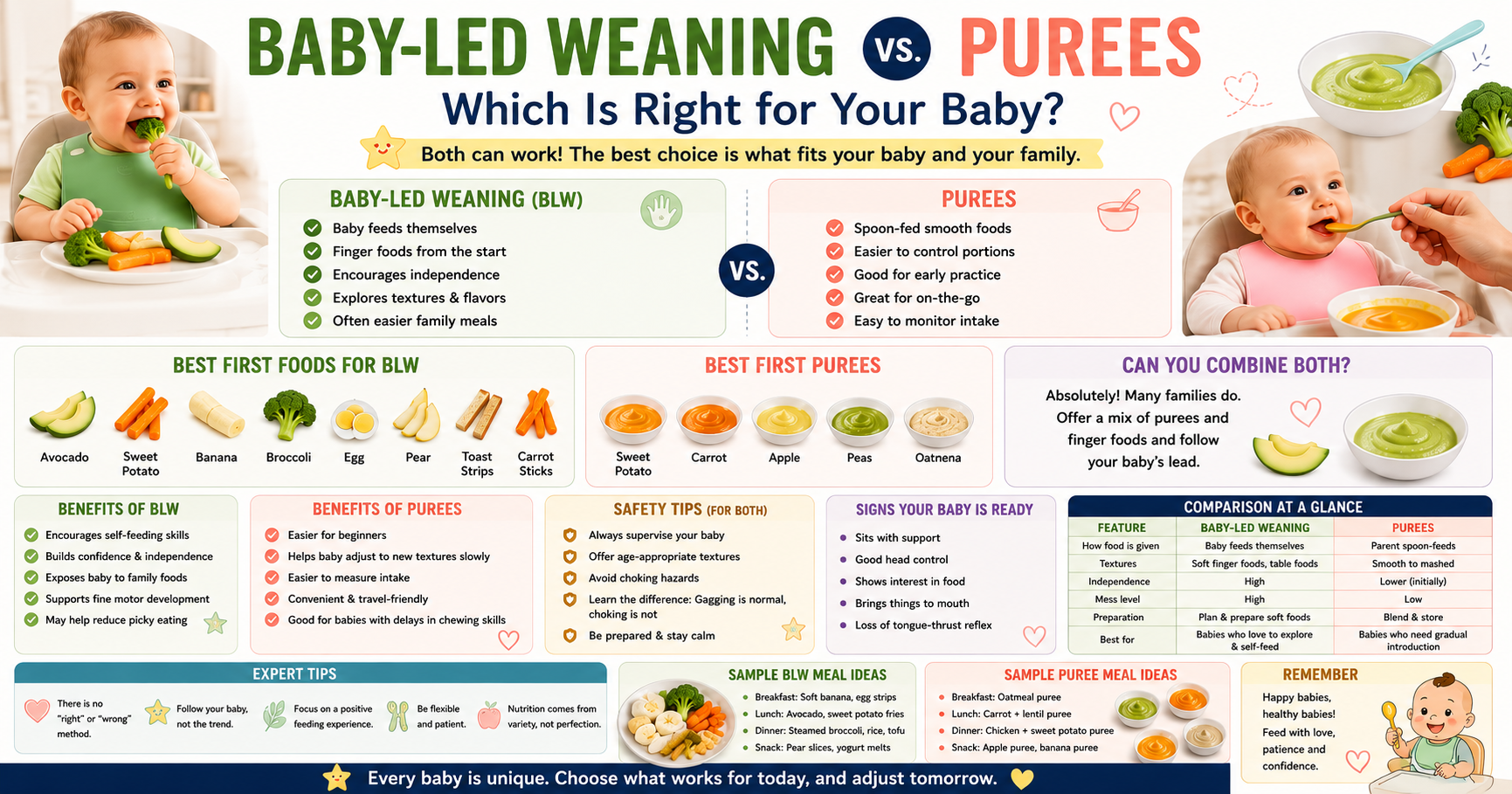
So you’ve been Googling baby-led weaning vs purees for the last three weeks. You’ve read seventeen articles, joined two Facebook groups, and you’re still not sure what to do. You’re not alone. Almost every parent goes through exactly this before their baby turns six months old.
Here’s what most articles won’t tell you: there is no single right answer. But there are better and worse fits — depending on your baby’s development, your confidence level, your work schedule, and yes, whether grandma is watching the baby three days a week.
This guide is different from what you’ll find elsewhere. We cover the research on choking (the number one fear), give you a real iron and nutrition table, walk through a practical combination feeding weekly schedule, and tackle the scenarios most blogs ignore entirely — like premature babies and caregiver disagreements.
By the end, you’ll know exactly how to approach baby-led weaning vs purees for your specific situation. Let’s get into it.
Baby-led weaning (commonly shortened to BLW) is a way of introducing solid foods where your baby feeds themselves right from the start. Instead of you loading a spoon and putting it into their mouth, you place soft, graspable pieces of food on their tray and let them explore.
The term was popularised by British midwife and health visitor Gill Rapley in the early 2000s. Despite the name, “weaning” in this context means starting solids — not stopping breastfeeding or formula. So if you’re breastfeeding and want to continue, BLW fits right alongside that.
At six months, a BLW meal might look like this: you put a finger-length strip of soft-cooked sweet potato, a piece of ripe banana, and a small floret of steamed broccoli on the baby’s tray. Your baby grabs at the food, squishes it, maybe gets some in their mouth, definitely gets most of it on their bib. That’s not failure — that’s learning.
The core idea is that your baby is in charge of what goes in their mouth. You never load the spoon and insert it. You offer — they decide.
Good to know: BLW typically begins at 6 months, not 4 months, because babies need to be able to sit up independently, hold their head steady, and bring objects to their mouth before self-feeding is safe or even possible.
Purees are smooth, blended foods fed to the baby on a spoon by a caregiver. This is the traditional method that most of our parents and grandparents used, and it’s still what most paediatricians and health visitors first suggest.
The puree approach usually starts between 4 and 6 months (depending on your country’s guidelines and your baby’s readiness signs) and progresses through textures: smooth purees → lumpier mashes → soft chunks → finger foods.
The main appeal is control and visibility. You can see exactly how much your baby ate. You can track new ingredients one at a time for allergy monitoring. And for many parents — especially first-timers — the predictability of a spoon-fed meal is genuinely reassuring.
There’s also the practical side. Purees can be batch-made and frozen in ice cube trays, making weekday mealtimes faster. Store-bought pouches exist as backup. And most childcare workers, grandparents, and babysitters are comfortable with spoon-feeding — which matters enormously in the real world.
One important note: The puree approach only works well when you advance textures by 7–9 months. Research consistently shows that babies who are still on smooth purees past nine months are more likely to develop feeding difficulties and texture aversions later. Purees are a starting point — not a long-term solution.
Here is everything side by side. No spin, no agenda — just the honest comparison that helps you decide.
| Factor | Baby-Led Weaning (BLW) | Purees (Traditional) |
|---|---|---|
| Starting age | 6 months (must sit independently) | 4–6 months (with caregiver support) |
| Who controls feeding | Baby leads — self-feeds entirely | Caregiver controls pace and amount |
| Motor skill development | Strong — pincer grip, hand-eye coordination develop fast | Slower to develop self-feeding skills |
| Texture exposure | Broad from day one — multiple textures, shapes | Starts narrow — must actively advance |
| Mess level | High (invest in a good splat mat) | Lower (you hold the spoon) |
| Tracking food intake | Harder — food goes everywhere | Easy — you see every spoonful |
| Choking risk | Not higher — if foods are prepared correctly (see section 4) | Not lower than BLW in research |
| Family mealtimes | Baby eats with the family naturally | Often separate feeding before family eats |
| Picky eating later | Some evidence of greater food acceptance | Risk increases if textures not advanced by 9 months |
| Iron intake | Requires deliberate planning of iron-rich foods | Fortified cereals make iron easier |
| Prep time | Lower if you eat the same foods as baby | Higher for homemade; lower with store pouches |
| Caregiver confidence | Takes getting used to; many parents anxious at first | Familiar and comfortable for most caregivers |
| Self-regulation of hunger | Strong — baby stops when full | Risk of overfeeding if parent-led |
This is the section every parent needs to read before making their decision. The fear of choking is the number one reason parents hesitate to try baby-led weaning. And it’s completely understandable — watching your baby gag is terrifying.
But there is an important distinction that will change how you see this.
A baby’s gag reflex is positioned much further forward in their mouth than an adult’s. This means babies gag much more easily than we do — and that’s on purpose. Gagging is how babies learn to manage food in their mouths before it goes too far. It’s their built-in safety mechanism.
Gagging looks alarming. The baby’s eyes water, their face goes red, they make a retching sound. But they recover almost immediately. Choking, by contrast, is silent — the baby can’t make noise, can’t cry, because airway is blocked.
What the science says: A landmark 2016 study by Fangupo and colleagues, published in JAMA Pediatrics, found that babies following a baby-led weaning approach were no more likely to choke than babies fed pureed foods. The key factor was how food was prepared — not which method was used.
Both BLW and purees carry choking risk if foods are handled carelessly. The following foods pose genuine risk with any method and should be avoided until age 4+:
Before you start solids — regardless of method — take a baby first aid course or at minimum watch a video on infant back blows and chest thrusts. The NHS, Red Cross, and St John Ambulance all have free resources. This is not optional: it’s the single most important preparation for starting solids. (NHS Baby-Led Weaning Guide )
Always supervise meals. Never leave a baby alone with food, regardless of whether you are doing BLW or purees.
Iron is the most important nutritional conversation around starting solids — and it’s the one most baby-led weaning vs purees articles handle the worst. Here is the truth, clearly.
Babies are born with a store of iron from their time in the womb. By around 6 months, that store starts to run low — at exactly the same time breastmilk (which is low in iron) becomes their primary nutrition. This timing is not a coincidence; it’s why the WHO recommends starting solids at 6 months.
The daily iron target for a 7–12 month old is 11 mg per day according to the American Academy of Pediatrics. That is a significant amount to get through food, whichever method you choose.
| Food | Iron per serving | BLW format | Puree format |
|---|---|---|---|
| Red meat (beef, lamb) | ~2.5 mg / 80g | Thin strip to gnaw, pulled shreds | Blended with stock or vegetable |
| Chicken liver | ~9 mg / 80g | Thin pâté spread on toast fingers | Smooth pâté mixed into vegetable puree |
| Lentils (cooked) | ~3.3 mg / 100g | Dal on tray — baby uses hands; pre-load spoon | Blended red lentil and carrot puree |
| Tofu (firm) | ~2 mg / 100g | Finger-size pieces, pan-fried for grip | Blended into sweet potato or squash |
| Chickpeas | ~2.9 mg / 100g | Well-cooked, squished flat (not round — choking risk) | Hummus served on pre-loaded spoon |
| Fortified baby cereal | ~6.5 mg / serving | Mixed thick, self-fed from preloaded spoon | Mixed with breastmilk/formula as usual |
| Edamame (shelled) | ~2.3 mg / 100g | Well-cooked, squished flat | Blended into a green puree |
| Spinach (cooked) | ~3.6 mg / 100g | Well-wilted, in egg or pasta | Blended into any vegetable puree |
Key tip: Pair iron-rich foods with vitamin C — it increases iron absorption significantly. Squeeze lemon on lentils, add tomato to meat, serve mango alongside a spinach dish. This applies whether you’re doing BLW or purees.
If you’re concerned your baby isn’t getting enough iron — especially in the early BLW weeks when food mostly ends up on the floor — speak to your paediatrician about a simple blood test. Most GPs are happy to check iron levels at the 9-month visit.
Before you choose between baby-led weaning vs purees, the most important question is simpler: is your baby ready for solids at all? Starting before readiness — in either method — creates unnecessary stress for the baby and the parent.
What readiness does NOT look like: Waking more at night, watching you eat (this happens from 3 months!), and chewing fists. These are common signs of development — not hunger that solids will fix.
Here is what almost no blog will tell you clearly: most families end up doing a combination of baby-led weaning and purees, and this is not a failure of commitment to either method. It’s just practical parenting.
The good news is that combination feeding is not only fine — many paediatric dietitians and feeding specialists now actively recommend it. It gives your baby exposure to self-feeding skills and texture exploration, while also giving you the reassurance of knowing they’ve taken in a certain amount of food via a spoon.
The simplest framework: start each meal with a finger food to explore, then offer a puree via a preloaded spoon for the baby to take themselves. You’re not inserting the spoon — you’re handing it over. The baby brings it to their mouth (messily, wonderfully messily).
This approach also works brilliantly for iron-rich foods that are hard to offer as finger foods — like lentils, porridge, and fortified cereals.
This is a starting-out schedule for a 6–7 month old who is just beginning solids. Meals are small — the aim is exploration and taste exposure, not calorie replacement. Breastmilk or formula remains the primary nutrition.
| Day | Meal 1 (morning) | Meal 2 (lunchtime) | Meal 3 (early dinner) |
|---|---|---|---|
| Mon | Soft banana strip (BLW) + preloaded spoon of porridge | Steamed carrot baton (BLW) + lentil puree spoon | Milk feed only |
| Tue | Scrambled egg (BLW) + sweet potato puree | Avocado strip (BLW) + yoghurt spoon | Milk feed only |
| Wed | Toast finger with thin peanut butter (allergen intro) + banana puree | Soft-cooked pea (squished, not round) + broccoli puree | Soft-cooked pasta pieces (BLW) + tomato sauce |
| Thu | Ripe melon strip (BLW) + iron-fortified baby cereal (preloaded spoon) | Shredded chicken on tray + butternut squash puree | Milk feed only |
| Fri | Soft-cooked baby oat strips + mashed banana | Tofu finger (pan-fried, BLW) + spinach and apple puree | Soft cooked lentil dal — preloaded spoon + strip of bread |
| Sat | Pancake strip — family breakfast (BLW) + fruit puree | Family lunch adapted — soft vegetable pieces + any puree | Soft cooked salmon fillet (BLW) + sweet potato mash |
| Sun | Soft-boiled egg soldiers (BLW) + mango puree | Avocado with cream cheese on toast finger + vegetable puree | Family dinner adaptation — soft pieces + whatever you eat |
As your baby moves to 8–9 months: increase to three full meals, reduce purees in favour of self-fed chunky mashes, and aim for your baby to be eating (not just exploring) family foods in adapted textures. By 12 months, milk becomes a drink alongside a full three-meal day with snacks.
“The goal of any feeding method — BLW or purees — is the same: a 12-month-old who eats a wide variety of flavours and textures, at a table with their family, and enjoys the experience. How you get there is flexible.”
This is the section that most blogs leave out entirely. But if a grandparent, childminder, or nursery is caring for your baby even two days a week, their comfort with the feeding method matters enormously.
Here is the reality: most grandparents are not familiar with baby-led weaning. They were raised in a time when purees were the only option, and watching a baby gag while holding a piece of broccoli can feel terrifying if you don’t know what normal gagging looks like.
This is combination feeding by circumstance, and it works fine. Your baby’s gut bacteria are remarkably adaptable. They can have spoon-fed meals at grandma’s house on Tuesday and self-fed finger foods with you on Monday, Wednesday, and Friday. The research shows no harm in this — in fact, it replicates real-world family eating variety.
Show your caregiver a short video — the NHS and St John Ambulance both have free resources. Understanding that gagging is protective, not dangerous, is often the turning point. Many grandparents become BLW converts once they actually see what normal gagging looks like versus what choking looks like.
Soft banana, ripe avocado, steamed sweet potato — these are so soft they dissolve on a baby’s gums almost instantly. Doing one supervised meal together before leaving the caregiver alone is often all it takes.
A laminated sheet that says: “Always supervise. Foods to offer: [list]. Foods to avoid: [list]. Gagging is normal — wait and watch. Choking is silent — back blows immediately.” This removes decision fatigue from anxious caregivers and gives them clear boundaries to work within.
This is the gap that almost nobody in the BLW vs purees debate addresses — and it matters for a significant number of families.
If your baby was born prematurely, the standard “6 months” guideline does not apply to their birth date — it applies to their corrected age (their age calculated from the due date, not the actual birth date). A baby born 8 weeks early should not start solids at 6 months old — they should start at roughly 7.5–8 months old (6 months corrected age).
Premature babies often have less developed oral motor skills and may not be ready for the self-feeding demands of BLW at the standard age. Starting with purees and moving to BLW or combination feeding as skills develop is often the most practical path — always in consultation with your neonatologist or health visitor.
Babies with significant reflux sometimes handle purees more easily at first, as there is less exploration and gagging involved. However, some families find that BLW actually improves reflux symptoms because the baby controls their own pace and is less likely to be overfed. This is individual — track carefully and discuss with your GP or paediatric gastroenterologist.
For babies with hypotonia (low muscle tone), Down syndrome, or motor developmental delays, the muscle strength and coordination needed for BLW may develop later than usual. Purees are often the starting point, with a referral to a paediatric occupational therapist or speech and language therapist who specialises in feeding being very valuable. These specialists are sometimes called feeding therapists or pediatric feeding specialists and can help you find the right approach for your specific baby.
💡 If your baby has any medical complexity — premature birth, reflux, low muscle tone, or a chromosomal condition — please don’t rely solely on general blog advice (including this one!). Work with your healthcare team to develop an individualised plan. (WHO Infant and Young Child Feeding Fact Sheet — outbound link 4)
Most blogs end with “there’s no right answer — you decide!” which is technically true but also completely unhelpful when you’re standing in the baby food aisle at 5.45pm.
So here is a more honest take, based on the research and on what actually works for families.
For a typically developing baby starting solids at 6 months, combination feeding has the strongest practical evidence base. It gives your baby the motor skill and texture benefits of BLW, the nutritional tracking reassurance of purees, and the flexibility that real family life demands.
If you feel confident about food safety and your baby has strong independent sitting, leaning toward more BLW is completely supported by research. If you’re anxious, your baby has any developmental considerations, or you have a caregiver who needs to be involved, starting with a puree-forward combination approach is equally valid.
The one thing the research is clear on: by 9 months, your baby needs to be exploring a wide variety of textures — not still on smooth purees only. Whatever method you choose today, plan for progression.
Both methods can typically start when your baby is around 6 months old and showing clear signs of readiness — sitting with support, showing interest in food, and losing the tongue-thrust reflex. Purees can begin as early as 4 months in some cases (always discuss with your GP first), while BLW requires a baby to sit independently and self-grasp, which usually comes at 6 months. Starting before your baby is ready — regardless of method — is more stressful for everyone and offers no developmental benefit.
Yes, baby-led weaning is safe when foods are prepared correctly and meals are always supervised. Research published in JAMA Pediatrics found that BLW babies are no more likely to choke than babies fed purees. The critical factor is food preparation — everything must be soft enough to squish between your finger and thumb, and high-risk foods (whole grapes, raw apple, whole nuts, popcorn) must be avoided. Learning the difference between gagging (normal, protective) and choking (silent, emergency) is essential before you start any method of solids.
Absolutely — and many paediatric feeding specialists now actively recommend it. Combination feeding means offering self-fed finger foods alongside preloaded spoons of puree. You’re giving your baby the motor skill development and texture exposure of BLW while maintaining the nutritional visibility of purees. There is no research showing any downside to this approach. In fact, for most families managing real life — with working parents, multiple caregivers, and a baby who has good days and bad days — combination feeding is the most practical and sustainable approach.
The evidence here is promising but not definitive. Some studies suggest BLW babies show greater food acceptance and are more willing to try new textures, possibly because they have more sensory experience with food from the start. However, picky eating is influenced by genetics, parental feeding behaviours, and food environment as much as weaning method. What the research is clear on: babies who are still on smooth purees only past 9 months are more likely to develop texture aversions and picky eating. Advancing textures — whatever method you use — is the key protective factor.
This is the hardest part of pure BLW, honestly. In the early weeks, a lot of food ends up on the tray, the floor, and in your baby’s hair rather than in their stomach. The practical reassurance is: your baby’s primary nutrition at 6–9 months still comes from breastmilk or formula, not food. Solids at this stage are about learning and exploration, not calorie replacement. Signs your baby is getting enough overall: consistent weight gain at check-ups, normal nappy output (6+ wet nappies a day), and normal energy levels. If you’re worried, your health visitor or GP can check growth at any time.
The best first BLW foods are soft, easy to grip, and nutritious. Great starting foods include: ripe banana cut into finger shapes, steamed sweet potato batons, soft-cooked broccoli florets (the stem makes a great handle), scrambled egg, ripe avocado in a strip, soft-cooked pasta, and shredded chicken. Prioritise iron-rich foods from the very beginning — lentils on a preloaded spoon, minced beef in a sauce, or fortified baby porridge work well alongside finger foods. Introduce one new food at a time for the first few weeks to watch for allergic reactions.
Yes — teeth are not required for baby-led weaning or for eating soft solids in general. Baby gums are surprisingly strong, and as long as food is soft enough to squish between your finger and thumb, they can manage it. Many babies do BLW successfully for months before their first tooth appears. Teeth become more relevant when you start offering harder textures — raw apple, harder bread crusts — which typically happens after 9–10 months anyway.
Yes, you can transition to BLW or combination feeding at any point. If your baby is now 6 months old and showing BLW readiness signs (sitting independently, good grasp), there is no reason you cannot start offering finger foods alongside or instead of purees. Many families move between methods fluidly as their baby develops. The transition is usually easiest if you start by offering one self-fed food per meal alongside the puree you’re already using, then gradually increase the proportion of finger foods as your baby’s confidence grows.
This is an interesting and genuinely underexplored area. Some speech and language therapists point out that spoon feeding supports bilabial sounds (the lip movements used for “m,” “b,” and “p” sounds) through the mouth movements involved in taking food from a spoon. On the other hand, BLW promotes extensive oral motor exploration — chewing, managing different textures, controlling food in the mouth — all of which are foundational for speech production. The honest answer is that the research does not yet clearly favour either method for speech development. What matters more is responsive feeding — being attentive to your baby’s cues, whatever method you use.
Most paediatric guidelines recommend that babies are eating soft, textured family foods — not smooth purees only — by around 9–10 months. By 12 months, the goal is a baby who is eating soft versions of family meals three times a day. Staying on smooth purees past 9 months is associated with texture aversions and feeding difficulties at toddler age. If your baby resists texture advancement, a referral to a paediatric feeding therapist can make a significant difference early — don’t wait until 18 months to seek help if you have concerns.