Physical Address
304 North Cardinal St.
Dorchester Center, MA 02124
Physical Address
304 North Cardinal St.
Dorchester Center, MA 02124

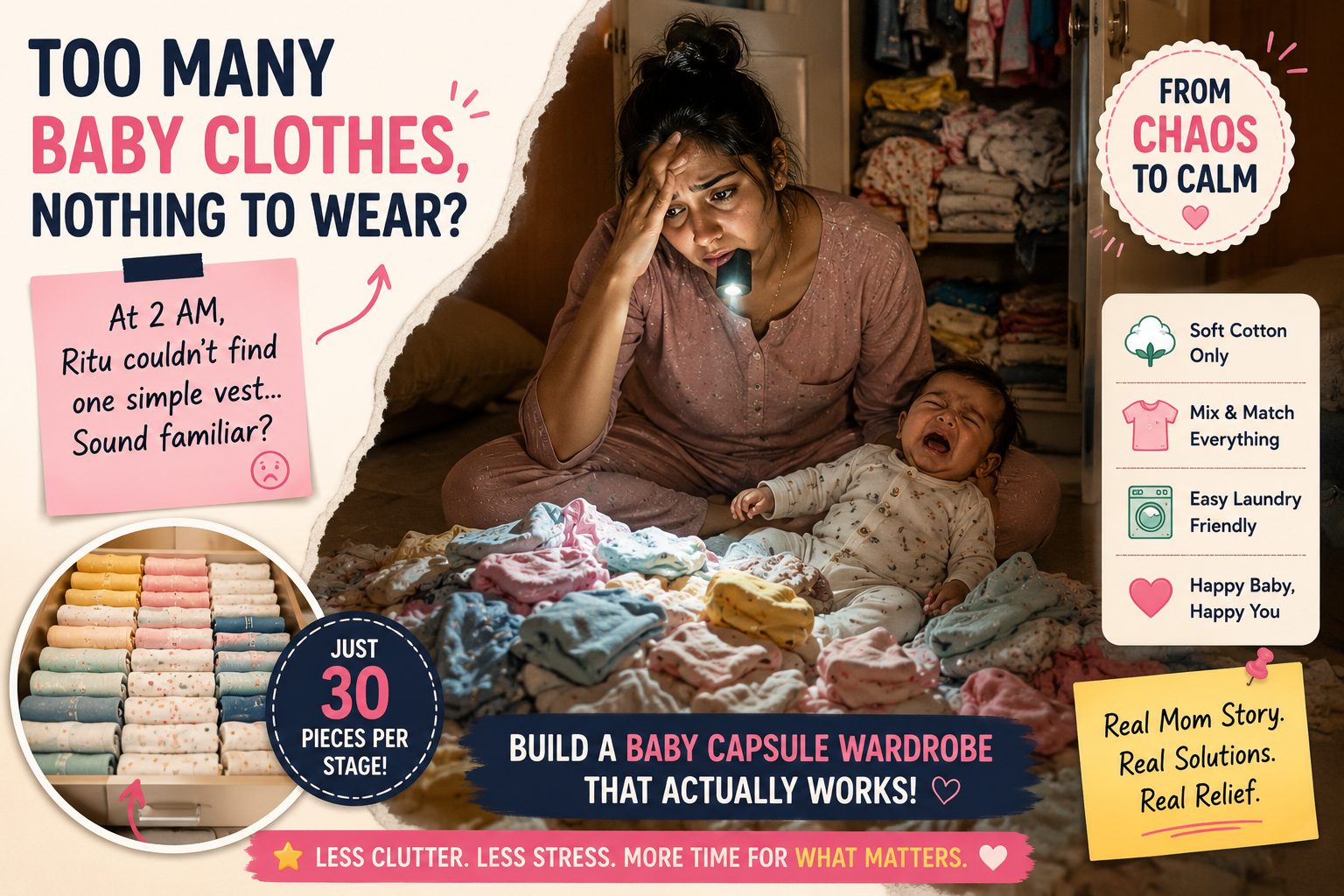
At two in the morning, Ritu was on her knees in front of her baby’s cupboard, with a phone torch in her mouth.
The baby had just leaked through a diaper for the third time that night. She needed a clean vest. She needed it fast, before the crying got louder and woke the whole house.
But the cupboard did not want to help. It was a mountain. Newborn frocks mixed with 6-month pants. Three woollen caps in the middle of a Kolkata monsoon. Tiny shoes in their boxes. A tangle of mittens. Gift bags that nobody had opened. Somewhere under all this was one soft vest, and she could not find it.
She pulled out a pile, and half of it slid onto the floor. The baby cried. Her husband turned over in bed and mumbled, “Kya hua?” And Ritu sat there, in the dark, surrounded by clothes, thinking one very strange thought:
I have so many clothes. And I have nothing to put on my baby.
If you are a parent in India, you may know this feeling. We receive clothes from everyone. Mamiji, chachi, neighbours, office friends, the whole family. We also buy a lot, because every outfit is so small and so cute. And then, one day, the cupboard bursts, and we still cannot find the one thing we need.
The next weekend, Ritu did something simple. She emptied the whole cupboard onto the bed, picked out the pieces her baby actually wore and loved, and packed the rest into labelled bags. She was left with a small, soft, mix-and-match set of clothes, thirty pieces in all. Mornings became easy. Laundry became easy. And, funny thing, her baby looked cuter, because everything matched.
That is the idea behind a baby capsule wardrobe. And in this article, I will show you how to build one for India, for the whole first year, with real numbers, real seasons and real laundry routines.
Quick note: I am a parent and content writer, not a doctor. A capsule wardrobe is a planning idea, not a rule. Every baby is different, and your baby’s needs, weather and laundry routine may need more or fewer pieces. For questions about your baby’s skin, temperature or health, please talk to your pediatrician.
A baby capsule wardrobe is a small set of soft, mix-and-match clothes that covers all your baby’s daily needs for one size stage. For India, a good capsule is about 30 pieces per stage, built around soft cotton, a few colours, your laundry routine and the season, with extras like socks and bibs kept in a small separate kit.
Here is the 30-piece capsule at a glance:
| Category | Pieces | What it covers |
|---|---|---|
| Everyday tops (jhabla, front-open tops, tees) | 8 | Daytime wear, mix and match |
| Bottoms (pyjamas, leggings, shorts, pants) | 6 | Pair with any top |
| Bodysuits (snap-bottom vests) | 4 | Base layer, under other clothes |
| Sleepwear (sleepsuits, gowns) | 3 | Nights and naps |
| All-in-one outfits (rompers, kurta rompers) | 2 | Easy, no-match outfits |
| Special outfit (festive or family function) | 1 | Photos, visits and festivals |
| Layers (cardigan, light jacket, sweater) | 2 | Season-dependent |
| Muslin swaddles and wraps | 4 | Wrapping, covering, wiping, comfort |
| Total | 30 |
Plus a small extras kit (not counted in the 30): socks, mittens, caps, bibs, burp cloths and towels. I will explain all of it below.
That is the whole idea. Now let me show you why it works, and how to build it step by step.
You may have heard of capsule wardrobes for adults. The idea is to own fewer clothes that all go together, so getting dressed is quick and nothing is wasted. The same thinking works well for babies, for a few reasons.
1. Babies outgrow clothes quickly. A big wardrobe is wasted money when the baby grows out of a size in a few weeks. A small wardrobe wastes less.
2. Babies wear the same favourites again and again. Most parents notice that a few soft pieces get worn every week, and the rest stay folded.
3. Indian laundry habits fit the capsule idea. Many families wash baby clothes every day or every other day, and dry them in the sun. A small stock that rotates quickly works well. (We explained this in our guide on how many clothes a newborn needs in India.)
4. A small cupboard is easy to manage. At 2 AM, you can find what you need in seconds.
5. Mix and match saves effort. When everything goes with everything, you never have to think.
6. Less clutter means less stress. And a calmer house helps a tired parent.
But I want to be honest about where the idea does not fit.
Babies are messy. Spit-ups, leaks and blowouts are real, and a tiny wardrobe can run out on a bad day.
Babies do not follow your plan. A growth spurt, a sudden season change or an illness can change what you need.
Gifts and family customs. You will receive clothes, and you may want to keep some for sentimental reasons. That is okay.
So, my version of a capsule wardrobe is not strict. It is a flexible core, with room for gifts, mess and surprises.
Before I list the 30 pieces, here are the rules I follow. They keep the capsule simple and useful.
Rule 1: Soft cotton first. Everything that touches the skin should be soft, breathable cotton, mulmul or muslin. (See our guide on the best fabric for baby clothes in India for details.)
Rule 2: Choose a small colour palette. Pick 3 to 4 colours that go together, so any top matches any bottom.
Rule 3: Easy to put on and take off. Front-open, snaps and stretch. No tight necks.
Rule 4: Build around your laundry routine. The more often you wash, the fewer pieces you need.
Rule 5: Plan for the season, not only for the age. A size that falls in monsoon or winter needs different pieces.
Rule 6: Keep a small, separate kit for extras. Socks, mittens, caps, bibs and cloths are not part of the 30. They have their own bag.
If you follow these six rules, you will already be ahead of most shoppers.
This is the part that makes a capsule wardrobe feel magical. When every top goes with every bottom, 8 tops and 6 bottoms can make 48 different outfits. You never have to match anything, because everything already matches.
Choose one or two neutral colours and one or two soft accent colours. For example:
For India, I like cream, mustard, sage green and a soft coral. They look good in photos and match with festive colours, and they do not show every stain as much as plain white.
Before you buy anything new, lay out your tops and bottoms on the bed. Ask yourself: does every top go with at least three bottoms? If yes, your capsule works. If not, you have a piece that does not fit, and you can swap it.
Now, here is the full capsule. I have kept the numbers for a family that washes baby clothes daily or every two days. If you wash less often, I will show you how to scale up later in the article.
These are the clothes your baby will wear most. Choose a mix of styles:
What to look for: soft cotton, a wide neck, flat seams, short ties or snaps. Keep prints small. Choose a mix of your 3 or 4 palette colours.
Bottoms are the pieces that make your capsule mix and match.
What to look for: soft elastic or a tie, a roomy waist, foldable cuffs, and neutral colours. Avoid hard waistbands and tight leg openings.
Bodysuits (also called onesies or snap-bottom vests) are the base layer. They keep tops from riding up, and work under other clothes in winter.
What to look for: an envelope neck or wide stretchy neck, soft snaps, and a good size (see our size chart guide). In hot weather, you may use bodysuits less, and wear only a jhabla or tee.
Sleepwear is the one place where fit matters most, so choose the correct size and a soft fabric.
What to look for: soft cotton, no hood, no loose ties, no beads, and no big buttons. A snug but comfortable fit is better than a very loose one for sleep. Ask your pediatrician about safe sleep clothing for your baby’s age.
These are your “no thinking” outfits. A romper, a kurta romper or a dungaree-style outfit in soft cotton. You pick one up, put it on, and you are ready to go out.
What to look for: snaps at the bottom, a wide neck, soft cotton, and a simple design.
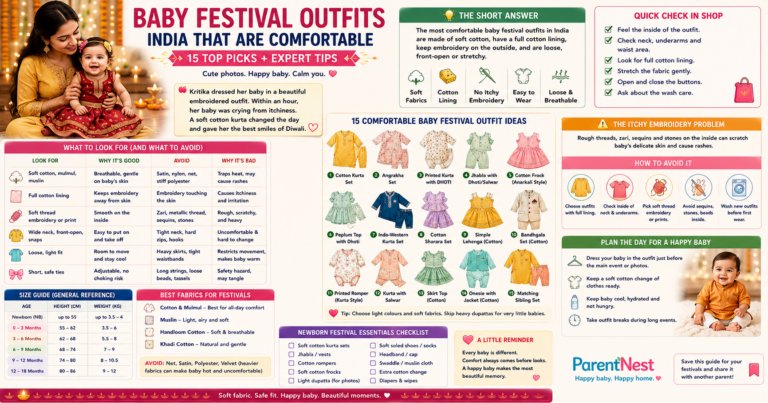
One festive or family-function outfit, in soft cotton or mulmul with a full cotton lining. Choose a size up, since it will be worn only a few times. (See our guide to comfortable baby festival outfits in India for ideas and tips.)
Keep it in a separate bag, ready for a surprise invitation.
These depend on your season and region.
What to look for: soft, front-open, no tight neck, and always a cotton layer underneath. Avoid scratchy wool next to the skin.
The hardest-working pieces in your wardrobe. You can swaddle, cover, wipe, feed under, shade, or use as a light sheet.
What to look for: large size (about a metre square or bigger), soft, washed muslin or mulmul.
A note on swaddling: if you swaddle, ask your pediatrician or nurse how to do it safely, and when to stop as your baby grows.
These small items need their own little bag or box. Do not mix them into the main wardrobe.
| Extra item | How many | Notes |
|---|---|---|
| Socks or booties | 3 pairs | More in winter, fewer in summer |
| Mittens | 2 pairs | Mostly for newborns, and optional |
| Caps | 2 | Thin cotton, as needed |
| Bibs | 4 to 5 | More once drooling starts |
| Burp cloths | 5 to 6 | Old soft cotton works |
| Hooded towels | 2 | One to use, one to dry |
| Washcloths | 4 | Soft, small cotton |
| Cotton bedsheets or changing sheets | 4 | Small, quick to wash |
Keep the extras kit in a box or a bag, with a clear label. You will thank yourself when you need a pair of mittens at midnight.
Let us do a quick bit of maths, because it shows why this works.
The real secret is not the number. It is that everything goes with everything, so you never feel you have nothing to wear.
This is the part that makes the capsule work for real Indian homes. The number of pieces you need depends on how often you wash. Here is a simple guide.
| Your laundry routine | Total pieces in the capsule | What changes |
|---|---|---|
| Wash every day, dry in the same day | About 24 | Fewer tops, bottoms and bodysuits are enough |
| Wash every 2 days | About 30 | The standard capsule in this article |
| Wash every 3 to 4 days | About 36 to 40 | Add more tops, bottoms, bodysuits and swaddles |
| Wash once a week | About 45 to 50 | Add a lot more, and extra for spit-ups |
| Monsoon or winter with slow drying | Add 4 to 6 to any of the above | Clothes take longer to dry |
| Cloth nappies or a baby who spits up a lot | Add 3 to 4 | More changes through the day |
If you wash every day, you can trim the capsule to about 24 pieces:
This works very well in homes with sun, a washing machine or a helper, and quick-drying thin cotton. It is also the version many mothers and grandmothers in India have used for generations.
If you wash only once a week, you need more:
At this size, it is still a capsule, because you are not buying a huge pile. You are just matching the number to your life.
(For the full maths on how many outfits you need, read our newborn clothes checklist for India, where I explain a simple formula.)
Your baby will pass through about four size stages in the first year, and each stage needs slightly different clothes. Here is how to adjust your capsule. Remember, these stages are rough, and the sizes depend on your baby. Use your baby’s real measurements and the brand’s size chart. (See our baby clothing size chart guide for how.)
What your baby does: sleeps, feeds, and looks around. Not much movement.
What matters most: easy changes, front-open styles, soft fabrics and swaddles.
The capsule at this stage:
Tip: buy only a few pieces in the newborn size, and the rest in 0-3 months. (See our guide on whether to buy newborn size or 0-3 months.)
What your baby does: rolls, kicks, drools and reaches for things.
What matters most: stretch, free movement, and bibs. Babies in this stage start to get messy.
What changes in the capsule:
Tip: many babies grow fast at this stage. Buy only what you need for the next 4 to 6 weeks, and re-check the size.
What your baby does: sits, crawls or tries to, and starts to explore everything.
What matters most: knee comfort, durable cotton, and clothes that do not ride up.
What changes in the capsule:
Tip: keep a few older, soft, worn-out pieces for the messy phase, like first food and floor time.
What your baby does: pulls up, cruises along furniture, and may start to walk.
What matters most: easy movement, comfortable pants and shorts, and clothes that do not trip the baby.
What changes in the capsule:
Tip: many babies are ready for 12-18 months clothes toward the end of this stage. Check the size chart before buying.
Here is a clever part of the capsule idea. Not everything needs to be replaced when your baby grows. Some things carry over:
The main things you will replace are bodysuits, tops, bottoms and sleepwear, because they are size-specific. So, over the first year, you may buy about 3 to 4 “mini capsules” of about 20 to 25 size-specific pieces each, plus the carry-over items. This is a calm, planned way to dress a growing baby.
India has many climates, so a capsule must adjust to the weather. Here is how to tune your 30 pieces for different seasons.
For more on fabrics by season, read our guide to the best breathable fabric for baby clothes in India.
A capsule idea also works for small, special situations.
Check your hospital’s own list first, because some provide certain items.
Pack in a zip pouch or small bag, and keep one complete outfit in your hand luggage.
Keep it in a bag at the daycare or at the grandparents’ house, so you never have to pack each morning.
Gifts are the main reason capsule wardrobes fail. People are generous, and they love buying baby clothes. Here is a way to handle it with kindness.
Before the baby arrives:
When gifts arrive, use the three-bag method:
When something is not suitable, you can still thank the giver warmly. You can also keep one or two sentimental pieces in a memory box, without making them part of the daily wardrobe.
(For more on handling gifts that are too small, see our article on newborn vs 0-3 month size clothes.)
A capsule only works if the cupboard stays tidy. Here is a simple system that fits a small Indian home.
Keep only the current size in the baby’s cupboard. Everything else goes into bags or boxes, labelled by size and season.
Use cloth bags, plastic boxes with lids, or even clean bedsheet bundles. Label each with size and season, like “6-9M, winter.” Store them on a high shelf or under the bed, in a dry place.
When a new piece comes in, an old piece goes out. This keeps the numbers steady.
Once a week, spend ten minutes:
Divide the cupboard into zones: tops on one shelf, bottoms on another, bodysuits and sleepwear on a third, extras in a basket. Stand clothes upright (file-fold) so you can see everything at once. At 2 AM, you will find things in seconds.
Keep a separate baby hamper. (See our guide on washing baby clothes separately from adult clothes.)
A capsule wardrobe is not only about saving money. It is about spending on the right things. Here is how I would think about it.
Spend a little more on:
Save on:
Smart ways to save:
Here is a simple way to see the value. Suppose you buy a soft cotton top and your baby wears it 15 times before outgrowing it. And suppose a fancy top is worn twice. The soft top costs far less per wear, even if the price was the same. The capsule idea is simply about buying for wear count, not just for looks. (This is an illustration, not a real price calculation.)
With fewer clothes, laundry matters even more.
| Stage | What to buy | What to carry over | Season note |
|---|---|---|---|
| 0-3 months | The 30-piece capsule, mostly jhabla, front-open tops, gowns, swaddles | Swaddles, towels, bedsheets | Plan layers for the birth season |
| 3-6 months | Tees, bodysuits, stretch pants, bibs | Swaddles, a few jhabla for hot days | Check the season when this size is worn |
| 6-9 months | Sturdy pants, rompers, bodysuits, grip socks | Swaddles, bibs, burp cloths | Knees wear out, buy extra pants |
| 9-12 months | Shorts, soft pants, tees, simple sets | Swaddles, towels | Avoid long frocks, plan a first birthday outfit |
| Whole year | Extras kit, special outfit, layers | Everything in the extras kit | Adjust for monsoon and winter |
Go back to Ritu, kneeling on the floor at 2 AM with a phone torch in her mouth, and a mountain of clothes around her.
Here is what I would tell her. You did not do anything wrong. You loved your baby, and so did everyone around you. You just ended up with a lot of clothes and no system. Tomorrow, take everything out, keep the soft, mix-and-match pieces your baby really wears, and pack the rest in labelled bags. Put the clothes on shelves where you can see them. Keep a small kit for socks and cloths. And promise yourself that next time, you will buy less, and buy better.
So, if you are looking for a baby capsule wardrobe in India for 0-12 months, start small. Choose soft cotton, a small colour palette, and about 30 pieces per stage, adjusted for your laundry routine and season. Keep a flexible mind, a small extras kit and a simple system for gifts and clutter.
A capsule wardrobe does not make parenting perfect. It makes mornings, nights and laundry days a little lighter. And when you are a new parent, a little lighter is a gift.
It is a small set of soft, mix-and-match baby clothes that covers all daily needs for one size stage. A good capsule for India is about 30 pieces per stage, plus a small extras kit for socks, bibs and cloths.
It depends on your laundry routine. With daily washing, about 24 pieces per size stage is enough. With washing every two days, about 30. With weekly washing, 45 to 50. Add a few for monsoon, winter or lots of spit-ups.
Plan about 3 to 4 mini capsules, one for each size stage, of about 20 to 25 size-specific pieces each, plus carry-over items like swaddles, towels and bedsheets. Your exact number depends on your baby’s growth and your laundry routine.
Choose a small palette of 3 to 4 colours, with neutral bottoms and a mix of plain and simply printed tops. Check that every top goes with at least three bottoms.
Eight everyday tops, six bottoms, four bodysuits, three sleepwear pieces, two all-in-one outfits, one special outfit, two layers and four muslin swaddles.
Yes. Choose light cotton and muslin, more jhabla, tees and shorts, fewer layers, and one light cardigan for air-conditioned rooms.
Full-sleeve bodysuits, soft pants, a cardigan or fleece, a shawl or dohar, socks and a thin cap, always with a cotton layer next to the skin. Keep layers you can add or remove.
Keep only the current size in the cupboard, store the rest in labelled bags by size and season, follow a one-in-one-out rule, and do a 10-minute reset each week. Sort gifts into use now, use later and pass on.
Guide family early on sizes and colours. When gifts arrive, sort them into three bags: use now, use later, and pass on. Exchange, donate or pass on clean, good-quality clothes, and keep one or two sentimental pieces.
Every day or every two days works best for a 24 to 30 piece capsule. If you wash less often, add more pieces.
Yes, but add 3 to 4 extra pieces, since leaks may be more common. Choose loose clothes with room for nappies.
Not everything. Swaddles, towels, bedsheets and some loose items carry over. You will mostly replace size-specific items like tops, bottoms, bodysuits and sleepwear.