
A few weeks before the baby came, my aunt showed up at the door with a small cloth bag. Inside were dry, brown, wrinkly things that looked a bit like old dates.
“Reetha,” she said. “This is what we used for you. No powder. No smell. Nothing.”
I smiled and thanked her. Then I put the bag in a drawer and went online, because I had questions. Was reetha really safe for a newborn? Did it clean milk stains? What about all those recipes with borax and essential oils that kept popping up? Everyone online said “natural” and “chemical-free”. Nobody said what could go wrong.
So I read. A lot. If you have searched for a homemade natural detergent for baby clothes safe recipe, you may be asking the same thing. I found out that there is a safe way to do it, but it looks quite different from the popular recipes. It is simpler, and it has clear limits. This guide shares that safe recipe, step by step, in plain words. It also tells you what to skip, and when a shop-bought detergent is the better choice. Get a cup of tea. The headings will help if you want to jump ahead.
Homemade Natural Detergent for Baby Clothes Safe Recipe
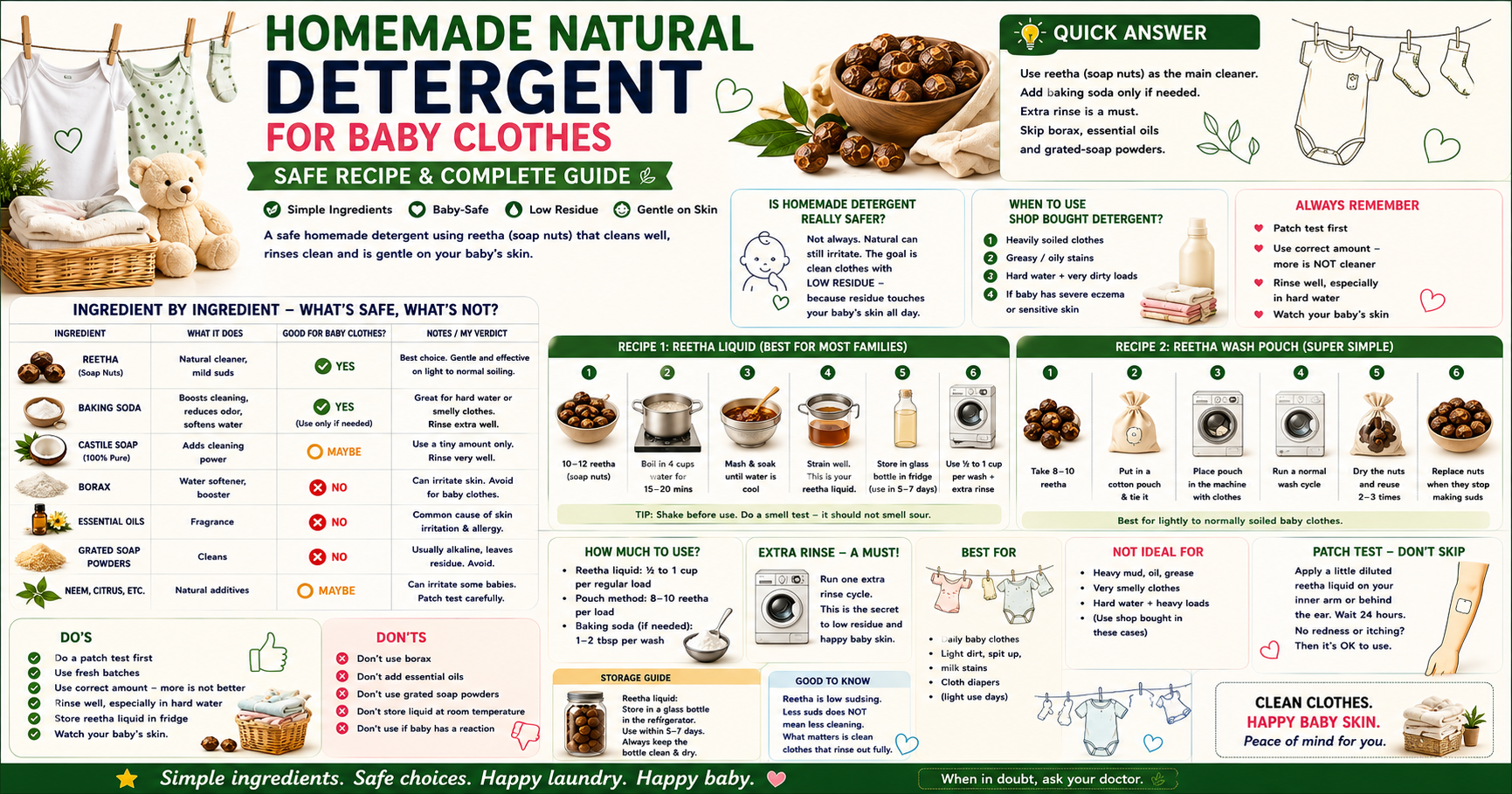
Quick answer: A safe homemade natural detergent for baby clothes is simple. Use reetha (soap nuts) as the cleaner, either boiled into a liquid or kept in a cotton pouch in the machine. Add baking soda only if your water is hard or clothes smell. Add a plain extra rinse. Skip borax, essential oils and grated-soap powders. Homemade works best on lightly soiled clothes. Patch test first, and ask your doctor if your baby has eczema.
Table of Contents
What I checked, and what I did not
Let me be honest before we start.
I did not test these recipes in a lab. I did not wash a hundred onesies. What I did was read many DIY recipes, safety notes about the ingredients, advice about skin and laundry, guidance from consumer testers, and a few Indian sources on using reetha. Then I kept only the parts that seemed safe, simple and sensible for baby clothes.
Three things to keep in mind:
- Treat the amounts as starting points. Reetha varies from shop to shop. Water varies from city to city. You will need to adjust.
- Patch test first. I explain how in a later section.
- This is not medical advice. If your baby has eczema or a rash that will not go away, talk to your paediatrician or a skin doctor before changing anything.
Now, the big question.
Is homemade detergent really safer for babies?
Not always. And this is the part many websites skip.
People make their own detergent because they want to know what is in it. That is a good reason. But “homemade” and “natural” do not automatically mean “gentle”. Here is what I found.
| What people say | What is more accurate |
| “Natural means safe.” | Natural things can still irritate or cause allergies. Reetha, neem, citrus and essential oils all can, for some people. |
| “Chemical-free.” | Everything is made of chemicals. Water is a chemical. Baking soda is a chemical. The real question is which ones, and how much stays in the clothes. |
| “Homemade has no hidden ingredients.” | True, but you also have no tested formula, no preservative and no dosing guide. |
| “Soap is gentle.” | Traditional soap is alkaline, and skin is slightly acidic. Soap residue can irritate sensitive skin. |
| “Reetha cures eczema.” | Some sellers say this. There is no good proof, and you should not use it as a treatment. |
So the goal is not “homemade at any cost”. The goal is clothes that are clean and low in residue, because residue is what touches your baby’s skin all day.
What makes a detergent safe for baby clothes
Whether you buy it or make it, a good baby detergent follows four simple rules. I call them the Four Safe Rules.
- Low residue. It rinses out fully and leaves no film or stiffness.
- No fragrance. Fragrance is one of the most common causes of skin irritation from laundry. Skin experts often say to start with fragrance-free and dye-free products.
- Mild. It should not be harsh or strongly alkaline.
- Fresh. If it is a water-based liquid with no preservative, it has to be fresh, because germs grow in it fast.
Keep these four rules in your head. They explain every choice in the recipes below, and they explain why I left out so many popular ingredients.
Homemade natural detergent for baby clothes: ingredient by ingredient
Here is how the common DIY ingredients stack up for baby clothes. The last column is my verdict.
| Ingredient | What it does | Main concern for babies | Verdict |
| Reetha (soap nuts) | A natural cleaner. The shells release saponin, which lifts dirt. | Mild cleaner, weak on heavy soil. Can cause allergy in rare cases. Liquid spoils fast. | Use |
| Baking soda | Helps with smell. Can help soften hard water. | Weak as a stand-alone cleaner. | Use as a booster |
| White vinegar | Acidic rinse that helps remove residue and sour smell. | Don’t mix with baking soda at the same time. Never mix with bleach. | Use carefully |
| Washing soda | Strong alkaline booster and water softener. | High pH. Can irritate skin. Must not be inhaled. Leaves alkaline residue. | Skip for babies |
| Borax | Cleaning booster. | Can irritate skin. Safety groups advise leaving it out. | Skip |
| Castile or grated bar soap | True soap that cleans well. | Makes soap scum in hard water. Can leave residue and gray clothes. Can clog machines. | Skip, especially with hard water |
| Essential oils | Scent. | Fragrance allergy and irritation risk. | Skip |
| Dish soap | Strong cleaner that foams a lot. | Over-sudsing, weak rinse, skin irritation. | Skip |
You’ll notice that the “Use” list is short. That’s on purpose. Fewer ingredients means fewer things that can go wrong, and less residue on the cloth.
Soap nuts (reetha) for baby laundry: what it is and how it works
Reetha is the dried shell of the soapberry. It grows on trees in India and Nepal, and it has been used for washing hair, silver and clothes for a very long time.
The shell holds a natural cleaning agent called saponin. When the shell touches water, saponin comes out. It makes a soft, low foam that lifts oil and dirt from cloth. You will not see big, fluffy bubbles. That is normal. Less foam also means less to rinse out.
What reetha does well:
- Cleans lightly soiled clothes, like vests, socks, muslins and a day’s worth of onesies.
- Makes very little foam, so it rinses out easily.
- Works in hand wash and in most washing machines, including front loaders, when used in a pouch.
- Is cheap, and the shells are compostable.
What reetha does not do well:
- It is not strong on heavy soil, like cloth nappies or big food stains.
- It has no enzymes, so dried milk and other protein stains are harder.
- The liquid goes bad quickly.
- It may smell a little, a bit like fermented apple, and you may notice it on clothes if you do not rinse enough.
A word about allergy. Reetha is natural, but natural is not allergy-proof. One published case report describes a worker who developed a true allergy to soapnut raw material after handling ground product at work. That does not mean it is dangerous for your family. It does mean you should patch test, avoid breathing in dust when you crush shells, and stop if your baby gets a rash.
What to look for when you buy:
- Choose clean, dry, whole shells with the seeds already removed (called deseeded), or remove the seeds yourself.
- Avoid shells that are damp, mouldy or smell sour.
- Buy from a reliable shop, and store the shells in a dry, airtight jar.
[IMAGE: close-up of deseeded reetha shells in a steel bowl]
The 1-1-1 Baby Wash: my simple method
Before the recipes, here is the whole idea in one line. I call it the 1-1-1 Baby Wash.
- 1 cleaner: reetha.
- 1 booster, only if needed: baking soda.
- 1 rinse: an extra plain-water rinse, with vinegar as an optional last step.
That’s it. One cleaner, one booster, one rinse. No long ingredient list, no scents, no guessing. Everything below fits into these three steps.
Recipe 1: Homemade reetha liquid for baby clothes (small batch)
This is the classic homemade natural detergent. It makes about 3 cups. Make small batches, because the liquid has no preservative and does not last long.
What you need:
- 8 whole reetha nuts (or about 12 to 15 halves), seeds removed
- 1 litre (4 cups) of clean water
- A clean steel pot (not one you use for spicy food)
- A potato masher or spoon
- A clean muslin cloth for straining
- A clean glass bottle with a lid
How to make it:
- Rinse the shells quickly under running water to remove dust.
- Add the shells and water to the pot.
- Bring to a boil, then turn the heat down. Let it simmer gently for about 30 minutes. It will foam at the edges, so use a big pot and stay nearby.
- Turn off the heat and let it cool fully.
- Mash the shells with a spoon or masher to squeeze out more of the liquid.
- Strain through a clean muslin cloth. Strain twice if you see any bits, because pulp can leave marks on cloth.
- Pour into a clean glass bottle, and label it with the date.
Safety while making it: Don’t boil it with a baby on your hip, and keep the pot and bottle out of reach of children. A bottle of brown liquid can look like tea or juice to a toddler. Label it clearly and store it up high.
How much to use:
- Machine, small baby load: start with about 1/4 cup. If clothes don’t feel clean, try up to 1/2 cup next time.
- Hand wash: start with about 1/4 cup in a 10-litre bucket of water.
These are starting points, not exact rules. Your reetha and your water will decide the right amount.
How long it lasts (be strict about this):
| Where you keep it | How long | Notes |
| Room temperature | Up to 2 days at most | Less in hot weather. Sources say anywhere from 2 days to 2 weeks, so I chose the cautious end. |
| Fridge | Up to 1 week | Keep it in a closed, clean glass bottle. |
| Freezer (ice cube trays) | A couple of months | Freeze in cubes, move to a bag and label the date. Two cubes is about 1/4 cup. |
Throw it away if: it smells sour or like fermenting food, looks cloudy or slimy, or has any mould on top. Don’t try to “rescue” it. Make a fresh batch. The pouch method below avoids this problem completely.
Recipe 2: The no-cook reetha pouch (easiest and safest to store)
If you only try one thing from this guide, make it this. There is no cooking, no liquid to spoil and almost nothing to measure.
What you need:
- 5 to 6 deseeded reetha shells per load
- A small drawstring pouch made of cotton or muslin (a clean handkerchief tied with a thread also works)
How to use it:
- Put 5 to 6 shells in the pouch and tie it tightly, so no pieces escape.
- Put the pouch in the machine drum with the baby clothes (not in the detergent drawer).
- Run your usual gentle or baby-care program. Many guides say warm water, around 30 to 40 degrees, helps the shells release saponin.
- After the wash, take the pouch out and let it dry fully in the sun or in open air.
- Reuse the pouch for 2 to 3 more loads, until the shells turn grey, thin and soft. Then replace them.
For hand wash: soak a pouch in a bucket of warm water for 15 to 20 minutes, squeeze it a few times until the water looks lightly soapy, then wash the clothes in that water.
A few tips:
- Always dry the pouch fully between uses, or it can go mouldy.
- Use new shells if you have a larger load or heavier soil.
- Skip the pouch if you see any rash on your baby, and talk to your doctor.
Several Indian sources suggest this pouch method, and so do many reetha sellers. It’s also very cheap per wash.
[IMAGE: muslin pouch with reetha shells inside a washing machine drum]
Recipe 3: Baking soda for baby laundry (booster, not detergent)
Baking soda gets a lot of hype, so let’s keep it real. Baking soda is not a detergent. It does not lift grease or food the way a cleaner does. But it has two useful jobs in baby laundry.
Job 1: smell. Baking soda helps cut sour milk and musty smells.
Job 2: hard water. If your water is hard, baking soda can act as a mild water softener. A laundry expert quoted by Consumer Reports said this may help.
How to use it:
- In the machine: add about 1/4 cup of baking soda directly into the drum with the clothes, along with your reetha pouch or liquid.
- As an odour soak: put about 1/4 cup of baking soda in a bucket of water (around 10 litres). Soak the clothes for about 30 minutes. Then wash as usual and rinse well.
Important: don’t use baking soda and vinegar in the same step. They cancel each other out. If you want both, use one, rinse, and then use the other.
Recipe 4: The vinegar rinse (optional)
White vinegar is acidic, and that is why it can help with sour smell and with soap or mineral residue. It is a rinse aid, not a cleaner.
How to use it:
- Machine: add about 1/2 cup of white vinegar to the fabric-softener compartment, so it joins the final rinse.
- Bucket: add about 1 cup of white vinegar to a bucket of cool water and soak for 30 minutes.
Rules:
- Never mix vinegar with bleach of any kind.
- Don’t use vinegar and baking soda in the same step.
- Check your machine manual. A few brands advise against using vinegar often.
- The vinegar smell goes away as the clothes dry.
Natural cleaning for baby clothes: what about milk stains and spit-up?
Here’s the honest bit. A homemade reetha wash has no enzymes. Enzymes are the helpers in many store detergents that break down milk and food. That means dried milk and spit-up stains are harder for a homemade wash.
The good news is that a lot of stain removal is about what you do first, not what you wash with. Use the same cold-water-first method from our spit-up stain guide:
- Blot the milk. Don’t rub.
- Rinse the back of the stain with cold water.
- Work a little reetha liquid into the stain with your fingers and leave it for about 10 minutes.
- Wash as usual.
- Check the stain before drying. If any shadow is left, repeat before using heat.
For stains that have set, a few hours of sunlight on white cotton can help fade them. If a stain still will not shift, a fragrance-free store-bought enzyme detergent is a better tool for that one job. Using homemade for daily washes and a store detergent for tough stains is a sensible middle path.
Chemical-free homemade detergent: what that phrase really means
Many parents search for a “chemical-free homemade detergent”. I get it. You want something simple and honest.
But “chemical-free” cannot be true. Reetha has saponin, which is a chemical. Baking soda is sodium bicarbonate. Vinegar is acetic acid. Even the water you use is a chemical, and tap water has minerals and sometimes chlorine in it.
A better goal is this: “few ingredients, low residue, no fragrance, and I know what each one does.” That is something you can actually achieve. And it matches the Four Safe Rules from earlier.
Homemade detergent and hard water in India
If you live in a hard water area, read this part twice.
Hard water has a lot of minerals, mainly calcium and magnesium. These minerals react with true soap (like castile or grated bar soap) and make a sticky, waxy film called soap scum. That film can make clothes stiff, grey and a bit smelly. Several sources say DIY soap-based recipes work poorly in hard water, and that is one big reason I left them out.
What about reetha? Reetha’s cleaning agent is saponin, not fatty-acid soap, so it does not behave in exactly the same way. But I could not find solid evidence either way about how it performs in very hard water. So please test it, and do not assume it will work.
A simple hard water test:
- Wash two clean white muslin cloths, one with your usual method and one with reetha.
- Rinse both well and dry them in the sun.
- Feel each one. Are they soft or stiff? Do they smell fresh? Do they look grey?
- Wash the reetha cloth again in plain water. If it still feels stiff or smells off, hard water or residue may be the problem.
If your water is very hard:
- Add 1/4 cup of baking soda to the drum, as a mild softener.
- Use an extra rinse every time.
- Don’t overload the machine.
- Try the vinegar rinse once in a while to clear residue.
- If clothes stay stiff or grey, a store-bought baby detergent made for hard water may be the better choice.
Ingredients and mixes to skip (and why)
I know, many recipes online tell you otherwise. Here is why I left these out.
| Skip this | Why |
| Borax | It can irritate skin. Some safety groups advise leaving it out of DIY laundry recipes. For baby clothes there is no good reason to take the risk. |
| Washing soda mixes | Washing soda is strongly alkaline and can irritate skin. It can leave alkaline residue, and you should never breathe in the powder. |
| Grated bar soap powders | They can make soap scum, especially in hard water. Consumer Reports notes that you cannot know the right dose, and some people report clogged front loaders. |
| Essential oils | Fragrance is a common irritant. Natural oils can still cause reactions in babies. |
| Dish soap | Too foamy, hard to rinse, and can irritate skin. |
| “Everything” blends | Salt, Epsom salt, oxygen cleaners, soda and soap all in one jar. More ingredients means more residue and more chances of a reaction. |
| Chlorine bleach with vinegar | This can release harmful gases. Never mix them. |
If a recipe says “safe for babies” and has borax, washing soda and essential oils in it, I would not use it on my baby’s clothes. Remember the Four Safe Rules.
Troubleshooting: when homemade doesn’t go to plan
Things will not always work on the first try. Here is a quick guide.
| What you notice | Likely cause | What to try |
| Clothes feel stiff | Residue from hard water or too much liquid | Rinse again in plain water. Cut the amount of liquid. Add 1/4 cup baking soda to the drum next time. |
| Clothes smell sour | Spoiled liquid, a damp pouch or a dirty drum | Throw away old liquid. Dry the pouch fully. Run a tub-clean cycle. Try a vinegar rinse. |
| Clothes look grey or dull | Residue or hard water minerals | Add an extra rinse. Try the vinegar rinse once. Dry whites in the sun. |
| Milk stains stay | No enzymes in reetha | Cold rinse first, then pre-treat. Use a store enzyme detergent for that stain only. |
| Brown marks on white cloth | Pulp or a strong batch of liquid | Strain twice. Use less liquid. Try the pouch method instead. |
| Baby has redness or rash | Possible irritation or allergy, or something else entirely | Stop using it, rinse clothes in plain water, and call your doctor. |
| Machine smells musty | Damp drum or gasket | Wipe the seal, leave the door open, run a monthly tub-clean cycle. |
If you try two fixes and nothing changes, switch back to a fragrance-free store detergent for a while. You can always try again later.
Seven common mistakes with homemade baby detergent
I’ve seen these in parenting groups again and again, and they are easy to avoid.
- Making a big batch. Reetha liquid spoils. Make a small amount, and freeze extra cubes.
- Adding “just a few drops” of essential oil. A few drops of fragrance is still fragrance.
- Using too much. More liquid does not mean cleaner clothes. It means more residue.
- Skipping the extra rinse. Rinsing is your best protection for baby skin.
- Switching everything at once. Change one thing at a time so you can spot the cause of any problem.
- Leaving the pouch wet. A damp pouch grows mould. Always dry it in the sun.
- Expecting it to do everything. Homemade is a gentle everyday wash. It is not a stain remover, a nappy cleaner or a disinfectant.
How to start safely: a 7-day patch test routine
Even a simple, gentle recipe needs a careful start. Here is how I would roll it out.
- Day 1: wash one item. Pick one old, clean vest or muslin. Wash it by the 1-1-1 method.
- Rinse twice. An extra rinse is your best protection.
- Dry fully in the sun. Then smell it and feel it. It should be soft and have almost no smell.
- Day 2: let your baby wear it for a few hours. Check the skin where it touched. Look for redness, dry patches, rash or fussing.
- Day 3 to 4: wash a few more items. If skin looks normal, wash a small baby load the same way.
- Day 5 to 7: keep watching. Rashes can sometimes show up 12 to 48 hours later.
- Change one thing at a time. Don’t start a new detergent, a new soap and a new cream in the same week. If something happens, you won’t know why.
Stop and call your doctor if: your baby gets a rash, redness, itching, blisters, or dry cracked skin, or if an existing eczema flares. Stop using the homemade wash and go back to what you used before while you check.
Cloth nappies and heavily soiled clothes: where homemade falls short
Be careful here. Cloth nappies, clothes after a stomach bug and anything with a lot of poop or vomit need a stronger clean than a mild reetha wash.
- Rinse off solids first, in cold water.
- Wash these items separately from everyday clothes.
- Use a hotter wash if the care label allows, as we cover in the washing machine settings guide.
- Consider a store-bought detergent that is made for the job.
- If you use homemade for nappies, rinse extra well, and watch the skin closely.
In my view, this is the one area where a good store detergent beats homemade, and there is no shame in using one.
How to store and handle homemade detergent safely
A few small habits keep your homemade wash safe.
- Use clean, dry containers. Wash glass bottles with hot soapy water and dry them fully.
- Label everything. Write the name, the date and “not for drinking”.
- Store out of reach. Use a high shelf or a locked cupboard. A bottle of liquid can look like tea to a toddler.
- Make small batches. It’s easier to make a fresh batch than to worry about an old one.
- Never reuse food or drink bottles for detergent.
- Wash your hands after handling, and keep shells and liquid away from your baby’s face.
- Keep reetha shells dry. Damp shells grow mould.
Using homemade detergent in a washing machine
Good news: the pouch method works in most machines, including front loaders, because reetha makes very little foam. Here are my tips.
- Put the pouch in the drum, not the detergent drawer.
- Use a gentle or baby-care program at 30 to 40 degrees, and add one extra rinse. Our Three-Dial Method in the machine settings guide explains this in detail.
- Pour the liquid into the drum or the main wash drawer, not the fabric softener slot, unless you are doing a vinegar rinse.
- Don’t overload. Clothes need room to rinse.
- Clean the machine every month. A dirty drum can add a smell, and homemade washes leave no strong scent to cover it up.
- Leave the door or lid open between washes so the drum can dry.
If your machine manual says anything about natural or soap-based products, follow it.
Is homemade cheaper? An honest cost check
Reetha is usually cheap, and a pouch of shells can wash several loads. So yes, it can cost less per load than many baby detergents. But think about the full picture.
| Cost | Homemade (reetha) | Store-bought baby detergent |
| Money per load | Often low | Low to medium, depending on the brand and dose |
| Your time | More: soaking, boiling, straining, drying the pouch | Almost none |
| Waste | Spoiled liquid if you make too much | Very little |
| Stain power | Mild, no enzymes | Many include enzymes |
| Consistency | Varies with the reetha you buy | Same formula each time |
To compare properly, work out cost per wash for both: the price of the pack divided by the number of washes it gives. Our baby detergent comparison shows how. Don’t choose homemade only to save a few rupees if it adds stress or doesn’t get the clothes clean.
When to buy a store detergent instead
Homemade is a nice option, but it isn’t for everyone. I would pick a shop-bought, fragrance-free baby detergent if:
- Your baby has eczema, very sensitive skin or any ongoing rash. Ask your doctor first.
- Your newborn is only a few weeks old and you want a tested, consistent product.
- You live in a very hard water area and the test cloth stays stiff or grey.
- You wash cloth nappies or lots of heavily soiled clothes.
- You do not have the time or space to make small fresh batches.
- You want enzymes for milk and food stains.
Choosing a store detergent doesn’t mean you failed at being natural. It means you picked the safest tool for the job. Our comparison of five Indian baby detergents can help you read the labels.
A simple weekly routine with the 1-1-1 method
Here’s how this can fit into a real week.
Daily: Rinse any stains in cold water. Wash the day’s baby clothes with the reetha pouch on a gentle cycle at 30 to 40 degrees. Add an extra rinse. Dry in the sun.
Twice a week: Wash bibs and muslins in their own load, because they take the worst of the milk and food.
Weekly: Dry the pouch in the sun and check the shells. If they are grey and soft, replace them. Add 1/4 cup of baking soda if your water is hard or clothes smell flat.
Monthly: Run an empty tub-clean cycle. Check your supply of reetha and your jars.
Always: Keep one plain store detergent in the cupboard for tough stains or heavy loads.
What my aunt’s bag of reetha taught me
A few months later, the little cloth bag came out of the drawer.
I used it for about six weeks. On most days it was lovely. The clothes smelled of nothing at all, which still feels strange and nice. The muslins came out soft. I felt calm about what was touching my baby’s skin.
But it wasn’t perfect. A set-in milk stain on a white vest would not shift, however long I soaked it. During a very hot week, a bottle of reetha liquid I had left out on the counter went sour in two days, and I poured it away with a sigh. And on the day of a stomach bug, I reached for a plain store detergent without thinking twice.
That’s when I understood what my aunt had really been telling me. She didn’t mean “reetha is magic”. She meant “keep it simple, keep it clean, rinse well”. The reetha was only the tool.
So here is my honest summary. A homemade natural detergent for baby clothes, with a safe recipe like this one, can be gentle and lovely, if you keep the recipe short, skip the scents and the strong boosters, make small batches, rinse twice and patch test. Use it for everyday clothes. Use something stronger when the job needs it. And be kind to yourself. Finding a homemade natural detergent for baby clothes safe recipe is really about asking the right questions, and you already are.
Frequently asked questions
Is homemade detergent safe for newborn clothes?
A homemade natural detergent for baby clothes can be safe if the recipe is very simple, fragrance-free and rinsed out fully. A reetha pouch with an extra rinse is a gentle choice for lightly soiled clothes. But newborn skin is delicate, so patch test first, and ask your paediatrician if your baby has eczema or sensitive skin.
Is reetha safe for baby clothes?
For most families, reetha is a mild, traditional cleaner that works well for lightly soiled baby clothes. But natural does not mean allergy-proof. Patch test with one item, rinse twice, and stop if you see a rash. Do not use it as a treatment for eczema.
Can baking soda replace detergent for baby laundry?
No. Baking soda helps with smell and can soften hard water, but it is not a real cleaner. Use it as a booster alongside reetha, about 1/4 cup per load, or as an odour soak. Don’t mix it with vinegar in the same step.
How long does homemade reetha liquid last?
Not long. Use it within 2 days at room temperature and within 1 week in the fridge. For longer storage, freeze it in ice cube trays. Throw it away if it smells sour, looks cloudy or slimy, or shows mould. The no-cook pouch avoids this problem.
Does homemade detergent work in hard water?
Soap-based recipes, such as castile or grated bar soap, often leave scum in hard water. Reetha works differently, but I found no clear proof of how well it works in very hard water. Test with a white muslin cloth, add 1/4 cup baking soda, and rinse extra well.
Can I use borax or essential oils in baby laundry?
I would skip both. Borax can irritate skin, and some safety groups advise leaving it out. Essential oils add fragrance, which is a common cause of skin reactions. A simple recipe with few ingredients leaves less residue and fewer chances of irritation.
Can I use homemade detergent in a front load washing machine?
The reetha pouch method works in most machines, including front loaders, because it makes very little foam. Avoid grated-soap powders, which some people say clog front loaders. Add an extra rinse, clean the drum monthly, and check your manual.
Does homemade detergent remove milk and spit-up stains?
Only partly. Reetha has no enzymes, so dried milk stains are harder. Rinse in cold water first, work a little reetha liquid into the stain, and dry in the sun. For set stains, a fragrance-free store detergent with enzymes may do better.
When should I buy a store detergent instead?
Choose a store detergent if your baby has eczema or very sensitive skin, if your newborn is only a few weeks old, if your water is very hard, or if you wash cloth nappies or heavily soiled clothes. Fragrance-free is the safest starting point.
Read Also
- How To Wash Cloth Diapers India Without Smell: 6 Steps, No Smell
- How to Remove Spit Up Stains From Baby Clothes Fast (Without Ruining Them)
- Top 5 Baby-Safe Detergent Brands India Comparison: A Label-by-Label Comparison
- Best Washing Machine Setting for Baby Clothes India (and Whether Front Load or Top Load Is Better)