
It was 11 p.m., and I was standing in front of the washing machine with a basket of tiny clothes on my hip and no idea what to press.
The dial had fifteen programs. Cotton. Synthetics. Quick 15. Hygiene. Allergy. Something with a little picture of a baby on it, which seemed promising until I realised I had no idea what it actually did. My neighbour had told me hot water was the only way to kill germs. My mother-in-law had said baby clothes should never touch a machine at all. A cousin swore by “delicate with an extra rinse”. Three people, three opinions, one blinking display.
I pressed Cotton, went to bed, and woke up worrying about it.
Best Washing Machine Setting for Baby Clothes India
If you’ve been lying awake over the same question, here is the guide I wish I’d had. We’ll look at the best washing machine setting for baby clothes in India, step by step: which temperature, which cycle, when hot water helps and when it hurts, what “hygiene mode” really does, and whether a front load or top load machine suits a house with a baby. Then I’ll give you a simple three-dial routine you can follow without thinking. Make some tea first. It’s a long one, so use the headings to jump around.
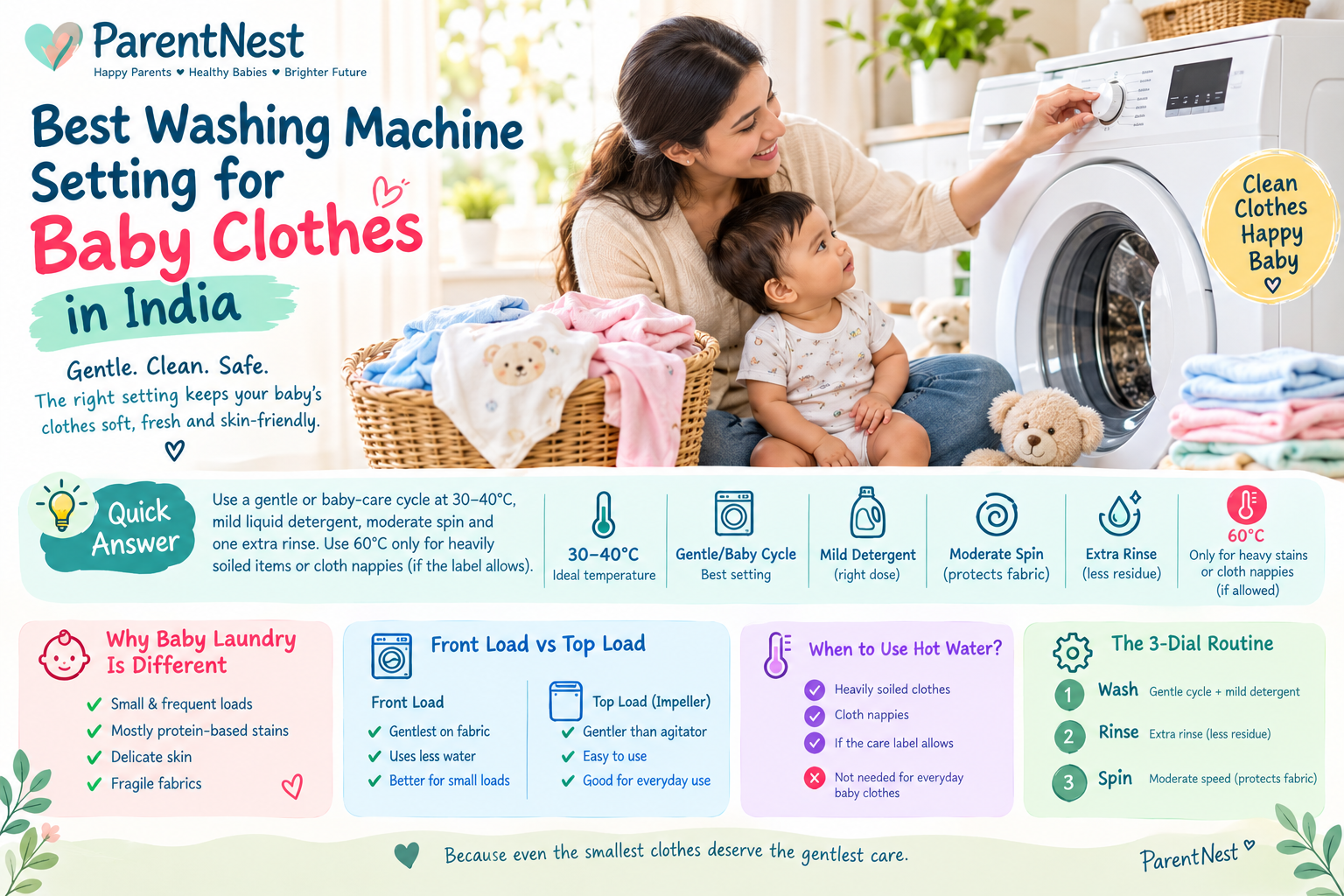
Quick answer: The best washing machine setting for baby clothes in India is usually a gentle or baby-care cycle at 30 to 40 degrees Celsius, with a mild liquid detergent at the recommended dose, a moderate spin and one extra rinse. Use 60 degrees only for heavily soiled items or cloth nappies, and only if the care label allows it. Treat hygiene or steam mode as an occasional extra, not an every-wash habit.
Table of Contents
What I checked, and what I didn’t
Before anything else, a short honest note.
I did not test washing machines. I don’t have a lab, and I didn’t run thirty loads of onesies through six models. What I did was read through published guidance on washing baby clothes, manufacturer pages for the hygiene, steam and baby-care programs sold in India, independent comparisons of front load and top load machines, and appliance advice on keeping machines free of mould. Then I put it together in the order a tired parent actually needs it.
Two limits to keep in mind:
- Every machine is different. Program names, temperatures and spin speeds vary by brand and model. Your manual is the final word.
- Care labels beat everything. If a garment label says “wash cold, do not tumble dry”, that overrides any advice in this article, including mine.
With that said, let’s start with why baby laundry is its own thing.
Why baby laundry is different from the rest of the pile
A baby’s wash isn’t like an adult’s. Four things make it special.
The loads are small and frequent. A newborn can go through three or four outfits a day. That means lots of tiny loads, and in a machine built for a big family wash, small loads can waste water and power.
The stains are mostly protein. Milk, spit-up and food are protein-based stains, and heat can set them into the fabric. This is exactly why the cold-water-first rule in our spit-up stain guide matters, and it quietly shapes every temperature choice below.
The skin is delicate. Baby skin reacts more easily to detergent residue, so rinsing matters more than it does for a work shirt. A machine that leaves a little soap behind is a bigger deal here.
The fabrics are fragile. Fine cotton, muslin, wool, tiny elastics, snap buttons. They need gentler handling than jeans and towels.
Keep those four in mind. Almost everything that follows is a response to one of them.
Front load vs top load washing machine for baby clothes: how each one actually washes
You can’t choose a setting well without knowing what the drum is doing to the clothes, so here is the plain version.
A front load machine has a horizontal drum. Clothes are lifted up the side by paddles and dropped back down through a shallow pool of water and detergent. The action is like gently tumbling clothes by hand.
A top load machine has a vertical drum with a lid on top. There are two main types. An agitator top load has a tall central post that twists and pushes clothes through a deep fill of water. An impeller top load has a low disc at the bottom that swirls the water and rubs clothes against each other. Most newer machines sold in India use impellers.
Here is how that plays out for baby clothes.
| What matters for baby laundry | Front load | Top load (impeller) | Top load (agitator) |
| Gentleness on fabric | Gentlest of the three, because of the tumbling action | Gentler than agitators, and the gap to front load is smaller | Roughest, because clothes are pushed and twisted |
| Water used per wash | Lowest | Higher | Highest |
| Rinse thoroughness | Less water to rinse with, so use an extra rinse | Deep water helps rinse | Deep water helps rinse |
| Ease of loading with a baby on your hip | Needs bending down | Easy, no bending | Easy, no bending |
| Adding a forgotten sock mid-cycle | Often possible only within a short window | Usually simple | Usually simple |
| Mould risk | Higher, if the door gasket stays damp | Lower | Lower |
| Typical price | Higher | Lower | Lowest |
Notice that no column wins every row. That’s the honest truth about this debate. Sources agree that front loaders are gentler and more water efficient, and that top loaders are cheaper and easier to use. For a baby, the “gentle” and “water” rows pull one way, and the “price” and “ease” rows pull the other.
Water efficiency for baby wash: what the numbers really say
Water is where front load and top load differ the most, and it’s also where the published numbers are the messiest.
Different sources give very different figures. One independent guide puts a typical front loader at roughly 40 to 50 litres per cycle and a top loader at 120 to 150. A finance-company explainer written for Indian buyers quotes about 80 to 120 litres for front loaders and 150 to 200 for top loaders. Another Indian buying guide says front loaders use 40 to 60 litres and top loaders 80 to 120. Clearly, it depends on the model, the load size and the program.
What all of them agree on is the direction. Front loaders use less water, often somewhere around 40 to 50 percent less. That’s a meaningful saving when you wash a small load every day.
| Published range (varies by source and model) | Front load | Top load |
| Lowest figure I found | About 40 litres | About 75 litres |
| Highest figure I found | About 120 litres | About 200 litres |
| Consistent finding | Uses less, often around half | Uses more |
So what does that mean for you?
- If you wash every day: a front loader’s lower water use adds up over a year, especially if you pay for water or live somewhere with shortages.
- If you own a top loader already: don’t panic. Pick the water level that matches your load (most machines let you choose) and avoid filling the tub for three onesies.
- If you’re buying new: check the energy and water ratings on the label, and read the manual for the minimum load and water level options. These numbers differ from model to model.
One baby-specific catch. Less water means less to rinse with. That’s why I always add one extra rinse for baby clothes in a front loader, a habit that costs a few litres and protects delicate skin.
Gentle cycle baby clothes: what the program really does
Most machines sell some version of a gentle program. It may be called Gentle, Delicate, Baby Care, Wool, Hand Wash or something a marketing team invented. Underneath the names, gentle programs usually do a few things differently from a normal cotton cycle: they shorten or soften the movement of the drum, lower the spin speed, and sometimes use more water or a longer soak.
Why this matters for baby clothes:
- Less friction helps fine cotton, muslin and printed fabric last longer and keeps tiny elastics from stretching.
- A lower spin is kinder to snaps, buttons and wool, but leaves clothes wetter, so drying takes longer.
- A longer soak or extra rinse (if available) helps lift milk and rinse out detergent.
My rule is simple. For everyday baby clothes, I choose the gentle or baby-care program if it exists, at 30 to 40 degrees, and I add an extra rinse. If the machine has no baby program, a delicate or gentle cycle does nearly the same job.
Check your machine’s spin options too. Many let you choose a lower spin speed, and for wool and fine items a lower setting is safer. For sturdy cotton onesies, a moderate spin is fine and will help in the monsoon.
Pro tip: Put small items like socks, mittens and bibs inside a mesh laundry bag. They won’t tangle around sleeves or vanish into the door seal of a front loader.
Hot water wash for germs: do baby clothes need 60 degrees?
This is the question my neighbour and I disagreed on, so let’s look at it carefully.
Heat does help kill germs. Washing at 60 degrees Celsius with a good detergent is the standard advice for removing germs from items like underwear, towels and bedding. The NHS, as quoted by consumer testing group Which?, says to wash underwear, towels and household linen at 60 degrees, or at 40 degrees with a suitable laundry product.
But everyday baby clothes don’t usually need it. For baby clothes, the same guide says to aim for a 30 or 40 degree program. Many parenting sources agree. At those temperatures, clothes get clean, colours and shapes last longer, and you avoid shrinkage and pilling.
Heat can also backfire. As we saw in the spit-up guide, milk is protein, and hot water can set protein stains into fabric. So 60 degrees is the wrong first move for a fresh milk stain. Rinse in cold water first, then wash.
Here’s how I think about it.
| Situation | Suggested temperature | Notes |
| Everyday onesies, vests, muslins | 30 to 40 degrees | Follow the care label. Add an extra rinse. |
| Fresh milk or spit-up stain | Cold rinse first, then 30 to 40 degrees | Cold first so the protein doesn’t set. |
| Cloth nappies, heavily soiled items, clothes after a stomach bug | Up to 60 degrees if the label allows | Pre-rinse off solids first. Wash these separately. |
| Wool and wool blends | Cool, on a wool or hand-wash program | Hot water and rough movement can shrink wool. |
| Items marked “do not exceed 30 degrees” | 30 degrees | The label wins, always. |
Two more points.
First, temperature isn’t the only germ fighter. Detergent, time and thorough rinsing do a lot of the work, and so does sunlight. Drying baby clothes in good sunshine is an old, free way to freshen and brighten white cotton.
Second, check that your machine actually heats. Some models have an inbuilt heater and a real temperature selector. Others only use the water that comes from your tap or geyser. If you aren’t sure, read the manual before assuming that a “hot” option actually reaches 60 degrees.
Washing machine hygiene mode: what it is and when to use it
Walk into any appliance shop and you’ll see programs with names like Hygiene Steam, Allergy Care, Sanitize or Steam Wash. They all sound reassuring. What are they?
In short, these programs use extra heat, often steam, to go beyond a normal wash. Samsung’s India product pages, for example, describe a Hygiene Steam program that releases steam into the drum and say it removes up to 99.9 percent of bacteria and allergens in tests carried out by Intertek and the British Allergy Foundation, with a note that individual results may vary. LG describes a steam-based Allergiene cycle and suggests it for items that deserve special care, including baby clothes. Several Indian brands, among them LG, Samsung, IFB and Bosch, sell machines with steam or hygiene features.
I’d treat these as a useful occasional tool, not a default.
- Good times to use it: after a stomach bug in the house, for cloth nappies, for new second-hand clothes, for bedding and soft toys that tolerate it, or after a long monsoon week when everything feels damp.
- Not necessary for: the daily wash of clean-ish onesies and bibs.
Remember that “99.9 percent” is a brand claim based on specific lab tests. It doesn’t mean your laundry is sterile, and it doesn’t replace rinsing well. Also check the care label first, because a steam or hot program can be too harsh for some fabrics.
There is one more meaning of “hygiene mode” that matters even more for a baby household: hygiene for the machine itself. Which brings us to the thing nobody warns you about.
Keeping the machine clean: the mould and smell problem
A washing machine can only get clothes as clean as it is itself. A drum with damp residue and a slimy door seal can leave a faint sour smell on baby clothes, which is the last thing you want pressed against a newborn.
Front loaders have a rubber door seal called a gasket. Because the door seals tightly, moisture and detergent residue collect in its folds after every wash. Appliance guides agree that this is where mould tends to start. The habits that prevent it are simple:
- Leave the door slightly open after every wash so the drum can dry.
- Wipe the gasket folds when you can, especially after the last load of the day.
- Run a tub-clean or hot sanitise cycle about once a month, with a washing-machine cleaner or the method recommended in your manual.
- Check the drain filter every few months and keep the detergent drawer clean.
- Don’t overdose detergent, because extra soap feeds the residue problem.
Top loaders have fewer gasket issues because the tub is open to the air, but they still collect residue on the tub, the rim and under the agitator or impeller. Wipe the rim, leave the lid open between washes, and run a tub-clean cycle regularly.
Some machines remind you. Samsung’s pages, for example, mention a Drum Clean program that gives a notification after every 40 cycles. If your machine has such a reminder, follow it.
A safety note for homes with babies and toddlers: an open front-load door looks like a cave to a curious crawler, and a top-load tub can be dangerous if a small child leans in. Use the child lock if your machine has one, keep the laundry area closed off from little ones, and never leave water standing in an open tub. Leave the door ajar only when you can keep children away from it.
[IMAGE: parent wiping the door gasket of a front load washing machine]
The best washing machine setting for baby clothes in India: the Three-Dial Method
All of this can feel like too much to remember at 11 p.m. So I boiled it down into a routine I call the Three-Dial Method. There are only three settings to know.
Dial 1: Everyday
For: daily onesies, vests, socks, muslins and bibs that aren’t heavily soiled.
- Gentle or baby-care program (or the normal cotton program if the clothes are sturdy)
- 30 to 40 degrees
- Mild, preferably fragrance-free liquid detergent at the recommended dose
- Moderate spin
- One extra rinse
- No fabric softener
Dial 2: Soiled
For: cloth nappies, heavily soiled items, clothes after illness, or anything that has been through a nappy leak.
- Rinse off solids and rinse stains in cold water first
- Wash separately from other baby clothes
- Up to 60 degrees if the care label allows (or a hygiene or sanitise program)
- Detergent at the recommended dose
- Extra rinse
Dial 3: Reset
For: the machine itself, once a month.
- Run an empty tub-clean or hot cleaning cycle
- Wipe the gasket or rim and the detergent drawer
- Clean the drain filter every few months
- Leave the door or lid open afterwards
That is the whole method. Everyday for most days, Soiled when needed, Reset once a month. Write it on a card and stick it on the machine.
How to load the machine for a baby wash, step by step
The setting is only half the story. How you load the drum changes the result just as much.
- Sort before you load. Keep everyday baby clothes together, and keep soiled items and cloth nappies in a separate load. Wool goes alone, or with other wool.
- Check pockets and snaps. Close velcro and zips, fasten snaps, and tie loose ribbons so nothing catches on the drum.
- Turn printed and embroidered items inside out. It protects the print and reduces rubbing.
- Use a mesh bag for the small things. Socks, mittens, hair bands and bibs go in the bag, and the bag goes in the drum.
- Don’t overload. Clothes need room to move through the water. A packed drum rinses badly, and baby clothes are the last thing you want half rinsed. A common rule of thumb is to fill a front loader loosely, leaving some space at the top of the drum, and to follow the maximum load in your manual.
- Measure the detergent. Use the cap or a small measuring cup, and match the dose to the load size.
- Pick the program, then the extras. Choose gentle or baby care, set 30 to 40 degrees, add the extra rinse, and choose a moderate spin.
- Take clothes out promptly. Don’t leave them sitting in the drum. Shake each item and hang it straight away.
If you have a top loader, add two small habits. First, choose a water level that matches the load, instead of leaving it on the highest setting by default. Second, add detergent to the water before the clothes, so it dissolves and spreads evenly. Many top loaders let you pre-soak, and a short soak helps with dried milk marks.
Power, water and geysers: a few Indian-home realities
Most laundry guides are written for countries with steady power, soft water and a tumble dryer in every home. Our situation is different, so here are a few practical points.
Power cuts mid-cycle. If the power goes off during a wash, don’t assume the clothes are fine. Detergent may still be in the drum. When power returns, run a rinse and spin before drying, and give baby clothes an extra rinse if you’re unsure. Many machines can resume on their own, and some have an auto-restart feature, but check your manual.
Hot water from a geyser. Some people fill a bucket with hot water for a pre-soak, and that can help with soiled items. Keep the water warm rather than scalding, test it with your hand, and remember the stain rule: milk stains should meet cold water first. Never leave a bucket of hot water where a toddler can reach it.
Voltage and water pressure. Low water pressure can mean a machine takes a long time to fill or flags an error, and low pressure can also lead to poor rinsing. If your pressure is often low, run a longer rinse or use the machine at hours when the supply is better.
Hard water. In much of India, water is hard, which makes detergent rinse less cleanly and can leave clothes stiff. Dose correctly, add the extra rinse, and don’t pile the drum. If clothes feel rough even after a good wash, talk to your appliance brand or a service engineer about options for your area.
Small flats, no balcony. If you dry indoors, a higher spin speed (for sturdy cotton), a fan and plenty of space between items make a real difference. A washing machine that leaves clothes very wet isn’t helping you in July.
These aren’t glamorous, but they’re the difference between a routine that works on paper and one that works in your home.
Settings cheat sheet for every kind of baby item
Here’s how the three dials apply to the things you’ll actually be washing. Always check the garment label first.
| Item | Program | Temperature | Extra notes |
| Cotton onesies and vests | Gentle or baby care | 30 to 40 degrees | Extra rinse. Turn printed items inside out. |
| Muslin and burp cloths | Gentle or normal | 30 to 40 degrees | Fast drying. Sunlight is a friend. |
| Bibs | Gentle or normal | 30 to 40 degrees | Rinse off food first. Use a mesh bag. |
| New clothes, first wash | Gentle | 30 to 40 degrees | Wash before first wear. Extra rinse. |
| Wool and wool blends | Wool or hand wash | Cool | Low spin. Mesh bag. No hot water. |
| Cloth nappies and soiled items | Normal or hygiene | Up to 60 degrees if label allows | Pre-rinse solids. Wash separately. |
| Blankets and bedding | Normal or bulky | 40 to 60 degrees if label allows | Don’t overload. Make sure they rinse well. |
| Soft toys | Gentle, if label allows | 30 to 40 degrees | Mesh bag. Check the label first. |
Detergent in the machine: less is more
Even the perfect setting can be undone by too much detergent. Machines, especially front loaders, use little water, and extra detergent doesn’t rinse out as easily.
- Use liquid, in the recommended dose. Powder can leave more visible residue in some conditions, and liquid is usually easier to measure. Our baby detergent comparison covers the choices.
- Check if your machine is meant for low-foam detergent. Many front loaders are designed for it. Too much foam can cause poor rinsing.
- Dose by load size. A half load needs less detergent, not the same amount.
- Skip fabric softener. It can leave residue and fragrance on fibres, and baby clothes don’t need it.
- Add the extra rinse. If your baby has sensitive skin, ask your paediatrician or dermatologist about the right routine.
A good test: if your baby clothes feel stiff, smell flat after drying, or leave a soapy film when you squeeze them under a tap, you’re probably using too much detergent or rinsing too little.
Should you have a separate baby laundry machine?
This is a question I see in parenting groups all the time, usually followed by a long argument. Here’s my honest answer: most families don’t need one.
The case for a separate machine:
- You control the detergent, so no adult fabric softener or strong fragrance touches baby clothes.
- No cross-contamination from muddy gear, gym clothes or pet blankets.
- Useful if your baby has eczema or very reactive skin, or if there’s illness in the house.
- Small, frequent loads can run without waiting for a full family wash.
The case against:
- It costs money and takes space.
- A second machine also needs cleaning, and a neglected one is worse than no machine.
- You can get most of the benefit with habits alone.
A middle path that works for most homes: wash baby clothes in their own small load, use a dedicated mild detergent, run the Three-Dial routine, and give the drum a monthly reset. If you do decide to buy a second machine, a compact, inexpensive model for baby loads can make sense, but a clean main machine and good habits matter more than owning two.
| Your situation | What I’d do |
| Healthy baby, one machine | Wash baby clothes in their own load. Use Dial 1, and reset the machine monthly. |
| Eczema or very sensitive skin | Ask your doctor, choose a fragrance-free detergent, and consider a dedicated machine or a thoroughly cleaned drum before each baby load. |
| Cloth nappies | Wash them separately from other baby clothes using Dial 2. A dedicated machine is optional. |
| Joint family with many people’s laundry | Schedule baby loads first, when the drum is cleanest, or consider a compact second machine. |
Which machine suits a home with a baby: front load or top load?
Now for the question in the title. Based on everything above, here is how I’d choose.
| Your priority | Better fit | Why |
| Lowest water use | Front load | Published figures consistently show lower water use. |
| Gentlest on fine fabric | Front load | Tumbling action. Impeller top loads are close behind. |
| Lowest price | Top load | Usually costs less up front. |
| No bending with a baby on your hip | Top load | Load from above at waist height. |
| Faster drying in the monsoon | Front load | Higher spin speeds in many models remove more water. |
| Low mould worry | Top load | Fewer sealed folds, though both need cleaning. |
| Hard water | Unclear | Sources disagree. Check the brand’s guidance for your water. |
| A hot or hygiene option | Front load, often | Many front loaders offer heaters or steam. Check each model. |
| Tight budget | A good impeller top load | Used well, it does a fine job. |
My honest summary: if you can afford it and have the space, a front loader is the gentler, more water-efficient choice. If you’re on a tight budget, or bending is hard on you, a good impeller top loader works perfectly well with the Three-Dial routine. Neither is a mistake, and neither is a magic solution.
A word on hard water, since it matters in much of India. Different sources I read disagree about which type copes better, so I won’t pretend there is a clear winner. What I can say is that hard water makes detergent rinse less cleanly, which is one more reason to dose correctly, add an extra rinse, and watch whether baby clothes feel stiff.
Monsoon and no-dryer homes: spin, dry and don’t trap damp
Washing is only half the job in India. Drying is the other half, especially from June to September.
- Spin matters. A higher spin speed pulls more water out of sturdy cotton, which shortens drying time. Use a lower spin only for wool and delicate items.
- Dry fully. Damp baby clothes smell musty. Dry them in sunshine when you can, or under a fan with space between each item.
- Don’t leave washed clothes sitting in the drum. Wet laundry left in a closed machine smells within hours, and in a humid house it smells faster.
- Iron nearly dry clothes (once any stain is fully gone) to finish drying and freshen fabric.
- Never store damp clothes.
Our monsoon drying guide goes deeper on this. The machine setting you choose and the way you dry work as a pair.
Seven mistakes parents make with the baby wash
I’ve made several of these, and I’ve seen the rest in every parenting group.
- Washing everything at 60 degrees “to be safe”. Heat can shrink fabric, fade colours, and set protein stains. Use it when it’s needed, not as a default.
- Skipping the extra rinse. Detergent residue is a bigger risk for baby skin than most germs.
- Overdosing detergent. More soap isn’t cleaner clothes, it’s more residue.
- Using fabric softener. It adds fragrance and residue without improving cleanliness.
- Leaving wet clothes in the drum. The smell sets in fast.
- Ignoring machine cleaning. A dirty drum or gasket can pass smells to clean clothes.
- Trusting a program name over the care label. “Baby care” on a dial is not a promise for every garment.
A weekly rhythm that keeps this easy
Habits beat heroics, so here’s a weekly rhythm that doesn’t take much thought.
Daily: Rinse stains in cold water. Run one small Dial 1 load, or two if you have a newborn. Leave the machine door or lid open afterwards.
Twice a week: Wash bibs and muslins in their own load, since they take the worst of the milk and food.
Weekly: Run one Dial 2 load for anything that needs it, and wash blankets and bedding. Wipe the gasket or tub rim and the detergent drawer.
Monthly: Run the Reset (Dial 3) with an empty tub-clean cycle. Check your stock of detergent.
Every few months: Clean the drain filter and review your routine.
If that sounds like a lot, remember that each step is tiny. It takes a couple of minutes, and the result is a machine that smells fresh and clothes that are gentle on your baby’s skin.
The machine I almost replaced
A few months after that 11 p.m. night, I nearly bought a new washing machine.
The baby clothes had developed a faint sour smell, even straight from the wash. I was sure the old machine was done. I’d already opened three shopping tabs, which felt very familiar by then.
Then a friend asked a simple question. “When did you last clean the drum?”
I couldn’t remember. I’d never done it. I wiped the gasket for the first time, found more gunk than I want to describe, ran a hot tub-clean cycle, left the door open, and cut my detergent in half. The smell vanished within a week.
I closed the shopping tabs. The machine was fine. The routine was the problem.
That’s really the point of this whole guide. The best washing machine setting for baby clothes in India isn’t one magic button. It’s a handful of small, boring habits: gentle cycle, 30 to 40 degrees, a sensible dose of mild detergent, an extra rinse, a hot wash only when it’s needed, and a clean drum. Do those, and whichever machine you own will do right by your baby.
So go and press the button. You’re allowed to sleep tonight.
Frequently asked questions
What is the best washing machine setting for baby clothes in India?
For everyday baby clothes, use a gentle or baby-care cycle at 30 to 40 degrees Celsius with a mild liquid detergent, a moderate spin and one extra rinse. Reserve 60 degrees for heavily soiled items or cloth nappies if the care label allows. Always follow the garment label.
Is a front load or top load washing machine better for baby clothes?
Front loaders are generally gentler on fabric and use less water, while top loaders cost less and are easier to load. A good impeller top loader works well too. Choose by budget, space and water use, then follow a gentle routine with an extra rinse.
Should I wash baby clothes in hot water to kill germs?
Not usually. Everyday baby clothes are fine at 30 to 40 degrees, and hot water can shrink fabric and set milk stains. Use up to 60 degrees only for cloth nappies or heavily soiled items, and only if the care label allows it.
Is the baby care cycle on my washing machine worth using?
Usually yes, if your machine has one. These cycles typically use gentler movement, a lower spin and sometimes an extra rinse. Program names vary by brand, so check your manual to see what each one does.
What is hygiene mode on a washing machine?
Hygiene, steam or sanitise modes use extra heat or steam to go beyond a normal wash. Brands claim high germ reduction in lab tests. They are useful occasionally, such as after illness or for cloth nappies, but not necessary for everyday baby washes. Check the care label first.
Do I need a separate washing machine for baby clothes?
Most families don’t. Washing baby clothes in their own small load, with a mild detergent, a gentle cycle and a monthly drum clean works well. A separate machine can help if your baby has eczema or very sensitive skin, but ask your paediatrician or dermatologist.
How often should I clean my washing machine if I wash baby clothes?
Wipe the gasket or tub rim regularly, leave the door or lid open between washes, and run a tub-clean cycle about once a month. Clean the drain filter every few months. If your machine has a drum-clean reminder, follow it.
Does a front load washing machine save water for baby clothes?
Yes, in most published comparisons. Figures vary by model, but front loaders typically use noticeably less water, often around half. Because there is less water to rinse with, add an extra rinse for baby clothes.
Can I wash baby clothes with the rest of the family’s laundry?
Many families do once the baby is a few months old and shows no skin reactions. For newborns or sensitive skin, a separate small load with mild detergent is the cautious choice. If your baby has eczema, ask your doctor before changing the routine.