
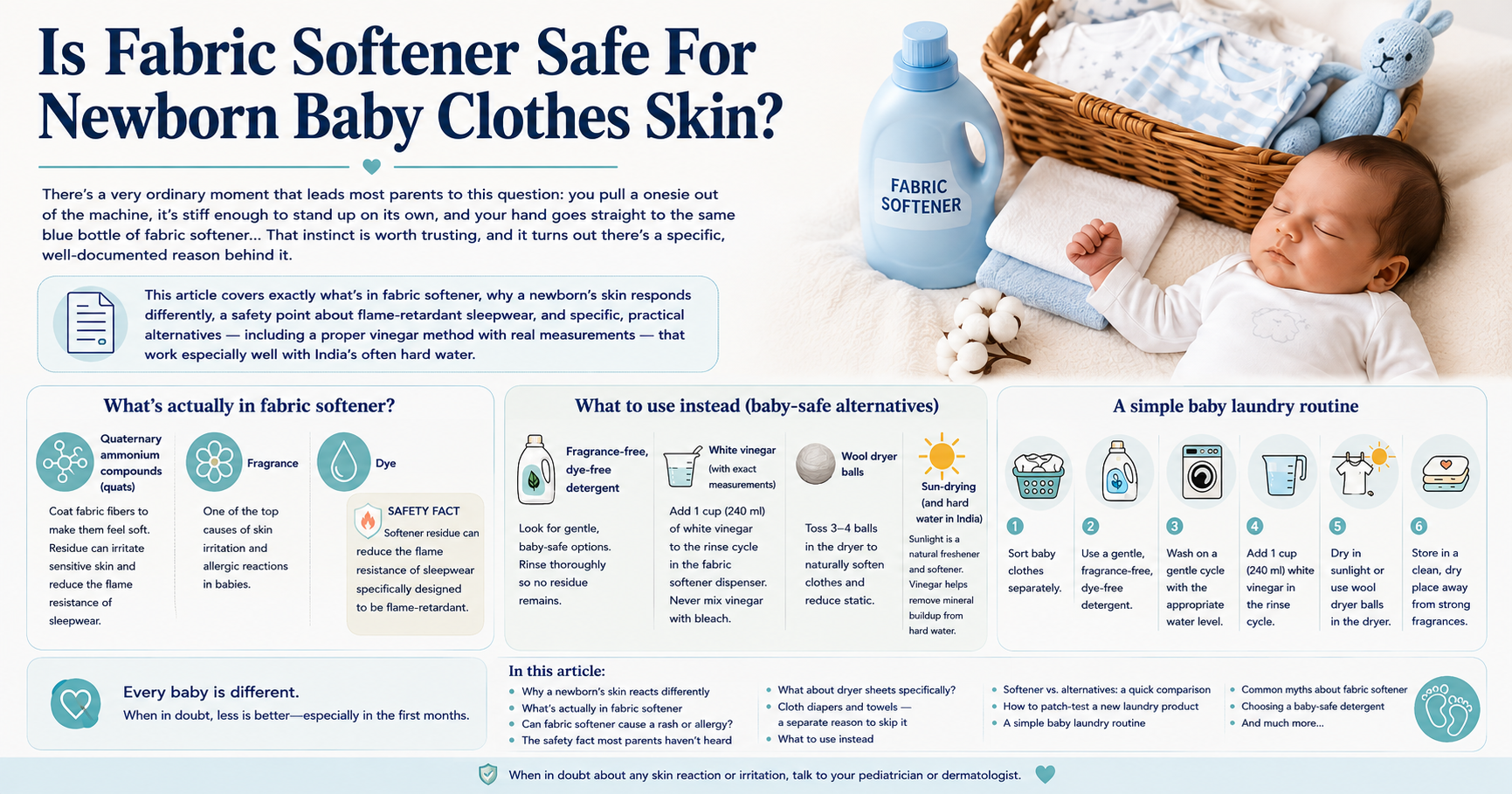
Most pediatric and dermatology sources recommend avoiding regular fabric softener and dryer sheets on baby clothes, especially for newborns. The concern isn’t that softener is toxic in a dramatic sense — it’s that the fragrance, dyes, and chemical residue it leaves on fabric can irritate a newborn’s thin, still-developing skin barrier, and softener residue can reduce the flame resistance of sleepwear specifically designed to be flame-retardant. A cup of white vinegar in the rinse cycle, wool dryer balls, or simply a fragrance-free detergent do the softening job without the residue — just never mix vinegar with bleach in the same wash.
Is Fabric Softener Safe For Newborn Baby Clothes Skin?
There’s a very ordinary moment that leads most parents to this question: you pull a onesie out of the machine, it’s stiff enough to stand up on its own, and your hand goes straight to the same blue bottle of fabric softener sitting on the shelf, the one that’s made every other load in the house smell like a spring meadow for years. Then you stop, holding it over the drawer, because something about putting it directly on a newborn’s skin feels different from putting it on your own t-shirts. That instinct is worth trusting, and it turns out there’s a specific, well-documented reason behind it.
This article covers exactly what’s in fabric softener, why a newborn’s skin responds to it differently than an adult’s does, a safety point about flame-retardant sleepwear that surprisingly few parents have heard, and specific, practical alternatives — including a proper vinegar method with real measurements — that work especially well with India’s often hard water.
Table of Contents
Why a newborn’s skin reacts differently
A newborn’s skin isn’t simply a smaller version of adult skin. It’s meaningfully thinner, with a less developed outer barrier layer, which means it loses moisture faster and absorbs substances from its surroundings more readily than mature skin does. This is a big part of why dermatologists generally recommend a more cautious approach to anything that sits directly against a baby’s skin for extended periods — and clothing, especially onesies and sleepsuits worn for hours at a stretch, sits against the skin about as directly and continuously as anything a baby encounters.
This doesn’t mean every baby reacts badly to fabric softener. Many don’t show any visible response at all. It means the margin for tolerating residue, fragrance, and mild chemical irritants is genuinely narrower in the first months of life than it will be later, which is the practical reason caution is generally advised here rather than treated as an overreaction.
There’s also a simple, practical factor worth naming: a newborn spends far more continuous time in the same set of clothes than an older child or adult does, especially in the early weeks when sleep and wake periods are scattered throughout the day and night rather than concentrated into predictable blocks. A onesie or sleepsuit might stay against the same skin for four, five, or six hours at a stretch. That length of continuous contact gives any residue on the fabric considerably more time and opportunity to transfer to skin and cause irritation than a few hours in the same shirt would for an adult moving around, sweating, and changing clothes more frequently across a day.
What’s actually in fabric softener
It helps to know what’s actually being avoided, rather than treating “fabric softener” as a vague, unspecified worry.
Quaternary ammonium compounds (quats)
The softening effect in most liquid fabric softeners comes from a class of chemicals called quaternary ammonium compounds. These work by coating fabric fibers with a thin, slightly waxy layer that reduces friction between fibers, which is what makes the fabric feel softer and reduces static. That same coating is the thing that can sit on skin-contact fabric and, in some babies, trigger irritation, and it’s also part of why softener residue reduces fabric breathability over time.
Fragrance
Fragrance is one of the most commonly recognized causes of skin allergy and contact irritation in cosmetic and household products generally, and fabric softeners are typically heavily fragranced, since scent is a major part of how these products are marketed and experienced. A fragrance that’s barely noticeable to an adult’s skin can still be enough to trigger redness or a rash on the more reactive skin of a newborn.
Dye
Many fabric softeners are dyed for visual branding (the blue or purple liquid), and while dye is generally a smaller concern than fragrance for skin reactions, dye-free and fragrance-free (“free and clear”) formulations are consistently the safer category to look for across both detergents and softeners, if you choose to use either on items touching a baby’s skin.
Can fabric softener cause a rash or allergy?
Yes, in some babies — this is a real and commonly reported reaction, not a rare or exaggerated one. The reaction usually looks like mild redness, small bumps, or general irritation in the areas where clothing sits closest and longest against the skin (waistbands, underarms, the neck of a onesie), and it typically improves once the softener is removed from the laundry routine. Babies who already have eczema or generally reactive skin tend to be more sensitive to fabric softener residue specifically, since their skin barrier is already compromised and residue-heavy fabric sits directly against already-irritated areas. If a persistent rash doesn’t improve after switching to fragrance-free products, or looks infected, painful, or is spreading, that’s worth an actual visit to a pediatrician rather than more laundry troubleshooting.
The safety fact most parents haven’t heard: flame retardancy
This is worth its own section because it’s genuinely under-discussed and it isn’t about skin irritation at all — it’s about fire safety. Children’s sleepwear is often manufactured to meet specific flame-resistance standards, and fabric softener and dryer sheet residue can build up on fabric over repeated washes in a way that reduces that flame resistance. This is why several laundry-care guides for children’s clothing specifically warn against using fabric softener on sleepwear, separate from the general skin-sensitivity concern. In practical terms: even if you decide fabric softener is fine for your baby’s daytime clothes, it’s worth checking the care label on flame-resistant sleepwear specifically and avoiding softener on those items regardless.
What about dryer sheets specifically?
Dryer sheets work through a similar mechanism to liquid softener — they’re coated in a waxy, fragranced layer that transfers onto fabric in the dryer to reduce static and add scent — so the same two concerns apply: fragrance and residue that can irritate sensitive skin, and the same flame-retardancy caution for sleepwear. If you dry-clean or machine-dry a mixed household load that includes baby items, it’s worth running baby clothes in a separate, dryer-sheet-free load, or air-drying them instead.
Cloth diapers and towels — a separate reason to skip it
If you use cloth diapers, there’s an additional, non-skin-related reason to avoid fabric softener specifically on those items: the same waxy residue that makes fabric feel softer also coats and clogs the fibers of absorbent materials, which measurably reduces how much liquid cloth diapers (and towels) can actually absorb. A diaper that’s been repeatedly washed with fabric softener can end up less effective at its actual job, regardless of how soft it feels.
What to use instead
A fragrance-free, dye-free detergent
This is the single highest-impact swap, more so than the softener question itself. Looking for a detergent labeled “fragrance-free,” “dye-free,” or “free and clear,” rather than one labeled “baby” or “sensitive” alone (marketing labels aren’t regulated the same way as an actual fragrance-free formulation claim), reduces the most common source of residue-based irritation from the start.
White vinegar (with exact measurements)
Plain white vinegar, added to the rinse cycle, works as a mild acid that helps dissolve mineral buildup and soap residue, which is often the actual cause of stiffness, especially with hard water. A reasonable starting amount is about a quarter to half a cup of white vinegar added to the fabric softener dispenser or directly into the rinse cycle, per load. It doesn’t leave a lingering vinegar smell once the load is dry, and it’s genuinely inexpensive and residue-free compared with a commercial softener.
Important safety note: never mix vinegar with chlorine bleach, in the same wash or in close succession without a thorough rinse in between. The combination produces chlorine gas, which is genuinely hazardous to breathe. If your regular routine involves bleach for any part of the wash, keep the vinegar step for a separate, bleach-free load.
Wool dryer balls
A few wool dryer balls tossed into the dryer with a load physically separate and fluff fabric as they tumble, which reduces drying time, softens fabric mechanically rather than chemically, and cuts down on static without leaving any residue at all. They’re reusable for hundreds of loads, which also makes them a reasonably economical long-term alternative.
Sun-drying (and hard water in India)
Many Indian households already sun-dry baby clothes as a matter of routine, and it’s worth knowing this genuinely helps with two separate problems at once: sunlight has a natural, mild antimicrobial effect on fabric, and air-drying tends to leave clothes noticeably less stiff than machine-drying does, especially once a mineral-residue-reducing rinse (like the vinegar method above) is already part of the routine. If your water is particularly hard, which is common across many parts of India, the stiffness you’re noticing may be more about mineral buildup than about needing a softening agent at all — the vinegar rinse specifically targets that cause.
Softener vs. alternatives: a quick comparison
| Method | Softening effect | Residue on skin | Cost | Extra notes |
|---|---|---|---|---|
| Commercial fabric softener | Strong | Yes, builds up over time | Low-medium | Fragrance and dye are the main concerns; avoid on flame-retardant sleepwear |
| Dryer sheets | Strong | Yes, similar residue to liquid softener | Low | Same fragrance and flame-retardancy concerns as liquid softener |
| White vinegar (rinse cycle) | Moderate, mainly by removing mineral/soap buildup | No | Very low | Never combine with chlorine bleach |
| Wool dryer balls | Moderate, mechanical softening | No | Low upfront, reusable for hundreds of loads | Also reduces drying time |
| Sun-drying / air-drying | Mild, depends on water quality | No | Free | Best paired with a vinegar rinse if water is hard |
| Fragrance-free detergent alone | Mild-moderate | Minimal if rinsed well | Low-medium | Often enough on its own if excess detergent is avoided |
None of these alternatives are mutually exclusive — many parents combine a fragrance-free detergent, an occasional vinegar rinse for hard-water stiffness, and wool dryer balls, and find that covers most of what a commercial softener was doing, without the residue trade-off.
What about everything else that touches your baby?
Clothes aren’t the only fabric in regular, close contact with a newborn’s skin, and it’s worth extending the same fragrance-free logic a bit further, without turning it into an exhausting project.
- Bedsheets and swaddle cloths: These sit against a baby’s skin for hours at a stretch during sleep, arguably even more continuously than daytime clothing, so the same fragrance-free approach is worth applying here specifically.
- Burp cloths and bibs: These are frequently against a baby’s face and neck, an area more prone to irritation than most.
- Your own clothing, when you’re holding or feeding your baby: A parent’s shirt, especially during skin-to-skin contact or breastfeeding, is in direct, prolonged contact with a baby’s face and skin. If a parent’s regular laundry is heavily softened and fragranced, that residue is reaching the baby indirectly, even though the baby’s own clothes were washed carefully. It’s not necessary to overhaul the entire family’s laundry, but being aware of this indirect exposure is useful, especially in the first weeks.
- Soft toys and comfort items: A blanket or soft toy a baby holds close to their face for long stretches deserves the same fragrance-free consideration as their actual clothing.
This doesn’t need to become a strict rule applied to every textile in the house — it’s simply worth knowing that the items closest and most continuous in contact with a baby’s skin (sleepwear, bedding, a parent’s shirt during feeding) matter more than something like a living room cushion cover a baby rarely touches directly.
How to patch-test a new laundry product
If you’re unsure whether a new detergent or a vinegar rinse will suit your baby’s skin, a simple patch test avoids guessing after the fact. Wash a single small item — a muslin cloth or one onesie — using only the new product, separately from the rest of the load, and let your baby wear or be wrapped in it for a few hours during the day rather than overnight, so you can check for any redness or irritation while it’s easy to observe. If there’s no reaction after a day or two, it’s reasonable to move the rest of your baby’s laundry over to the same product. This small extra step is especially worth doing when introducing vinegar for the first time, switching detergent brands, or trying wool dryer balls with a new type of fabric.
A simple baby laundry routine
- Wash new baby clothes before first use, since manufacturing residues and dyes can also be mild skin irritants.
- Use a fragrance-free, dye-free detergent, in a small enough amount to avoid detergent residue itself building up (excess detergent is a commonly overlooked cause of stiffness and irritation).
- Add a quarter to half a cup of white vinegar to the rinse cycle if clothes come out stiff, particularly with hard water — never in the same load as bleach.
- Skip fabric softener and dryer sheets on sleepwear specifically, given the flame-retardancy concern, and consider skipping them for all baby clothing as a simpler, consistent rule.
- Air-dry or sun-dry where practical, or use wool dryer balls in the machine dryer for the same softening effect without chemical residue.
- Wash a new brand or type of clothing separately the first time, so if a reaction does occur, it’s easier to identify the specific cause.
How fabric softener actually works, in plain terms
It helps to understand the mechanism itself, since it explains almost every recommendation in this article. Cotton and other fabric fibers naturally have a slightly rough, uneven surface at a microscopic level, and repeated washing and friction in a machine roughens them further over time, which is part of why old towels and clothes eventually feel scratchy. Fabric softener works by depositing a thin coating of positively charged compounds onto the negatively charged surface of wet fabric fibers. This coating physically smooths the fiber surface, reduces the friction between individual fibers, and — because it also reduces the fabric’s ability to build up a static electric charge — cuts down on static cling as an added effect.
This is genuinely effective at making fabric feel softer, which is exactly why the product exists and remains popular. The trade-off is that the same coating that smooths fiber friction doesn’t wash away completely with a single rinse; it builds up gradually over repeated use, which is part of why heavily softened towels can start to feel almost waxy over time, and why the same residue sits against skin rather than rinsing cleanly away.
Common myths about fabric softener and baby clothes
“Natural or plant-based softener is automatically fine.” Not necessarily. “Natural” and “plant-based” are marketing terms, not a guarantee of fragrance-free or hypoallergenic status. Many plant-based softeners are still heavily scented, often with essential oils marketed as natural, which can be just as likely to trigger skin irritation as a synthetic fragrance. The label to actually look for is “fragrance-free” or “unscented,” not “natural.”
“If it doesn’t bother my other kids, it won’t bother the new baby.” Every child’s skin sensitivity is different, and a newborn’s skin barrier is measurably less mature than an older child’s or an adult’s. A product that’s never caused a visible reaction on an older sibling isn’t a reliable predictor for a newborn.
“Baby-specific softener brands are automatically safe.” Some products marketed specifically for babies are genuinely fragrance-free and gentler; others use the word “baby” or “gentle” purely as a marketing angle while still containing fragrance. It’s worth checking the actual ingredient or labeling claim rather than trusting the packaging category alone.
“If my baby hasn’t reacted yet, softener must be fine for them.” Some skin reactions build up gradually with repeated exposure rather than appearing after the very first wash, so an absence of visible irritation in the first few weeks doesn’t rule out a slower-developing sensitivity.
“Scent boosters and fragrance beads are basically the same as softener, so the same caution applies and nothing more.” Actually, scent boosters (small beads added directly to a wash to leave a long-lasting fragrance) are typically even more concentrated in fragrance than liquid softener, and are generally considered a stronger irritant risk for a baby’s laundry than softener itself. If you’re already avoiding softener for a newborn’s clothes, it’s worth extending the same caution to scent boosters and heavily fragranced laundry beads.
Choosing a baby-safe detergent: what the labels actually mean
Laundry aisles are crowded with claims, and it helps to know what a few of the common ones actually indicate:
- “Fragrance-free” or “unscented”: This should mean no added scent at all, which is the single most protective claim for a newborn’s laundry. Note that “unscented” sometimes technically means a masking fragrance is used to cancel out other scents, so “fragrance-free” is the more reliably precise term to look for.
- “Dye-free”: Means no added coloring, which reduces one additional, smaller source of potential skin irritation.
- “Hypoallergenic”: This claim isn’t strictly regulated in most markets, so it indicates a general intention toward lower allergy risk rather than a guaranteed, tested outcome. It’s a reasonable secondary signal, not a substitute for checking fragrance-free and dye-free status directly.
- “Dermatologically tested”: Usually means the product has undergone some testing for skin reaction in a study, though the specifics (sample size, population, testing method) vary by brand and aren’t always disclosed. Treat it as a positive general signal rather than a personal guarantee for your specific baby.
- “Free and clear”: A commonly used phrase across both detergents and softeners, typically indicating both fragrance-free and dye-free formulation together — often the most useful single label to search for.
Powder, liquid, or bar: what Indian households commonly use
Many Indian families rely on detergent powder, a dedicated laundry bar, or a liquid detergent, sometimes all three for different types of laundry, and the fragrance-free principle applies across all of these formats, not just liquid detergent.
- Detergent powder: Widely used across Indian households for general laundry. Check for a fragrance-free or baby-specific line if available; standard powders are often heavily fragranced by default.
- Laundry bar/soap: A traditional choice for hand-washing baby clothes in many households, and often less heavily fragranced than a liquid detergent, though this varies by brand — the same “fragrance-free” check applies.
- Liquid detergent: Increasingly common, dissolves more completely in cooler water, which can leave less residue than powder if a wash uses lower water temperatures.
Whichever format your household already uses, the underlying principle stays the same: fragrance-free and dye-free options exist across all three, and switching formats entirely isn’t necessary — switching to the fragrance-free version of whatever you already use is usually enough.
Hand-washing vs. machine-washing baby clothes
A lot of Indian households, especially with a newborn, hand-wash baby clothes separately rather than machine-washing them with the rest of the family’s laundry, and this habit has some genuine benefits worth keeping even as a baby grows.
Hand-washing generally allows for a more thorough rinse than a machine cycle, since you can visually check that soap has actually been rinsed out rather than trusting a machine’s rinse cycle to remove all residue — and incomplete rinsing, whether of detergent or of any softening agent, is itself a common and often overlooked cause of skin irritation. If you do hand-wash, an extra plain-water rinse after the soap rinse is a small, low-effort habit that meaningfully reduces leftover residue.
If you machine-wash baby clothes together with other laundry, running an extra rinse cycle (many machines have this as a selectable option) achieves a similar benefit without extra manual effort.
Does this change as your baby gets older?
The caution recommended here is strongest in the newborn and early infant period, when the skin barrier is least developed and most permeable. As a baby grows past the first several months, and especially past the first year, skin generally becomes more resilient and closer to a young child’s more mature skin barrier, though there’s no single date at which sensitivity suddenly disappears — it’s a gradual continuum rather than a switch.
In practical terms, this means the fragrance-free, softener-free approach described here is most important to prioritize consistently in the first few months, remains a reasonable general habit through toddlerhood (especially for any child with eczema or generally reactive skin), and can be relaxed somewhat as a child grows older and shows no history of skin sensitivity — though the flame-retardancy caution for sleepwear specifically applies regardless of age, since that’s a fabric-safety issue rather than a skin-sensitivity one.
What not to do
- Don’t assume a softener labeled “gentle,” “sensitive,” or with a baby on the packaging is automatically fragrance-free — check the ingredient or labeling claim specifically rather than relying on marketing language.
- Don’t use fabric softener or dryer sheets on flame-resistant sleepwear, regardless of how it’s marketed for skin sensitivity, given the flame-retardancy concern.
- Don’t mix vinegar with chlorine bleach in the same wash or without a full rinse cycle in between — this produces a genuinely hazardous gas.
- Don’t overload the detergent dispenser assuming more equals cleaner — excess detergent residue is a common, overlooked cause of the same stiffness and irritation people try to fix with softener.
- Don’t ignore a persistent rash in the hope that it will resolve on its own once you’ve already switched products and waited a reasonable amount of time — that’s the point to involve a pediatrician.
When to talk to a doctor
Most laundry-related skin irritation is mild, temporary, and resolves once softener or a fragranced product is removed from the routine. It’s worth a pediatrician visit if you notice:
- A rash that doesn’t improve within a week or so after switching to fragrance-free products
- Broken, weeping, or clearly infected-looking skin
- A rash that spreads beyond the areas of direct fabric contact
- Any sign of significant distress, feeding difficulty, or fever alongside the skin issue
None of this is meant to suggest a diagnosis from an article — persistent or unusual skin reactions are worth a proper in-person look rather than continued laundry troubleshooting alone.
Real moments parents recognize
You might stand in front of the laundry shelf holding two bottles — your regular softener and a plain, boring-looking fragrance-free detergent — and feel a small pang of guilt that the “boring” one is somehow less loving, when in fact it’s usually the more protective choice for a newborn’s skin specifically.
Or you might notice your baby’s onesie comes out of a vinegar-rinsed wash smelling like nothing at all, and worry that “nothing” means it isn’t properly clean — when actually, no lingering fragrance is exactly the point for a newborn’s laundry.
Or a relative might insist that everyone in the family has always used the same softener on baby clothes with no issue at all, and it’s worth remembering that’s entirely possible and still doesn’t tell you much about your own baby’s particular skin, which is the only one that actually matters here.
Frequently Asked Questions
Is fabric softener safe for newborn baby clothes skin?
Most pediatric and dermatology guidance recommends avoiding regular fabric softener on newborn clothing, since the fragrance and chemical residue it leaves behind can irritate a newborn’s thinner, more reactive skin. A fragrance-free detergent plus a vinegar rinse or wool dryer balls softens clothes without that residue.
Can fabric softener cause a rash on a baby?
Yes, in some babies. The fragrance and residue in fabric softener are a recognized cause of mild skin irritation and rash, particularly where clothing sits closest to the skin, such as waistbands and necklines. It typically improves once softener is removed from the laundry routine.
Are dryer sheets baby-safe?
Dryer sheets carry similar concerns to liquid fabric softener — fragrance and a waxy residue that can irritate sensitive skin — plus the same flame-retardancy caution for sleepwear. Many of the same fragrance-free, residue-free alternatives used instead of liquid softener apply to dryer sheets as well.
Does fabric softener affect flame-retardant baby sleepwear?
Yes. Softener and dryer sheet residue can build up on fabric and reduce the flame resistance of sleepwear specifically designed to meet flame-retardant standards. It’s worth avoiding fabric softener on sleepwear regardless of your approach to other baby clothing.
How do I stop baby clothes from having static cling without fabric softener?
Wool dryer balls reduce static mechanically during drying without any chemical residue, and a vinegar rinse also helps reduce static somewhat by cutting down on mineral and detergent buildup on fabric.
What can I use instead of fabric softener for baby clothes?
A quarter to half a cup of white vinegar added to the rinse cycle, wool dryer balls in the dryer, or simply sun-drying or air-drying clothes are all residue-free ways to reduce stiffness without the chemical additives found in commercial softener.
Can I mix vinegar and bleach when washing baby clothes?
No — never mix vinegar with chlorine bleach in the same wash or without a full rinse in between. The combination produces chlorine gas, which is hazardous to breathe. Keep vinegar use to a separate, bleach-free load.
Does vinegar ruin baby clothes or leave a smell?
No, when used in reasonable amounts (about a quarter to half a cup per load), white vinegar doesn’t damage typical baby clothing fabrics and doesn’t leave a lingering smell once clothes are dry — it works during the wash to help dissolve residue and mineral buildup rather than remaining on the fabric.
Why do baby clothes feel stiff after washing, especially in India?
Stiffness is often caused by mineral buildup from hard water rather than a lack of softening agent. A vinegar rinse specifically targets this cause, and is often more effective for hard-water stiffness than a standard fabric softener.
Does fabric softener affect cloth diaper absorbency?
Yes — the waxy residue fabric softener leaves on fibers can reduce how much liquid absorbent materials like cloth diapers and towels can hold, which is a separate, functional reason to avoid it on those specific items beyond the skin-sensitivity concern.
Is natural or plant-based fabric softener safe for babies?
Not automatically. “Natural” and “plant-based” describe the source of ingredients, not whether a product is fragrance-free. Many natural softeners still use essential oils as fragrance, which can irritate a newborn’s skin just as much as a synthetic scent. Look for “fragrance-free” specifically.
Should I also avoid fabric softener on my own clothes if I’m holding my newborn a lot?
It’s not strictly necessary to overhaul all family laundry, but since a parent’s clothing is in close, prolonged contact with a baby during feeding and holding, using a fragrance-free option for your own frequently-worn shirts is a reasonable extra step in the first weeks especially.
At what age can I start using regular fabric softener on my child’s clothes?
There’s no single fixed age, since skin sensitivity decreases gradually rather than switching off at a specific point. Many parents continue the fragrance-free approach through the first year or two, especially for a child with eczema-prone skin, and relax it later if there’s no history of irritation. The flame-retardancy caution for sleepwear applies at any age.
Do scent boosters or laundry fragrance beads carry the same risk as fabric softener?
Generally a similar or greater risk, since scent boosters are often more concentrated in fragrance than liquid softener. If you’re avoiding softener for a newborn’s laundry, it’s worth avoiding fragrance beads and scent boosters as well.
How much white vinegar should I actually use per load?
A quarter to half a cup is a reasonable starting amount for a standard load, added to the rinse cycle or the fabric softener dispenser. There’s no need to increase this for extra softness — a larger amount doesn’t meaningfully improve the result and simply uses more vinegar than necessary.
Final thoughts
The instinct that made you pause before reaching for the family’s usual fabric softener bottle was a reasonable one. A newborn’s skin genuinely handles residue and fragrance differently than yours does, and the fix doesn’t require a special, expensive product line — a plain fragrance-free detergent, a splash of vinegar in the rinse, and a few wool balls in the dryer do the same softening job without the chemical trade-off. The clothes will still come out soft. They’ll just come out that way without anything extra sitting against your baby’s skin that didn’t need to be there.
None of this needs to become a source of anxiety over every load of laundry. Most of the guidance here boils down to two habits worth keeping consistently for the first several months: choose fragrance-free over scented wherever you reasonably can, and rinse thoroughly whatever you use. Everything else — vinegar, wool balls, sun-drying — is simply a way of getting genuinely soft clothes without asking a newborn’s skin to tolerate more than it needs to.
If there’s one single change worth making before any of the others, it’s swapping whatever detergent is currently in the house for its fragrance-free version and giving one extra rinse when you can. That alone addresses most of what this article has covered — long before you need to think about vinegar measurements, wool balls, or anything else. Start there, and add the rest only if you still notice stiffness or irritation afterward.