
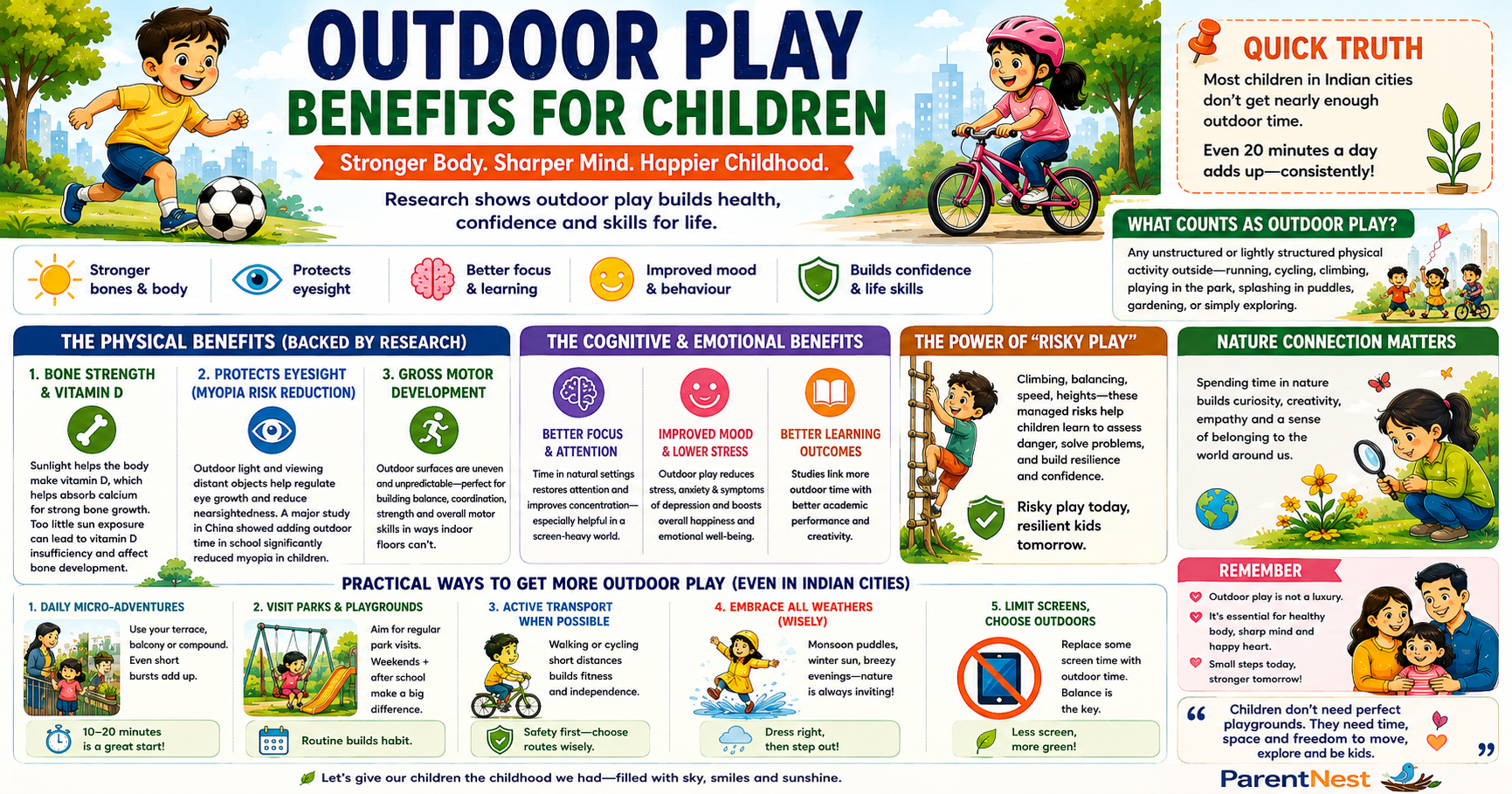
Outdoor play does more than tire a child out before dinner — research links it to stronger bones, better motor skills, a measurable reduction in the risk of nearsightedness, improved attention and mood, and even better long-term risk assessment through what researchers call “risky play.” Most children in Indian cities aren’t getting nearly enough of it, not from a lack of parental interest, but because of real constraints — limited safe space, pollution, monsoon weather, and packed academic schedules. The good news is that meaningful outdoor time doesn’t require a garden; even a building terrace or twenty minutes at the local park, done consistently, adds up.
Outdoor Play Benefits For Children
There’s a specific kind of guilt that shows up on a Sunday evening, watching your child glued to a tablet, when you remember that you, at their age, spent entire afternoons outside — cycling around the colony, playing gully cricket with the neighbourhood kids, coming home only when it got dark or Mummy called out from the balcony. It’s tempting to write this off as nostalgia, the way every generation thinks the next one had it easier. Except in this particular case, the research actually backs up the instinct: something real is lost when outdoor play disappears from a child’s routine, and it isn’t just about fitness.
This article walks through what outdoor play actually does for a child’s body, brain, and behaviour according to the research, and — because a garden and a smog-free afternoon aren’t a given for most Indian families — practical ways to get meaningful outdoor time even in a cramped city apartment during a bad air quality week.
Table of Contents
What counts as outdoor play (it’s broader than you think)
Outdoor play doesn’t have to mean an organised sport or a proper park. Research on this topic generally treats “outdoor play” as any unstructured or lightly structured physical activity that happens outside — running around a building compound, cycling in a colony lane, playing in a terrace garden, splashing in monsoon puddles, or simply sitting outside doing something with your hands. The common thread across the benefits below isn’t the specific activity, it’s the combination of natural light, physical movement, and a degree of freedom that indoor, structured, or screen-based activities generally don’t offer.
The physical benefits, backed by research
Bone strength and vitamin D
Sunlight exposure is the body’s main natural source of vitamin D, which plays a direct role in how the body absorbs calcium for bone growth. Children who consistently spend very little time outdoors are at higher risk of vitamin D insufficiency, which in more severe, prolonged cases can affect bone development. This is a genuinely relevant point for Indian families, where a common pattern — fair-skin sun avoidance, combined with heavy academic schedules — can add up to surprisingly little actual sun exposure despite living in a country with abundant sunlight most of the year.
The eyesight finding that surprises most parents
This is probably the least-known benefit, and arguably the most striking: a meaningful and growing body of research links more time spent outdoors in childhood with a lower risk of developing myopia (nearsightedness). Researchers believe this works through a combination of two mechanisms — bright outdoor light appears to help regulate the eye’s growth and reduce the risk of the eyeball elongating (an eyeball that’s too elongated is what causes nearsightedness), and outdoor settings naturally require the eyes to shift focus between near and distant objects far more than indoor, close-up activities like reading or screen use. A well-known randomized study conducted with schoolchildren in China found that simply adding a dedicated outdoor period into the school day meaningfully reduced how many children went on to develop myopia over the following years, compared with children whose school day didn’t include that outdoor time. Given how common myopia has become in Indian schoolchildren, particularly with rising screen use, this is one of the more concrete, medically-relevant reasons to prioritise outdoor time — not just as a nice-to-have, but as something with a genuine, measurable protective effect.
Gross motor development
Running on uneven ground, climbing on playground equipment, balancing on a kerb, or pedalling a cycle all demand a level of full-body coordination that indoor play rarely requires. Researchers have specifically pointed to outdoor environments as unusually effective for building gross motor competence — balance, coordination, and strength — partly because outdoor terrain is naturally varied and unpredictable in a way that indoor floors and mats aren’t.
The cognitive and emotional benefits
Attention and focus
There’s a body of research — often discussed under the idea of “attention restoration” — suggesting that time spent in natural, outdoor settings helps replenish a child’s capacity for sustained attention, in a way that indoor, especially screen-based, environments don’t. Some studies have also found associations between more time spent outdoors and better concentration and academic performance in school, though it’s worth being careful here: association isn’t the same as proof of direct cause, since children who get more outdoor time may also differ from their peers in other ways (family routines, screen habits, sleep) that independently affect school performance.
Mood and stress
Multiple studies link time in nature and outdoor physical activity with lower reported stress and anxiety in children, along with improved mood. Some of this is likely simply the effect of physical activity generally (which has well-established mood benefits at any age), and some appears specific to the natural, less-structured setting itself.
Risky play — why “be careful” isn’t always helpful
This is the part of outdoor-play research most parents haven’t encountered, and it often runs against instinct. Researchers studying what’s called “risky play” — climbing higher than feels entirely comfortable, playing near controlled heights or speeds, rough-and-tumble play — have found that this kind of play appears to help children build genuine risk-assessment skills and reduce certain fears and anxieties over time, functioning almost like a natural, low-stakes exposure exercise. This doesn’t mean abandoning supervision or safety basics — it means recognising that a constant stream of “careful, don’t climb that, get down” may remove a genuinely useful developmental experience, not just an unnecessary risk. The research draws a clear line between risky play (child-led, within a reasonably safe environment, involving manageable uncertainty) and actual hazards (unsafe equipment, genuinely dangerous conditions, lack of supervision near real danger) — the goal is more of the first, not less caution about the second.
Outdoor play vs. screen time
It’s worth being direct about this, since it’s often the real competition for a child’s free time. Outdoor play and screen time aren’t simply two equally valid ways to spend an afternoon — they differ in several of the specific benefits discussed above (natural light exposure for eye health, full-body movement for motor development, and the kind of unstructured problem-solving that screens rarely require). This doesn’t mean all screen time is harmful or that outdoor time needs to fully replace it, but when the two are competing for the same after-school hour, the research reasonably favours protecting some outdoor time first, rather than treating it as a nice extra to add if time allows.
How much outdoor play is actually enough, by age
| Age group | General guidance | What this can look like |
|---|---|---|
| Toddlers (1–3 years) | Several short outdoor sessions across the day, adding up to roughly an hour or more where possible | A morning walk to the park, terrace time after breakfast, an evening walk before dinner |
| Preschoolers (3–5 years) | At least an hour of active outdoor play daily, spread across the day if needed | Park visits, cycling in a safe compound, active outdoor games with other children |
| School-age (6–12 years) | At least an hour of outdoor physical activity daily, alongside any structured sport | A mix of unstructured outdoor free play and, separately, sport or exercise |
These figures are general guidance drawn from widely cited public health recommendations for physical activity, not a strict prescription — some days will fall short, and that’s normal. The bigger pattern that matters is a consistent, near-daily habit rather than any single day’s total.
Making it work in Indian cities — realistic solutions
No park nearby
Building compounds, society gardens, and even a stretch of terrace can substitute for a formal park for a meaningful chunk of daily outdoor time, especially for toddlers and preschoolers who don’t need much space. If your building doesn’t have safe common outdoor space, coordinating with a few neighbourhood families for a shared, supervised rotation at whichever nearby space exists (a society garden two blocks away, a school ground after hours) can work better than waiting for a perfect solution.
Pollution days
On days when air quality is genuinely poor — a real and recurring issue in many Indian cities, particularly in winter — it’s reasonable to shift outdoor play to early morning hours when pollution levels are often somewhat lower, keep sessions shorter, and treat indoor active play (dancing, simple indoor obstacle courses, stair climbing where safe) as a genuine, if imperfect, substitute rather than defaulting straight to screen time. Checking a local air quality index before deciding is a reasonable, low-effort habit rather than an overreaction.
Monsoon season
Monsoon doesn’t have to mean months of indoor confinement. Supervised, appropriately-clothed puddle play, a covered terrace or balcony for active games, and simply making the most of dry windows between showers can maintain a reasonable amount of outdoor exposure through the season, rather than treating the whole monsoon as a write-off.
Academic pressure and tuition schedules
This is often the most emotionally loaded constraint, especially once a child reaches school age and the family’s schedule fills with tuition and homework. It can help to treat a short daily outdoor block the same way you’d treat a subject on the timetable — non-negotiable, even if it’s only 20–30 minutes — rather than something that only happens if every other task is finished first. Framing it to a concerned grandparent or spouse as something that actually supports academic performance (given the attention and mood research above) can help make the case, since “play” alone sometimes doesn’t carry enough weight against “studies” in a typical Indian household’s priorities.
Structured sports vs. free outdoor play
Both have real, distinct value, and one doesn’t replace the other. Structured sport (a coached class, a school team) builds specific skills, discipline, and social cooperation within rules. Unstructured free outdoor play builds different things — independent problem-solving, creativity, self-directed risk assessment, and the kind of open-ended social negotiation that comes from children organising their own games without an adult setting the rules. A child who only gets structured sport and never unstructured free play is missing a genuinely different developmental experience, not just getting a slightly less efficient version of the same thing.
What not to do
- Don’t treat outdoor play as optional “extra” time only available after all academic work is done — for the reasons above, it plausibly supports academic performance rather than competing with it.
- Don’t hover with constant “be careful” commentary during safe, child-led risky play (climbing, balancing) — some manageable risk appears to be part of what makes this kind of play developmentally useful.
- Don’t assume a screen-based “outdoor-themed” app or a treadmill session indoors delivers the same benefits — the natural light exposure, varied terrain, and unstructured social negotiation are specific to genuine outdoor settings.
- Don’t wait for perfect conditions (a nearby park, clean air, a free afternoon) before starting a routine — a short, consistent daily habit in imperfect conditions beats an occasional, ideal outing.
- Don’t dismiss a grandparent’s safety concerns outright — address them specifically (appropriate footwear, supervision, clear boundaries) rather than treating caution itself as the enemy of outdoor play.
Real moments parents recognize
You might find your child begging for “five more minutes” on the terrace as the sky darkens, in a way they never do for screen time being switched off gently — worth noticing as a small, real signal of what’s actually engaging them.
Or you might watch your toddler climb a step slightly higher than feels comfortable and catch yourself saying “careful, careful” before you’ve even registered whether they’re actually in danger — a moment where the risky-play research is worth remembering before the words come out.
Or you might be juggling a tuition schedule so tight that a walk to the park feels like an indulgence you can’t justify — and it’s worth reframing that walk as something closer to a study aid than a distraction from one, given what the attention research suggests.
Frequently Asked Questions
Is outdoor play better than indoor play? Not universally “better,” but outdoor play offers specific benefits — natural light exposure linked to eye health, varied terrain for motor development, unstructured social interaction — that indoor play generally can’t fully replicate. A balance of both, with outdoor time protected rather than treated as optional, tends to serve children best.
Does sunlight help prevent nearsightedness in kids? Growing research links more time spent outdoors with a lower risk of developing myopia in childhood, likely through a combination of bright light exposure affecting eye growth and the natural distance-focusing that outdoor settings require. It’s one of the more concrete, research-backed reasons to prioritise daily outdoor time.
How much outdoor play does a toddler need? General guidance suggests aiming for roughly an hour or more of active outdoor time daily for toddlers and preschoolers, spread across shorter sessions if needed — consistency matters more than hitting an exact daily number every single day.
What is risky play and why is it good for kids? Risky play refers to child-led play involving manageable uncertainty — climbing a bit higher, moving a bit faster, testing physical limits within a reasonably safe environment. Research associates this kind of play with better long-term risk assessment and reduced certain anxieties, distinct from actual unsafe conditions.
How can I get my child outdoor time if there’s no park nearby? A building compound, society garden, or terrace can provide meaningful outdoor time, especially for younger children. Coordinating a shared, supervised rotation with neighbourhood families at whichever safe outdoor space exists nearby is a practical workaround.
Is it safe to send kids outside on high-pollution days? On days with genuinely poor air quality, it’s reasonable to shift outdoor time to early morning hours, shorten sessions, and check a local air quality index before deciding, rather than either ignoring pollution entirely or defaulting straight to indoor screen time on every uncertain day.
Does outdoor play actually help academic performance? Some research associates more outdoor time with better attention, concentration, and school performance, though this is based on association rather than tightly controlled cause-and-effect studies. It’s a reasonable, evidence-informed argument for protecting outdoor time, even during a busy academic schedule.
Can outdoor play replace screen time entirely? It doesn’t need to replace all screen time, but when the two compete for the same free hour, research reasonably favours protecting outdoor time first, given the specific physical and cognitive benefits that screens generally don’t provide.
Is monsoon a valid reason to skip outdoor play for months? Not entirely — supervised puddle play, covered-terrace activity, and making use of dry windows between showers can maintain a reasonable amount of outdoor exposure through the monsoon season, rather than pausing outdoor play altogether.
Do structured sports classes count as enough outdoor play? They provide real, distinct benefits (skill-building, discipline, teamwork) but don’t fully substitute for unstructured free play, which builds independent problem-solving and self-directed social negotiation in a different way. Ideally children get some of both.
Final thoughts
None of this requires a garden, a village, or a childhood free of screens and tuition. It requires a fairly modest, consistent daily habit — a walk, a terrace session, twenty minutes at whatever outdoor space is actually available — protected the way you’d protect any other important part of the day. The research doesn’t ask for a dramatic lifestyle overhaul; it just quietly makes the case that the thing you already suspected as a child who grew up playing outside was probably right all along.