Physical Address
304 North Cardinal St.
Dorchester Center, MA 02124
Physical Address
304 North Cardinal St.
Dorchester Center, MA 02124

Nisha visited seven preschools in eleven days. By the fourth one, she’d started keeping notes on her phone, because the schools had genuinely started blurring together in her memory — the same bright primary colours on the walls, the same laminated “Our Little Stars” boards, the same coordinator saying “we follow a holistic curriculum” in almost identical words. It was only when she walked into the fifth school and noticed a teacher kneel down to a crying child’s eye level, unhurried, instead of scooping him up and moving on, that Nisha finally felt something click. “That,” she told her husband that evening, “is what I actually can’t tell from a brochure.”
That instinct — the thing brochures can’t show you — is really what this guide is about. Every preschool in India will tell you they’re child-centred, holistic, and safe. Almost none of that is verifiable from a website or a glossy pamphlet. What actually separates a good preschool from a mediocre one is visible only when you know exactly what to look for, ask, and notice during an actual visit — which is precisely what most “top 10 preschools” listicle articles never help you do.
This is a working checklist, built the way an experienced parent — not a marketing team — would build it.
Search “best preschools near me” in any Indian city and you’ll get dozens of ranked lists, most of them written by people who’ve never actually walked into the classrooms they’re ranking. These lists are useful for one thing only — generating a shortlist of names to investigate. They’re almost never useful for the actual decision, because the things that genuinely matter (how a teacher responds to a crying child, whether the toilets are actually clean at 11 AM and not just at 9 AM before parents arrive, whether the “holistic curriculum” is real or a single sentence on a brochure) simply can’t be captured in a ranked list.
This guide assumes you’ve already got 3–5 names on a shortlist — from a “top preschools” search, a friend’s recommendation, or simple proximity — and walks through exactly how to move from that shortlist to a confident final decision.
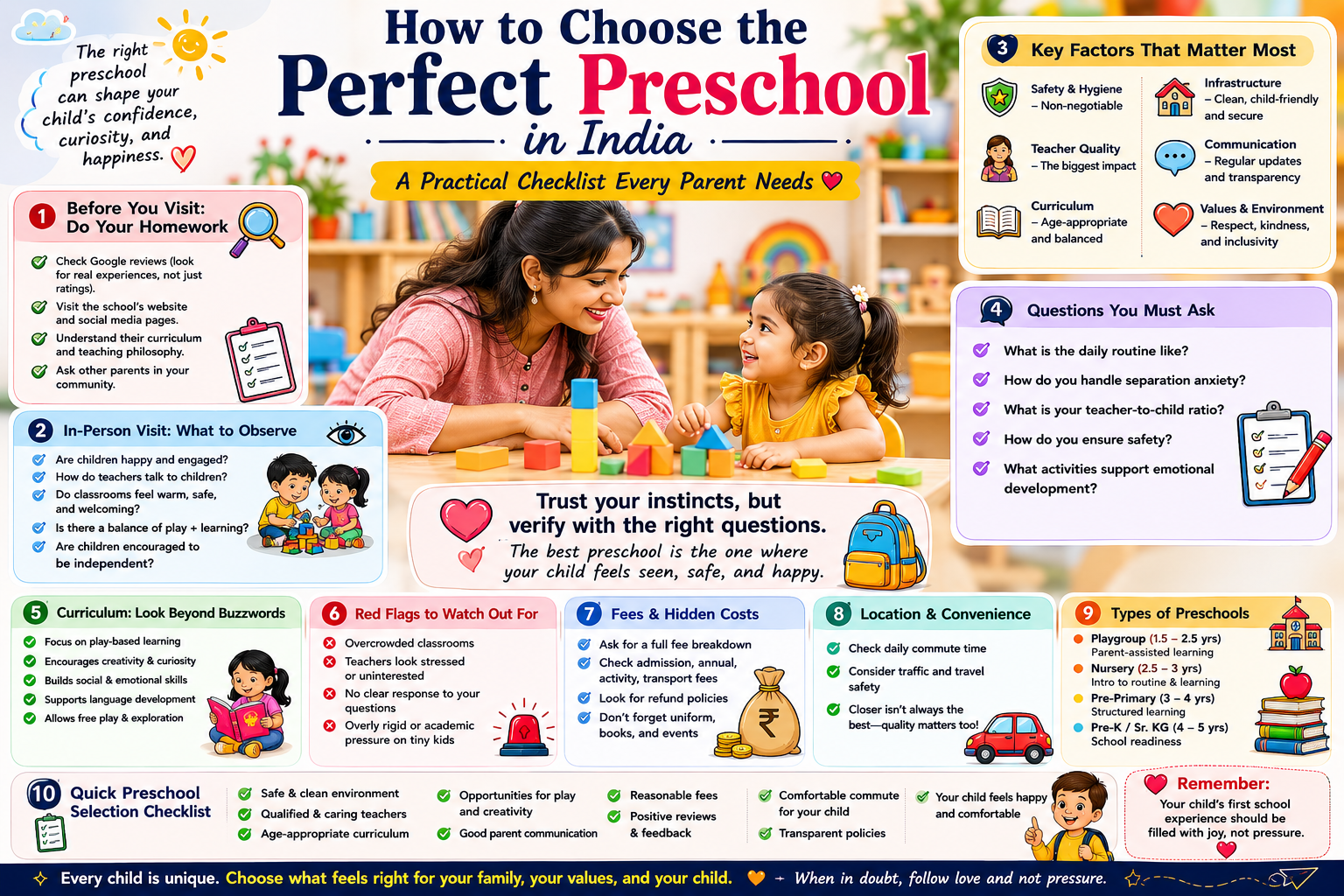
A little homework before visiting saves real time and helps you ask sharper questions in person.
Check accreditation and affiliation. Many quality preschools in India are affiliated with recognised early-childhood education frameworks or larger K-12 school chains with an established track record — this isn’t mandatory for a good preschool, but it’s a useful data point, especially for independent, newer schools.
Read reviews with a skeptical eye. Google reviews for preschools skew heavily toward extremes — very happy or very upset parents — and can be manipulated. Look specifically for reviews that mention specific details (a particular teacher’s name, a specific incident, a specific policy) rather than generic five-star praise, since specificity is harder to fake.
Check the school’s safety and policy documents online, if available — CCTV policy, staff background verification claims, emergency protocols. Not every school publishes this, but its presence (or complete absence) is itself informative.
Ask in local parenting groups, which tend to be far more useful than public review platforms for honest, specific feedback — most Indian cities have active WhatsApp or Facebook parenting communities where recent, unfiltered experiences get shared.
Note the fee structure listed, even if incomplete, so you can specifically probe for hidden costs during your visit rather than being surprised later.
No preschool decision should be finalised without at least one in-person visit — ideally during actual school hours, not a special “showcase” slot arranged only for prospective parents, which shows a curated version rather than a normal day.
Timing your visit: Aim for mid-morning on a regular weekday, when the school is in full session — this is when you’ll see real classroom dynamics rather than an empty or freshly-decorated space.
What to observe, not just ask about:
Nearly every preschool will describe its approach using similar language — “holistic,” “child-centred,” “play-based,” “Montessori-inspired.” These words tell you almost nothing on their own. What actually matters:
Ask for a sample daily schedule, not a marketing paragraph. A concrete schedule (circle time, free play, structured activity, outdoor time, snack, story time) tells you far more than an abstract philosophy statement.
Ask how much of the day is free play versus structured/academic time. For the youngest preschool age groups especially, a heavy academic focus (worksheets, formal writing drills) is generally considered developmentally inappropriate by most early-childhood education standards, regardless of how it’s marketed.
Ask specifically what “Montessori-inspired” or “Reggio Emilia-inspired” means in practice at this particular school, since these terms are used loosely in India and can range from a genuinely trained, certified approach to a single shelf of wooden toys and the label alone.
Check how the school handles individual pacing. Every genuinely child-centred preschool should have a clear answer for “what happens if a child isn’t interested in today’s activity” — a good answer involves flexibility, not forced participation.
Ask how progress is communicated to parents — regular informal updates, a structured portfolio system, periodic parent-teacher conversations — and how concerns (behavioural or developmental) are raised if they come up.
These aren’t “nice to have” — they should be treated as deal-breakers if unsatisfactory, regardless of how good everything else looks.
Ratio matters enormously at this age and is one of the most concrete, comparable data points across schools.
Commonly recommended ratios for the youngest preschool groups (2.5–3.5 years) are generally in the range of 1 teacher (plus an assistant) per 10–15 children; ratios significantly looser than this warrant a direct question about how individual attention is actually managed in practice.
Ask about teacher qualifications and turnover. High staff turnover is a meaningful red flag — it disrupts the consistency young children need and often signals underlying workplace issues (low pay, poor management) that indirectly affect classroom quality.
Ask whether the primary teacher is supported by a dedicated assistant/ayah in the classroom at all times, not just during specific hours, since bathroom breaks, minor injuries, and individual attention needs happen unpredictably throughout the day.
Observe teacher-child interaction directly during your visit rather than relying solely on ratio numbers — a technically compliant ratio with disengaged or impatient staff is a worse outcome than a slightly looser ratio with genuinely warm, attentive teachers.
Fee structures in Indian preschools are notoriously non-transparent at first glance. Ask directly about each of these before signing anything:
Get fee commitments in writing wherever possible — verbal assurances during an admission pitch don’t always match the fine print in the enrolment agreement.
It’s easy to get swept up in curriculum philosophy and infrastructure and underweight something simpler: a 45-minute commute each way is genuinely hard on a 2.5-year-old, regardless of how excellent the school is. A slightly less “prestigious” but nearby preschool often serves a young child better in practice than a highly rated one that adds an hour of daily transit fatigue.
Questions worth asking yourself specifically:
None of this is a reason to rule out a school automatically, but it deserves genuinely equal weight next to curriculum quality — not an afterthought decided after everything else.
A practical script for your visit, organised by category:
Safety: “Can you walk me through your pickup verification process?” / “Who has access to CCTV footage, and how quickly can I request it if there’s a concern?”
Curriculum: “Can you show me today’s actual schedule, not a general one?” / “What happens if a child doesn’t want to join a planned activity?”
Staff: “What’s your current teacher-to-child ratio in this specific classroom?” / “How long has the lead teacher been with the school?”
Health: “How do you handle a child who’s mildly unwell during the day?” / “How are allergies communicated to all staff who interact with my child, not just the class teacher?”
Fees: “Can I see the complete, itemised annual cost in writing, including all mandatory charges?” / “What’s your refund policy if we withdraw mid-term?”
Settling in: “What does your process look like for a child who’s struggling with separation beyond the first couple of weeks?”
This is a common source of confusion for first-time preschool parents in India.
Branded chain preschools (national or multi-city franchises) typically offer standardised curriculum, more consistent staff training programs, and established safety protocols across branches — but quality can still vary meaningfully branch to branch depending on local management and franchise ownership, so brand reputation alone isn’t a substitute for visiting the specific branch.
Independent/standalone preschools often offer more flexibility, sometimes lower fees, and occasionally more personalised attention from an owner-operator who’s personally invested in day-to-day quality — but consistency and formal safety documentation can vary far more widely than with established chains, making the in-person evaluation even more essential.
Neither model is inherently better — the specific branch or centre matters far more than which category it falls into, which is exactly why this entire guide focuses on evaluation criteria rather than brand recommendations.
Nisha, Pune — “I genuinely almost chose based on the fanciest building, until I saw that teacher kneel down for a crying child at another, much simpler-looking school. That one moment told me more than every brochure combined. We chose the simpler school. Zero regrets two years in.”
Arjun, Delhi NCR — “We picked a ‘top-rated’ school forty minutes away over a decent one ten minutes from home, because the reviews were incredible. Six months in, my son was exhausted every single evening just from the commute, and we ended up switching to the nearer school anyway. I wish I’d weighed commute time as seriously as curriculum from the start.”
Farah, Hyderabad — “The school we almost chose gave us a beautifully rehearsed demo tour. On a whim, I went back unannounced a week later, told them I’d left something behind, and asked to peek into the actual classroom. It was chaos — completely different energy from the curated tour. Glad I trusted that instinct instead of the polished visit.”
Deepak, joint family, Jaipur — “My mother-in-law came with us to every single school visit — three generations weighing in on one decision. It sounds chaotic, but honestly her questions about hygiene and staff turnover were sharper than mine. Don’t underestimate involving grandparents in this process if they’re going to be part of daily pickup/drop-off logistics anyway.”
Research phase
Visit phase
Safety phase
Financial phase
Logistics phase
Final decision
There’s no single most important factor, but safety fundamentals (staff verification, CCTV, pickup protocols) and observed teacher-child interaction during an unannounced or regular-hours visit tend to matter more than curriculum branding or infrastructure polish.
Neither is inherently better — quality varies significantly branch to branch even within reputed chains, and evaluation of the specific centre matters far more than which category it falls into.
Commonly recommended ratios for the youngest preschool age groups are around 1 teacher (with an assistant) per 10–15 children; significantly looser ratios warrant a direct question about how individual attention is managed.
Most parents find 3–5 in-person visits sufficient to make a confident, well-informed comparison without decision fatigue setting in.
Not necessarily — fee level often reflects brand and infrastructure investment more than actual teaching quality or child-teacher warmth, both of which are better assessed through direct observation than price point.
Questions about staff background verification, CCTV access policy, current teacher-to-child ratio, and complete itemised fees are the ones parents most commonly regret not asking clearly enough before enrolling.
More important than most parents initially assume — a long daily commute can meaningfully affect a young child’s mood and energy regardless of how strong the school itself is, and deserves roughly equal weight in the decision.
This guide reflects commonly recommended early-childhood evaluation practices; specific regulatory and safety standards can vary by state and municipal authority in India. It’s worth checking any locally applicable childcare licensing requirements for your city when finalising a decision.