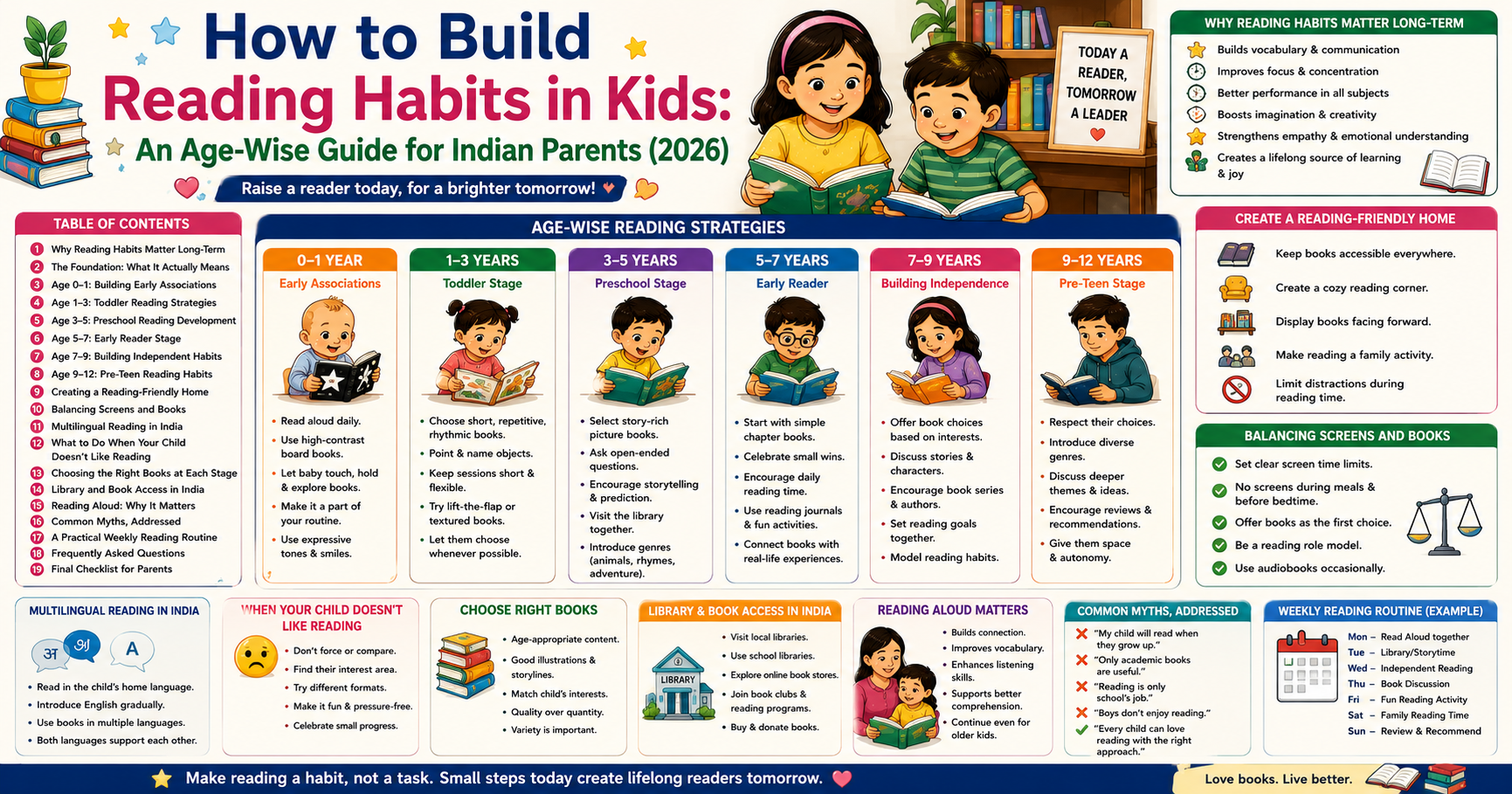
Raising a child who genuinely loves reading — not one who reads only because they’re told to — is one of the most valuable long-term gifts a parent can give. Strong reading habits are consistently linked to better vocabulary, stronger academic performance across subjects, improved focus, and richer imagination. But building a genuine love of reading doesn’t happen through a single strategy applied uniformly at every age — what works to build reading interest in a 2-year-old looks completely different from what works with a reluctant 10-year-old reader.
How to Build Reading Habits in Kids
This guide breaks down practical, age-specific strategies for building reading habits in children, from infancy through the pre-teen years, along with troubleshooting advice for reluctant readers and India-specific considerations like multilingual reading and balancing screens with books.
1. Why Reading Habits Matter Long-Term
Reading regularly from an early age is associated with a wide range of developmental benefits that extend well beyond literacy itself. Strong early reading habits are generally linked to broader vocabulary development, improved concentration and attention span, stronger comprehension skills across all academic subjects (not just language arts), and better emotional understanding through exposure to characters and narratives.
Beyond academic benefits, reading also builds a lifelong source of independent entertainment, stress relief, and personal growth that serves children well into adulthood — a genuinely portable skill that doesn’t depend on external activities, screens, or company to provide value.
The goal of building reading habits isn’t to create a child who reads out of obligation, but one who reaches for a book because they genuinely want to — which requires a fundamentally different approach than simply assigning reading time.
2. The Foundation: What “Building a Reading Habit” Actually Means
Before diving into age-specific strategies, it’s worth clarifying what a genuine reading habit looks like, since parents sometimes conflate reading ability with reading habit — these are related but distinct.
Reading ability is the technical skill of decoding and understanding text, which develops through structured learning, often school-driven.
Reading habit is the voluntary, self-motivated choice to read for enjoyment, which develops through positive associations, exposure, and autonomy over book choices — this is what parents are primarily building through the strategies in this guide, separate from (though supportive of) formal reading instruction.
A child can be technically capable of reading at grade level while having no genuine reading habit at all — and conversely, a child with a strong reading habit often develops stronger reading ability as a natural byproduct of frequent, motivated practice.
3. Age 0–1: Building Early Reading Associations
At this stage, “reading” isn’t about comprehension — it’s about building warm, positive associations between books and comforting, connected time with a caregiver.
- Read aloud daily, even for just a few minutes — the specific content matters far less than the consistent, comforting ritual itself
- Choose high-contrast, simple board books designed for this age group, since infant visual development responds well to bold patterns and simple shapes
- Let your baby explore books physically — touching, mouthing, and turning pages (even out of order) is developmentally appropriate exploration, not “wrong” reading
- Incorporate books into existing routines, like a bedtime or post-bath ritual, building automatic positive association over time
- Use varied vocal tones and expressions while reading, since infants respond strongly to vocal engagement even without understanding specific words
4. Age 1–3: Toddler Reading Strategies
Toddlers are building language rapidly during this stage, making it a valuable window for reading-related vocabulary growth, even with short attention spans.
- Choose short, repetitive, rhythmic books — toddlers often enjoy predictable patterns and requesting the same book repeatedly, which is genuinely valuable for language reinforcement, not a sign of “boredom” with new content
- Point and name objects in illustrations, building vocabulary through interactive engagement rather than passive listening alone
- Keep sessions short and flexible — a toddler wandering away after two pages is developmentally normal, and it’s worth following their engagement level rather than insisting on finishing every book
- Introduce simple lift-the-flap or textured books, which add an interactive, sensory dimension that holds toddler attention more effectively than text-heavy books at this stage
- Model your own reading visibly during this period — toddlers who see parents reading for pleasure (not just reading to them) begin building an early association between reading and normal, valued adult behavior
5. Age 3–5: Preschool Reading Development
Preschoolers are developing longer attention spans, stronger narrative understanding, and growing pre-literacy skills, making this a valuable stage for expanding both reading complexity and independence.
- Introduce longer picture books with simple plots, allowing your child to begin following a full narrative arc rather than just individual pages
- Ask simple prediction and recall questions during reading (“What do you think happens next?”), building comprehension skills alongside enjoyment
- Begin letter and sound recognition activities alongside story reading, supporting foundational literacy development, though formal reading instruction typically remains school-led at this stage
- Let your child “pretend read” familiar books independently, using memory and picture cues — this is a genuinely valuable pre-reading stage, not something to correct prematurely
- Visit a library or bookstore together regularly, building excitement around book selection as an enjoyable activity in itself
6. Age 5–7: Early Reader Stage
This stage often coincides with formal reading instruction beginning in school, making the home reading environment particularly important for reinforcing positive associations alongside new academic pressure.
- Provide “just right” level books — not so difficult that decoding becomes frustrating, but with enough challenge to build confidence and skill progressively
- Continue reading aloud together, even as your child begins reading independently — shared reading remains valuable and shouldn’t stop the moment independent reading begins
- Celebrate effort and progress, not just fluency, since early independent reading can feel effortful and slow, and encouragement at this stage significantly affects long-term motivation
- Offer a mix of independent reading and read-aloud time, rather than shifting entirely to independent reading once your child is technically capable
- Avoid correcting every mistake during independent reading, which can undermine confidence — focus corrections on words that significantly affect meaning, letting minor errors self-correct naturally over time
7. Age 7–9: Building Independent Reading Habits
By this stage, many children have solid basic reading skills, and the focus shifts toward building genuine, self-motivated reading habits rather than skill-building alone.
- Give genuine autonomy over book choices, even if selections seem “too easy” or repetitive — motivation and enjoyment matter more at this stage than pushing reading level constantly upward
- Introduce chapter books and early series fiction, which often build strong engagement through character continuity across multiple books
- Establish a predictable daily reading time — even 15–20 minutes — building reading into routine rather than treating it as an occasional activity
- Avoid turning reading into a purely academic obligation tied only to school assignments — maintain separate, enjoyment-focused reading time distinct from schoolwork
- Model discussing books casually, sharing what you’re reading or asking what they’re enjoying about their book, building reading into normal family conversation
8. Age 9–12: Sustaining Interest Through the Pre-Teen Years
This stage often sees genuine risk of declining reading interest, as academic workload increases and competing entertainment options (games, social media exposure, sports) intensify.
- Respect genre preferences fully, even if they lean toward graphic novels, fantasy series, or non-fiction over what parents might consider more “serious” literature — sustained reading interest matters more long-term than genre snobbery
- Introduce audiobooks as a complementary format, particularly valuable for reluctant readers or during transitions like car rides, without treating this as a lesser substitute for print reading
- Encourage book discussions with peers, whether through school book clubs or informal friend groups, since social reinforcement becomes increasingly influential at this age
- Continue some family reading rituals even as independence grows, such as periodically reading the same book separately and discussing it together
- Watch for early signs of declining interest and address proactively — offering new genres, formats, or simply protecting reading time amid growing extracurricular demands
9. Creating a Reading-Friendly Home Environment
Environment plays a significant, often underestimated role in whether reading habits take root and sustain over time:
- Keep age-appropriate books visibly accessible, not stored away — visible, easily reachable books get picked up far more often than those in closed cupboards
- Designate a comfortable reading spot, even a simple cushioned corner, which builds a positive physical association with reading time
- Rotate book selection periodically, keeping the available options fresh and interesting rather than static
- Model visible reading behavior as a parent — children consistently reading in front of them significantly reinforces the value of reading as a normal, enjoyable adult activity, not just a childhood obligation
- Minimize background screen presence (TV, tablets) during designated reading time, reducing competing stimulation
10. Balancing Screens and Books
Screen time and reading habits don’t have to be positioned as strictly opposing forces, though intentional balance matters:
- Use screen-free windows specifically for reading, particularly during transition times like right after school or before bed
- Consider e-readers or reading apps thoughtfully — for some reluctant readers, the novelty of a screen-based reading format can actually increase engagement, though this varies by child
- Avoid using screens as the default filler activity during downtime, which can crowd out the boredom that often naturally leads children toward books when alternatives aren’t immediately available
- Be mindful of your own screen modeling, since children notice when reading time competes directly with visible parental phone use
11. Multilingual Reading: A Uniquely Indian Consideration
Many Indian families navigate reading habit-building across multiple languages, which adds both richness and complexity to this process:
- Introduce books in your home/regional language alongside English, rather than prioritizing one exclusively — bilingual or multilingual reading exposure generally supports stronger overall language development, not confusion, when introduced consistently
- Don’t worry excessively about “mixing” languages during early reading exposure — young children generally navigate multilingual environments more fluidly than adults often assume
- Seek out regional language children’s literature specifically, which is increasingly available through Indian publishers focused on vernacular children’s content
- Consider your family’s specific language goals — if maintaining strong regional language literacy alongside English is a priority, intentionally allocating reading time across both supports this goal more effectively than leaving it to chance
12. What to Do When Your Child Doesn’t Like Reading
A genuinely reluctant reader is a common, addressable challenge rather than a fixed trait — a few strategies tend to help:
- Investigate the specific reason — is it a skill-level mismatch (books too hard or too easy), a genre mismatch (fiction-only exposure when they’d prefer non-fiction), or a format issue (long chapters vs. shorter, illustrated content)?
- Start with high-interest, low-pressure material — comics, graphic novels, joke books, or non-fiction on a specific passionate interest (dinosaurs, space, sports) often re-engage reluctant readers more effectively than “improving” literary content
- Separate reading from performance pressure, particularly if a child associates reading with school-based correction or evaluation
- Try audiobooks or read-aloud family time as a bridge, building story enjoyment separate from the mechanical effort of decoding text
- Be patient and avoid framing reluctance as a character flaw — some children simply take longer to find their genre or format, and pressure often backfires by reinforcing reading as an unpleasant obligation
13. Choosing the Right Books at Each Stage
Selecting genuinely engaging, appropriately leveled books matters significantly for sustained habit-building:
- Match difficulty to comfort, not just grade level — a book that requires excessive decoding effort reduces enjoyment even if it’s “age-appropriate” by school standards
- Let interest drive selection over academic “quality” judgments, particularly for building habit — a child engrossed in a fun, simple series is building stronger long-term reading habits than one forcing through a “better” book they find tedious
- Introduce variety gradually — fiction, non-fiction, poetry, graphic novels — rather than assuming one format fits every child
- Ask librarians or bookstore staff for age-appropriate recommendations specifically matched to your child’s demonstrated interests, which often surfaces options parents wouldn’t have found independently
14. Library and Book Access in India
Access to a wide, rotating selection of books significantly supports reading habit-building, and India offers several practical options worth exploring:
- Local public libraries, where available, offer free or low-cost access to a rotating selection, particularly valuable for maintaining variety without high ongoing cost
- School libraries often go underutilized beyond mandatory assignments — actively encouraging your child to borrow for pleasure reading, not just school requirements, expands access meaningfully
- Book rental and subscription services, increasingly available in Indian cities, offer curated, age-appropriate selections delivered regularly, which can also reduce the burden of book selection on parents
- Community book exchanges or building/society-level book swaps are a low-cost, increasingly common way to rotate children’s books without ongoing purchase costs
15. Reading Aloud: Why It Matters Even for Older Children
Many parents stop reading aloud once a child becomes an independent reader, but continuing read-aloud time — even occasionally — offers distinct, lasting benefits:
- Exposes children to vocabulary and sentence structures above their independent reading level, since listening comprehension typically outpaces reading comprehension for years
- Maintains a positive, connected association with books separate from the effort of independent decoding
- Models fluent, expressive reading, which children absorb and often imitate in their own reading over time
- Provides continued bonding time structured around a shared activity, valuable well beyond early childhood
Even 10–15 minutes of occasional read-aloud time with an 8, 9, or 10-year-old — perhaps a chapter of a book slightly above their independent level — can meaningfully reinforce reading enjoyment during years when independent reading habits are still solidifying.
16. Common Myths About Building Reading Habits, Addressed
Myth: If my child only wants to reread the same book, I should push them toward new material. Reality: Repetition, particularly for younger children, supports language reinforcement and comprehension confidence — new material can be introduced gradually alongside continued access to beloved favorites, not as a forced replacement.
Myth: Comics and graphic novels aren’t “real” reading. Reality: Graphic novels and comics involve genuine reading comprehension, vocabulary engagement, and narrative understanding — they’re a legitimate reading format, not a lesser substitute, and often serve as an effective bridge for reluctant readers.
Myth: A child who reads quickly and voraciously doesn’t need continued encouragement. Reality: Even strong, enthusiastic readers benefit from continued positive reinforcement, varied genre exposure, and protected reading time, since competing demands (academics, extracurriculars, screens) can erode even well-established habits over time without ongoing support.
Myth: Screen-based reading (e-books, apps) undermines “real” reading habits. Reality: For many children, particularly reluctant readers, screen-based reading formats can genuinely increase engagement and access — the core habit of voluntary reading matters more than the specific medium, within reasonable screen-time balance.
17. A Practical Weekly Reading Routine by Age
Ages 0–3: Daily short reading sessions (5–10 minutes), tied to an existing routine like bedtime
Ages 3–5: Daily reading (10–15 minutes) plus a weekly library or bookstore visit for selection variety
Ages 5–7: Daily independent reading practice (15–20 minutes) alongside continued parent read-aloud time (10–15 minutes)
Ages 7–9: Daily independent reading (20–30 minutes), with periodic family book discussions and continued occasional read-aloud time
Ages 9–12: Daily or near-daily independent reading (30+ minutes), balanced with audiobook options during commutes or downtime, and periodic genre variety check-ins
This is a flexible guide, not a rigid requirement — consistency matters more than hitting exact time targets every single day.
18. Frequently Asked Questions
My toddler won’t sit still for a full book — is that a problem?
No, short attention spans are completely normal at this age. Following your toddler’s engagement level, even if that means stopping after a page or two, is developmentally appropriate and won’t harm long-term reading habit development.
Should I force my child to finish every book they start?
Generally, no — building genuine reading habit benefits more from autonomy and enjoyment than from strict completion requirements, which can create negative associations, particularly for reluctant readers.
Is it bad if my child only wants to read graphic novels or comics?
No, these are legitimate reading formats that build genuine literacy and comprehension skills. Sustained engagement with any reading format supports long-term habit-building more than pushing toward “higher status” formats a child isn’t genuinely interested in.
How do I balance reading in English with our regional language at home?
Consistent, intentional exposure to both, without excessive worry about mixing, generally supports stronger overall language development. Seek out regional language children’s books specifically to support this balance.
My 10-year-old used to love reading but has lost interest — what do I do?
This is common during the pre-teen years due to increasing competing demands. Try reintroducing choice and autonomy, explore new genres or formats (including audiobooks or graphic novels), and consider peer-based reinforcement like a book club, rather than assuming the interest is permanently lost.
Do reading apps and e-books count toward building a real reading habit?
Yes, generally — the core value lies in voluntary, engaged reading, regardless of format, though maintaining some print reading alongside digital formats offers additional benefits like reduced screen exposure and different sensory engagement.
19. Final Checklist for Parents
- Establish a consistent daily reading ritual appropriate to your child’s age
- Keep age-appropriate books visibly accessible at home
- Model your own visible reading behavior regularly
- Allow genuine autonomy over book choice, even for “easy” or repetitive selections
- Continue some read-aloud time even after independent reading begins
- Explore library, book rental, or community book-swap options for variety
- Introduce regional language books alongside English, if relevant to your family
- Watch for early signs of declining interest and address proactively with new genres/formats
- Separate enjoyment-focused reading time from academic reading obligations
Read Also