Physical Address
304 North Cardinal St.
Dorchester Center, MA 02124
Physical Address
304 North Cardinal St.
Dorchester Center, MA 02124

Deciding when to send your child to playschool is one of the more emotionally loaded decisions new parents face — too early and you worry about separation stress or missed bonding time; too late and you wonder if your child will struggle to adjust socially compared to peers. The truth is there’s no single universal “right age” — it depends on your child’s developmental readiness, your family’s specific circumstances, and what you’re hoping playschool will actually provide.
This guide walks through the real considerations behind playschool timing in India — developmental readiness signs, age-wise pros and cons, NEP 2020’s foundational stage guidelines, cost considerations, and how to recognize whether your specific child is ready, rather than relying purely on age as a number.
Playschool (sometimes called preschool or nursery, depending on the specific age group and institution) refers to early childhood education programs designed primarily around play-based learning, social interaction, and foundational skill-building rather than formal academics. In India, playschool typically precedes formal schooling (Nursery, LKG, UKG, and then Class 1), serving as a gentle introduction to structured group settings.
The core purposes of playschool include:
Playschool is generally not meant to accelerate academic learning at this age — most early childhood experts emphasize play-based, exploratory learning over formal instruction for children under three or four years old.
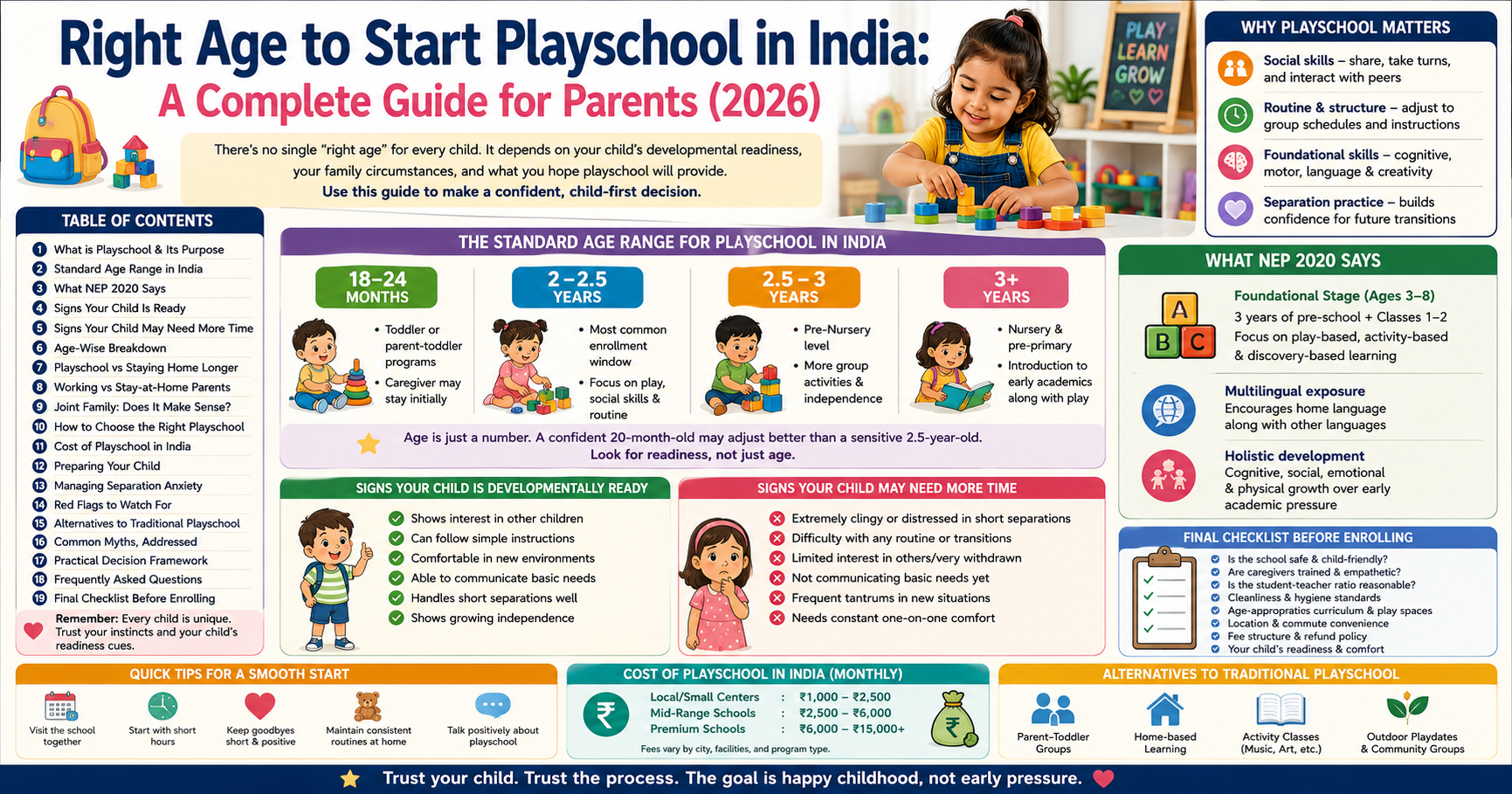
Most playschools in India accept children starting anywhere between 18 months and 2.5 years, with the most common enrollment age falling between 2 and 3 years. Some institutions offer a “toddler program” or “parent-toddler program” for children as young as 15–18 months, which typically involves a caregiver staying present during initial sessions.
By age 3, most children move into a more structured “Nursery” or pre-primary program, which begins to introduce more formal pre-academic concepts (letters, numbers, basic concepts) alongside continued play-based learning.
It’s worth noting that “right age” varies meaningfully by child — a confident, socially curious 20-month-old might adjust more smoothly than a more sensitive 2.5-year-old, making individual readiness a more useful guide than age alone.
India’s National Education Policy (NEP) 2020 introduced a formal “5+3+3+4” structure for school education, with significant implications for early childhood education specifically:
This policy shift reflects a broader recognition, echoed in early childhood education research globally, that formal academic instruction before age 5 or 6 offers limited long-term advantage compared to strong foundational play-based learning, and can in some cases increase stress without proportional benefit.
For parents, this policy direction offers useful reassurance: playschool doesn’t need to be treated as an academic head-start race — its primary value at this stage lies in social, emotional, and foundational skill development.
Rather than relying purely on a birthday milestone, consider these practical readiness signs:
No child needs to show all of these signs perfectly — readiness is about a general trend, not a checklist that must be fully completed before starting.
Equally important is recognizing when waiting a bit longer may serve your child better:
Delaying playschool by a few months rarely causes lasting disadvantage — many children who start slightly later adjust just as well, or better, once they’re genuinely ready.
18 months: Generally the earliest reasonable starting point, usually only for short, caregiver-accompanied “parent-toddler” programs rather than full drop-off settings. Best suited for social, outgoing toddlers with a caregiver who has flexibility to stay present initially.
2 years: A common starting age for short-duration drop-off programs (often 2–3 hours, a few days a week). Many toddlers at this age can manage brief separations, though individual variation is significant.
2.5 years: Often considered a sweet spot by many Indian playschools, balancing enough language and self-regulation development with still-flexible adjustment ability. Many programs see smoother transitions at this age compared to slightly younger toddlers.
3 years: A very common starting point, often coinciding with a shift into more structured Nursery programs. By this age, most children have stronger communication skills, longer attention spans, and more established peer interaction interest, generally easing the adjustment process.
Potential benefits of starting playschool earlier:
Potential benefits of waiting longer:
Neither path is inherently superior — research on early childhood education generally suggests that quality of interaction and environment (whether at home or in playschool) matters considerably more than the specific starting age within a reasonable range.
For working parents, playschool often serves a dual purpose — developmental benefit alongside practical daytime care needs. In this context, starting somewhat earlier (potentially 18 months to 2 years) may make practical sense, provided the specific program and caregiver ratios are appropriate for very young toddlers.
For stay-at-home parents, there’s typically more flexibility to wait until the child shows clearer readiness signs, since daytime care isn’t a driving factor. Some stay-at-home parents choose playschool primarily for social exposure once they observe their child seeking more peer interaction than home environment alone provides.
Neither situation is more “correct” — it’s worth being honest about your family’s actual practical needs alongside your child’s developmental readiness when making this decision.
Families living in joint households sometimes wonder whether playschool is necessary at all, given built-in family support and multiple adult caregivers already at home.
Playschool can still offer meaningful value even in a well-supported joint family setting:
That said, if a joint family provides rich social interaction through cousins or neighborhood children of similar age, some families reasonably choose to delay playschool slightly longer, prioritizing family-based social exposure first.
Once you’ve settled on rough timing, choosing the specific playschool matters just as much as the age decision:
Playschool fees vary enormously across India depending on city, area, and program quality:
It’s worth evaluating cost against your family’s specific budget and the practical value you’re seeking (developmental benefit, daytime care necessity, or both) rather than assuming higher cost automatically means proportionally better outcomes for a toddler at this early stage.
A few weeks of preparation can meaningfully ease the actual transition once you’ve decided to start:
Some degree of separation distress during the first days or weeks is developmentally normal and doesn’t necessarily indicate the timing was wrong:
While some initial distress is normal, certain patterns are worth discussing with the school or reconsidering timing altogether:
If these patterns emerge, a conversation with the school about their specific approach, or considering a short pause and later restart, is a reasonable option rather than pushing through indefinitely.
For families who decide traditional playschool isn’t the right fit yet, several alternatives can provide some of the same developmental benefits:
Myth: Starting playschool later means my child will fall behind socially. Reality: Social development happens through many channels, not exclusively playschool — children who start slightly later, with rich social exposure through family or informal groups, generally catch up without lasting disadvantage.
Myth: Earlier playschool start means better academic performance later. Reality: Early childhood education research doesn’t support a strong link between very early playschool start and long-term academic advantage — quality of interaction matters more than the starting age itself within a reasonable range.
Myth: If my child cries at drop-off, it means they’re not ready. Reality: Some initial protest at separation is developmentally normal and often eases within a few weeks with a consistent, supportive settling-in process — it’s not automatically a sign that the timing was wrong.
Myth: Toilet training must be complete before starting playschool. Reality: Many playschools, particularly those accepting toddlers under 2.5–3 years, don’t require full toilet training and have processes in place to support children still in this stage — it’s worth confirming the specific school’s policy rather than assuming this is a strict universal requirement.
Rather than fixating on a single “correct” age, walk through these questions as a family:
Answering these honestly, rather than anchoring purely to a number, tends to produce a much smoother experience for both child and parent.
Not necessarily — many playschools offer age-appropriate programs for 2-year-olds, and many toddlers adjust well at this age, particularly with a gradual settling-in process. Individual readiness matters more than the number itself.
Many playschools, especially those accepting younger toddlers, don’t require full toilet training as a prerequisite. It’s worth confirming the specific school’s policy directly, since this varies by institution.
Most children take somewhere between two and four weeks to settle into a comfortable rhythm, though this varies by individual temperament and the specific school’s settling-in approach.
Some parents believe early playschool enrollment improves later school admission chances through “continuity” with a school’s own pre-primary program, but this varies significantly by specific school policy and shouldn’t be the sole driver of timing decisions.
Yes — parental readiness, including comfort with separation and confidence in the chosen school, is a legitimate factor in timing this decision, not just the child’s readiness alone.
This depends on the individual child, but many parenting professionals suggest allowing some settling time after a major change before introducing an additional big transition, if timing allows some flexibility.