Physical Address
304 North Cardinal St.
Dorchester Center, MA 02124
Physical Address
304 North Cardinal St.
Dorchester Center, MA 02124

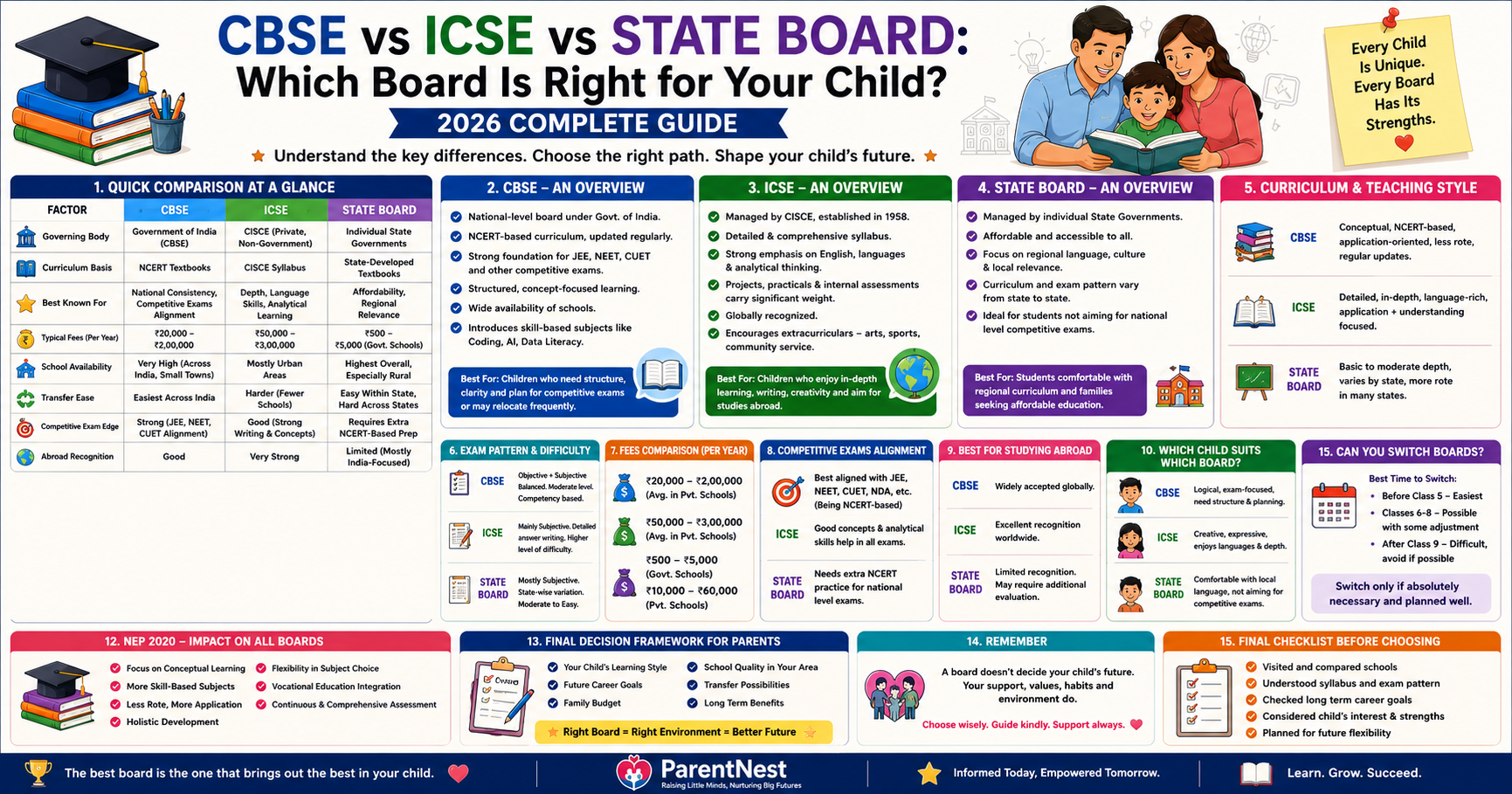
Choosing the right education board is one of the biggest decisions Indian parents make — and it’s one that quietly shapes everything from daily homework style to which competitive exams your child will find easier down the line. With CBSE, ICSE, and State Boards all offering genuinely different strengths, there’s no single “best” answer — only the board that best fits your specific child, your family’s circumstances, and your long-term goals.
This guide breaks down every major difference between CBSE vs ICSE vs State Board — curriculum depth, exam style, fees, recognition, competitive exam alignment, and school availability — so you can make a confident, informed decision rather than choosing based on assumptions or neighborhood trends.
| Factor | CBSE | ICSE | State Board |
|---|---|---|---|
| Governing body | Government of India (Central Board of Secondary Education) | CISCE (private, non-government) | Individual state governments |
| Curriculum basis | NCERT textbooks | CISCE syllabus, broader and more detailed | State-developed textbooks |
| Best known for | National consistency, competitive exam alignment | Depth, language skills, analytical learning | Affordability, regional relevance |
| Typical fees | Moderate (₹20,000–₹2,00,000/year) | Higher (₹50,000–₹3,00,000/year) | Lowest (₹500–₹5,000/year in govt schools) |
| School availability | Very high, including small towns | Mostly urban areas | Highest overall, especially rural areas |
| Transfer ease | Easiest across India | Harder due to fewer schools | Easy within state, hard across states |
| Competitive exam edge | Strong (JEE, NEET, CUET alignment) | Good, with strong writing/analytical skills | Requires extra NCERT-based prep |
| Abroad recognition | Good | Very strong | Limited, mostly India-focused |
This table gives you the headline differences — but the right choice really depends on factors specific to your child and family, which the rest of this guide explores in depth.
The Central Board of Secondary Education (CBSE) is a national-level board managed by the Government of India, following the NCERT curriculum. It was originally created to support the children of central government employees who were frequently transferred between cities, ensuring consistent education regardless of location — a legacy that still shows in how easy it is to transfer between CBSE schools today.
Strengths of CBSE:
Who tends to thrive with CBSE: Children who benefit from structure and a clear, predictable syllabus tend to do well with CBSE. It’s also a strong choice for families who anticipate relocating between Indian cities, or who are planning for their child to appear in national-level competitive exams later on.
The Indian Certificate of Secondary Education (ICSE) is managed by the Council for the Indian School Certificate Examinations (CISCE), a private, non-governmental board established in 1958. It’s known for offering one of the most comprehensive and detailed curricula among Indian boards, with particular strength in English language skills, humanities, and analytical thinking.
Strengths of ICSE:
Who tends to thrive with ICSE: Children who enjoy reading, writing, and deep exploration of topics — rather than purely exam-focused learning — often find ICSE a natural fit. It also tends to suit families with strong plans for international higher education, given its global recognition and emphasis on English proficiency.
Each Indian state operates its own education board, designing curriculum, textbooks, and examination patterns according to regional priorities. Examples include the Maharashtra State Board, Tamil Nadu State Board, and Uttar Pradesh Board, among many others. Exam structures vary by state — some conduct board exams as early as Class 8, while others start at Class 10.
Strengths of State Boards:
Who tends to thrive with State Boards: Families planning to stay long-term within a specific state, or prioritizing affordability without compromising access to quality regional education, often find State Boards a genuinely strong choice — not simply a “budget” fallback, as it’s sometimes mischaracterized.
CBSE tends to favor conceptual clarity delivered through a moderately paced, standardized syllabus. Under NEP-driven reforms, CBSE classrooms increasingly incorporate discussions, experiments, and project-based assignments alongside traditional textbook learning, aiming to balance structure with application.
ICSE typically covers more ground per subject, with a stronger expectation of independent reading, detailed written responses, and analytical depth. This can mean a heavier workload, but many students who enjoy this style find it intellectually rewarding rather than purely burdensome.
State Boards generally offer a more straightforward, textbook-centered approach. This isn’t necessarily a lesser education — it often means content is easier to follow and score well in — but it can require supplementary preparation later for students aiming at competitive exams built primarily around NCERT content.
Difficulty perception varies significantly by board, though it’s worth noting upfront: no board guarantees or prevents future success — student effort, family support, and school quality matter enormously regardless of board choice.
CBSE exams tend to be moderately paced, with a growing emphasis on competency-based and application-oriented questions rather than pure memorization, especially following recent NEP-aligned reforms. Some recent changes, including a “two-attempt” exam structure for certain classes, are also designed to reduce single-exam pressure.
ICSE exams are often considered more demanding, given the syllabus depth and the expectation of detailed, well-structured written answers rather than short factual responses. Students used to rote learning may need an adjustment period to build the writing and analytical stamina ICSE exams expect.
State Board exam patterns vary considerably from state to state, but many are considered more straightforward and score-friendly compared to ICSE, with a stronger focus on direct textbook-based questions.
Fee structures vary enormously by school and city, but general patterns hold across India:
It’s worth noting that fees depend more on the specific school than the board itself — a well-regarded CBSE school in a metro city can cost as much as a mid-range ICSE school, so it’s worth evaluating specific schools rather than assuming board-level pricing applies uniformly.
This is one of the most common questions Indian parents ask, particularly those anticipating an engineering or medical career path for their child.
CBSE has a natural advantage here, since JEE Main (conducted by the National Testing Agency) and NEET are both built closely around the NCERT curriculum — meaning CBSE students are essentially studying the same core content for their board exams and their entrance exams simultaneously.
ICSE students can and do perform excellently in these exams too — the board’s emphasis on analytical thinking and detailed problem-solving translates well to competitive exam preparation, particularly for newer, application-heavy question formats. However, ICSE students often need supplementary NCERT-based study specifically to align with exam-setting patterns.
State Board students similarly succeed in large numbers, but generally require deliberate additional NCERT-aligned preparation, since state syllabi can differ meaningfully in depth and structure from the national entrance exam pattern. Many state board students prepare for exams like state-specific CET alongside JEE/NEET, using integrated coaching approaches aligned with their state’s system.
Bottom line: No board prevents a student from cracking JEE or NEET — thousands of successful candidates come from all three boards every year. CBSE offers a slightly more direct overlap with exam content, but strong preparation matters far more than board choice alone.
For families considering international higher education, ICSE generally holds a slight edge in terms of global recognition, largely due to its rigorous English language standards and detailed, analytical curriculum style, which aligns well with the expectations of many international university admissions processes.
CBSE is also widely recognized internationally and is a common choice among Indian schools operating abroad, making it a solid option as well, particularly for families who may not have finalized international education plans and want to keep options open.
State Board recognition is comparatively more India-focused, and students planning specifically for international higher education from a state board background may need additional preparation or bridging coursework (such as foundation programs) depending on the destination country and university requirements.
For families who anticipate relocating — whether due to work transfers or simply moving between cities — school availability and transfer ease matter significantly.
CBSE offers the smoothest transfer experience by far, given the sheer number of CBSE-affiliated schools across virtually every Indian city and even smaller towns, all following the same standardized syllabus.
ICSE schools are concentrated primarily in urban areas, meaning families relocating to smaller towns may find limited or no ICSE options, making transfers more complicated.
State Board schools offer the widest overall accessibility, particularly in rural and semi-urban regions, but transferring between different states’ boards can be genuinely difficult, since curriculum and language of instruction can vary significantly from state to state.
ICSE tends to place the strongest formal emphasis on extracurricular activities, often building arts, sports, and community service directly into the academic structure rather than treating them as optional add-ons.
CBSE maintains a reasonably balanced approach, particularly following NEP-driven reforms that emphasize holistic development alongside academics.
State Boards, while certainly not devoid of extracurricular opportunities, generally place comparatively less structured emphasis on this area, with focus remaining more concentrated on core academic and textbook learning.
It’s worth remembering that school quality, teacher engagement, and the specific learning environment often matter more than the board label itself — a strong CBSE school can outperform a weak ICSE school, and vice versa, so evaluating specific schools remains essential regardless of which board you lean toward.
Yes — switching boards at a later stage is entirely possible and fairly common in India, though timing matters:
If a switch becomes necessary later due to relocation or changing family circumstances, it’s rarely a permanent disadvantage — with the right support during the transition period, most children adapt successfully.
The National Education Policy (NEP) 2020 has introduced sweeping reforms that are gradually reshaping all three board systems, not just CBSE:
This convergence means the historical gaps between boards are gradually narrowing in certain respects, even as each board retains its distinct character in syllabus depth, exam style, and regional focus.
For families who place strong value on regional language fluency and cultural grounding, State Boards offer a distinct advantage — instruction is often available in the regional language, and curriculum content frequently incorporates local history, culture, and context in ways that national boards generally don’t replicate to the same depth.
This can be a meaningful factor beyond pure academics — children educated in their regional language and cultural context often develop a stronger connection to local community, extended family conversations, and regional literature, which some families weigh heavily in their decision alongside academic considerations.
Myth: ICSE is always harder, so it must be “better.” Reality: ICSE’s depth suits certain learning styles well, but “harder” doesn’t automatically mean better outcomes for every child — a State Board or CBSE education, well-supported, can lead to equally strong results for a child whose learning style fits differently.
Myth: State Board education limits future opportunities. Reality: Students from State Boards regularly gain admission to top colleges, crack competitive exams, and pursue successful careers — the board provides a framework, not a ceiling.
Myth: Switching boards will permanently set my child back academically. Reality: While an adjustment period is real and worth planning for, most children successfully adapt within a few months, particularly when switches happen at natural transition points like the start of a new academic level.
Myth: The board matters more than the specific school. Reality: Teaching quality, school culture, and individual attention often matter more for a child’s actual experience and outcomes than the board name alone — it’s genuinely worth evaluating specific schools rather than deciding purely on board reputation.
Rather than trying to determine an abstract “best” board, consider walking through these practical questions as a family:
Answering these questions honestly, as a family, tends to produce a far more confident and well-suited decision than simply following general reputation or neighborhood trends.
State Boards, with regional language instruction options, may ease the initial learning curve, though CBSE and ICSE schools also increasingly offer strong English-language support systems — it’s worth discussing your child’s specific needs directly with shortlisted schools.
For most colleges, particularly those using CUET-based admissions, the board itself doesn’t determine eligibility — entrance exam performance matters far more. Some state quota admissions may offer a slight regional advantage to state board students within that state.
CBSE is generally considered more structured and NCERT-focused, while ICSE tends to be more detailed and writing-intensive. “Easier” is subjective and depends heavily on your child’s individual learning style and strengths.
Yes, but they typically need deliberate additional preparation specifically aligned with the NCERT curriculum used by these exams, since state syllabi can differ meaningfully in depth and structure.
This depends entirely on your specific financial situation and the actual quality difference between the schools you’re comparing — a strong, affordable school often outperforms an expensive one with weaker teaching quality, so it’s worth evaluating specific schools rather than assuming price reflects quality uniformly.
While switches become logistically more complex closer to board examination years (Class 10 and 12), they’re not impossible — many students successfully switch even during Class 11, particularly when recalibrating for specific competitive exam preparation.