Physical Address
304 North Cardinal St.
Dorchester Center, MA 02124
Physical Address
304 North Cardinal St.
Dorchester Center, MA 02124

Setting screen time boundaries with babysitters and grandparents is one of those parenting conversations that sits in a special category of awkward. Not because it’s inherently complicated. But because the people involved are people you love, people you’re dependent on, people who are doing you a genuine favor by caring for your children — and telling someone you love that they’re doing something wrong, or asking someone you depend on to follow rules they didn’t make, requires a kind of social courage that most people find genuinely uncomfortable.
So what usually happens instead is this: you say something vague about “not too much screen time.” The grandparents nod. The babysitter nods. And then you come home to a child who has watched three episodes of something and eaten crackers in front of a tablet for two hours, and you don’t say anything because what can you say, they were doing you a favor, and besides it’s just one afternoon, and you’ll deal with it next time.
Next time, the same thing happens.
Setting screen time boundaries with babysitters and grandparents is not a one-time conversation. It’s a skill — one that involves clear communication, realistic expectations, written guidelines, and the willingness to have a slightly uncomfortable exchange in the service of something you actually care about. This post is a complete guide to doing exactly that: setting screen time limits that are clear, respectful, and actually followed — without creating family conflict, losing your babysitter, or spending every night you go out anxious about what’s happening on the other end of a tablet screen.
Before any strategy makes sense, it helps to name honestly why setting screen time boundaries with babysitters and grandparents is difficult in ways that other parenting conversations aren’t.
Grandparents occupy a unique relational position. They are not your employees. They are family — often family who helped raise you, who have opinions about child-rearing that are informed by experience even when they diverge from current guidance, and who feel entitled to some degree of latitude in how they operate. Setting screen time limits with grandparents can feel like criticizing their parenting, overruling people who have been parents longer than you have, or being ungrateful for free childcare that you could not otherwise afford.
Babysitters are employees — but employees you’re asking to enforce rules they didn’t set. Babysitter screen time guidelines require that you communicate them clearly, that they’re reasonable in the context of the care being provided, and that the babysitter understands and agrees to follow them. When you don’t communicate the rules clearly, babysitters default to whatever is easiest — and a tablet that occupies a child for two hours is, objectively, easier than most alternatives.
Screen time is a genuinely contested topic between generations. Grandparents and screen time limits are a particular flashpoint because grandparents often grew up in an era where television was the primary screen and the concerns about it were less acute. “A bit of telly never hurt anyone” is a real perspective held by real people who raised real children without screen time guidelines and whose children turned out fine. The research on smartphone and tablet use in young children is newer, more specific, and less culturally absorbed — which means you may genuinely be asking grandparents to comply with rules whose rationale they don’t fully accept.
Everyone is trying to be helpful. This is the part that makes the conversation both easier and harder. The grandmother who lets your toddler watch two hours of YouTube is not sabotaging your parenting. She is making her grandchild happy, giving herself a manageable afternoon, and probably sincerely believing that a little screen time isn’t worth the battle. The intentions are good. The outcomes aren’t aligned with your values. Navigating that gap without making the person feel attacked is genuinely delicate work.
Children and screen time with caregivers involves a specific dynamic. Children quickly learn that different settings have different rules — and that grandma’s house means more screen time, and that asking for the tablet when the babysitter is here is more likely to produce results than asking when a parent is home. This is not manipulative child behavior. It’s adaptive intelligence. Children and screen time with caregivers is a context in which children are actively testing and calibrating the rules, which means the rules need to be communicated not just to the caregiver but reinforced at the child level too.
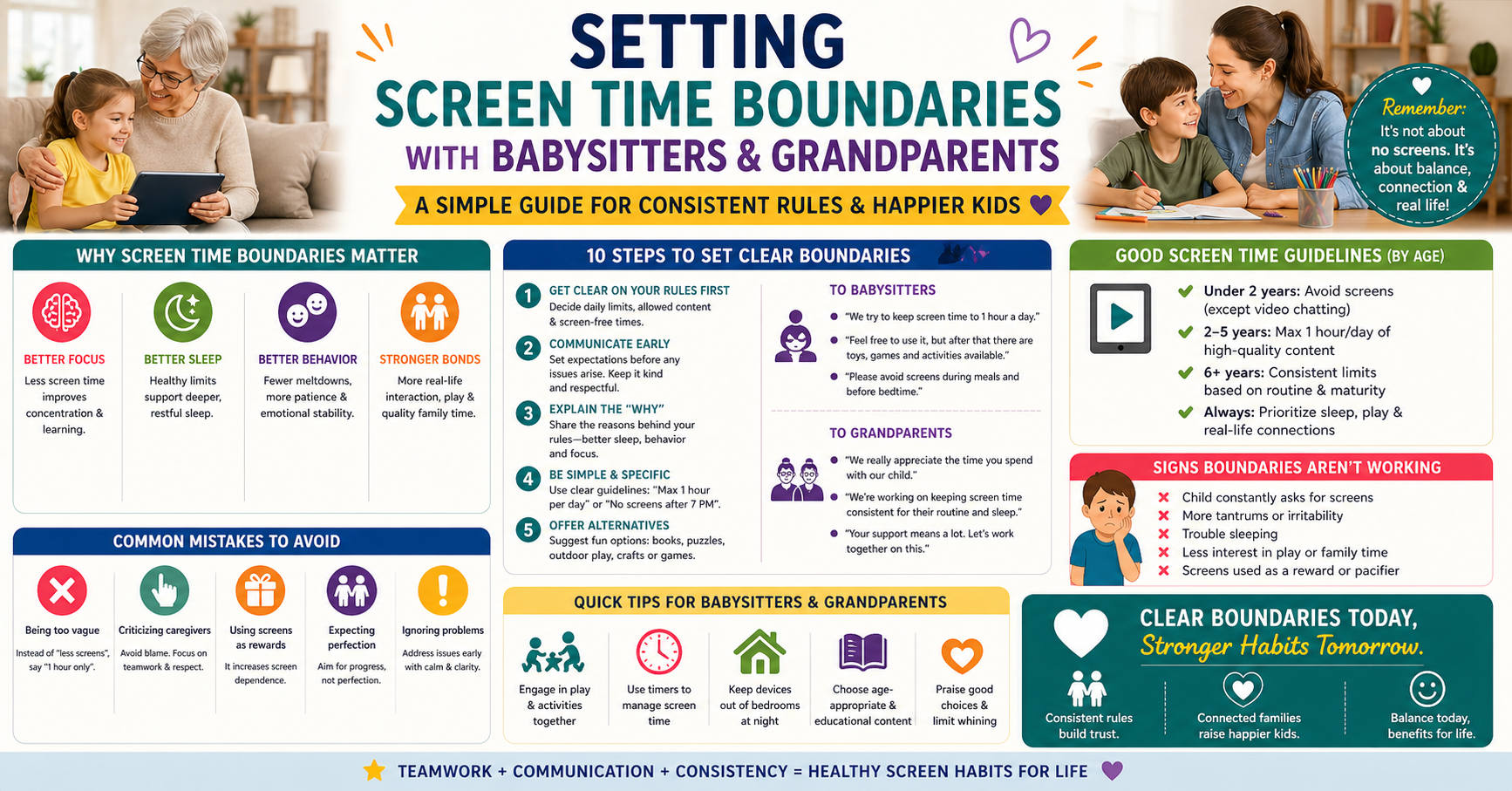
Setting screen time boundaries with babysitters and grandparents requires you to first be clear about what your screen time rules actually are. Vague intentions — “not too much,” “only educational stuff,” “we try to limit it” — are not rules. They’re preferences. And preferences without specificity are impossible for caregivers to follow because they require interpretation at every moment of the day.
Before you can communicate screen time rules for caregivers effectively, you need to articulate them to yourself.
Be specific about time. Not “not too much.” A specific number of minutes or hours per day for each type of device and context. “No more than 45 minutes of tablet time total while we’re out” is a rule that can be followed. “We try to keep it limited” is a sentiment that produces nothing consistent.
Be specific about content. Not “nothing inappropriate.” Specific apps, channels, or types of content that are approved, and specific categories that are not. “These three apps are fine: [name them]. YouTube is not approved — the autoplay and algorithm produce content we haven’t vetted.” This is actionable. “Age-appropriate only” requires the caregiver to make judgments you may not trust them to make consistently.
Be specific about context. Screens during meals? During certain activities? Only after outdoor play? Only when the child is sick or tired? The context matters, and “when they’re tired” is different from “never during lunch.”
Decide what the non-negotiables are. Enforcing screen time boundaries consistently requires knowing which rules you’ll go to bat for and which ones you’re genuinely flexible about. If no screens during meals is a firm value, know that. If you’re flexible about an extra thirty minutes on a particularly difficult day, know that too — and communicate the flexibility explicitly so the caregiver doesn’t have to guess whether the rules are rules or suggestions.
The American Academy of Pediatrics has established screen time guidelines by age group — no screens for children under 18–24 months except video calling, limited high-quality programming for ages 2–5, and consistent limits for older children. These guidelines are useful as a framework when explaining your rules to caregivers because they anchor your position in professional guidance rather than personal preference.
Once you know what your rules are, the question is how to communicate screen time rules for caregivers in ways that are clear, respectful, and actually followed.
Create a written caregiver instruction sheet.
This is the single most practical step you can take, and it is underused by most parents who rely on informal verbal instructions that are easily forgotten or misremembered. A simple one-page document — the kind you can print, leave on the fridge, or send as a text photo — that covers the core caregiving rules including screen time is immensely valuable.
For screen time, the written sheet should include:
Having this in writing does several things simultaneously. It removes ambiguity. It gives the caregiver something to reference rather than relying on memory. It communicates that these are genuine household rules rather than vague preferences. And it makes enforcing screen time boundaries easier because the caregiver can point to the written rule rather than making judgment calls.
For grandparents, the written document works differently.
Sending your parents or in-laws a printed childcare rulebook is likely to land as cold, clinical, or controlling. For grandparents, the written screen time rules for caregivers work best when they’re introduced as “just so we’re all on the same page” — a reference document rather than an order. Consider integrating the screen time information into a broader conversation rather than leading with the document.
Have the conversation before you need it.
Setting screen time boundaries with babysitters and grandparents is a proactive conversation, not a reactive one. Having it in the car on the way to dropping off your child, or as a text sent an hour before pickup, or — worst of all — as a comment made after you’ve come home to a screen-saturated child, positions you as reactive and puts the caregiver on the defensive.
The right moment is a calm, unhurried, pre-care conversation. “Before you come on Thursday, I wanted to share our screen time guidelines — can we have a quick five-minute chat?” This framing is respectful, gives the conversation proper space, and establishes the rules before the situation rather than after the problem.
Grandparents and screen time limits is a specific relational challenge that deserves its own treatment, because the conversation with grandparents is different in character from the conversation with a babysitter.
Lead with appreciation, every time.
Not performative gratitude — genuine acknowledgment of what they’re doing for your family. “We really appreciate you spending time with Alina or “We know how much you love being with them, and they love it too” establishes that this is a conversation between people who share the same fundamental goal — the child’s wellbeing — before you get into the specifics.
Frame rules as your family’s approach, not a critique of theirs.
“We’ve been working on keeping screen time limited at home” positions the screen time rules as something your household is navigating, not as an indictment of the grandparent’s judgment. “We’re trying to follow the pediatrician’s guidelines on this” adds external authority that de-personalizes the request. Grandparents and screen time limits are easier to discuss when the rules aren’t framed as “you’re doing something wrong” but as “here’s what works for our family right now.”
Acknowledge the generational gap honestly and warmly.
“I know this is different from how things were when we were growing up, and the research has changed a lot on this” is a disarming, honest statement that names the elephant in the room without making anyone wrong for it. Grandparents who feel their experience is being respected are significantly more likely to follow screen time limits they don’t entirely agree with than grandparents who feel their parenting legacy is being dismissed.
Give them alternatives.
One of the most practical strategies for getting grandparents to reduce screen time is not just telling them what not to do — it’s giving them genuinely good alternatives. A list of activities the child loves, crafts that work for their age, outdoor games, books they enjoy, songs they know. Grandparents who have nothing to replace the tablet with will return to the tablet. Grandparents with a repertoire of alternatives are much more able to follow the rules you’ve set.
Choose your battles within the grandparent relationship.
Enforcing screen time boundaries with grandparents requires some degree of proportionality. If your parents or in-laws are providing substantial free childcare and are otherwise loving, attentive, safe caregivers who occasionally bend the screen time rules — consider whether the battle is worth the relationship cost. Screen time rules for caregivers matter, but they exist in the context of a relationship that has its own value and its own fragility. Know which rules are non-negotiable and be genuinely willing to flex on the edges.
This does not mean having no rules. It means being strategic about which rules you enforce firmly and which you allow to float.
The conversation around babysitter screen time guidelines is structurally different from the grandparent conversation because babysitters are, in the formal sense, employees. You are paying them. The rules of the house are part of the job. This does not mean the conversation can be skipped — it absolutely cannot — but it means that the expectation of compliance is more direct.
Include screen time rules in the initial interview.
When you’re hiring a babysitter — or when you have a new caregiver starting — include screen time as part of the explicit conversation about household rules. “We have a screen time policy for the kids, and I’ll share the written guidelines with you — is that something you’re comfortable following?” This frames the rules as a known condition of the job rather than a surprise correction later.
A babysitter who is told the screen time rules upfront can decide whether they’re comfortable with them. A babysitter who is told after the fact feels managed rather than partnered.
Provide the written instruction sheet.
For babysitters, the written document is not optional — it’s standard professional communication. It covers screen time (specific limits, approved content, context rules), alongside other care essentials like snacks, bedtime, emergency contacts, and the child’s current routine. Keep it simple, clear, and available — on the fridge, in a message, somewhere the babysitter can reference it.
Be specific about what you want the babysitter to do instead of screens.
Babysitter screen time guidelines are more followable when they come with practical alternatives. A list of activities the child enjoys, games they know, outdoor options available, books in the rotation. Asking a babysitter to limit screen time without providing alternatives puts them in the position of having to generate engagement activities on the fly — and the tablet will win that competition most evenings.
Check in, but don’t spy.
Children and screen time with caregivers is something you can monitor to a reasonable degree — asking your child casually what they did, noticing behavioral cues when you arrive home, occasionally checking device usage stats. But covert monitoring of your babysitter’s screen time compliance, or arriving home early to catch them out, corrodes the trust that makes the babysitter relationship work. Set clear expectations, trust that you’ve communicated them, and address specific problems when they arise through conversation rather than surveillance.
Address violations calmly and specifically.
When you come home to evidence that the babysitter screen time guidelines were not followed — your child reports watching three hours of YouTube, or the device history reveals something you didn’t approve — address it at the next opportunity. Not in anger, not in the moment of returning home, but soon after. “I noticed the kids had more screen time than we discussed last time — I want to check in about the guidelines I shared.” Give the babysitter the opportunity to explain and to recommit. A single violation, addressed calmly, is usually sufficient. Repeated violations are a different conversation.
Setting screen time boundaries with babysitters and grandparents sometimes produces pushback — not hostile or dramatic, but the kind of gentle resistance that makes people back down from rules they should hold.
“A little bit won’t hurt them.”
This is the most common pushback you’ll encounter around screen time rules for caregivers, and it comes from a genuine place of care. The response: “I know it seems small, and I understand it’s not a big deal from one perspective. But we’re trying to be consistent so that Alina has the same expectations everywhere they go — it helps them a lot when the rules are the same. We’d really appreciate your help with this.”
“They asked for it and I didn’t want a battle.”
Children and screen time with caregivers involves children who are expert at identifying which adults will say yes. When a caregiver says they gave in to avoid a tantrum, the honest response is: “I understand — they can be really persistent about this. I’ll talk to Alina about the rules before your next visit so they know what to expect. And it’s completely okay to tell them ‘that’s not allowed at grandma’s today’ — they’ll complain but they’ll adjust.”
“In my day, we didn’t worry about any of this.”
This is specifically the grandparent and screen time limits push back that calls for the most care. Acknowledge it genuinely: “You’re right that this is a newer thing, and it can feel like overthinking. The research on tablets and smartphones is different from television — it’s newer technology with some different effects — and we’re just trying to navigate it carefully while Alina is young.” Don’t make it a debate. State it once, warmly, and move on.
“But Alina loves it so much.”
This is the hardest one, because it’s true. Children love screens. Enforcing screen time boundaries often produces unhappy children in the short term, and caregivers who are motivated by making children happy find that hard to navigate. Response: “I know, and that’s exactly why we have the rule — if they could regulate it themselves we wouldn’t need to. The limit isn’t about them not enjoying it. It’s about making sure they get other things in too. It actually makes them better at managing the limit over time when it’s consistent.”
Grandparents ignoring screen time rules is, for some families, not an occasional frustration but a consistent pattern — and it requires a more direct response than gentle conversation.
Have a specific conversation, not a general one.
Rather than re-stating the general rule again, address the specific pattern. “I’ve noticed that the screen time guidelines haven’t been followed the last few visits, and I want to understand what’s making that hard.” This opens a problem-solving conversation rather than a repetitive rule-statement.
Involve your partner if the grandparents are their parents.
When grandparents and screen time limits are in conflict and the grandparents are your partner’s parents, the most effective advocate for the rule is your partner. A parent addressing their own parents’ screen time non-compliance is both more likely to be heard and less likely to create the “difficult daughter/son-in-law” dynamic that can make these conversations genuinely damaging to family relationships.
Consider whether the overall childcare arrangement is working.
If enforcing screen time boundaries with a particular grandparent or babysitter is consistently impossible — if the rules are routinely not followed and the conversations are not producing change — it’s worth asking whether this care arrangement is actually working for your family. This is a more serious step and not one to take lightly, but there are circumstances where the childcare relationship needs restructuring because the fundamental alignment on values isn’t there.
Setting screen time boundaries with babysitters and grandparents is not a single conversation. It’s an ongoing practice of communication and recalibration as children grow, caregivers change, and the rules themselves evolve.
Review the rules when something changes. When your child moves into a new developmental stage, when a new app becomes relevant, when the household screen time policy changes — update your caregivers. Screen time rules for caregivers that were written when a child was three may need significant revision by age seven. Keep the communication current.
Acknowledge when caregivers follow the rules well. This is genuinely underused. When a grandparent tells you they put the tablet away after thirty minutes and the kids played outside for the rest of the afternoon, say something. “Thank you for sticking to the screen time rules — that means a lot to us and it makes such a difference for Alina.” Positive reinforcement of caregiver compliance with screen time limits builds the behavior pattern you want, just as it does with the children themselves.
Be willing to update the rules as your child grows. Children and screen time with caregivers evolves. A six-year-old’s screen time guidelines are different from a ten-year-old’s. Part of maintaining good caregiver relationships around screen time is being willing to revisit and adjust the rules rather than holding rigidly to a policy that no longer fits the child’s developmental stage. Caregivers who see that the rules are thoughtful and responsive are more likely to follow them than those who feel the rules are arbitrary.
Model the rules in your own behavior. This is the part that parents sometimes miss: children and screen time with caregivers involves the child observing the adults around them. If grandchildren see their grandparents on phones for hours and their parents on phones during family time, the screen time rules they’re being asked to follow will feel arbitrary and resentful. The most effective long-term screen time policy in any household is one that applies to everyone, including the adults.
Below is a simple, adaptable template for the written screen time guide you can share with any caregiver — babysitter, grandparent, or other family member.
[CHILD’S NAME] SCREEN TIME GUIDELINES
Thank you so much for caring for [name]. Here are our screen time guidelines for your visit:
Total screen time allowed: [X minutes/hours] per day/per visit
Approved apps and programs:
Not permitted:
Context rules:
If [child’s name] asks for more: It’s completely fine to say “that’s our rule for today” and offer one of these alternatives: [list 3–4 activities they enjoy]
Questions? Call or text: [Your number]
We appreciate you following these guidelines — consistency really helps [child’s name] manage screen time well across different settings.
This template is direct without being rigid. It gives caregivers everything they need to enforce screen time boundaries without interpretation or guesswork. Adapt it to your family’s specific rules, print two copies — one for the fridge and one for the caregiver — and update it as the rules change.
The key to setting screen time boundaries with babysitters and grandparents without conflict is timing, framing, and written documentation. Have the conversation proactively — before the care visit, not after a problem. Frame the rules as your family’s approach rather than a criticism of the caregiver’s judgment. Provide the rules in writing so nothing is left to memory or interpretation. And lead with genuine appreciation for the care they provide before getting into specifics. Most caregivers follow screen time rules for caregivers far more consistently when the rules are clear, written down, and communicated respectfully in advance.
When grandparents and screen time limits are in ongoing conflict, move from general rule-stating to specific conversation. Address the pattern directly: “I’ve noticed the screen time guidelines aren’t being followed — I’d love to understand what’s making that difficult.” Involve your partner if the grandparents are their parents. Provide concrete alternatives to replace screens. If the pattern persists without change, it may be necessary to have a more direct conversation about whether the care arrangement is working as it stands. Grandparents ignoring screen time rules consistently is worth addressing specifically rather than hoping the general rule eventually sticks.
Babysitter screen time guidelines should generally follow your household’s established screen time rules rather than a different standard for caregiver time. The American Academy of Pediatrics recommends no screen time for children under 18–24 months except video calling, limited high-quality programming for ages 2–5, and consistent daily limits for older children — typically one to two hours for school-age kids. The specific number that works for your family should be stated explicitly in your written guidelines so that enforcing screen time boundaries doesn’t require the babysitter to make judgment calls.
Talk to your child directly about the rules before they go to a caregiver’s home or before the caregiver arrives. “When you’re with grandma, the screen time rules are the same as at home — [X minutes], then it goes away.” Children and screen time with caregivers is an area where children will test limits — particularly with grandparents who are perceived as more permissive. Preparing your child in advance, and letting them know you’ve discussed the rules with the caregiver too, removes the leverage for negotiation. Consistent repetition of this pre-visit conversation builds the expectation over time.
A babysitter who expresses disagreement with babysitter screen time guidelines should be given the opportunity to discuss the rules — and you should be genuinely open to their perspective, particularly if they have experience and care deeply about the children. However, the ultimate decision about screen time rules for caregivers is yours as the parent. If the disagreement is a matter of degree (they think an hour is fine, you prefer forty-five minutes), find a workable compromise. If the babysitter refuses to follow the guidelines as a matter of principle, this is a fundamental mismatch about who is setting household rules — and that conversation may determine whether the placement continues.
Children adapt remarkably well to different rules in different settings when those rules are communicated clearly and enforced consistently within each setting. The goal of setting screen time boundaries with babysitters and grandparents is not to make every environment identical — it’s to ensure that each environment has a known, consistent rule that children can predict and rely on. “At grandma’s, the rule is [X]. At home, the rule is [Y]” is manageable for children who understand that different places have different standards. What is destabilizing is unpredictability within a single setting — the grandparent who sometimes enforces and sometimes doesn’t, the babysitter whose compliance depends on the day.
This depends on the degree of the issue and the overall health of the caregiver relationship. Minor, occasional non-compliance with screen time limits — an extra twenty minutes here, a less-vetted program there — is probably not worth a significant family conflict, particularly when grandparents are otherwise excellent, loving caregivers. Consistent, significant non-compliance — hours of unmonitored screen time, content that violates your values, rules being actively dismissed — is worth addressing directly, with patience, because the alternative is having your household screen time policy effectively undermined. Enforcing screen time boundaries should be proportionate: hold firm on the things that genuinely matter, and let the smaller things go with grace.
Provide a specific, practical activity list alongside your babysitter screen time guidelines. Don’t just say “they like playing outside” — say “the ball is in the garden shed, they love penalty shootouts” or “there’s a craft box in the kitchen with supplies, they’ve been making cards lately.” The more specific and ready-to-use the alternatives, the more likely they are to be used. Babysitters default to screens when screens are the path of least resistance — your job is to make the alternatives almost as easy, not more work than the tablet.