Physical Address
304 North Cardinal St.
Dorchester Center, MA 02124
Physical Address
304 North Cardinal St.
Dorchester Center, MA 02124

Kunal and Meera were sitting in a small café in Nagpur, three weeks before their baby was due, with a paper napkin between them and a pen that was running out of ink.
On the napkin, in Kunal’s messy handwriting, were two words: KUNAL. MEERA.
They had decided something sweet and slightly dangerous. Their son’s name would carry a little of both of them.
“Kumee,” said Kunal, grinning.
“Absolutely not,” said Meera.
“Meekun?”
“Kunal. It sounds like a sneeze.”
For the next hour, they tried everything. Kunmeera. Meeral. Kuneer. Each one was a little funnier than the last. By the time the chai went cold, they had laughed so much that the waiter came by to ask if everything was all right.
It was. But the napkin was a mess, and they still had no name.
If you are reading this, I suspect you have been there. Maybe you have already typed your names into some online “baby name mashup generator” and got a result that sounded like a medicine. Maybe your sister-in-law has suggested something that blended her name and her husband’s so cleverly that nobody could pronounce it. Or maybe you simply love the idea that your child’s name carries a small piece of each of you, and you do not know where to begin.
That is exactly what this guide is for.
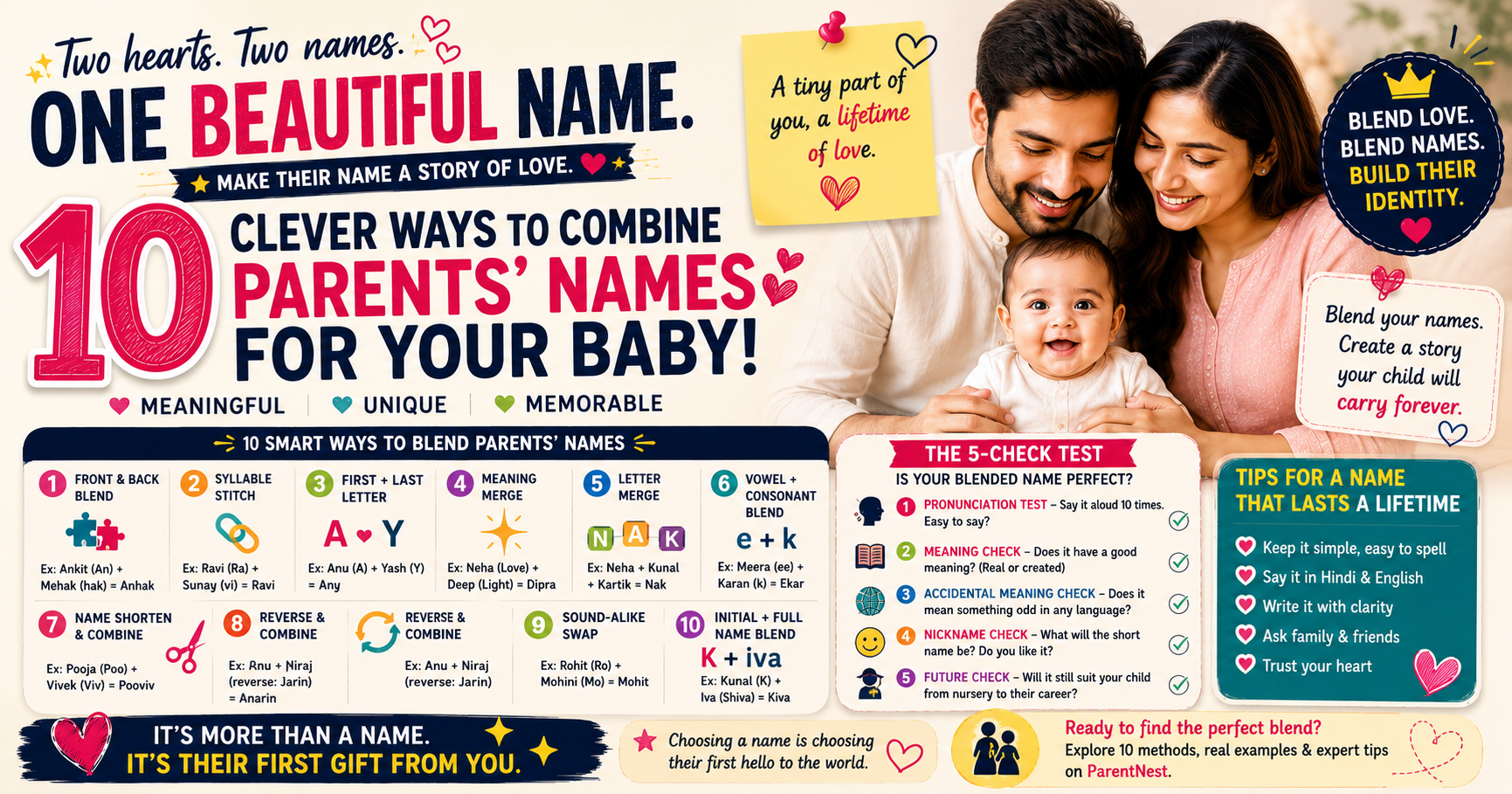
Below you will find 10 clever and easy ways to combine parents’ names for baby, each with a simple method, real Indian examples, and a note on what to watch out for. I have also added a quick five-check test so your blended name does not turn out to be a joke, a typo or something that means something odd in another language.
One honest note first: I am a parenting content writer, not a Sanskrit scholar or a linguist. When you blend names, the result may be a real name with a known meaning, or it may be a brand new name. I have marked which is which, and please verify any meaning with a trusted source before you finalise anything.
Want to know how Kunal and Meera finally solved it? Keep reading. It is in Idea 3.
The easiest ways to combine mom and dad names for a baby in India are: blend the first part of one name with the end of the other, stitch together syllables, use the first letter of one name and the last letter of the other, merge the meanings of both names, or rearrange their letters into a new name. For the best result, pick a method that gives a name that is easy to say, has a real meaning and passes a quick pronunciation test.
Keep reading for all 10 ideas with examples, plus a simple checklist so your blended name does not backfire.
Blending parents’ names is not a new trick. In many Indian families, you will see children named after a grandparent, a deity, a star, or a family tradition. Combining parents’ names is the modern, personal version of the same love.
Here is why so many parents are drawn to it.
1. It feels like a signature. A name that carries letters or syllables from both of you says, “This child belongs to both of us.” It is a small, quiet way to share the moment.
2. It ends the “whose choice?” argument. In many homes, the baby name becomes a polite tug-of-war. A blended name gives both parents a place in it.
3. It makes the name feel unique. Blended names are unlikely to be shared with half the class. They are rare by design.
4. It tells a story. When your child grows up and asks, “Why this name?”, you get to tell them: “Because it has a bit of Mummy and a bit of Papa.” That story can last a lifetime.
5. Names like Krishiv have made the idea familiar. Many Indian parents have seen names like Krishiv, which blends the names of Krishna and Shiva. These composite names helped people feel that creating a name from two parts is natural and even traditional in spirit.
In simple words: combining parents’ names is a personal, creative and often very emotional way to choose a name. It just needs a little care so the result is as lovely as the idea.
I have seen enough funny and not-so-funny blended names to know that a few simple rules save a lot of trouble. Keep these in mind as you try the ideas below.
Rule 1: Say it aloud, not just on paper. A name can look beautiful in writing and sound awkward in speech. Say each option ten times, and call it across the room the way you would call your child.
Rule 2: Prefer a real name when you can. A blend that lands on an established name, like Anvi or Mayank, comes with a meaning and a history. A fully invented blend may have no meaning, which can feel empty later. Both are fine, but be clear about which one you are choosing.
Rule 3: Check for accidental meanings. A blended name can sound like an unfortunate word in Hindi, Punjabi, Tamil, English or another language. Ask two or three friends from different backgrounds to say it aloud and tell you what it reminds them of.
Rule 4: Think about the nickname. Every Indian child gets a pet name within a week. If the blend is long or tricky, the family will shorten it. Make sure you like the shortened version too.
Rule 5: Settle the spelling now. Blended names often have more than one way to be written. Choose one spelling and use it on every document: hospital records, birth certificate, Aadhaar, school forms and later the passport.
Each idea below has four parts: how it works, examples with Indian names, best for, and watch out for. Try two or three methods with your own names. Most couples find that one of them clicks quickly.
How it works: Take the first part of one name and the last part of the other, and join them so that they flow as one.
This is the most popular way to combine parents’ names for baby. It works best when the sounds at the joining point fit naturally.
Examples:
Best for: Parents whose names have friendly, flexible sounds. Names with vowels at the joining point blend more easily.
Watch out for: Joins that create hard consonant clusters or an accidental word. Say it aloud before you fall in love with it.
How it works: Break both names into syllables and stitch one or two from each into a new name. Try both orders, mother first and father first, because the sounds often work better one way than the other.
This is a more flexible cousin of Idea 1. You are not limited to the front of one name and the back of the other. You can pick syllables from anywhere.
Examples:
Best for: Parents with longer names. More syllables give you more combinations to try.
Watch out for: Spending three hours on this and getting too attached to a name that sounds odd to everyone else. Take a break and ask a friend to say it out loud.
Tip: Write each syllable on a small piece of paper and move them around like Scrabble tiles. It is surprisingly fun, and it works better than staring at a screen.
How it works: Choose a real name that starts with the first letter of one parent’s name and ends with the first letter of the other’s. This is a popular way to use parents’ initials without inventing a new word.
This is how Kunal and Meera finally solved their napkin problem.
They sat down one evening with a list of boys’ names and asked a simple question: which names start with M (for Meera) and end with K (for Kunal)? After a few minutes, they found it.
Mayank.
Mayank is a lovely Sanskrit name meaning the moon. It starts with Meera’s M and ends with Kunal’s K. Meera said it out loud, then Kunal said it, and neither of them wanted to laugh. It just fit.
More examples:
Best for: Parents who want a real, established name with a clear meaning and a personal twist. It is also one of the easiest methods for grandparents to understand.
Watch out for: Forcing it. If no name fits, try using the first letters of both names at the start, or the last letters at the end, or use a middle name for the second letter.
How it works: Look up what each parent’s name means, then choose a baby name that brings both meanings together. The name itself may not contain any of your letters, but it carries the same story.
This is a quieter, more poetic way to combine parents’ names for baby. It works especially well for parents who love meaning more than sound.
Examples:
Best for: Parents whose names have clear meanings and who love a gentle, symbolic story to tell later.
Watch out for: Meanings that vary by source. Check each name’s meaning with a trusted Sanskrit or Hindi reference, and do not rely on a single baby-name website.
How it works: Write down all the letters from both parents’ names, then rearrange them to form a real name. It is like making words from a pile of Scrabble tiles.
This is a fun idea for parents who love puzzles. It is also how some of the most surprising, personal names are born.
Examples:
Best for: Parents who enjoy wordplay and want a name that quietly hides both of their names inside.
Watch out for: Rules of the game. Decide in advance whether you must use all letters or only some. Using only some is easier and usually gives better results.
Tip: Cross off each letter you use so you do not use the same one twice. A pencil and paper work better than any app for this one.
How it works: Look for a spot where one name ends with the same sound or letters that the other begins with, then join them with that overlap. Or, find a classic name part, like -ansh, -ika or -anya, that sits inside one parent’s name and attach it to a name part from the other.
Examples:
Names like Devansh, Shivansh and Krishiv are good examples of what many parents mean by Krishiv type names: a modern name built from two respected parts. If your names already contain a divine or classic part, this idea is very easy.
Best for: Parents who like traditional, devotional-sounding names with a modern twist.
Watch out for: Names that look very similar, such as Shivansh, Devansh and Krishiv. They are lovely, but they are also quite popular, so your child may share a name in class.
How it works: Choose any first name you love, and carry both parents’ names into the full name through the middle name or the family-name slot.
This is one of the simplest ways to combine parents’ names for baby, and it has the huge benefit of not changing the first name at all. Your child can have a clean, easy first name, and still carry both of you.
Examples:
In many Indian communities, using the father’s name as the middle name is already common. Some families are now adding the mother’s name too. Customs differ across Maharashtra, Gujarat, South India and other regions, so follow what feels right in your family.
Best for: Parents who want a short, easy first name for daily life and still want both of their names recorded.
Watch out for: Long full names on forms. Some systems have character limits, so test your full name on school forms and online portals. Also, keep the format the same across all documents.
How it works: If you and your partner come from different regions or language backgrounds, choose or build a name that is easy and natural in both languages.
This is a very Indian problem, and a very lovely one. A Punjabi mother and a Tamil father, a Bengali mother and a Gujarati father, or any such pairing, can find that a name that sounds beautiful in one language is awkward in the other.
How to do it step by step:
Examples of names that travel well across regions: Mihir, Tara, Kavya, Ira, Arya and Rohan. These are easy to pronounce in most Indian languages, though, as always, ask family to confirm.
Best for: Inter-regional and inter-community couples, and families that live abroad.
Watch out for: Names that mean something different in one language. A friend from each side can help you spot this quickly.
How it works: Instead of blending your formal names, blend the pet names you use for each other. This gives you a cute family nickname, while the formal name can be chosen separately.
In almost every Indian home, the baby gets a nickname within days. Why not make it a happy blend?
Examples:
Then, choose a formal name using any other idea from this list or a name you simply love. The blended pet name stays a family secret and a soft, private joke.
Best for: Playful couples who want a family nickname with a story, without worrying about how it looks on a certificate.
Watch out for: Pet names that are only funny for you. Imagine your child’s teacher or friend hearing the nickname at school, and check you are happy with that.
How it works: If your family follows a tradition where the baby’s name begins with a specific letter, such as a nakshatra letter or a letter from a naming ceremony, start with that letter first, then blend within that rule.
Many Indian families receive a starting letter from an astrologer, a pandit or a religious ceremony, and then choose a name that begins with it. That does not stop you from combining your names. It simply gives you a starting point.
How to do it step by step:
Example: If the family letter is K, and the parents are Kunal and Meera, then names starting with K that carry a hint of both might include Kavya or Kabir. Not every combination will contain both names, and that is perfectly fine. Even a single shared sound can be enough.
For more on naming traditions, you might enjoy our guide to twin and nakshatra baby names.
Best for: Families who follow letter-based naming traditions and still want a personal touch.
Watch out for: Treating the tradition and the blend as a competition. Talk to your elders first so everyone is on the same page.
Many parents search for Krishiv type names, so here is a simple explanation.
Krishiv is a modern name that is popularly understood as combining Krishna and Shiva. It is a good example of a composite name, where two respected names or name parts are joined to make one. Other names of the same style include Shivansh, Devansh and Krishnav.
There are three things to know:
If you like this style, you can build your own composite name using your parents’ names as the parts, as in Idea 1 and Idea 6.
Before you fall in love with a blended name, run it through these five quick checks. They take ten minutes and can save you years.
Check 1: The Say-It-Aloud Check. Say the name ten times, at normal speed. Does it flow, or do you stumble on one sound?
Check 2: The Hear-It-Wrong Check. Ask a friend to say the name after seeing it written. If two out of three say it the way you meant, you are in good shape.
Check 3: The Hidden-Word Check. Ask people who speak different languages what the name sounds like. A blend may accidentally sound like a word in Hindi, English, Punjabi, Tamil or another language.
Check 4: The Meaning Check. Does the name carry a meaning, either as an established name or a story you can tell? If it is an entirely new name, are you happy that it has no traditional meaning?
Check 5: The Nickname and Initials Check. What will it be shortened to? Write the full name with initials and see if they spell something awkward.
A name that passes all five is one you can use with confidence.
You do not have to try all ten ideas. Here is a quick way to find the one that suits you.
Step 1: Write both names and their meanings. Put them on a page. If you do not know the meaning of your own name, ask your parents. It often leads to a lovely story.
Step 2: Try Ideas 1, 3 and 4 first. These are the three most likely to give you a real, meaningful name quickly.
Step 3: Make a shortlist of three. Write each one with the full name. Say it aloud with your surname.
Step 4: Run the 5-check test and sleep on it. The name you still love after two nights is usually the right one.
Here are the traps I see most often.
1. Using an online “name mashup generator” and trusting the result. These tools simply join letters. They do not check meaning, sound or cultural fit. Use them for a laugh, not a final decision.
2. Not checking the meaning. A blend may sound lovely but mean something odd in another language. Always check.
3. Making the name too long. Blended names can become very long. If the family shortens it right away, you might as well choose the short version from the start.
4. Forgetting one parent. A name that is 90 percent Dad and 10 percent Mom can feel unfair. Try to make the blend feel balanced, or use the middle-name tribute to even it out.
5. Ignoring grandparents. You do not need their approval, but a gentle conversation avoids hurt feelings. Share your idea early and explain the story behind it.
6. Inconsistent spelling. Krishiv or Krishiiv? Vihan or Vihaan? Pick one and use it everywhere.
7. Falling for novelty. A name must work for a five-year-old, a twenty-five-year-old and a fifty-five-year-old. Imagine saying it in a job interview.
Sometimes the hardest part is not choosing the name. It is explaining it to the family. Here is a gentle way to do it.
Start with the story. “We wanted our baby’s name to carry a little of both of us. Mayank starts with Meera’s M and ends with Kunal’s K, and it means the moon.”
Lead with the meaning. Elders often care more about the meaning than the method. A beautiful meaning helps.
Invite their blessings. “We would love your blessings on the name.” It is a small phrase that makes a big difference.
Be ready for questions. Someone will ask, “Why not name him after Dada ji?” You can say, “We love that idea, and we are thinking of using Dada ji’s name as the middle name.”
You can blend the first part of one name with the end of the other, stitch syllables together, use the first letter of one name and the last letter of the other, merge the meanings of both names, or rearrange their letters into a new name. Always check the pronunciation and meaning of the final result.
The easiest way is the first-letter, last-letter method (Idea 3). You look for a real name that starts with one parent’s initial and ends with the other’s. It gives you an established name with a known meaning.
Krishiv type names are modern composite names that join two respected parts, such as Krishna and Shiva in Krishiv. Other examples include Shivansh and Devansh. You can build your own by joining parts of your names.
Yes, many parents do. Just be clear that the name is a new creation, and consider adding a meaning of your own, such as “a blend of Mummy and Papa.” Check that it does not accidentally sound like a word in another language.
They are fun, but they only join letters. They do not check meaning, sound or culture, so treat their results as ideas, not final names.
There is no rule. Try both orders and choose the one that sounds better. Many couples alternate: the first child gets one order, and the second gets the other.
Yes. Start with the letter your family has been given, then try a blend within that rule, or use one of your names as a middle name. Talk to your elders first.
Decide on one spelling before the birth registration, and use it on every document: hospital records, birth certificate, Aadhaar and school forms. Check your state or municipal rules for registering and correcting names.
Try a different method. If the first letter and last letter method does not work, try the middle-name tribute, where each of you has a place in the full name. Sometimes the best answer is a name you both love, with your names hidden in the middle.
A name is a very small word that your child will carry for a very long time. It will be on a school bag, a cricket team list, a college form and, one day, in a message that begins with “Hey, it is me.”
Combining your names is a lovely way to start that story. It does not have to be clever or complicated. It only has to feel right to the two of you.
Kunal and Meera did not choose the funniest blend. They did not choose the most unusual one. They chose Mayank, because it started with Meera and ended with Kunal, and because, when they said it out loud, their baby seemed to turn his head.
I hope you find a name that feels just as right.
If you liked this guide, you might also enjoy our articles on short baby names in India and baby names that mean strength. And if you have combined your names in a way we have not covered, tell us in the comments. We would love to hear your story.
Important note: Name meanings can vary by source, language, root and spelling, and blended names may be newly created with no traditional meaning. Please verify the meaning, spelling and suitability of any name with a trusted source, an elder or a qualified scholar in your tradition before finalising. This article is for general information. The story of Kunal and Meera is an illustrative example.