Physical Address
304 North Cardinal St.
Dorchester Center, MA 02124
Physical Address
304 North Cardinal St.
Dorchester Center, MA 02124

Pooja has been correcting people for thirty-one years.
“It is Poo-jaa. P, O, O, J, A.” On forms, on train tickets, on the little paper cup at the coffee counter. Her name has come back as Pooja, Puja, Pujah and, once memorably, “Pooza.” She laughs about it now. But the day her daughter was born in Pune, she and her husband Sandeep sat in the hospital room, and Pooja said something that stayed with both of them.
“Whatever we name her, nobody should have to spell it twice.”
Sandeep nodded. Then the family WhatsApp group woke up.
His mother wanted a long, heavy, traditional name. A cousin suggested something with a double a and a silent h. A friend sent a list of 200 “unique” names, and Pooja scrolled through them at 3 a.m. thinking: unique is lovely, but will a teacher in Class 1 be able to say it?
That night, she did what a lot of new parents do. She started whispering short names, one after another. Ira. Tara. Diya. Anu. Each one felt like a small, clean bell.
If you are reading this, I think I know why you are here. You want a name that is beautiful, has a real meaning, and fits on a school form without a fight. You want a name that your child can write in a Class 1 notebook, that the doctor’s receptionist can read out without a pause, that a grandparent in the village and a colleague in Singapore can both say right.
That is what this guide is for.
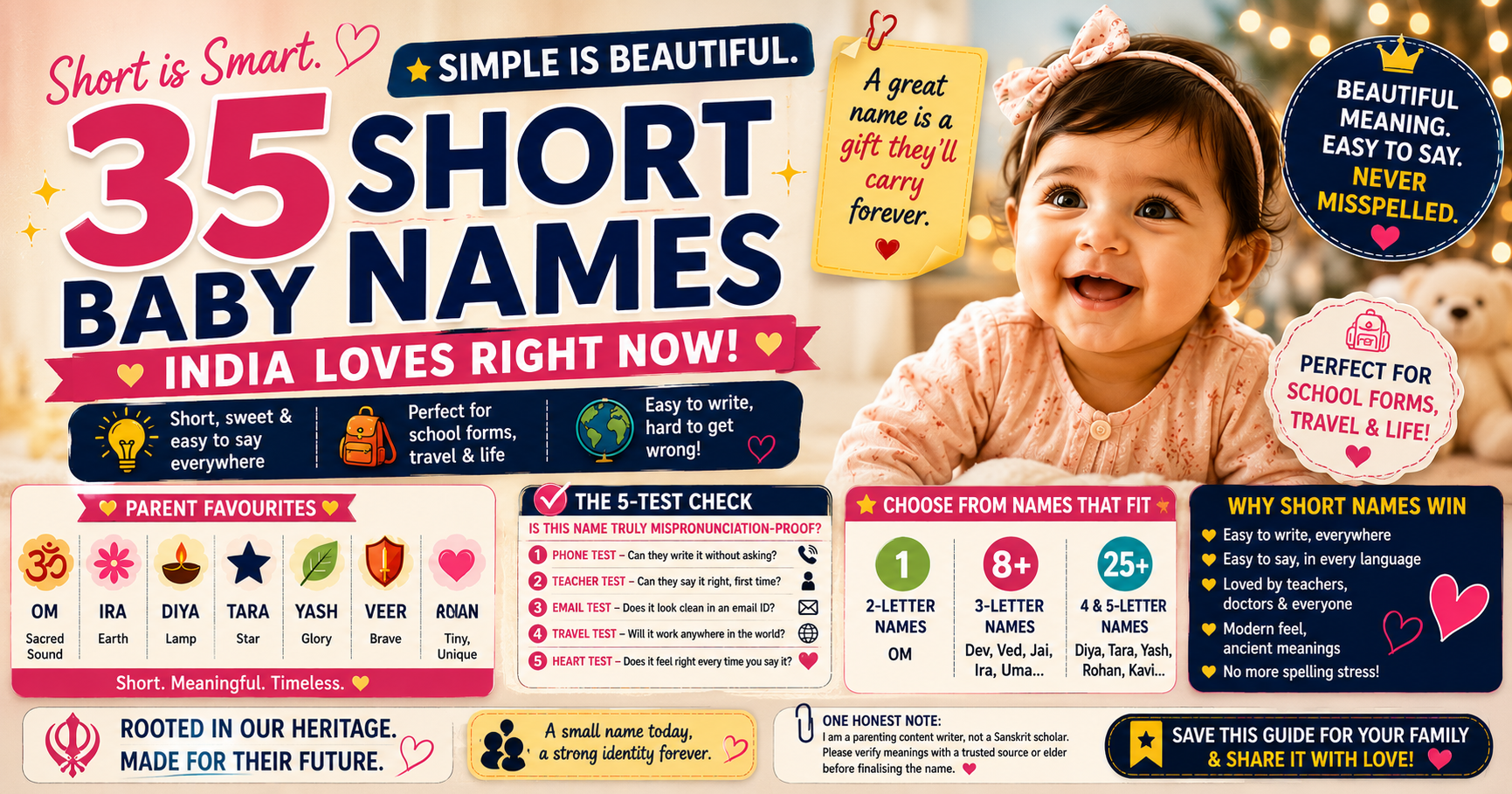
Below you will find 35 short baby names India parents are choosing right now, from 2-letter and 3-letter names to simple 4 and 5-letter ones. Each has a clear meaning, a pronunciation guide and a small note on how it feels in real life. I have also added a simple test to check if a name is truly mispronunciation-proof, plus the common mistakes that make short names go wrong.
One honest note first: I am a parenting content writer, not a Sanskrit scholar. Name meanings can vary slightly between sources, languages and spellings. Please verify the meaning of your final choice with a trusted source or an elder before you put it on any paper.
Shall we begin?
Some of the most loved short baby names in India right now are Om, Dev, Ved, Jai, Ira, Uma, Diya, Tara, Yash, Veer, Kavi and Rohan. They are short (usually 2 to 5 letters), easy to pronounce in Hindi and English, and have clear meanings in Sanskrit or Hindi, such as “sacred sound,” “divine,” “lamp,” “star” and “glory.”
Keep reading for all 35 names with meanings, pronunciation tips and a quick test to make sure your favourite will never be mispronounced.
Ten years ago, the common advice was “pick a long, meaningful Sanskrit name.” Today more parents are asking a different question: “Will this name survive a roll call?”
There are a few honest reasons short names are rising.
1. Everyone is writing the name more often. Your child’s name will go on school forms, app logins, email addresses, sports team lists and, one day, a visa form. A shorter name means fewer typing errors.
2. Families live across cities and countries. A name that is easy in Hindi, English and a bit of Tamil or Bengali travels better. Cousins in Bengaluru, Delhi and Dubai should all be able to say it.
3. Nicknames arrive anyway. In almost every Indian home, a long name turns into a pet name within a week. A short name often skips that step, and that is a quiet relief.
4. Teachers and doctors say them correctly. This may sound small, but children feel it. A name that is said right on day one feels like being seen.
5. Short names feel modern but are often very old. Dev, Ved, Ira, Uma and Om are ancient names. They feel fresh simply because they are short.
In simple words: short baby names are not a trend away from tradition. They are old meanings in light, easy sounds.
Many parents search for 2 letter baby names India and 3 letter baby names India with meaning. Let me save you some scrolling with a straight answer.
2-letter names are rare. In everyday Indian use, the only widely accepted 2-letter name is Om. Other two-letter combinations you may see online are usually nicknames or shortened forms of longer names, not formal names with established meanings. So if a website promises you “100 two-letter Indian baby names,” be a little careful. Many of those are made up or borrowed.
3-letter names are the sweet spot. There are many lovely three-letter names with genuine Sanskrit or Hindi roots: Dev, Ved, Jai, Raj, Yug, Ira, Uma, Ila and Anu, among others. They are short, classic and easy to write.
4-letter and 5-letter names give you more choice. Diya, Tara, Yash, Veer, Rohan and Kavya are all short, but they give you a wider range of meanings and a softer sound.
In this guide, I have kept to names with a real, widely accepted meaning, so you do not have to wonder whether you are choosing a real name or a random sound.
Here is the part I wish someone had told Pooja earlier. A name being short does not automatically make it easy. Before you finalise a favourite, run it through these five quick tests.
Test 1: The Phone Test. Say the name over a bad phone line to a relative. Can they write it down correctly, without asking you to spell it? Try this with someone who does not speak your language well.
Test 2: The Teacher Test. Write the name on paper and hand it to a friend. Ask them to say it out loud without any hints. If three out of four friends say it the way you intended, you are in good shape.
Test 3: The Email Test. Type the name into an email address with a surname: name.surname at gmail dot com. Does it look clean? Is there an awkward letter combination? Short names usually pass this one easily.
Test 4: The Search Test. Google the name with your surname. Check that nothing odd or unfortunate comes up. It takes one minute and saves years of worry.
Test 5: The Nickname Test. Think of what the family will shorten it to. Dev becomes Devu. Tara becomes Taru. Meera becomes Meeru. Do you like every nickname you can imagine?
A name that passes all five is a name you can trust.
Each name below comes with four things.
Some names, like Avi and Mahi, are used for both boys and girls, and I have marked those. I have also grouped the names by length so you can jump straight to the style you like.
Most of these names have Sanskrit or Hindi roots and are widely used in Hindu families, though many are also loved across Indian communities. Choose what fits your family and tradition.
These are the shortest and the simplest. If you want a name that fits on a single line of any form, start here.
Meaning: The sacred syllable, the primordial sound of the universe. Origin: Sanskrit. Say it: OHM.
Om is the only well-established 2-letter name in everyday Indian use. It is as short as a name can be, and it carries one of the most respected meanings in Indian tradition. Because it is so short, many parents pair it with a longer second name, such as Om Prakash or Om Aarav, to give it a fuller feel on documents.
Good to know: Some families prefer to keep Om as a standalone name, while others feel it is too sacred to use as a regular name. Ask your elders what your family prefers.
Meaning: God, divine, a celestial being. Origin: Sanskrit. Say it: DAYV.
Dev is one of the most popular short boy names in India, and it is easy to see why. It is crisp, strong and recognised from Kashmir to Kerala. It also works well as a prefix, as in Devansh or Devesh, if you want a longer name later.
Good to know: Spell it Dev, not Deva or Dave, if you want it read the way you meant it. Pick one and keep it consistent.
Meaning: Sacred knowledge, wisdom; linked to the Vedas. Origin: Sanskrit. Say it: VAYD.
Ved is a quiet, thoughtful name that has grown a lot in popularity. It sounds modern, yet it is as old as the Vedas themselves. Parents who value learning often pick it.
Good to know: English speakers sometimes read it as “Ved” with a short e, like “bed.” A quick, friendly correction on day one usually settles it.
Meaning: Victory, triumph. Origin: Sanskrit and Hindi. Say it: JAI (rhymes with “sky”).
Jai is a joyful, energetic name that also works in many regional languages. It is also the first part of many longer names like Jaiveer and Jaideep, so you can always add a second name later. You will also see it spelled Jay, and both are fine. Just choose one spelling.
Meaning: King, ruler, a person of authority. Origin: Sanskrit. Say it: RAAJ.
Raj is a timeless name that has never really gone out of style. It is easy to say in any language, and it works beautifully with almost any family name. If you like a classic with a confident sound, Raj is a safe and lovely choice.
Meaning: Friend. Origin: Hindi and Gujarati usage, related to the word mitra. Say it: MIT.
Mit is a gentle, friendly name that is especially common in Gujarati families. It is short enough to feel light, and the meaning, “friend,” is a lovely wish for a child. Check your family’s language and tradition to see if it feels natural to you.
Meaning: An era, an age. Origin: Sanskrit (yuga). Say it: YOOG.
Yug is bold and unusual, yet simple. It gives a sense of something big, like a whole age, in just three letters. Be ready for the occasional “Yug? Like Yoog?” and a patient smile.
Three letters, soft sounds. These names are gentle on the tongue and easy on the eye.
Meaning: Among its meanings are earth, speech and vigour. Origin: Sanskrit. Say it: EE-ra.
Ira is one of the loveliest short girl names in India right now. It is soft, it is easy and it is rooted in a rich meaning. It is also the name Pooja and Sandeep ended up choosing for their daughter, but more on that at the end.
Good to know: Some English speakers read it as “EYE-ra.” A small phonetic tip on the school form, “Ira (EE-ra),” can help in the early years.
Meaning: A name of Goddess Parvati; also linked to tranquility. Origin: Sanskrit. Say it: OO-ma.
Uma is a classic name that is making a quiet comeback among young parents. It is warm, familiar to every grandmother and very easy to say. It also carries a lot of tradition without being heavy.
Meaning: The earth. Origin: Sanskrit. Say it: EE-la.
Ila is gentle and graceful, with a simple, grounded meaning. It is also easy to spell, though some people may confuse it with Ela or Ilaa. A little care in spelling at the start will help.
Meaning: A tiny particle, an atom; also something subtle and delicate. Origin: Sanskrit. Say it: AH-noo.
Anu is simple, friendly and works across many Indian languages. It is also a common short form of longer names like Anushka and Anuradha, so be sure you want it as a full, formal name and not only a pet name.
Meaning: Commonly given as sun or sky; used for both boys and girls. Origin: Sanskrit usage (meanings vary by source). Say it: AH-vee.
Avi is bright and breezy, and works as a unisex name. It is also a common short form of names like Avinash and Avishka, so keep that in mind if you plan on a longer formal name later. As always, check the meaning with a trusted source.
Four letters give you a little more music without losing the simplicity.
Meaning: Glory, fame, success. Origin: Sanskrit. Say it: YASH (the a is short, like in “cut”).
Yash is crisp, confident and loved across India. It works in almost every language and every region, and it also pairs well with longer second names like Yash Vardhan. It is a strong name that never sounds harsh.
Meaning: Brave, heroic. Origin: Sanskrit and Hindi. Say it: VEER.
Veer is a name that Indian grandparents love, and young parents are happy to bring back. It is also a common building block in names like Karanveer and Jaiveer, so you can use it alone or as part of a longer name. Spelling can vary, such as Vir or Veer, so choose one early.
Meaning: Poet, a wise and creative person. Origin: Sanskrit. Say it: KAH-vee.
Kavi is gentle and artistic, and it carries a lovely wish: that your son will see the world in a thoughtful way. It is easy to say in any Indian language. Be careful with spelling, as some write it Kavy or Kavee.
Meaning: The first, the beginning. Origin: Sanskrit. Say it: AA-dee.
Aadi is perfect for a firstborn, or for any parent who sees a baby as a fresh start. It is also used as a short form of longer names, like Aditya, so decide whether you want it as a full, formal name. You may also see Adi without the double a.
Meaning: Vitality, radiance, inner strength. Origin: Sanskrit. Say it: OH-jus.
Ojas sounds modern and polished, yet its roots are deep in Sanskrit and Ayurvedic language. It is less common than Dev or Yash, so your son is less likely to share it with half the class. It is also easy to say once someone hears it once.
Meaning: Calm, peaceful, serene. Origin: Sanskrit and Hindi usage (often written Aarav). Say it: AH-rav.
Arav, and its longer form Aarav, has been one of the most popular boy names in India in recent years. It is short, soft and easy for everyone. Because it is so popular, expect a few namesakes in school. If that bothers you, choose a less common spelling or pair it with a distinctive second name.
These are the names you hear in every playground, and for good reason. They are light, musical and easy.
Meaning: A lamp, a light. Origin: Sanskrit and Hindi. Say it: DEE-ya.
Diya is a name that glows. It brings to mind Diwali evenings, warm lamps and a little girl who lights up the room. It is simple, it is pretty and it is widely loved. You may also see Dia, but Diya is the more common Indian spelling.
Meaning: A name for Sita, associated with grace and devotion. Origin: Sanskrit and Hindi. Say it: SEE-ya.
Siya is a soft, sweet name with a strong cultural link to Sita, and many families love it for that reason. It is easy to say and easy to spell, which makes it a good all-rounder.
Meaning: Goddess, or one who protects; also linked to the idea of a ruler or lady. Origin: Sanskrit. Say it: EE-sha.
Isha is a gentle, graceful name with a strong meaning. Some English speakers read it as “EYE-sha” at first, so a small pronunciation tip on forms helps. It also works well with a longer second name.
Meaning: Commonly given as “singer” or “graceful”; meanings vary by source. Origin: Used widely in India across Hindi and Gujarati families. Say it: REE-ya.
Riya is one of the most popular short girl names in India. It is warm, easy and has a sunny sound. Because meanings are explained in different ways, please verify the version your family prefers.
Meaning: Love, affection. Origin: Sanskrit and Hindi. Say it: NAY-ha.
Neha is a classic that has stood the test of time. It is a name your child’s grandmother will say with ease, and a school teacher will read correctly the first time. It is a safe, lovely choice for parents who like something familiar.
Meaning: Star. Origin: Sanskrit. Say it: TAH-ra.
Tara is bright, simple and recognised across India and the world. It is also a name of a goddess in some traditions. It is easy for English speakers, which makes it handy for families with relatives abroad.
Meaning: The earth. Origin: Sanskrit. Say it: AV-nee.
Avni is a grounded, graceful name with a clear and gentle meaning. It is also easy to say across languages, though it is sometimes spelled Avani. Choose the version you like and keep it the same everywhere.
Meaning: The earth; also used to mean “great.” Used for both girls and boys. Origin: Sanskrit and Hindi usage. Say it: MAH-hee.
Mahi is light, friendly and flexible. It is a good unisex option if you are thinking of a name that works for any child. It is also a short form of longer names like Mahika or Mahima, so check which form you prefer.
If you want a little more shape to the name but still want it clean and easy, these nine are lovely.
Meaning: Ascending, rising. Origin: Sanskrit. Say it: ROH-han.
Rohan is a steady, friendly name that has been loved for decades. It is easy to say, easy to spell and rarely mispronounced. It also shortens naturally to Ro or Rohu at home.
Meaning: The sun. Origin: Sanskrit. Say it: MEE-hir.
Mihir is warm and bright, and it is a common name in many Indian regions. The h is soft, so English speakers sometimes say “MEE-her” or “Meer.” A short phonetic note on forms helps.
Meaning: The sun; a ruler or lord, also a name linked to Lord Shiva. Origin: Sanskrit. Say it: EE-shaan.
Ishan has a gentle but confident sound. It is very popular among young parents, so you may want to pair it with a distinctive second name if you want your son to stand out.
Meaning: Dawn, early morning. Origin: Sanskrit. Say it: VEE-han.
Vihan is a fresh, hopeful name with a beautiful meaning for a new baby. You may also see it spelled Vihaan. The two spellings look close but can cause paperwork confusion, so pick one.
Meaning: Poetry, a poem. Origin: Sanskrit. Say it: KAAV-ya.
Kavya is lyrical and warm, and it has been a favourite for years. It is easy for most people to say, though the y is sometimes dropped by mistake. A small spelling check on forms will help.
Meaning: New, young, fresh; also used to mean praiseworthy. Origin: Sanskrit. Say it: NUV-ya.
Navya is modern and light, with a beautiful and hopeful meaning. It is also easy to say once someone hears it, though some may read it as “NAH-vya.” A short note on pronunciation helps in the early years.
Meaning: Commonly given as grace or mercy; meanings vary by source. Origin: Sanskrit usage. Say it: AH-ni-ka.
Anika is a graceful, popular name that works in many languages. Because it is widely used abroad as well, it travels very well. Please check the meaning with a trusted source, since explanations differ.
Meaning: Linked with the devoted poet-saint Mirabai; also given the sense of “prosperous” or “ocean” in different sources. Origin: Sanskrit and Hindi usage. Say it: MEE-ra.
Meera is warm and timeless. It is easy for everyone and often chosen by families who love devotional poetry. You may also see it spelled Mira, so choose one.
Meaning: Delicate, slender, gentle. Origin: Sanskrit. Say it: TAN-vee.
Tanvi is soft and pretty, with a sweet meaning. It is quick to say and easy to write. It also works well with many family names, since the ending sound is light.
Here is a simple cheat sheet you can screenshot and share with family, teachers and your child’s first school. Most names in this list follow the same simple pattern.
A tip that works wonders: write the pronunciation in brackets on your child’s first school form, like “Ira (EE-ra).” Teachers are kind and almost always appreciate it. Just a small “Hum bata dete hain” saves you years of correcting.
A short first name is lovely, but it needs a good partner. Here is how to check.
Say them together ten times. “Dev Sharma.” “Ira Deshmukh.” “Yash Kulkarni.” Does it flow? Or do the sounds bump into each other?
Watch the last and first letters. If the first name ends in the same sound that the surname starts with, such as “Mahi Iyer” or “Avni Iyer,” it can sound blurred. It is not a mistake, only something to notice.
Balance the length. A very short first name with a long surname, like “Om Venkateswaran,” has a lovely contrast. A very short first name with a very short surname, like “Om Rao,” may feel a little abrupt. Say it aloud and see how it feels to you.
Think about a second name. Many Indian families add a middle name or a family name for balance. Dev Prakash, Ira Meenakshi or Yash Vardhan can all feel full and grounded while keeping the everyday name short.
Short names look easy, but there are a few traps. Here are the ones I see most often.
1. Assuming short means easy. A short name with an unusual spelling can be harder than a long, clear name. Always run the 5-test check above.
2. Choosing a name that is too common. Aarav, Ishan, Diya and Riya are lovely, but they are also extremely popular. If you want your child to be the only one in class, consider a rarer short name like Ojas, Ila, Yug or Mit.
3. Not deciding on one spelling. Vihan or Vihaan. Dev or Deva. Avni or Avani. Pick one spelling and use it on every document: hospital records, birth certificate, vaccination card, Aadhaar, school admission and later your child’s passport. A mismatch can mean forms, affidavits and a lot of time.
4. Picking a nickname-style name as a formal name. Names like Anu and Avi are also pet names for longer names. They are perfectly valid as full names, but make sure you do not want a longer formal name in addition.
5. Forgetting the meaning. A short name should still carry a meaning you are proud of. Verify it with a trusted source or an elder, and do not rely on a single baby-name app.
6. Ignoring how it sounds across languages. A name that is perfect in Hindi may sound odd in Tamil, Bengali or English. Say it to relatives from different backgrounds and see how it lands.
7. Skipping family. Dadi and Nani do not need to choose the name, but a small conversation helps a lot. Nobody wants a name that causes an unexpected silence at the dinner table.
Some popular short baby names in India are Om, Dev, Ved, Jai, Raj, Ira, Uma, Diya, Tara, Yash, Veer, Kavi, Rohan and Kavya. They are usually 2 to 5 letters long, easy to say and have clear meanings in Sanskrit or Hindi.
Om is the only widely accepted two-letter name in everyday Indian use. Most other two-letter combinations you see online are nicknames or shortened forms rather than established names, so check the meaning before you choose.
Popular three-letter names include Dev (divine), Ved (sacred knowledge), Jai (victory), Raj (king), Yug (era), Ira (earth, speech), Uma (a name of Goddess Parvati), Ila (earth) and Anu (atom, tiny particle).
Yes, many young parents are choosing shorter names because they are easier to spell, say and write on forms, and they travel well across cities and countries.
Avi and Mahi are used for both boys and girls. Several other names, such as Tara and Siya, lean strongly toward girls, while names like Dev, Veer and Yash are used for boys.
Run the 5-test check: the phone test, the teacher test, the email test, the search test and the nickname test. Also add a small pronunciation note, like “Ira (EE-ra),” on school forms.
Yes. Names like Dev, Ira and Tara are complete names in themselves. If you want a more traditional feel, you can add a second name, such as Dev Prakash or Ira Meenakshi.
Confirm it with a reliable Sanskrit or Hindi source, and ask an elder in the family. Meanings can vary slightly between sources, spellings and regions, so one baby-name app is not enough.
This depends on your family’s tradition and community. Many families have a naming ceremony, and some wait for an astrologer or elder to suggest a starting letter. In India, births are generally required to be registered within 21 days, and the name can often be added later, but the process may need extra paperwork. Check your local municipal rules.
A name is a small word that your child will hear more than any other word in their life. It will be on a first school bag, in a first cricket team list, on a college form and, one day, in a message that begins with “Hey, it is me.”
So take your time. Read the meanings. Say the names aloud. Run the five tests. Talk with your family, listen to your elders and then listen to that quiet voice inside you.
Pooja and Sandeep chose their daughter’s name on the fifth night, with the baby asleep on Pooja’s shoulder. It was Ira. Three letters. Easy to write. Easy to say. Nobody has asked them to spell it twice, not even once.
I hope your name feels just as easy and just as right.
If you liked this guide, you might also enjoy our article on baby names that mean strength and our guide to twin and nakshatra baby names. And if you have already chosen a short name, tell us in the comments. We would love to hear your story.
Important note: Name meanings can vary by source, language, root and spelling. Please verify the meaning, spelling and suitability of any name with a trusted source, an elder or a qualified scholar in your tradition before finalising. This article is for general information. The story of Pooja and Sandeep is an illustrative example.