Physical Address
304 North Cardinal St.
Dorchester Center, MA 02124
Physical Address
304 North Cardinal St.
Dorchester Center, MA 02124

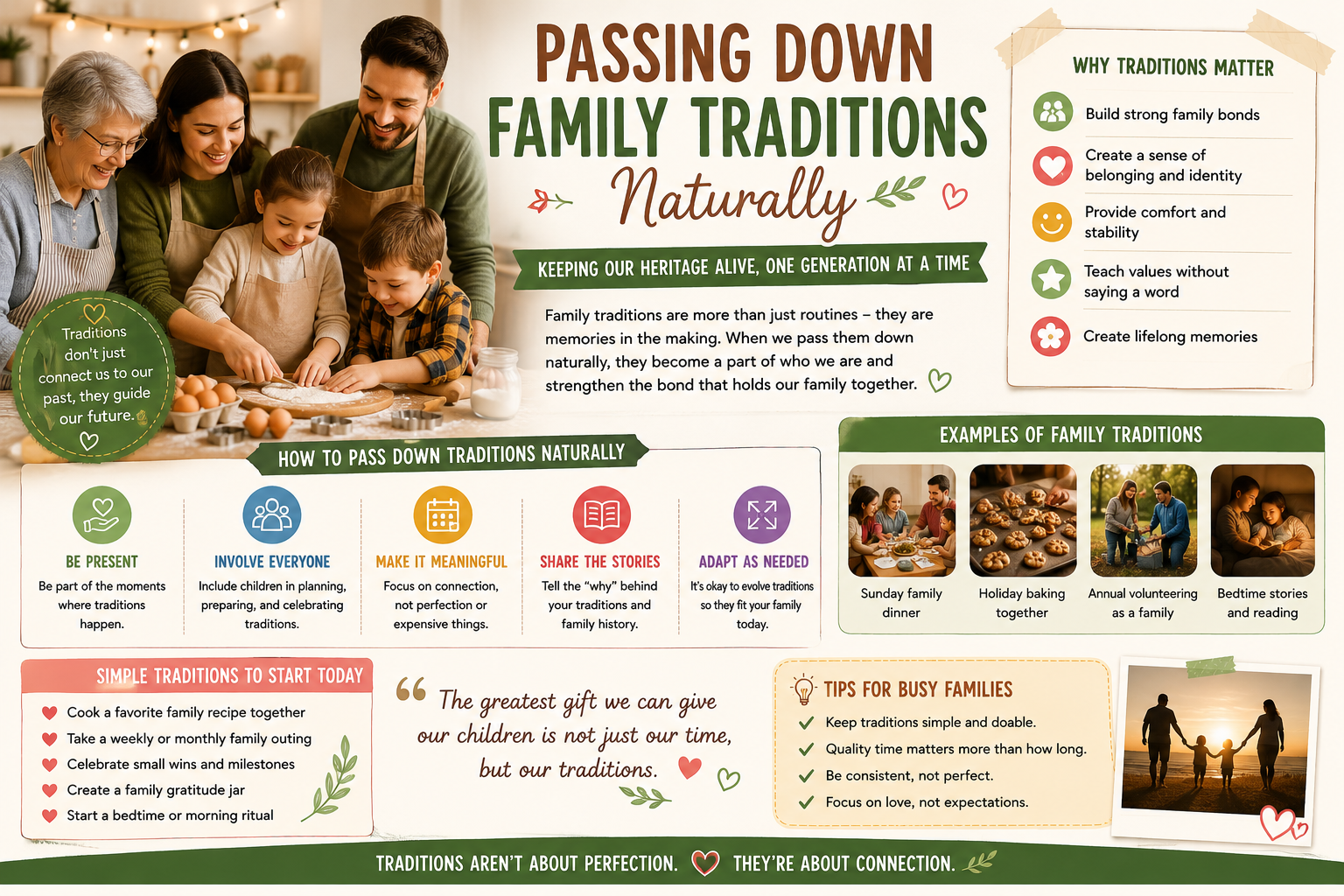
My grandmother never sat me down and said ‘now I will teach you a tradition.’
She just made chai the same way every morning — two cardamom pods, always cracked not ground, milk added before the water was fully boiling. I watched from the kitchen doorway for years before I ever joined her. And one day, without any announcement, I was standing beside her doing it myself.
That is what passing down family traditions naturally actually looks like. Not a lesson. Not a scheduled activity. Not a PowerPoint on cultural heritage. Just a person doing something meaningful, consistently, in the presence of someone who is watching and quietly absorbing.
But here is what makes 2026 different from every generation before it: we are the first generation of parents trying to pass down traditions while also managing screen time, nuclear family isolation, cross-cultural marriages, migration to new cities, and the very real possibility that our children’s world will look nothing like the one those traditions were born into.
The old way of passing traditions down — by proximity, by repetition, by having three generations in the same house — is not available to most of us anymore. So how do we do it without forcing it? Without turning a beautiful living tradition into a homework assignment our children resent?
This guide is the honest answer to that question. Written for real families — joint or nuclear, urban or small-town, Indian or diaspora or somewhere in between — this is how you pass down family traditions naturally in the modern world.
Before we talk about how to pass down family traditions naturally, it helps to understand what actually makes a tradition stick in the first place. Because not everything repeated becomes a tradition, and not every tradition needs to look the same across generations.
Researchers who study ritual and family culture have found that traditions persist across generations for one reason above all others: they carry emotional meaning. Not because they were enforced. Not because children were told they were important. Because the people practising them visibly loved them.
Your children will not carry forward traditions because you explained why they matter. They will carry them forward because they watched you light up while doing them.
This changes the entire approach. Instead of asking ‘how do I make my children learn this tradition’, the right question is ‘how do I make sure they see what this means to me?’
| Tradition Type | What It Looks Like |
| Landmark traditions | These happen at specific, recurring moments — festivals, birthdays, anniversaries, new year. Diwali puja, Christmas morning rituals, Eid family gatherings, anniversary dinners. These are the easiest to notice and the hardest to keep consistent when life gets busy. |
| Everyday traditions | These are the small, repeated acts that most families don’t even recognise as traditions until they’re gone. Sunday morning chai together. Reading before bed. The specific way your family says goodbye before a journey. The dish that appears whenever someone comes home after a long absence. These are often the most powerful. |
| Passage traditions | These mark life transitions — a child’s first haircut, coming-of-age rituals, the way a wedding is conducted, how a family grieves. These are the traditions most at risk of being lost in nuclear families because they require community knowledge to perform correctly. |
Understanding which type of tradition you are trying to preserve changes how you approach it. Landmark traditions need calendar intentionality. Everyday traditions need daily awareness. Passage traditions need community connection.
Here is the central truth of passing down family traditions naturally: you cannot force someone to inherit meaning. You can only create the conditions in which meaning is discovered.
Every parent who has tried to force a tradition knows exactly what happens. The child goes through the motions. They comply. They are polite about it. And the moment they leave home, the tradition disappears — because it was never theirs. It was yours, performed by them under obligation.
The difference between a tradition that lasts and one that dies with your generation comes down to one word: invitation. Not instruction. Not obligation. Invitation.
The families who most successfully pass down their traditions are the ones who hold those traditions lightly — who love them deeply but do not grip them tightly. Traditions survive when they are living things, not museum pieces.
These are not projects. They are not scheduled activities. They are ways of being in your family that carry tradition forward without anyone feeling like it is being taught.
Food is the most powerful vehicle for passing down family traditions naturally. It engages every sense, it creates physical memory, and it is repeated often enough to become deeply embedded. Here is how to use it intentionally:
The most common failure in festival traditions is that they become performances rather than experiences. You set everything up correctly. You light the right lamps. You say the right words. And your children sit there politely, waiting for it to be over.
The fix is not more explanation. It is more embodiment. Your children need to see that the festival means something to you — not as an obligation, but as something you would do even if nobody was watching.
One of the most powerful — and most invisible — ways of passing down family traditions naturally is through language. Not through formal language classes, but through everyday use.
Traditions need physical anchors. A place, an object, a smell — something that makes the nervous system say ‘this is familiar, this is home, this is ours.’
For families spread across cities or countries, passing down family traditions naturally requires an honest engagement with technology — not as a replacement for in-person connection, but as an extension of it.
If you are in an interfaith, intercaste, or cross-regional marriage, the question of which traditions to pass down is not abstract — it is a real daily negotiation. And it is one of the most underserved topics in all of family tradition writing.
Here is what actually works, based on real families who have navigated this:
Children who grow up with two cultural or religious traditions are not confused. Research on bicultural identity consistently shows they are often more resilient, more empathetic, and more comfortable with ambiguity than children raised with a single cultural identity. The goal is not to choose one tradition over another. The goal is to make both feel like home.
In many modern families, one parent grew up without a strong connection to their own cultural tradition — either because of migration, adoption, family rupture, or simply a secular upbringing. This creates an asymmetry: one parent has rich traditions to transmit, the other has a gap.
The answer is not for the disconnected parent to perform enthusiasm they do not feel. It is for them to become a curious companion to the other parent’s traditions — asking genuine questions, participating with openness, and modelling for the children what it looks like to encounter something cultural with respect and interest, even without personal history.
If you have moved from your hometown, your state, or your country, passing down family traditions naturally faces a specific challenge: the physical ecosystem that made those traditions feel normal no longer exists around you.
The smell of incense that used to come from three houses was just the neighbourhood. The sound of temple bells in the morning was just background. The way everyone around you dressed during festivals was just what people wore. When you move, all of that context disappears — and suddenly the tradition that was invisible because it was everywhere becomes visible because it requires deliberate effort to maintain.
This is hard. And it is also an opportunity — because traditions practised with deliberate intention tend to be passed down more successfully than traditions that are simply absorbed through environmental proximity. Your children may know your traditions more deeply than you know your own, simply because you had to explain them.
This is the section most blogs skip. And it is one of the most important ones.
Not every family tradition deserves to be passed down. Some traditions carry within them structures of inequality — expectations about who serves and who is served, who has voice and who does not, who belongs and who is excluded. Passing these down without examination is not cultural preservation. It is cultural perpetuation of harm.
The good news: you do not have to choose between your cultural identity and your values. Traditions can be examined and reformed while retaining their meaning. The ceremony can stay; the hierarchy within it can go. The food tradition can stay; the expectation that only women make it can go. The festival can stay; the caste-based guest list can go.
How to have this conversation in your family:
Every tradition that exists today was started by someone. Your great-grandmother was once a young woman who made a dish for the first time and did not know it would be made by her great-grandchildren a hundred years later. You have the same power — right now, today — to start something that lasts.
The conditions for a new tradition to take root are simple:
| New Tradition | How It Works |
| Friday night story hour | One adult tells one real family story every Friday evening — no screens, just the story. Rotates across family members including children as they get older. |
| The birthday letter | Every birthday, each parent writes the child a letter about who they were that year. Sealed in an envelope, read together when the child turns 18. |
| First day of every season ritual | Acknowledge the season change with a small, consistent act — a specific food, a specific walk, a specific prayer. Connects children to the natural calendar their ancestors lived by. |
| The family recipe addition | Every year on a specific date, the family collectively decides to add one new recipe to the family recipe book — either inherited or invented. |
| Return home ritual | Every time a family member returns from a long journey, there is a specific welcome — a specific food made, a specific song sung, a specific phrase said. Small but deeply felt. |
| The gratitude naming | Before a family meal on a specific day each week, each person names one thing they are grateful for. Not as a performance, just as part of eating together. |
| Annual family photograph in the same spot | Every year on the same date, the family takes a photograph in the same location. Across decades, the changing faces create a living record. |
If you are a grandparent reading this — or a parent thinking about the role of grandparents in your family’s tradition-keeping — this section is for you.
Research on intergenerational transmission consistently shows that grandparents are the most effective carriers of family tradition. Not because they are more knowledgeable, but because they have no agenda. They are not trying to produce a certain kind of child. They are just themselves — and being around a person who is fully themselves, practising what they love, is one of the most powerful learning environments that exists.
The ways grandparents pass down family traditions naturally:
Passing down family traditions naturally means transmitting cultural practices, rituals, and values through everyday living rather than through formal instruction or obligation. It happens when children observe the adults they love practising something meaningful, feel genuinely welcome to participate, and slowly absorb the tradition through repeated exposure and positive association. The key word is ‘naturally’ — the tradition grows into the child the way language grows into a child: through immersion, relationship, and love, not through lessons and tests.
Research in developmental psychology consistently shows that children who have strong family traditions and who know their family’s stories show greater emotional resilience, higher self-esteem, stronger identity, and better ability to navigate difficult situations. The landmark Marshall Duke and Robyn Fivush study at Emory University found that children who knew more about their family’s history had better mental health outcomes across multiple measures. Family traditions create what researchers call ‘intergenerational narratives’ — the sense of belonging to something larger than yourself. This sense of belonging is one of the most powerful protective factors in child development.
The most effective approach is counterintuitive: stop trying to make them care. Instead, care deeply yourself, and let them see it. Do the tradition fully, with genuine engagement, without requiring their participation. Create an open invitation — they can join or observe, but neither is obligatory. Most children who initially resist traditions begin participating on their own when they observe that the tradition genuinely matters to someone they love, and when they are never made to feel guilty for their initial disinterest. Resistance to a pushed tradition is normal. Curiosity about a lived one is almost inevitable.
The most important thing is to find community — other families who share your regional or cultural background, whether through a local temple, cultural association, or online group. Traditions are communal and are much harder to sustain in complete isolation. Beyond community, focus on the traditions that travel well: food traditions, language habits, festival observances at home, and family storytelling. These require no physical infrastructure beyond your own household. For the traditions that genuinely require community or geography — certain passage rituals, regional festivals, temple observances — plan for return visits to your home region when possible, and use video calls with extended family to participate remotely.
Yes — and in many cases, it is necessary. Traditions that are kept alive must be living things, not museum exhibits. A tradition that is maintained exactly as it was performed three generations ago, regardless of changed context, often loses its meaning and becomes hollow performance. The heart of any tradition — the value, the connection, the celebration, the memory it honours — is what deserves to be preserved. The specific form it takes can adapt to new circumstances, new understandings, and new family compositions without the tradition being ‘lost.’ Changed traditions that retain their heart are more alive than unchanged traditions that have lost theirs.
The most successful interfaith and intercultural families operate on a ‘both, not either’ principle. Each tradition is given its own uncontested space and celebrated with full integrity rather than blended into a compromise that waters down both. Children in these families benefit enormously — they grow up with access to two rich cultural identities and typically develop greater cultural intelligence and flexibility than peers raised in monocultural households. The key is that both parents need to be genuinely respectful of each other’s traditions, ideally finding genuine appreciation rather than mere tolerance. Children absorb not just the tradition but the emotional relationship the parent has with it.
The traditions that take root most easily are the simplest and most frequent. Specific foods on specific days. A consistent goodbye ritual before long journeys. A question asked at the dinner table on the same day each week. Reading the same story aloud at the same time each year. A specific greeting used only within the family. These tiny repeated acts are the seeds of lasting traditions — they require almost no planning, just consistency and genuine feeling. The grandmother who always pinches the same cheek and says the same blessing is performing one of the most powerful tradition-transmission acts possible, entirely without knowing it.
This is one of the most important and most delayed actions in family tradition preservation. Do not wait for the ‘right time’ — start now, even imperfectly. Use your phone to record a five-minute video of an elder making a traditional dish, performing a prayer, or simply talking about their childhood. Ask specific questions rather than general ones: ‘How exactly did your mother make this?’ rather than ‘Tell me about your traditions.’ Specific questions get specific answers. Compile these recordings in a shared family folder or drive that multiple family members can access. Also consider writing down the stories — not just the procedures, but the context, the emotion, the memories attached. The procedure can be looked up. The emotion cannot.
Passing down family traditions naturally is not a project with a completion date. It is not something you succeed at or fail at. It is something you practise — imperfectly, inconsistently, sometimes brilliantly, sometimes not at all.
The traditions that survive into your grandchildren’s lives will not be the ones you performed most perfectly. They will be the ones you loved most visibly. The ones your children saw light something in you that nothing else did. The recipe you made while humming. The prayer you said quietly before sleep, not for their benefit but for yours. The story you told at the dinner table not because it was educational but because you love telling it.
Your children are watching. Not all the time — sometimes they are distracted, or resistant, or somewhere entirely else. But more than you know, they are watching. And what they are absorbing is not the procedure of the tradition. It is the fact that it matters to you.
That — more than any scheduled tradition night, more than any cultural enrichment class, more than any beautifully documented recipe book — is how passing down family traditions naturally actually works.
You carry it. They watch. One day, without any announcement, they are carrying it too.