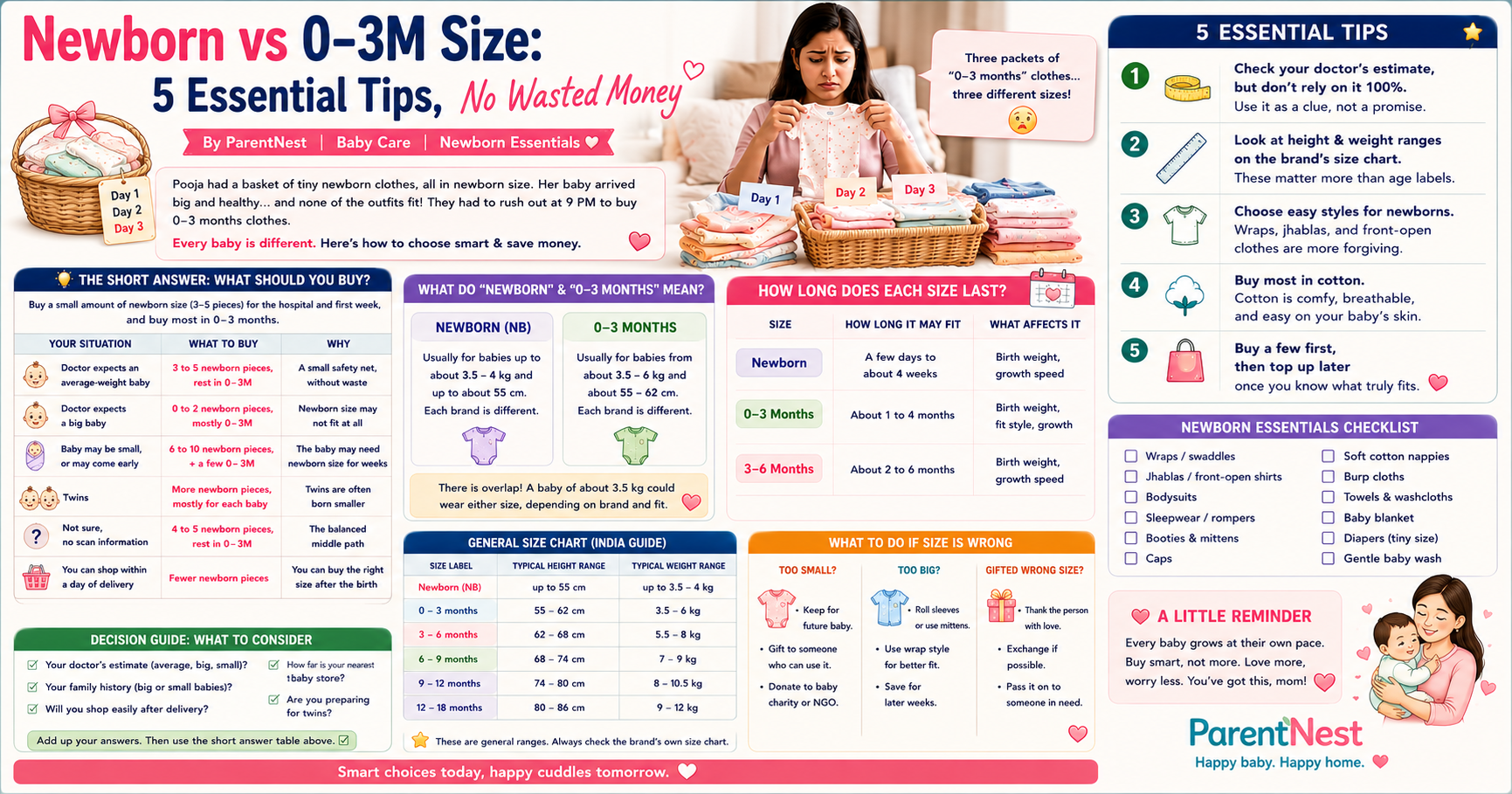
Pooja had a gorgeous basket of tiny clothes ready in her hospital room. She had folded each piece twice, tied a little ribbon around every set, and written “Day 1,” “Day 2,” and “Day 3” on small paper slips.
All of it was newborn size.
Her baby arrived two days after the due date, and she was a big, healthy girl. The nurse placed her on the scale and smiled. “Madam, achhi weight hai.”
Pooja smiled back, a very tired smile. Then she reached for the first outfit in her basket.
It would not go over the baby’s legs.
Should I Buy Newborn Size Clothes or 0-3 Months? 5 Easy Tips
She tried the second one. The snaps would not close across the tummy. The third was like trying to dress a very small doll’s clothes on a real baby. Her husband stood there, looking at the pile, saying “Arre, yeh toh bahut chhote hain.”
They ended up sending a cousin to a nearby shop at 9 PM, to buy anything labelled 0-3 months. The beautiful basket with the ribbons went back into the bag. It stayed there for two months, and then went to a neighbour whose baby was smaller.
That is the story of the wasted newborn clothes. But I also know another story, with the opposite ending. A friend of mine had a baby a few weeks early. She had bought only 0-3 months, because she had read that “newborn size is a waste.” Her baby swam in those clothes. They had to roll the sleeves three times, and the neck kept slipping over the baby’s chin. She had to go out and buy tiny clothes in a hurry, at full price, with a baby in the NICU.
So, who is right? Should you skip newborn size, or should you buy it? Honestly, both stories are true. There is no one answer for every baby. But there is a clear way to decide, and a way to make sure you do not waste money whichever way things go.
In this article, I will help you answer the question: “Should I buy newborn size clothes or 0-3 months?” I will share 5 essential tips, a simple decision guide, and a plan for what to do if you end up with clothes that are too small, too big, or gifted in the wrong size.
Quick note: I am a parent and content writer, not a doctor. I cannot predict your baby’s size, and no one can with full certainty. For questions about your baby’s expected weight, growth or health, please talk to your doctor.
Table of Contents
The Short Answer: Should I Buy Newborn Size Clothes or 0-3 Months?
Buy a small amount of newborn size (about 3 to 5 pieces) for the hospital and first week, and buy most of your clothes in 0-3 months. Skip newborn size almost completely only if your doctor expects a big baby, and buy a bit more only if your baby may be small or early.
Here is the same answer in a simple table:
| Your situation | What to buy | Why |
|---|---|---|
| Doctor expects an average-weight baby | 3 to 5 newborn pieces, rest in 0-3M | A small safety net, without waste |
| Doctor expects a big baby | 0 to 2 newborn pieces, mostly 0-3M | Newborn size may not fit at all |
| Baby may be small, or may come early | 6 to 10 newborn pieces, plus a few 0-3M | The baby may need newborn size for weeks |
| Twins | More newborn pieces, mostly for each baby | Twins are often born smaller |
| Not sure, no scan information | 4 to 5 newborn pieces, rest in 0-3M | The balanced middle path |
| You can shop within a day of delivery | Fewer newborn pieces | You can buy the right size after the birth |
Now let me explain why this works, and how to decide for your own baby.
Why This Question Is So Hard to Answer
If only someone could tell us the exact size of the baby before birth, this article would not be needed. But that is not how it works.
Babies are born in many sizes. Some are small, some are average and some are big. All can be healthy. Even within one family, siblings can be very different.
Scan estimates are estimates. Your doctor may tell you at a late scan that the baby is expected to weigh a certain amount. This is useful, but it is an estimate, and it can be a little higher or lower than the real birth weight. Please use it as a clue, not a promise.
Delivery dates can change. A baby may come earlier than the due date, or later. This changes the size of the baby.
Newborn size is also a short window. Even if your baby fits into it on day one, the baby may outgrow it in a couple of weeks. Babies gain weight and length quickly in the early weeks.
So the challenge is to prepare for a range, not for one fixed size. That is what a smart plan does.
What Does “Newborn Size” Really Mean?
Let me explain this in simple words, because the labels can be confusing.
Newborn (NB) size is meant for babies in the first days and weeks of life. Many brands design it for babies up to about 3.5 to 4 kg, and up to about 55 cm in length. These are not exact numbers. Each brand has its own idea, as we explained in our guide to the baby clothing size chart in India.
0-3 months size is meant for babies roughly from the first few weeks up to about the third month. Many brands design it for babies from about 3.5 to 6 kg, and from about 55 to 62 cm.
Notice the overlap. A baby who weighs about 3.5 kg could wear either size, depending on the brand and the fit of the clothes. That overlap is where the decision lies.
Here is another thing that surprises parents: a newborn size garment is not much smaller than 0-3 months in many cases. The difference between them can be small, and the shape matters more than the label. A 0-3M jhabla with ties may fit a newborn well. A 0-3M bodysuit with a narrow neck may not.
How Long Does Each Size Last?
This varies a lot, but here is a rough picture.
| Size | How long it may fit | What affects it |
|---|---|---|
| Newborn | A few days to about 4 weeks | Birth weight, growth speed |
| 0-3 months | About 1 to 4 months | Birth weight, fit of garment, feeding |
| 3-6 months | About 2 to 4 months | Growth spurts |
A baby born at a good weight may fit newborn size for only a few days, or not at all. A baby born small may stay in it for a month or more. This is why the phrase “outgrow in weeks” is so common in baby shops and parenting groups.
The Weight Picture: Why Small Babies Are Common in India
I want to be careful here, because I am not a doctor, and I do not want to say anything that sounds like medical advice. But there is one general point I can share: many healthy babies in India are born on the smaller side, often somewhere in the range of about 2.5 to 3.5 kg, though there is a wide spread. Some are born bigger, and some are born smaller.
Why does this matter for clothes? Because the global advice “skip newborn size, babies grow fast” is often written for places where babies tend to be born bigger on average. For many Indian families, a small stock of newborn clothes makes real sense.
But please do not take that as a rule for your baby. Your baby may be different. Use your own situation to decide.
The Cost of Getting It Wrong (A Simple Example)
Let me show you why this matters, with a simple example. These numbers are illustrative, not real prices.
Imagine you buy 12 newborn outfits at a cost of Rs 250 each. That is Rs 3,000. If your baby fits them for only one week, and wears each outfit just 3 times, you have spent about Rs 83 per wear.
Now imagine you buy 4 newborn outfits and 8 outfits in 0-3 months, at the same price. If the baby fits the 0-3M outfits for 6 to 8 weeks, and wears each many times, your cost per wear drops by a lot.
The lesson is simple: the shorter the time a size fits, the more expensive it is per wear. Newborn size is the shortest-lived size, so it is the one to buy in small numbers.
But the opposite is also true: if your baby really needs newborn size, and you have none, you may end up paying a premium in a rush, with a tired mind and a crying baby. A small, planned stock avoids that.
How to Decide: Five Simple Questions
Here is a simple way to decide for your own baby. Answer these five questions, and you will see a pattern.
Question 1: What does your doctor say about the baby’s expected size? If your doctor, or your latest scan report, says the baby is expected to be small, you will need more newborn size. If the baby is expected to be big, you will need fewer or none. If the doctor has not said anything, treat the baby as average.
Question 2: Is there any chance of an early birth, or twins? Babies born early, and twins, are often smaller. If this applies to you, plan for more newborn size. Ask your hospital what size the baby may need.
Question 3: Can someone shop for you after the birth? If a family member or friend can run to a shop or place a same-day order within a day or two, you can keep your newborn stock small. If you live far from shops, or have no help, keep a slightly bigger safety net.
Question 4: How often do you wash baby clothes? If you wash daily and dry fast, you need fewer clothes overall, and a few newborn pieces will be enough. If you wash only every few days, you may want more of everything.
Question 5: What will the weather be like? In a hot summer, babies wear just a light jhabla and a nappy, and fit is not a big issue. In a cold winter, a baby needs layers, and wrong sizes can be a bigger problem.
Here is how to read your answers:
- Mostly “average, no special risks, can shop later”: 3 to 5 newborn pieces.
- Mostly “big baby expected”: 0 to 2 newborn pieces.
- Mostly “small, early or twins”: 6 to 10 newborn pieces per baby.
- Mixed or unsure: 4 to 5 newborn pieces, and keep your tags.
5 Essential Tips to Avoid Wasting Money on Newborn vs 0-3M Clothes
Now the heart of this article. These five tips are the ones that save the most money and stress.
Tip 1: Decide by Your Doctor’s Guidance, Not by Hope or Fear
This is the most important tip, and the one that most parents skip.
We all imagine our baby in a certain way. Some parents are sure they will have a tiny baby and buy all newborn. Others are sure they will have a big healthy baby and buy all 3-6 months. Both are guessing.
Instead, use real information:
- Ask your doctor, at a late visit, whether the baby is expected to be on the smaller, average or bigger side. Doctors often share this, if you ask.
- Ask whether there is any chance of early delivery, and what size the baby may need in that case.
- If you are having twins, ask your hospital for guidance on clothing sizes.
- Remember that the estimate is not exact. Keep room for a surprise.
A small note: do not feel upset if your doctor says the baby is expected to be small or big. Both are common. Use the information only for planning clothes, and for everything else, follow your doctor’s advice.
What this saves you: the cost of buying a full set of the wrong size.
Tip 2: Buy “Just Enough” Newborn Size, and Make It Adjustable
If you are buying newborn size at all, buy it smartly.
How many? For an average baby, about 3 to 5 pieces is enough. That covers the hospital stay and the first few days at home, with daily washing. If you wash less often, add one or two more.
What type? Choose the types of clothes that fit across a range of sizes:
- Jhabla and front-open tops with ties. They adjust to the baby’s chest.
- Wraps and swaddles. Most are one size, and they are useful at any age.
- Soft cotton bodysuits with an envelope neck. The stretch helps.
- Loose gowns and kaftans. They fit a wide range.
- Pants with foldable cuffs. You can roll them up.
What to avoid in newborn size: costly, fancy outfits that the baby will wear once. Skip tiny shoes, stiff frocks and anything with hard parts. If you want to buy a special outfit, buy it in 0-3 or 3-6 months, so it lasts longer.
Also, keep the tags on a few of the pieces, so you can exchange them if the shop allows.
What this saves you: the “worn once” clothes that fill the cupboard.
Tip 3: Put the Bulk of Your Money in 0-3 Months, and Choose Forgiving Designs
This is where most of your clothes budget should go. The 0-3 months size is the workhorse size, and for many babies it fits longer and more comfortably than newborn.
But not every 0-3M garment is a safe buy for a tiny baby. Here is how to choose pieces that work for both a small newborn and a three-month-old.
Choose these:
- Jhabla and wraps. Ties let you adjust the fit.
- Envelope-neck bodysuits. The neck stretches over the shoulders, and the snaps keep it in place.
- Pants and sleepsuits with fold-over cuffs. Roll up the cuffs for a small baby, and unroll them as the baby grows.
- Footless sleepsuits. There is no foot length to worry about.
- Soft, stretchy cotton knit rather than stiff woven fabric.
- Side-snap or front-open styles. They fit across a wider range.
Be careful with these in 0-3M:
- Anything with a narrow neck. It may be hard to pull over a small baby’s head.
- Clothes with a lot of extra fabric at the shoulders. They may slide off a tiny baby.
- Very long sleeves on a very small baby. Fold them back, or choose another piece.
- Loose sleepwear. For sleep, the fit matters for safety. A baby should not be lost inside a large garment. Ask your pediatrician about safe sleep clothing.
A trick for small babies in 0-3M: If your baby is small, and the clothes are a bit big, fold back the sleeves and cuffs once or twice, and use a soft swaddle or wrap over the top for warmth. This works well for a few weeks, until the baby grows into the garment.
A trick for big babies in 0-3M: If your baby is big and long, check the length of the legs and the width of the chest. A garment that fits across the chest may be too short in the legs. In that case, choose pants and tops separately, rather than all-in-one outfits, and move to 3-6M sooner. (We explain how to measure in our baby clothing size chart guide.)
What this saves you: the stress of discovering that your 0-3M clothes do not suit your baby’s actual shape.
Tip 4: Use a Smart Gift and Exchange Strategy
Gifts are the biggest hidden reason for wrong sizes. Relatives and friends love to buy baby clothes, and most of them pick the size by age. They think a newborn must wear newborn or 0-3M. So you get a mountain of the two smallest sizes, and the baby outgrows them within weeks.
Here is how to handle it with warmth, and without hurting anyone’s feelings.
Before the birth:
- Gently guide the gifts. When someone asks what to buy, say: “Anything in 3-6 or 6-9 months would be lovely. Babies grow so fast, and the small sizes are already covered.” Most people are happy to have a clear idea.
- Share a small list. A simple message, like “We need swaddles, burp cloths, soft cotton in 3-6M,” can save you a lot.
- Ask for gift receipts, where you can. Some shops allow exchange.
After the gifts arrive:
- Do not wash or cut tags from every gift. Wash only what you will use now. Keep the rest unwashed, with tags, in a bag, labelled by size.
- Sort by size. Make a bag for each size, like 0-3M, 3-6M and 6-9M, and put the clothes inside. When your baby grows into a size, open that bag.
- Exchange what you can. If the shop allows, swap the extra newborn and 0-3M pieces for bigger sizes. Do it within the return window.
- Say thank you, and do not worry about what you exchange. Most gift givers would prefer that the baby uses the clothes.
If gifted clothes turn out too small:
- Wash them well, and pass them to a friend, relative or neighbour with a smaller baby.
- Donate them to a hospital, a charity or a local group that collects baby clothes. Check with the group before dropping them, to make sure they accept used items, and that the clothes are clean and in good condition.
- Keep a few for a second baby, or for a future baby in the family, if you have the space.
- Use soft old cotton clothes in other ways: as cloth for wiping, as a base for a cloth nappy, or as a clean rag in the house. (Never use these for the baby’s skin, unless they are clean and soft.)
If gifted clothes turn out too big:
- This is the easy one. Store them in the correct size bag, and use them later.
- Check the season. A heavy woolen set gifted in March may be useful in December, so keep it safe.
What this saves you: the hundreds of rupees of “wasted baby clothes” that sit in a cupboard until the baby outgrows them.
Tip 5: Keep a “Ready-to-Buy” Plan for the First 48 Hours
The last tip is a quiet one, but it works like a safety net, and it lets you buy less newborn size at the start.
Here is the idea. Instead of buying everything before the birth “just in case,” you prepare a plan to buy the right size quickly after the birth, once you know the baby’s weight.
Here is how to set it up:
- Make a short list. Write down the 8 to 10 pieces you will need in the size the baby turns out to need. For example: 4 jhabla, 3 bodysuits, 2 pyjamas, 2 swaddles.
- Pick the shop. Choose a nearby shop, or an online store with same-day or next-day delivery, and save the product links in a note on your phone.
- Choose a helper. Tell a family member or friend that they are in charge of this errand, and give them the list and the budget.
- Keep a small safety net. Buy only 3 to 5 newborn pieces and 2 or 3 pieces in 0-3M, and keep everything else for after the birth.
- Get the weight. After the birth, ask the staff for the baby’s weight and length, and write them in your note.
- Shop that day. Your helper buys the rest, in the right size, within a day or two.
This plan works best if you live close to shops, or have a reliable delivery option. If you live far from shops, or if delivery is slow in your area, keep a bigger safety net instead.
What this saves you: the “just in case” purchases that turn out to be the wrong size, and the panic of a 9 PM shopping run.
Big Baby Clothes Size: What If Your Baby Is Born Bigger Than Expected?
Here is a situation many parents face. You prepared for an average baby, and the baby arrives bigger. The newborn clothes do not fit at all.
Do not worry. Here is what to do.
Step 1: Check the actual size. Ask for your baby’s weight and length. A baby of about 3.5 kg or above will often move straight into 0-3M, depending on the brand.
Step 2: Try the 0-3M clothes. Check whether the neck is wide enough, whether the snaps close easily, and whether the legs and arms have room.
Step 3: Use the adjustable pieces. Jhabla, wraps, gowns and swaddles still work for a bigger baby.
Step 4: Exchange or pass on the newborn pieces. If you kept the tags, exchange them for a bigger size. If you washed them, pass them on to a friend or donate them.
Step 5: Plan for 3-6M sooner. A big baby may move into 3-6M within a month or two. Start watching the signs, and buy a few pieces when needed. (See our size chart guide for the signs.)
Also remember: a big baby is not a problem. It is simply a baby who needs a bigger size. All babies are different, and your doctor is the best person to talk to about your baby’s growth.
Small or Early Baby: What If Your Baby Is Born Smaller Than Expected?
The opposite situation is also common. The baby arrives early or small, and even newborn size is loose.
Here is what to do.
Step 1: Ask your hospital team. They can tell you what to dress the baby in, how to keep the baby warm, and what size to buy. This matters most for very small or early babies. Their advice comes first, before any chart.
Step 2: Look for smaller sizes. Some brands and shops make tiny baby or preemie sizes. Ask the shop, or search online.
Step 3: Use soft cotton wraps and swaddles. They suit any size, and help keep the baby warm, if your doctor says it is safe.
Step 4: Choose a safe, snug fit. For sleep, a correct fit matters. Do not use very loose clothes. Ask your pediatrician what is best for your baby.
Step 5: Fold and adjust. Roll up cuffs and sleeves on newborn clothes, and choose styles with ties and snaps that adjust.
Step 6: Re-check the size every week or two. Small babies often grow quickly once they settle in. Move up when the clothes feel snug.
Never feel guilty about needing more newborn size. It is not a mistake. It is just a baby with its own timing.
Wasted Baby Clothes: What to Do With Clothes Your Baby Never Wore
Even with a good plan, you may end up with clothes that were not used, or were worn only once. This happens to almost every family. Here are some good ways to use them.
- Exchange or return, if the tags are on and the policy allows. Check the date.
- Pass them to a friend or cousin with a baby in the right size.
- Sell or swap. Many cities have online groups for parents to sell or swap baby clothes. Only share clean, good-quality items, and price them fairly.
- Donate to a hospital, orphanage, NGO or local group. Always ask first, and give only clean, undamaged clothes.
- Keep for a future baby, if you plan to have another child, and store them in a dry, clean place away from damp.
- Re-use the fabric. Soft cotton can become burp cloths, small washcloths or nappy inserts. Wash them well first.
The message here is simple: an unused outfit is not a wasted outfit if it finds another baby. Someone, somewhere, will be glad to wear it.
Storing Clothes for the Right Time
If you are saving clothes for later sizes, store them well, so they stay fresh and soft.
- Wash and dry them fully before storing, if they have been worn.
- Store in a clean, dry place, like a cupboard shelf or a cloth bag, and not in a damp corner.
- Keep sizes in separate, labelled bags. Write the size and the season on the label.
- Avoid mothballs near baby clothes, and avoid strong-smelling products. Ask your pediatrician if you want to use any storage product.
- Check the bags every few months, especially after monsoon, for dampness or insects.
- Before using any stored clothes, wash them once with a mild detergent.
A Simple Plan: How Many Clothes in Each Size?
Here is a sample plan for an average-sized baby, for a family that washes baby clothes daily or every two days. Adjust it using the questions earlier in the article.
| Size | Pieces to buy before birth | Notes |
|---|---|---|
| Newborn | 3 to 5 | Jhabla, bodysuits, one gown. Keep tags on |
| 0-3 months | 5 to 8 | Main size. Tops, pants, bodysuits |
| 3-6 months | 0 to 2 | Only if gifted, or if there is a sale |
| Swaddles and wraps | 4 to 6 | Mostly one size, useful for all |
| Burp cloths | 5 to 6 | Easy to make from old cotton |
If you expect a big baby: 0 to 2 newborn pieces, 7 to 10 in 0-3M, and a few in 3-6M.
If you expect a small or early baby: 6 to 10 newborn pieces, 3 to 5 in 0-3M.
For the full list of 21 newborn essentials, with quantities, read our newborn clothes checklist for India.
Seasonal Thinking: Does the Weather Change the Answer?
Yes, a little.
Hot summer (Indian summer): Newborns wear very little. A jhabla and a nappy are often enough at home. So the size matters less, and a loose 0-3M jhabla is almost always fine. You can keep your newborn stock very small.
Monsoon: Clothes dry slowly, so you may need more pieces overall. Keep the extra pieces in 0-3M, because that is the size that lasts longer.
Winter: Layers matter. In winter, a tiny baby in a very big sweater is not good. Buy a small sweater, or choose adjustable layers, and check the neck opening. If your baby is born in a cold season, you may want a few more newborn pieces, because the right fit helps with warmth.
In all seasons, remember to check the back of the baby’s neck. If it is sweaty, remove a layer. If it feels cool, add one. (For more on fabrics by season, read our guide to the best breathable fabric for baby clothes in India.)
10 Common Mistakes When Choosing Between Newborn and 0-3M
Here are the mistakes I see most often.
- Buying a full wardrobe of newborn size. It is the shortest-lived size.
- Skipping newborn size without checking anything. If the baby is small or early, you will be in a rush.
- Cutting all the tags too early. You lose the chance to exchange.
- Washing every gifted piece at once. Keep unneeded pieces unwashed, with tags.
- Buying fancy, one-time outfits in newborn size. Save the fancy outfit for a bigger size.
- Ignoring the shape of the garment. A narrow neck or a tight snap can make a garment unusable.
- Buying very loose sleepwear for a small baby. A correct fit is important for sleep.
- Not telling family which sizes to gift. Then you get a mountain of the same size.
- Forgetting the season. A size bought for summer may be worn in winter.
- Feeling guilty. Every parent buys a few wrong things. It is part of the journey.
What I Would Tell Pooja (and You)
Go back to Pooja, standing in the hospital room with her beautiful basket of tiny clothes, and a big baby girl who did not fit into any of them.
Here is what I would tell her. You were not wrong to prepare. You did what you could with the information you had. Next time, buy just a few newborn pieces, ask the doctor about the expected size, and keep the tags on. Send the family to exchange the rest. Put your money in the 0-3 months size, because it is the one most babies wear the longest. And keep a list of what to buy after the birth, so that you can shop calmly, not at 9 PM.
So, should you buy newborn size clothes or 0-3 months? Buy a few of both. A small, adjustable stock of newborn size protects you from the surprise of a small baby. A strong stock of 0-3 months gives you the clothes your baby will wear for the longest time. And a simple plan for gifts, exchanges and last-minute shopping saves you from waste.
There is no perfect answer. There is only a smart, flexible plan, and a parent who is kind to herself. You have both.
Frequently Asked Questions
Should I buy newborn size clothes or 0-3 months?
Buy a small amount of newborn size, about 3 to 5 pieces, for the hospital and the first week, and buy most clothes in 0-3 months. Buy more newborn size if your baby may be small or early, and almost none if your doctor expects a big baby.
Can I skip newborn size clothes completely?
Yes, if your doctor expects a big baby, or if you can shop quickly after the birth. But if your baby is small or comes early, you may need newborn size for a few weeks. A few adjustable pieces, like jhabla and wraps, give you a safety net.
How long does a baby wear newborn size?
It varies. A baby may fit newborn size for only a few days, or for up to a month or more if born small. Many babies outgrow it within a few weeks.
How many newborn size outfits do I need?
For an average baby, about 3 to 5 pieces is enough, with daily washing. For a small or early baby, 6 to 10. For a big baby, 0 to 2.
What if my newborn clothes are too small?
Exchange them if the tags are on and the policy allows. Or pass them to a friend, sell, swap or donate them, and move to 0-3 months.
What if my baby is too small for 0-3 months?
Fold back the sleeves and cuffs, choose adjustable styles, and use a wrap or swaddle for warmth. Ask your doctor or hospital about the right size, and look for smaller sizes in shops.
Does a big baby need newborn clothes?
Often not. A big baby may move straight to 0-3 months. Check the length and chest, and choose clothes with room.
Is 0-3 months too big for a newborn?
For some small babies, yes, but adjustable styles like jhabla, wraps and gowns still work. Avoid very loose sleepwear, and ask your pediatrician about safe sleep clothing.
What should I do with gifted clothes that are too small?
Wash and pass them on, donate them to a group that accepts used clothes, or keep them for a future baby. Ask first before donating, and give only clean, good-quality clothes.
How do I avoid getting too many newborn size gifts?
Tell family kindly that you would love clothes in 3-6 or 6-9 months, and share a short list of what you need. Ask for gift receipts, and keep tags on unused pieces.
How do I know what size to buy after my baby is born?
Get your baby’s weight and length from the hospital, and compare them with the brand’s size chart. Do not rely on age labels alone. Our baby clothing size chart guide explains how.
Is newborn size only for premature babies?
No. Many full-term babies who are small to average in weight fit it for a short time. But it is most useful for small and early babies.