
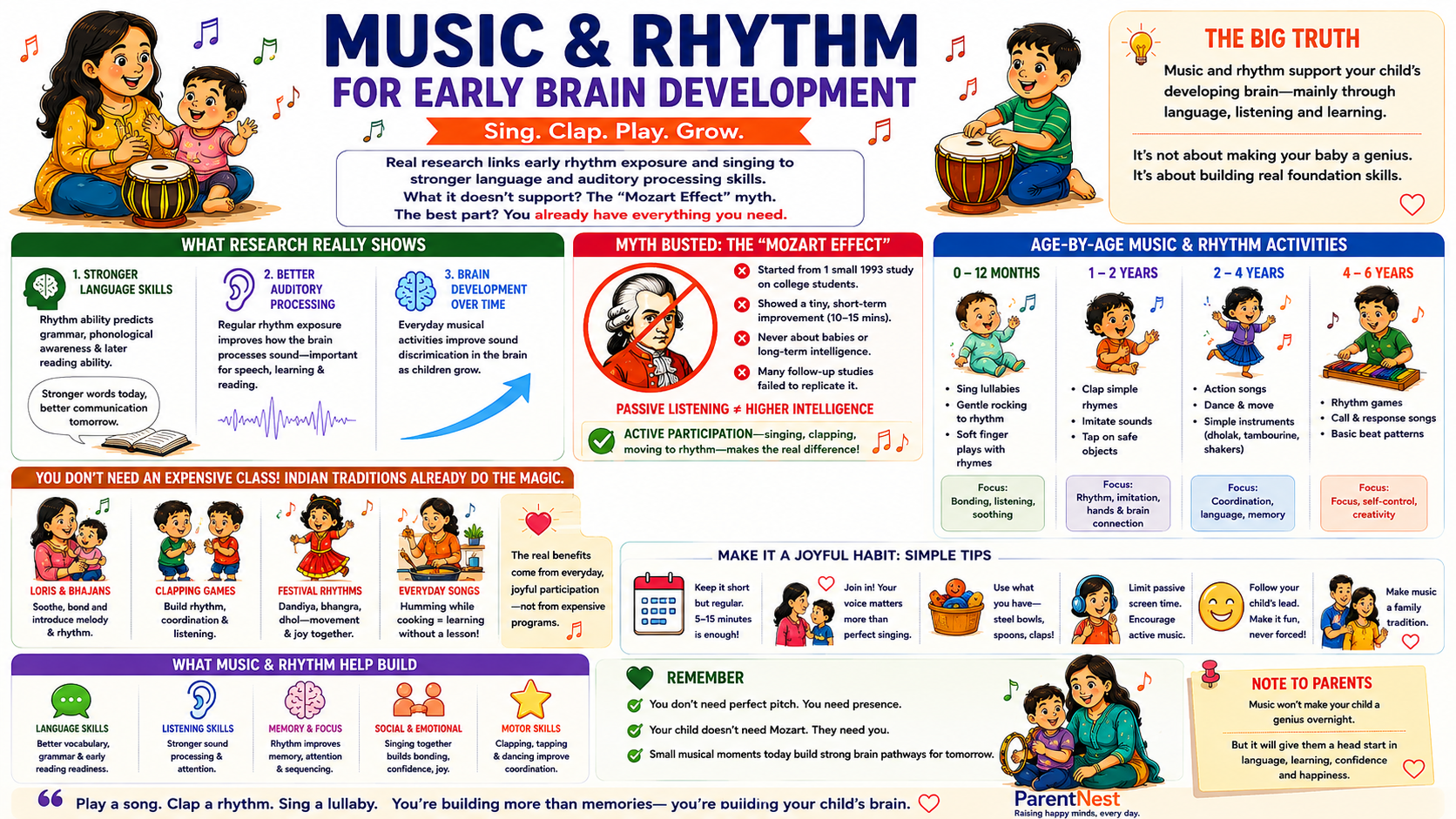
Music and rhythm do genuinely support early brain development — but not in the “make your baby a genius” way marketing often implies. Real research links early rhythm exposure and singing to stronger language and auditory processing skills, through mechanisms that are becoming better understood each year. What it doesn’t support is the popular “Mozart Effect” (the idea that passively playing classical music raises a baby’s intelligence) — that specific claim has been thoroughly debunked. The good news is that the activities that actually help are free and already familiar: singing lullabies, clapping games, and rhythmic play, not a paid class with a brand name attached.
Music and Rhythm Activities for Early Brain Development
Somewhere between the Dadi humming a lori at bedtime and the glossy brochure for a ₹15,000 “brain development through music” toddler program, there’s a real, research-backed answer about what music actually does for a young child’s developing brain — and it’s a lot less expensive and a lot more familiar than the brochure suggests. Most Indian households are already doing a version of this without realising it: bhajans playing during morning routines, clapping games passed down from grandparents, festival rhythms during Navratri or Ganpati, film songs hummed absentmindedly while cooking. The question worth answering honestly is which parts of this actually do something for a developing brain, and which parts are just pleasant background noise — both are fine, but they’re not the same thing.
This article looks at what music and rhythm research genuinely supports, debunks the specific myth that keeps getting repeated in marketing material, and lays out simple, free activities by age that use what most Indian homes already have.
Table of Contents
What music and rhythm actually do for a developing brain
The real link between rhythm and language
This is the strongest, most consistently supported finding in this area, and it’s less well-known than it deserves to be. Music and spoken language share a lot of underlying structure — both rely on timing, rhythm, and pattern recognition, and both are processed using overlapping brain systems. Research reviewing multiple studies has found that musical rhythm ability specifically predicts children’s performance on language tasks, including grammar and what’s called phonological awareness — the ability to notice and work with the sound structure of language, a skill closely tied to later reading ability. Some studies have found that rhythm discrimination skill is actually a strong predictor of a child’s grammar comprehension, which is a striking, specific finding rather than a vague “music helps everything” claim.
What happens with auditory processing
Several studies using brain-response measurements (recording the brain’s electrical response to sound) have found that infants and young children who get regular musical rhythm exposure — including fairly informal, everyday musical activity, not just formal training — show measurable differences in how quickly and accurately their brains process sound. One longitudinal study following children through preschool found that participation in ordinary, informal group musical activities (the kind of thing that happens in many playschools and homes) was associated with faster development of the brain’s sound-discrimination response over time. This matters because efficient sound processing in early childhood is connected to later language and reading skills.
What the research does NOT support (the Mozart Effect myth)
Here’s where it’s important to be honest, since this specific myth is repeated constantly in parenting content and school marketing material. The “Mozart Effect” — the popular idea that simply playing classical music (often specifically Mozart) to a baby, especially in the womb or during passive listening, measurably raises intelligence — comes from a single, narrow 1993 study on college students that measured a brief, temporary improvement in one specific spatial reasoning task after listening to music, lasting only about 10–15 minutes. It was never actually about babies or long-term intelligence at all. Despite this, the idea spread into a widespread myth about playing classical music to infants and even to pregnant bellies. Follow-up research attempting to replicate the original finding has largely failed to find a lasting or general intelligence effect, and more recent, broader reviews of music’s effect on general cognition describe the transfer effects as weak at best. Passive listening to any specific genre of music, however pleasant, isn’t shown to raise a baby’s intelligence. Active participation — singing along, clapping, moving to rhythm — is where the real, evidenced benefits (rhythm-language links, auditory processing) actually come from.
You don’t need an expensive class — the Indian-tradition case
Given that the real evidence points toward active participation in everyday rhythm and singing rather than passive listening to a specific genre, it’s worth saying plainly: a paid toddler “music and brain development” class isn’t required to get these benefits, and Indian households often already have exactly what the research supports, built into daily and festival life.
- Lullabies (lori): Singing directly to an infant — regardless of language, melody, or musical “correctness” — provides exactly the kind of live, rhythmic, socially engaged sound exposure the research on auditory processing and language points toward. A parent’s own voice, however untrained, is doing real work here.
- Clapping games and nursery rhymes: Traditional clapping games and rhymes, in any Indian language, build the rhythm-timing skills linked to phonological awareness — the mechanics matter more than the specific song.
- Bhajans and devotional singing: Group or family devotional singing, with its repetitive, predictable rhythmic structure, offers a genuinely rich, active rhythm experience for a young child present in the room, especially if they’re encouraged to clap or sway along rather than just listen passively.
- Festival rhythms: Dandiya sticks during Navratri, dhol beats during Ganpati visarjan, or simply clapping along to festival songs are active, socially embedded rhythm experiences — arguably closer to what the research actually studied than a quiet, passive classical-music listening session would be.
None of this is to say a music class is a bad choice if a family enjoys it and can afford it — structured group music activities do show real benefits in some studies. It’s simply that the specific evidence doesn’t support it being necessary, or being meaningfully better than these free, culturally familiar alternatives, when done with genuine engagement.
Age-by-age activities that actually work
0–12 months
- Sing directly to your baby regularly — during feeding, bath time, or before sleep — rather than relying solely on recorded music playing in the background
- Gently bounce or sway your baby in rhythm while singing, since the research on rhythm processing in infancy involves movement and body engagement, not just passive hearing
- Use simple, repetitive rhymes rather than varying material constantly — predictability and repetition appear to support early auditory pattern learning
- Respond to your baby’s own sounds rhythmically (a kind of vocal “call and response”) rather than only playing music at them
1–2 years
- Introduce simple clapping games with clear, steady rhythms, letting your toddler attempt to clap along even imperfectly
- Use household items as rhythm instruments — a steel katori and spoon, an empty tin, a plastic container — real percussion doesn’t require a purchased toy
- Sing along to familiar songs and pause occasionally to let your toddler fill in a word or sound, encouraging active participation over passive listening
- Dance or move together to music with a clear beat, connecting rhythm to physical movement
2–4 years
- Play simple rhythm “copy” games — clap a short pattern and have your child repeat it, gradually increasing complexity
- Introduce basic instruments if available (a small dholak, tabla, or even a homemade shaker) and let your child experiment with tempo and volume themselves
- Incorporate rhythm into everyday routines — clapping out the syllables of your child’s name, or the days of the week, links rhythm directly to language structure
- Encourage group musical moments during family or festival gatherings rather than treating music purely as background — active family participation appears to matter more than the specific genre or occasion
What not to do
- Don’t assume passive background music of any specific genre (including classical music) is doing meaningful developmental work on its own — active participation is where the evidence actually points.
- Don’t feel pressure to enroll in an expensive class specifically because of “brain development” marketing claims — the underlying research doesn’t show it’s necessary for the documented benefits.
- Don’t play music constantly throughout the day with no quiet time — some research on infant auditory development suggests quiet periods matter too, allowing a young child’s brain time to process without competing input.
- Don’t worry about musical “correctness” — singing off-key or clapping imperfectly doesn’t reduce the benefit; the engagement and rhythm exposure themselves are what matter, not performance quality.
- Don’t expect music activities to function as a substitute for addressing a genuine speech or language concern — if you’re worried about your child’s language development specifically, that’s worth raising with a pediatrician directly rather than relying on music activities alone.
Real moments parents recognize
You might catch yourself humming the same lori your own mother sang to you, slightly out of tune, and wonder if it’s “doing anything” compared to the polished nursery rhyme videos your child sees elsewhere — and the research would actually suggest your imperfect, live singing is doing more of the real work than the passive video.
Or you might watch your toddler bang enthusiastically on a steel tiffin box with a spoon, completely off-rhythm, and start to wonder if you should be correcting them toward “real” rhythm — when in fact that uncoordinated banging is exactly the kind of active exploration the research associates with rhythm development, long before precision matters.
Or during a family Navratri gathering, you might notice your two-year-old clapping wildly off-beat next to the dandiya circle, clearly delighted, and realize this chaotic, joyful participation is a far richer musical experience for their developing brain than a quiet hour of recorded classical music would ever be.
Frequently Asked Questions
Does music help brain development in babies?
Yes, in specific, evidenced ways — particularly rhythm’s link to language and auditory processing development. It doesn’t support the popular idea that any particular genre of music generally boosts intelligence; the real benefits come from active participation like singing and rhythmic movement, not passive listening.
Is the Mozart Effect real?
No, not in the way it’s popularly understood. The original study measured a brief, temporary effect on one spatial task in college students, not babies or long-term intelligence. Follow-up research has largely failed to replicate a lasting general intelligence benefit from passively listening to classical music.
Do I need expensive music classes for my toddler’s brain development?
Not based on the current evidence. The research points to active rhythm participation and singing — things like clapping games, lullabies, and family musical moments — as the meaningful activities, and these don’t require a paid program to be effective.
Is Indian classical music better than Western classical music for a baby’s brain?
The research doesn’t support any specific genre being superior for brain development; what matters more is active engagement (singing along, clapping, moving) rather than the genre of music being passively played.
Can rhythm activities help with speech delay?
There’s a real research link between rhythm skills and language development, but rhythm activities aren’t a substitute for professional evaluation if you have a genuine concern about your child’s speech. It’s worth discussing directly with a pediatrician or speech-language professional rather than relying on music activities alone.
Is playing music for a baby in the womb useful?
There’s limited strong evidence that prenatal music exposure produces measurable developmental benefits after birth; a baby’s hearing is still developing throughout pregnancy, and any specific claims about prenatal music boosting later intelligence should be treated with the same skepticism as the general Mozart Effect claim.
What age should a child start learning a musical instrument?
There’s no fixed “must-start-by” age for formal instrument training, and most research on early brain-development benefits relates to informal rhythm and singing exposure well before formal instrument lessons typically begin around age 4–6, depending on the instrument and the child’s interest.
Does clapping actually help toddler development?
Yes — clapping games build rhythm-timing skills that are linked in research to phonological awareness, a skill connected to later reading ability, alongside supporting bilateral coordination and social engagement.
Do lullabies actually do anything, or are they just for comfort?
Both — lullabies provide genuine comfort and bonding, and the live, rhythmic, socially engaged nature of a parent singing directly to a child aligns with the kind of active musical exposure the research links to auditory and language development.
How much music exposure is too much?
There’s no precise threshold established by research, but some evidence suggests quiet periods matter for a young child’s developing auditory system, so constant background music with no quiet time isn’t necessarily better than a more balanced mix of musical engagement and quiet.
Final thoughts
None of this requires buying an instrument, enrolling in a class, or curating a classical-music playlist for a nursery. It mostly requires doing what a lot of Indian households already do without thinking of it as “brain development” — singing off-key lullabies, clapping games passed down from a grandparent, banging a spoon on a steel tiffin box, joining in in a family bhajan or a Navratri circle. The research, read honestly, gives you permission to stop wondering whether the expensive class is necessary. The tune you already know, sung badly and often, is doing more than the brochure gives it credit for.