Physical Address
304 North Cardinal St.
Dorchester Center, MA 02124
Physical Address
304 North Cardinal St.
Dorchester Center, MA 02124

When Meghna found out she was pregnant with her second, her first genuine thought — before joy, before nervousness about managing two under three — was a strange flash of financial dread. She still remembered, vividly, the spreadsheet she’d built for her first daughter: hospital package, nursery furniture, a stroller she’d researched for three weeks, a diaper bag, a car seat, a whole colour-coded tab for “things nobody warned me about.” That spreadsheet had ended somewhere north of ₹3 lakh in the first year alone, and the thought of doing all of it again felt genuinely exhausting before she’d even opened a new tab.
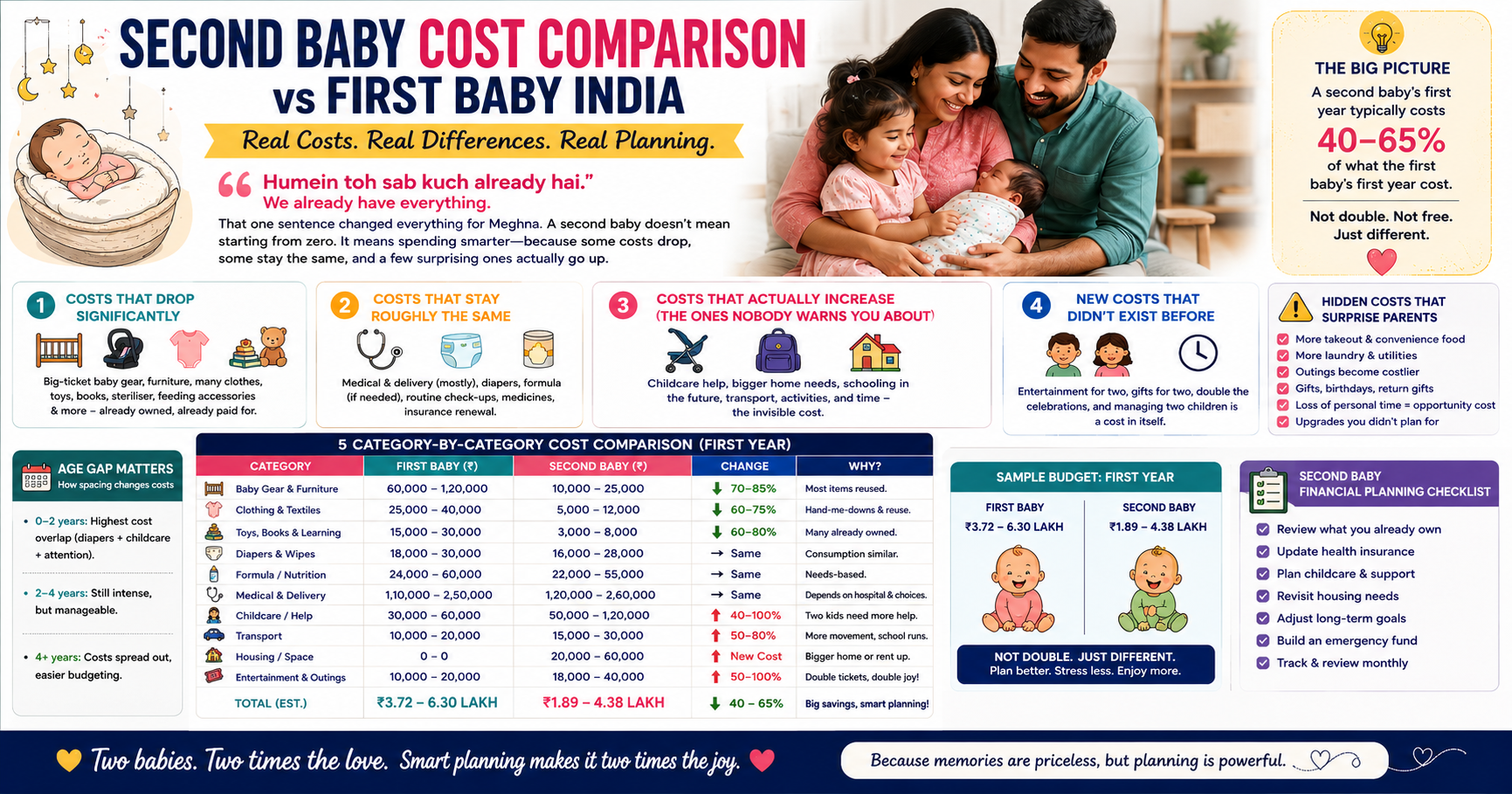
Then her husband said something that changed the whole conversation: “Humein toh sab kuch already hai.” We already have everything. And Meghna realised, sitting there, that she’d been mentally recalculating her first child’s entire budget from scratch, without accounting for the fact that a crib, a car seat, a full wardrobe of newborn clothes, a steriliser, and dozens of smaller items were sitting in a storage room upstairs, fully usable, costing nothing this time around.
That realisation — that a second baby’s actual cost profile looks meaningfully different from the first, not simply doubled — is the entire premise of this guide. Some costs genuinely fall dramatically. A few, surprisingly, go up. And a handful of expenses that didn’t exist at all with baby one become real, sometimes significant, considerations with baby two. This is a complete, honest, India-specific breakdown of exactly where the money actually goes differently the second time around.
The instinctive assumption most expectant parents make — that a second child simply doubles the household’s baby-related expenses — turns out to be meaningfully wrong in both directions. Several major cost categories drop dramatically because durable items (furniture, gear, many clothes) are already owned and simply get reused. A few categories increase, sometimes substantially, because of factors that genuinely didn’t exist with an only child — overlapping childcare needs, larger housing requirements, and compounding education costs chief among them.
The honest, useful framing: a second baby’s first-year cost, for many Indian families, tends to land somewhere between 40-65% of what the first baby’s first-year cost was — a genuinely significant saving, but not the “almost free” assumption some families mistakenly go in with, particularly once childcare and space considerations (covered later in this guide) are factored in properly rather than overlooked.
Big-ticket durable items — crib, car seat (assuming it’s not past its safety-rated expiry, discussed further in Section 11), stroller, high chair, baby bathtub, steriliser, baby monitor — represent one of the largest cost categories for a first baby and, when reused for a second, effectively drop to zero beyond minor cleaning or minor part replacement.
Newborn and early-months clothing, assuming reasonable storage and the second baby’s similar seasonal timing to when the first baby’s clothes were originally purchased, can be substantially reused, particularly items that see limited wear before being outgrown (many newborn-size items are worn for only a few weeks).
Nursery setup and room decor, if the family isn’t specifically creating an entirely separate nursery space for the second child (many Indian families, particularly in space-constrained urban housing, have the second child share a room with the first or with parents initially), represents a cost that’s largely already been incurred and doesn’t need to be substantially repeated.
“Learning curve” costs — items purchased for a first baby that turned out to be unnecessary or rarely used (certain gadgets, particular toy categories, specific products a first-time parent bought out of anxiety rather than genuine need) are typically not repurchased for a second child, since parents have already learned, through direct experience, what was actually worth the money.
Some prenatal and postnatal information/education costs — antenatal classes, certain first-time-parent educational resources or books — are often skipped entirely the second time around, since the foundational knowledge already exists from the first pregnancy and postpartum experience.
Diapers, wipes, and other consumables remain a recurring cost regardless of which child is using them, since these are inherently non-reusable — the second baby’s consumable costs are genuinely comparable to the first’s, adjusted only for any general price inflation between the two children’s respective infancy periods.
Formula feeding costs, if applicable, similarly don’t meaningfully change between children, since this is an ongoing consumable expense tied directly to that specific child’s needs rather than something that benefits from prior purchases.
Vaccination costs remain essentially constant per child, since immunization schedules apply individually to each child regardless of what was previously spent on an older sibling.
Basic paediatric care and routine check-up costs remain broadly similar per child, tied to that individual child’s own health needs and check-up schedule rather than benefiting from any prior-child cost efficiency.
Childcare costs frequently increase, sometimes substantially, once a second child arrives, particularly if the first child is still young enough to require significant supervision alongside a newborn — many families who managed with a part-time helper or no formal help for their first child find they genuinely need more structured, often more expensive, childcare support (a full-time nanny, additional part-time help, or increased daycare hours) once managing two young children simultaneously, a cost category explored in full in Section 7.
Housing costs can increase if the family’s current living space genuinely can’t comfortably accommodate a second child long-term, prompting a move to a larger home, an added room, or renovation — a cost that didn’t exist at all with the first child and can represent one of the single largest financial impacts of a second child for space-constrained urban families, explored further in Section 8.
Transport costs can increase, particularly if a family’s current vehicle can’t comfortably or safely accommodate two car seats alongside other family members, sometimes prompting a vehicle upgrade specifically driven by the second child’s arrival rather than general family growth over time.
Cumulative education costs compound rather than simply double, since two children moving through school simultaneously (rather than one having graduated before the second begins significant schooling) means a family faces overlapping, simultaneous major education expenses for a meaningfully longer stretch of years than a single-child or widely-spaced-children family would, a dynamic explored in Section 9.
Parental income impact can also increase disproportionately — if a parent (statistically, still more often the mother in most Indian households) further reduces work hours, delays a return to work, or exits the workforce entirely following a second child, the household’s income-side impact can be genuinely larger than after the first child, particularly if childcare logistics for two children prove more complex to manage around two working parents’ schedules than for one child alone.
| Category | First Baby | Second Baby | Typical Change |
|---|---|---|---|
| Nursery furniture & big gear | Full cost | Minimal (reused) | Drops sharply |
| Newborn/early clothing | Full cost | Partially reused | Drops moderately |
| Diapers/wipes/consumables | Full cost | Full cost | Roughly unchanged |
| Formula/feeding | Full cost | Full cost | Roughly unchanged |
| Vaccinations & routine care | Full cost | Full cost | Roughly unchanged |
| Childcare/help | Baseline | Often increased need | Increases |
| Housing/space | Baseline | Possible upgrade needed | Increases (case-dependent) |
| Transport | Baseline | Possible upgrade needed | Increases (case-dependent) |
| Education (cumulative, later years) | Single-track cost | Overlapping simultaneous cost | Compounds over time |
| Parental income impact | Baseline reduction | Often larger reduction | Increases (case-dependent) |
| First-time “learning curve” purchases | Present | Largely avoided | Drops sharply |
Prenatal care and delivery costs for a second pregnancy are broadly comparable to the first, tied primarily to the specific hospital, delivery type (normal vs C-section), and city/hospital tier chosen, rather than benefiting from any first-pregnancy cost carryover — this is a genuinely “same cost” category rather than one that drops or increases meaningfully purely due to it being a second pregnancy.
One meaningful cost consideration specific to a second pregnancy: if the first delivery was a C-section, many obstetricians will discuss delivery planning for the second pregnancy with this history specifically in mind, which can, depending on the individual medical situation, influence delivery approach and associated costs — a conversation worth having directly with your obstetrician early in the second pregnancy rather than assuming an automatic repeat of the first delivery’s cost and approach.
Health insurance considerations: families should specifically confirm how their existing health insurance policy (whether employer-provided or independently purchased) handles maternity coverage for a second pregnancy, since some policies have specific waiting periods, sub-limits, or coverage caps that apply per policy period rather than per child, meaningfully affecting the actual out-of-pocket cost comparison between a first and second delivery depending on timing relative to the policy’s specific terms.
This is, for a large number of Indian families, the single most significant and most underestimated cost shift between a first and second child.
Managing one newborn alongside a toddler or preschooler simultaneously is a meaningfully different logistical challenge than managing a single newborn, and many families who managed their first child’s early months without formal paid help, relying on family support or simply managing themselves, find this approach genuinely unsustainable with two young children requiring simultaneous, different types of attention.
Formal childcare cost increases can take several forms: hiring a nanny or additional domestic help for the first time, increasing an existing helper’s hours or responsibilities (often with a corresponding pay increase), enrolling the older child in preschool earlier than originally planned specifically to create manageable daytime structure while managing a newborn, or a combination of these approaches.
Grandparental or extended family support, while financially free, often reaches its practical limits with two children in a way it may not have with one — many families report that grandparents who happily, easily helped with a single grandchild find two children genuinely more physically demanding to manage, sometimes necessitating supplementary paid help even in families that relied entirely on family support for the first child.
This childcare cost increase deserves specific, deliberate budgeting during a second pregnancy rather than being assumed to work itself out with existing arrangements, since it’s one of the clearest examples in this entire guide of a cost that increases meaningfully rather than dropping, contrary to the general “second baby is cheaper” assumption many families carry in.
Many families with a single child in a smaller apartment or home genuinely do have adequate space for that one child without needing to reconsider housing, but a second child can shift this calculation meaningfully, particularly once both children are old enough to need somewhat separate sleeping arrangements, more storage for two sets of belongings, or simply more functional living space for a four-person household’s daily routine.
This cost, when it materialises, is often one of the largest in this entire comparison — whether it takes the form of moving to a larger rental, purchasing a larger home, or renovating/adding a room to an existing home, housing-related costs driven specifically by a second child’s arrival can dwarf every other cost category discussed in this guide combined, for families where this genuinely becomes necessary.
Not every family faces this cost — some homes comfortably accommodate two children without any housing change at all, particularly if the age gap allows a later, gradual room-sharing transition, or if the family’s existing home was originally sized with future children already in mind — but it’s a cost category worth genuinely assessing honestly during a second pregnancy rather than discovering the need reactively once the second child is already several months or years old and space pressure becomes unavoidable.
The most significant long-term cost dynamic between one and two children isn’t a doubling of total education cost over each child’s individual schooling years — it’s the compounding effect of overlapping simultaneous costs.
A family with a single child faces significant education costs sequentially — preschool fees, then primary school fees, then potentially higher secondary and college costs, each phase’s cost pressure easing somewhat as the child ages out of the more expensive early private-schooling years relative to typical income growth over that same period.
A family with two children, particularly with a moderate age gap (roughly 2-5 years apart), faces a meaningfully longer stretch of years where both children are simultaneously in some stage of paid schooling at the same time, rather than one child’s schooling costs easing before the second child’s costs begin in earnest — this compounding overlap is a genuinely different financial planning consideration than simply doubling a single child’s total lifetime education cost estimate.
This dynamic is precisely why financial planning tools like the PPF and other long-term savings instruments discussed elsewhere on this site benefit from being started specifically for each child individually and early, rather than assuming a single family education fund can simply be split proportionally when the time comes — the overlapping-years dynamic means both children’s major cost phases may genuinely coincide, requiring a correspondingly larger simultaneous outlay than sequential single-child planning would.
A smaller age gap (roughly under 2 years) tends to increase near-term costs meaningfully, particularly around simultaneous childcare needs (Section 7) and overlapping expensive product-purchase phases (diapers for two, for example, for a longer overlapping stretch), but can reduce some longer-term costs by allowing more hand-me-down clothing and gear reuse with minimal storage time in between, and can sometimes allow both children to progress through school stages closely enough together that some economies (shared tutoring, combined school transport, shared extracurricular enrolment) become more feasible.
A larger age gap (roughly 4+ years) tends to reduce near-term simultaneous costs, since the first child requires meaningfully less intensive supervision by the time the second arrives, often easing the childcare cost increase discussed in Section 7 — but can increase total lifetime cost predictability challenges, since a wider gap means the family’s major expensive phases (early years, later schooling, college) for each child are less likely to overlap and ease each other through economies of scale, and stored items from the first child may be more likely to need replacement due to wear, changed safety standards (particularly relevant for car seats, discussed in Section 11), or simply extended storage time.
There’s no universally “cheaper” age gap — the honest answer is that different gaps shift where and when costs concentrate, rather than making the overall second-child cost meaningfully higher or lower in aggregate; the practically useful takeaway is understanding your own family’s specific gap and planning around its particular cost concentration pattern rather than assuming a generic second-child cost estimate applies regardless of spacing.
This is an illustrative example only, intended to demonstrate the general cost-shift pattern described throughout this guide — actual figures vary enormously by city, family circumstances, and specific choices, and should not be treated as a universal benchmark for any individual family’s actual expected costs.
Illustrative first-year cost pattern for Baby One (approximate, general urban middle-income household): nursery furniture and big gear typically represents one of the largest single categories; ongoing consumables (diapers, formula if used, basic clothing) represent a substantial recurring category; medical/delivery costs represent another major category; and a range of smaller “learning curve” and miscellaneous purchases round out the total.
Illustrative first-year cost pattern for Baby Two, same household: the nursery furniture/big gear category typically shrinks dramatically due to reuse; ongoing consumables remain comparably substantial, tied to the individual child’s needs; medical/delivery costs remain broadly comparable to the first pregnancy; but a new childcare cost category, often not present at all in year one with the first child, frequently emerges as a meaningful new line item — meaning the overall total, while typically lower than the first year’s total, is not proportionally as dramatically lower as the “we already have everything” assumption alone would suggest, once this childcare category is honestly included.
The genuinely useful exercise for your own family: build your own actual comparison using your specific city’s costs, your specific reused-inventory situation, and your specific childcare plan, rather than relying on any generic illustrative figure — the category-by-category framework in Section 5, applied to your own numbers, will give a far more accurate and useful picture than any single aggregate figure this guide (or any general online source) could responsibly provide.
Meghna, Mumbai — “The gear savings were real and genuinely dramatic — we spent almost nothing on furniture or big equipment the second time. What surprised me was the childcare cost. We’d managed completely without help for our first daughter. With two, we hired part-time help within the first month, something I genuinely hadn’t budgeted for going in.”
Rohan and Sneha, Bangalore — “We had to buy a bigger car. Our hatchback fit one car seat comfortably; two side by side with a booster for our older son just wasn’t safe or practical. That was an expense that had absolutely nothing to do with ‘baby costs’ in the traditional sense, and it wasn’t small.”
Farah, Chennai — “Our car seat from four years earlier had actually expired — I didn’t even know car seats had expiry dates until our paediatrician mentioned it. Had to buy a new one, which felt like exactly the kind of cost I thought we’d avoided by having ‘everything already.'”
Vikram, joint family, Lucknow — “Honestly, the biggest saving for us wasn’t gear at all — it was confidence. We spent so much on unnecessary gadgets and products out of first-time-parent anxiety with our son. With our daughter, we knew exactly what mattered and skipped a huge amount of stuff we now recognise we never actually needed the first time either.”
Pre-pregnancy/early pregnancy
Mid-pregnancy
Post-birth
Long-term
Generally yes, particularly in the first year, primarily due to reused furniture, gear, and clothing — but the saving isn’t as dramatic as many families expect, since childcare, housing, and transport costs can increase meaningfully with a second child, offsetting some of the gear-related savings.
Childcare/help costs, potential housing or vehicle upgrades to accommodate two children comfortably, and the long-term compounding effect of overlapping education costs are the main categories that can increase rather than decrease with a second child.
Only if it hasn’t reached its manufacturer-specified expiry date and still meets current safety standards — many parents are surprised to learn car seats do expire, making this an important check before assuming automatic reuse is safe.
A smaller age gap (under 2 years) tends to increase near-term childcare and overlapping-consumable costs but allows more gear reuse; a larger age gap (4+ years) tends to ease near-term childcare costs but may require replacing stored items due to wear or changed safety standards, and creates less overlap in schooling-cost economies.
Many families do, even if they managed without formal help for their first child, since managing two children of different ages simultaneously is a meaningfully different logistical challenge than managing one — this is one of the most commonly underestimated cost increases in second-child planning.
This varies enormously by city, family circumstances, and how much gear can genuinely be reused, making a universal figure unreliable — building your own estimate using a category-by-category framework (reused items, ongoing consumables, medical costs, and realistic childcare needs) specific to your own family’s situation gives a far more accurate picture than any generic total.
Not necessarily — some policies have waiting periods, sub-limits, or coverage caps that apply per policy period rather than per child, so it’s worth confirming your specific policy’s maternity coverage terms directly with your insurer well before the second delivery.
This article provides general information on second-child cost patterns in India based on commonly reported family experiences and does not constitute financial advice. Actual costs vary significantly by city, family circumstances, and individual choices. Please consult a financial advisor for guidance specific to your family’s situation.