Physical Address
304 North Cardinal St.
Dorchester Center, MA 02124
Physical Address
304 North Cardinal St.
Dorchester Center, MA 02124

Anand opened his daughter’s PPF account at the same post office branch where his own father had opened his, thirty-one years earlier, with a photocopy machine that still looked exactly as tired as it had in his childhood memory. The clerk barely looked up from her register as she processed it — for her, it was form number 3,847 that week, nothing remarkable. For Anand, holding his eleven-day-old daughter’s Aadhaar-linked birth certificate in one hand and a deposit slip in the other, it felt like the first genuinely adult financial decision he’d made purely on her behalf, before she could even hold her own head up.
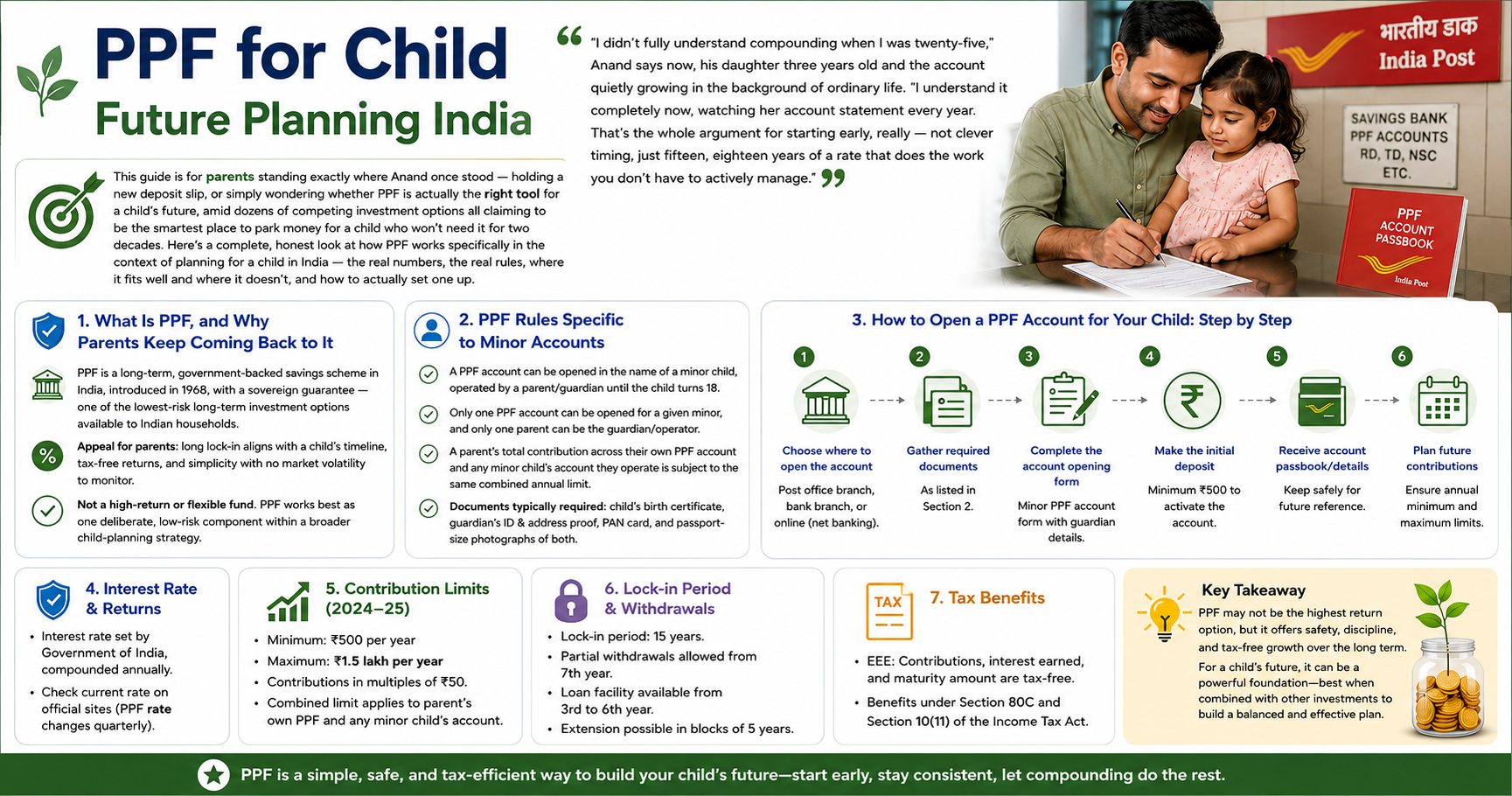
“I didn’t fully understand compounding when I was twenty-five,” Anand says now, his daughter three years old and the account quietly growing in the background of ordinary life. “I understand it completely now, watching her account statement every year. That’s the whole argument for starting early, really — not clever timing, just fifteen, eighteen years of a rate that does the work you don’t have to actively manage.”
This guide is for parents standing exactly where Anand once stood — holding a new deposit slip, or simply wondering whether PPF is actually the right tool for a child’s future, amid dozens of competing investment options all claiming to be the smartest place to park money for a child who won’t need it for two decades. Here’s a complete, honest look at how PPF works specifically in the context of planning for a child in India — the real numbers, the real rules, where it fits well and where it doesn’t, and how to actually set one up.
The Public Provident Fund (PPF) is a long-term, government-backed savings scheme in India, originally introduced in 1968, designed to encourage long-term savings with the safety of a sovereign guarantee — meaning the principal and declared interest are backed by the Government of India, making it one of the lowest-risk long-term investment options available to Indian households.
For child-focused financial planning specifically, PPF holds a particular appeal for a few consistent reasons: the long, mandatory lock-in period (discussed in Section 6) naturally aligns with a child’s own timeline toward higher education or early adulthood expenses; the interest earned and maturity amount are entirely tax-free under current rules (Section 7); and the scheme’s simplicity — no market volatility to actively monitor, no fund selection decisions to make — appeals to parents who want a genuinely “set it and let it grow” component within a broader, more diversified child-planning strategy.
It’s worth being clear from the outset about what PPF is not: it’s not designed to be a family’s sole child-planning vehicle, given its relatively modest, government-set interest rate compared to long-term equity market returns over a similar period, and it’s not a flexible, easily accessible fund for near-term needs, given its multi-year lock-in structure. Where PPF genuinely shines is as one deliberate, low-risk component within a broader plan — a role this guide explores fully in Section 11.
A PPF account can be opened in the name of a minor child, operated by a parent or legal guardian on the child’s behalf until the child reaches the age of majority (18 years), at which point specific transition rules apply (covered in Section 9).
Only one PPF account can be opened for a given minor, and only one parent can be the guardian/operator of that account at a time — meaning parents cannot each independently open a separate PPF account for the same child; the combined contribution limit (Section 5) applies to that single account regardless of which parent operates it.
An individual’s total contribution across their own personal PPF account and any minor child’s account they operate is subject to the same combined annual limit under current rules — this is an important, sometimes overlooked detail, since a parent already maximising their own personal PPF contribution cannot simply add a full separate additional limit’s worth of contribution into a child’s account without exceeding the combined ceiling that applies to them as the account operator.
Documentation typically required to open a minor PPF account includes the child’s birth certificate, the guardian/parent’s identity and address proof, passport-size photographs of both the child and the guardian, and the guardian’s own PAN card — specific documentation requirements can vary slightly by bank or post office branch, so confirming the current exact list with your chosen institution before visiting is a practical time-saver.
The PPF interest rate is set and reviewed quarterly by the Government of India, meaning it can and does change periodically rather than remaining fixed for the scheme’s entire duration — historically, it has generally moved in a range broadly around 7-8% per annum over recent years, though this genuinely fluctuates with each quarterly review, and readers should check the current official rate directly (via the India Post or your specific bank’s PPF page) rather than relying on any single figure as a permanent constant, including any figure that might be cited elsewhere in general parenting or finance content.
Interest is calculated on the lowest balance in the account between the 5th and the last day of each month, compounded annually and credited at the end of the financial year — this specific calculation rule is precisely why many financial planners recommend depositing before the 5th of a month rather than later in the month, since depositing after the 5th means that month’s deposit doesn’t earn interest for that particular month.
Compounding over a long, uninterrupted period is genuinely the core mechanism that makes PPF meaningful for child planning specifically — the mathematical effect of compound interest becomes considerably more pronounced over 15-18 years than over a shorter horizon, which is exactly why starting early in a child’s life, even with modest contributions, tends to matter more than the specific contribution size in any single year.
Because the rate is government-set and subject to change, any specific maturity projection is necessarily an estimate based on assumed future rates — Section 13 provides an illustrative example using a stated assumed rate specifically to demonstrate the mechanism, not as a guaranteed or promised outcome, since actual returns will depend on the actual rates declared over the full account duration.
PPF accounts have a minimum annual contribution requirement and a maximum annual contribution ceiling, both set by current government rules and periodically subject to revision — checking the current official minimum and maximum figures directly via India Post or your bank at the time of opening and each subsequent financial year is the most reliable approach, since citing a specific figure here risks going stale as rules are periodically revised.
Deposits can be made in a lump sum or in instalments (up to a limited number of instalments per financial year, per current rules), giving families flexibility to structure contributions around their own cash flow — some families prefer a single annual lump-sum deposit early in the financial year to maximise the interest-calculation timing advantage described in Section 4, while others prefer smaller, more frequent instalments that fit better within a regular household budget.
A practical strategy several financial planners suggest for child-focused PPF accounts specifically: treating the annual PPF contribution as a fixed, non-negotiable line item within the broader household budget — similar in spirit to how a school fee or insurance premium is treated as a fixed annual commitment — rather than as a flexible, “whatever’s left over” contribution that risks being skipped in tighter financial years, since consistency over the account’s full duration matters considerably to the compounding effect described above.
It’s entirely reasonable, and common, to start with modest contributions in a child’s early years when household expenses (childcare, medical costs, other early-life costs) are often at their highest, and to increase contributions gradually as income grows and other expenses ease — PPF doesn’t require maximising the annual limit every single year to be a meaningful component of a child’s long-term financial plan.
A PPF account has a mandatory lock-in period of 15 years from the year of opening, after which the account can be closed and the full balance withdrawn, or extended in blocks (commonly 5-year blocks under current rules) with or without further contributions, depending on the account holder’s preference at that point.
For a child’s account specifically, this lock-in timeline often aligns naturally with major life milestones — an account opened at birth reaches its initial 15-year maturity point when the child is 15, a timeline that, depending on the family’s specific planning goals, may be extended further to align more precisely with college-entry-age fund availability, or accessed at that point if the family’s planning specifically targeted an earlier milestone.
Because the lock-in is genuinely long, PPF should be understood as a patient, long-horizon component of child financial planning, not a source of near-term flexibility — families anticipating needing access to funds for a specific near-term child expense (school admission costs in the next few years, for example) should look toward more liquid savings or investment vehicles for that specific near-term need, reserving PPF’s structure for the genuinely long-horizon portion of their overall plan.
The partial withdrawal and loan facilities available during the lock-in period (Section 8) provide some limited flexibility within this long-term structure, though these facilities come with their own specific conditions and shouldn’t be relied upon as a substitute for planning genuinely liquid, accessible savings alongside a child’s PPF account for shorter-term needs.
PPF enjoys what’s commonly referred to as “EEE” (Exempt-Exempt-Exempt) tax status under current Indian income tax rules — meaning contributions (up to the specified limit) are eligible for deduction under Section 80C of the Income Tax Act, the interest earned during the account’s tenure is tax-free, and the maturity amount withdrawn at the end of the term is also tax-free — a combination that makes PPF one of relatively few investment vehicles in India offering this full three-stage tax exemption under current rules.
For a parent operating a minor’s PPF account, the 80C deduction is generally claimed by the parent/guardian making the contribution, as part of their own overall Section 80C deduction limit (which also covers other common deductions like life insurance premiums, EPF contributions, and other eligible instruments) — meaning contributions to a child’s PPF account don’t provide an entirely separate, additional 80C benefit beyond the parent’s own overall limit, an important detail worth understanding for accurate tax planning.
Tax rules, including Section 80C limits and specific exemption provisions, are subject to change through annual budget announcements and broader tax policy revisions — the general EEE framework has been a consistent, long-standing feature of PPF, but readers should verify current specific limits and provisions with a qualified tax advisor or the current official Income Tax Department guidance, particularly at the time of filing returns each year, rather than relying on any figure that might become outdated as tax policy evolves.
Partial withdrawal from a PPF account is permitted from a specified year onward (commonly available from the 7th financial year of the account under current rules), subject to a formula-based limit on the maximum withdrawable amount, tied to the account balance at specific earlier points — the exact permitted withdrawal amount and calculation method should be confirmed with your specific bank or post office at the time of any actual withdrawal need, since the precise formula and any periodic rule revisions matter for an accurate calculation.
A loan facility against the PPF balance is available during an earlier window (commonly between the 3rd and 6th financial years under current rules), allowing account holders to borrow against a portion of their accumulated balance at a specified interest rate, without needing to make a full or partial withdrawal — this can be a useful, lower-cost borrowing option for a genuine short-term need arising during a child’s PPF account’s earlier years, compared to more expensive unsecured borrowing alternatives.
Both facilities exist specifically to provide some flexibility within an otherwise long-locked structure, and understanding they exist — even if a family never actually needs to use them — is useful context for feeling confident that a child’s PPF account isn’t entirely inaccessible in a genuine emergency, while still respecting that the account’s core design intention is long-term, largely undisturbed growth.
Upon reaching the age of majority (18 years), the account transitions from a guardian-operated minor account to the young adult’s own independently operated account — the account holder (now an adult) typically needs to complete a specific transition/conversion process with the bank or post office, including submitting their own KYC (identity and address proof) documentation directly.
The account’s original opening date and accumulated tenure carry forward — turning 18 doesn’t reset the account’s maturity timeline or lock-in period; it simply changes who has operating control and legal authority over the account going forward.
This is a meaningful, practical moment worth preparing for administratively — ensuring the young adult has their own PAN card, Aadhaar, and other KYC documentation ready around this transition avoids unnecessary delay or friction in what should otherwise be a straightforward account-conversion process at the relevant bank or post office branch.
Many families use this transition point as a natural opportunity for a broader financial literacy conversation with their now-adult child — walking them through how the account has grown, what compounding actually achieved over the preceding 15-plus years, and involving them directly in decisions about extension, partial withdrawal, or continued contribution going forward, rather than the account simply becoming “theirs” administratively without any accompanying understanding of how it works.
For parents of daughters, PPF is frequently compared against the Sukanya Samriddhi Yojana (SSY), another government-backed scheme specifically designed for a girl child’s future, and it’s worth understanding the genuine differences rather than assuming either is a strictly superior default choice.
SSY is specifically restricted to girl children only, opened before the daughter turns 10, with a maturity structure tied specifically to her reaching 21 years of age or marriage after 18 (subject to current specific rules), whereas PPF is available for children of any gender and follows the general 15-year lock-in structure described in Section 6, unrelated to the child’s specific age at any milestone.
SSY has historically offered a somewhat higher interest rate than standard PPF under the government’s periodic rate announcements, reflecting its status as a specifically incentivised scheme for the girl child, though — as with PPF’s rate — this should be verified against the current officially declared rate rather than assumed fixed, since both rates are independently revised by the government periodically and the specific gap between them can shift.
SSY generally has a stricter deposit tenure requirement (contributions typically required for a set number of years from account opening under current rules, rather than PPF’s more flexible ongoing contribution structure across its full tenure), which is worth understanding clearly if considering SSY specifically.
Many families with daughters choose to use both PPF and SSY together rather than treating them as an either/or decision — SSY specifically for the girl-child-focused benefit and rate advantage, and PPF as a more broadly flexible, gender-neutral component that could, depending on family circumstances, also later serve a sibling or the family’s own broader retirement-adjacent planning if held in a parent’s own name — a combined approach several financial planners suggest for families wanting to maximise available government-backed, tax-advantaged options for a daughter’s future specifically.
PPF vs Sukanya Samriddhi Yojana: covered in detail in Section 10 — SSY for daughters specifically offers a typically higher rate with gender-specific eligibility; PPF offers broader flexibility and gender-neutral eligibility.
PPF vs child-specific mutual fund/equity investment plans: equity-linked investments, held over a similarly long 15-18 year horizon, have historically offered meaningfully higher average returns than PPF’s government-set rate over comparable long periods, though with genuine market volatility and no guaranteed principal — meaning equity investment carries real risk that PPF’s sovereign-guarantee structure specifically doesn’t, a fundamental risk-versus-return trade-off worth understanding clearly rather than assuming one option is simply “better” than the other in all circumstances.
PPF vs fixed deposits (FDs) for a child: FDs generally offer more flexible tenure and easier access to funds than PPF’s long lock-in, but typically don’t match PPF’s tax-free EEE status, meaning post-tax FD returns are often meaningfully lower than PPF’s effective post-tax return for a family in a higher income tax bracket, even when the pre-tax FD rate looks numerically similar or slightly higher.
PPF vs traditional child insurance-cum-investment plans: many financial advisors specifically caution against combined insurance-and-investment products marketed for children, since these products often deliver comparatively modest investment growth relative to their cost structure while providing limited insurance value — a pure term insurance policy on the earning parent (protecting the child’s financial future in case of parental loss) combined separately with a dedicated investment vehicle like PPF or mutual funds is a structure many independent financial advisors generally recommend over a single bundled child insurance-investment product, though this is a genuinely individual decision worth discussing with a qualified, ideally fee-only, financial advisor given your family’s specific circumstances.
The broadly sensible approach many financial planners suggest: using PPF as the guaranteed, low-risk anchor within a child’s broader financial plan, complemented by some exposure to higher-growth-potential, higher-risk options (equity mutual funds, for families comfortable with that risk profile) for the portion of the plan aiming for growth beyond what a government-set rate alone can provide — rather than treating any single instrument, PPF included, as sufficient on its own for a child’s entire financial future.
This example uses an illustrative, assumed interest rate purely to demonstrate how compounding works over time — it is not a prediction, projection, or guarantee of actual future PPF returns, since the actual rate is government-set and revised quarterly, and will almost certainly vary, in either direction, from any single assumed figure over an 15-18 year period.
Illustration: a parent depositing a consistent amount annually, at an assumed constant interest rate held steady purely for illustration purposes, into a child’s PPF account starting from birth, would see the effect of compounding become increasingly pronounced in the account’s later years specifically — the interest earned in years 12-15, for example, meaningfully exceeds the interest earned in years 1-4 on the exact same annual contribution amount, purely due to the compounding base having grown substantially larger by that later point.
The core, genuinely reliable takeaway from any such illustration isn’t a specific rupee figure, since that depends entirely on actual future rates that cannot be predicted with certainty — it’s the general principle that starting earlier and contributing consistently matters more, for the ultimate outcome, than trying to time contributions around anticipated rate changes or attempting to contribute the maximum only in isolated, ad hoc years.
For an actual, personalised projection based on current rates and your own specific contribution plan, most bank and post office PPF calculators (widely available on official bank websites and the India Post website) can generate an illustrative maturity estimate using the currently declared rate — a more useful exercise for your own specific planning than any generic figure presented in general parenting or finance content, given how much the actual outcome depends on rates over your child’s specific account’s full future duration.
Anand, Pune — “I opened it at eleven days old, mostly on instinct, the way my own father had done for me. I didn’t have a sophisticated strategy at the time — I just knew starting early mattered more than starting big. Looking at the statement now, three years in, the actual numbers are still modest, but I understand exactly why patience is the entire point of this specific account.”
Kavita and Rohit, Bangalore — “We use PPF alongside a separate equity mutual fund SIP for our son — PPF for the guaranteed, worry-free portion, the mutual fund for the growth potential we’re comfortable taking some risk on. Neither alone felt like the complete answer for us; together they cover both sides of what we wanted.”
Farah, Chennai, mother of a daughter — “We opened both an SSY account and a PPF account for my daughter. Our financial advisor specifically suggested this combination — SSY for the girl-child-specific rate advantage, PPF as the more flexible backup that could also technically support a future sibling’s needs if our family situation changes. Having both didn’t feel excessive once it was actually explained clearly.”
Vikram, Delhi — “Honest admission: we skipped two full years of contributions during a genuinely difficult financial stretch, and I regretted it once I understood, properly, how much that gap cost us in compounding over the following decade. I’d tell any new parent — even a small, boringly consistent contribution beats an inconsistent, occasionally larger one, by a meaningful margin over 15-plus years.”
Before opening
Ongoing management
Long-term planning
Yes — a PPF account can be opened for a minor of any age, including a newborn, with a parent or legal guardian operating the account on the child’s behalf until the child turns 18.
The PPF interest rate is set and revised quarterly by the Government of India, so it’s important to check the current officially declared rate directly via India Post or your bank rather than relying on any single fixed figure, since it does change periodically.
No — only one PPF account can exist for a given minor, operated by one parent or guardian at a time, with a combined contribution limit that applies across that parent’s own personal account and the child’s account together.
Neither is strictly “better” — SSY is specifically for girl children and has historically offered a somewhat higher rate with a more structured contribution tenure, while PPF offers broader flexibility and gender-neutral eligibility; many families with daughters use both together rather than choosing one exclusively.
The account transitions to the young adult’s own independent operation, requiring their own KYC documentation for the conversion process; the account’s original opening date, tenure, and lock-in timeline carry forward unchanged.
Partial withdrawal is permitted from a specified year onward (commonly the 7th financial year under current rules), subject to a formula-based limit, and a loan facility is separately available in the account’s earlier years — both provide limited flexibility within the otherwise long lock-in structure.
For most families, PPF alone is unlikely to be sufficient for major goals like higher education, given its relatively modest, government-set rate compared to the potential returns (and risks) of other long-term investment options — it’s generally most effective as one guaranteed, low-risk component within a broader, diversified financial plan rather than a sole solution.
This article provides general information about the Public Provident Fund scheme and does not constitute financial advice. PPF interest rates, contribution limits, and tax rules are set by the Government of India and are subject to periodic revision. Please verify current rules directly via India Post or your bank, and consult a qualified financial advisor for guidance specific to your family’s financial situation before making investment decisions.