Physical Address
304 North Cardinal St.
Dorchester Center, MA 02124
Physical Address
304 North Cardinal St.
Dorchester Center, MA 02124

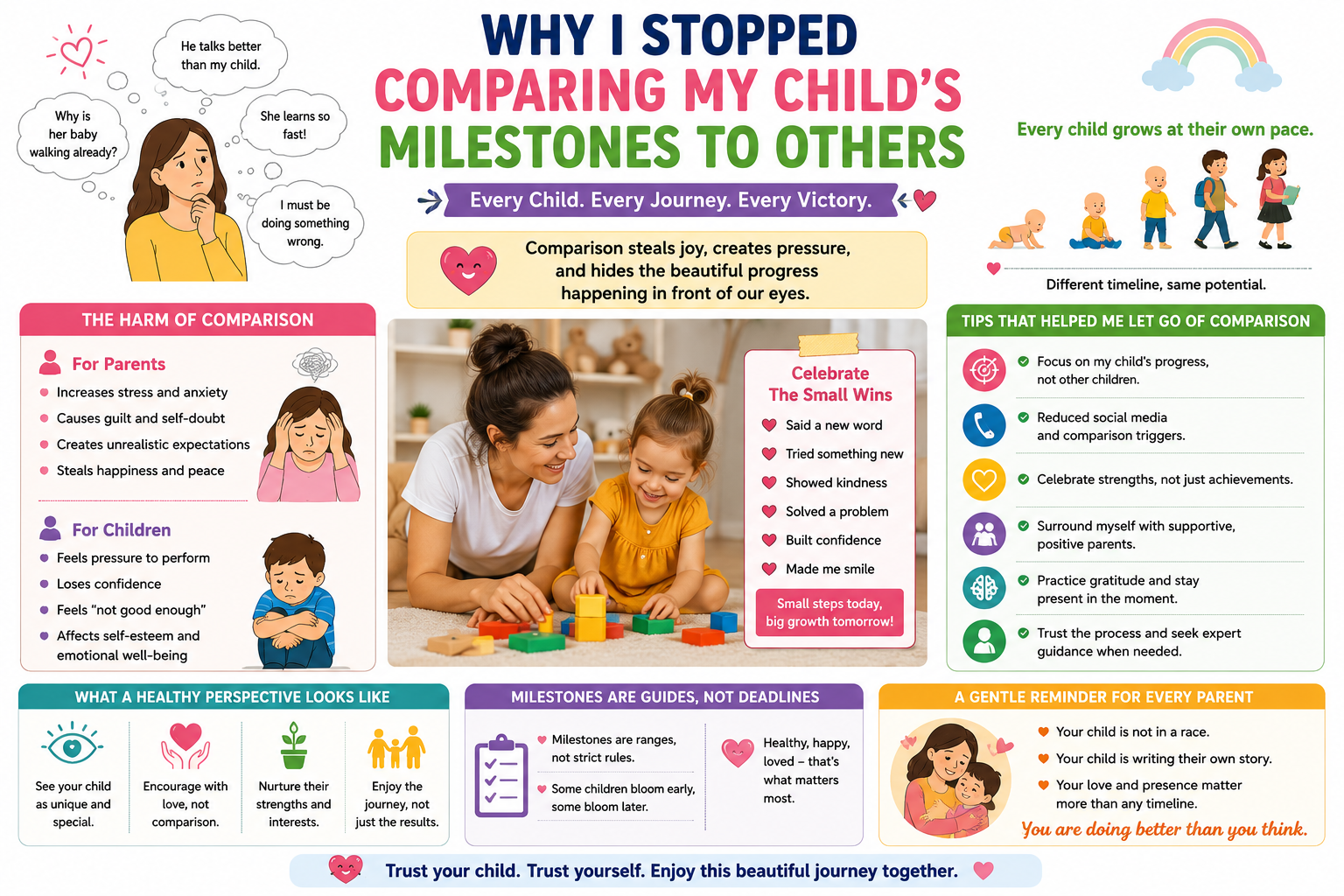
I remember the exact moment I decided to stop comparing my child milestones comparison to other children. It was at a playgroup. Another mom casually mentioned that her 10-month-old was already pulling up to stand. I looked at my own 10-month-old, happily chewing on a toy on the floor, and felt a cold knot form in my stomach.
That feeling — that quiet, creeping worry — is something almost every parent knows. But here is the truth I wish someone had told me earlier: child milestone comparison is one of the most damaging things we can do as parents. Not just for our own mental health, but for the way we see and treat our children.
In this post, I want to talk about why I stopped comparing my child’s milestones, what I learned along the way, and how you can start celebrating your child’s unique developmental journey instead of measuring it against someone else’s child.
This is not just my story. This is backed by child development research, pediatric guidance, and real parenting experience. If you have ever typed “is my child developing normally” into Google at 2 a.m., this post is for you.
Child milestones are a set of skills or behaviors that most children can do by a certain age. These include things like rolling over, sitting up, walking, saying first words, pointing, and making eye contact. Doctors and child development experts use milestone checklists to track whether a child is developing in a typical range.
The key word there is “range.” Child milestone comparison becomes a problem when we treat these ranges as strict deadlines rather than helpful guidelines. A milestone chart tells you that most children take their first steps between 9 and 12 months. But some perfectly healthy children walk at 8 months, and others do not take their first steps until 15 months. Both are completely normal.
So why do parents still compare? Because we love our children more than anything else in the world, and that love comes with fear. We want to know they are okay. We want to know we are doing everything right. And in a world full of social media posts showing other people’s children hitting every milestone early, it is very hard not to measure our own child against that invisible standard.
Social media has made child milestone comparison much worse than it used to be. Parents share exciting moments — first steps, first words, first days of school — and these posts create a highlight reel that feels like real life but is not. Nobody posts the days when their child refused to eat anything but crackers for a week, or the night they cried because their toddler still was not talking at 18 months.
When you scroll through your feed and see another parent’s child reading at age 3, it is easy to feel like your child is falling behind. But the truth is, you are seeing a curated version of one moment in one child’s life. You are not seeing the full picture of that child’s development, and you are certainly not getting an accurate view of what “normal” child development looks like.
This constant social comparison is not just bad for parents. Research shows that when parents are anxious about their child’s development, children pick up on that anxiety. Child milestone comparison does not just hurt parents — it can affect the parent-child relationship and even the child’s confidence over time.
One of the most important things I learned when I stopped comparing my child’s milestones was how wide the range of normal child development actually is. The science is clear: every child’s brain and body develop at a unique pace, influenced by genetics, environment, personality, and early experiences.
According to the Centers for Disease Control and Prevention (CDC), developmental milestones give parents and doctors a general guide for tracking child growth, but they are not rigid deadlines. The CDC’s “Learn the Signs. Act Early.” program is designed to help parents know when to seek professional advice — not to create anxiety about every small variation in child development timing.
Child development is shaped by both nature (genetics) and nurture (environment). A child who has a family history of late talkers might start speaking later — and still catch up completely by age 3. A child who does not have much tummy time might reach some motor milestones a little later without it signaling any developmental problem.
The American Academy of Pediatrics (AAP) emphasizes that child milestone comparison between peers is less useful than tracking a child’s own individual growth over time. Your child’s developmental journey is not a race. It is a path that is uniquely their own.
Some children develop language skills early but take more time with fine motor skills. Some children are walking at 9 months but do not show much interest in picture books until age 2. These variations are completely normal and do not predict long-term outcomes. Einstein reportedly did not speak in full sentences until age 4. Child development is far more complex — and far more varied — than any milestone chart can fully capture.
When parents engage in child milestone comparison, they are often comparing their child to one specific child, or to an idealized version of what development “should” look like. But the range of normal is genuinely wide. Here are just a few examples of the normal developmental ranges for common child milestones:
Seeing these ranges written out makes it clear that child milestone comparison between two children of the same age is often comparing two children who are both perfectly within normal range — just at different points within it.
I want to be very clear about something: comparing your child’s milestones to others is not a sign that you are a bad parent. It is a completely natural response to loving someone and wanting them to thrive. But it does come with real costs — and once I understood those costs, stopping became much easier.
When we constantly measure our child’s development against other children, we set ourselves up for a cycle of worry that never really ends. Even when our child hits a milestone, there is always another child ahead of them in something else. Child milestone comparison is a game you simply cannot win, because there will always be another benchmark, another achievement, another “but her child is already doing this” moment around the corner.
Parental anxiety about child development is one of the most common concerns that pediatricians hear from parents. Many of these worries are rooted in comparison rather than actual developmental concerns. When parents are relaxed and confident, children tend to thrive. When parents are anxious and worried, children often sense that and it can affect their behavior, attachment, and emotional security.
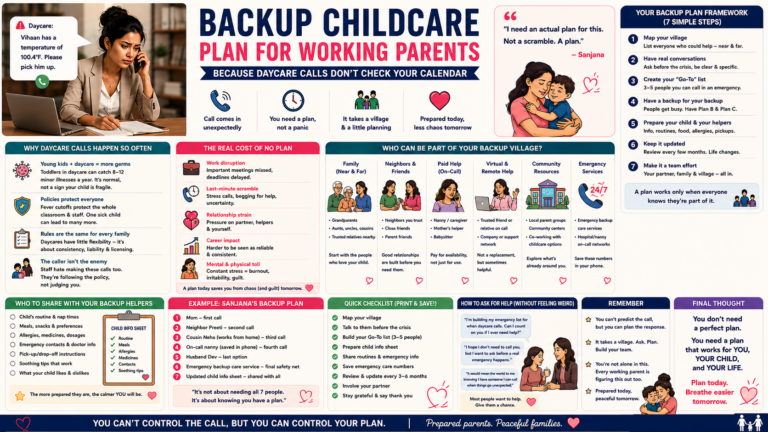
Here is something that took me a long time to admit: when I was deep in child milestone comparison mode, I stopped seeing my child clearly. Instead of noticing all the incredible things they were doing, I was fixated on what they were not doing yet. I was measuring a tiny, developing human being against an abstract standard — and finding them lacking.
That is a heartbreaking way to spend the early years with your child. Those years go so fast. And the truth is, looking back, my child was extraordinary all along. They were doing amazing things every single day. I just was not always paying attention to the right things because I was too busy comparing.
Child milestone comparison can also push parents to seek unnecessary interventions for children who are developing completely normally. Parents who are constantly comparing sometimes push for therapies, tutoring, or medical evaluations for children who do not need them — sometimes because a well-meaning relative or another parent planted a seed of doubt.
This is not to say that intervention is wrong. Early intervention for genuine developmental delays is extremely valuable and can make a huge difference. But there is a real difference between seeking help because your child’s doctor has identified a developmental concern and seeking help because your friend’s child walked two months earlier than yours.
I have already mentioned the playgroup moment. But the real turning point came a few months later, when my child took their first steps — and instead of just feeling pure joy, my first thought was, “they are finally catching up.” That phrase — “finally catching up” — stopped me cold.
Finally catching up to what? To whom? My child was right on schedule. They were healthy, happy, and thriving. But I had been so deep in child milestone comparison that I had framed their perfectly normal first steps as being somehow behind. I had robbed myself of a moment of pure celebration — and almost robbed my child of seeing complete, uncomplicated joy on my face in that moment.
That was when I knew something had to change. Not my child’s development. My mindset.
Stopping child milestone comparison is not something that happens overnight. But here are the specific things I did that made the biggest difference:
None of these things were perfect. I still had moments of comparison. But over time, those moments became shorter and less frequent. And my relationship with my child became richer because I was finally seeing them clearly.
Once I stopped child milestone comparison, I discovered something beautiful: there is so much more space to actually enjoy your child when you are not constantly measuring them. Here is how I learned to celebrate my child’s unique journey — and how you can too.
Instead of asking “is my child doing what other 18-month-olds are doing?” start asking “what can my child do now that they could not do three months ago?” This shift in perspective makes child development feel like what it really is: a journey of growth, not a competition.
Keep a simple photo journal, a voice memo folder, or even just a notes app entry every few weeks. You will be amazed at how much progress you see when you look back at your child’s own timeline rather than comparing it to someone else’s.
Child milestone checklists are screening tools, not scorecards. They are designed to help healthcare providers identify children who might benefit from additional support — not to rank children or make parents feel anxious.
When you understand this, child milestone comparison starts to lose its power. Your child’s 12-month well-child visit is about checking in on their health and development, not judging whether they measure up to the child in the next exam room.
Not all parenting communities are created equal. Some are warm, supportive, and genuinely celebrate every child’s unique journey. Others are quietly — or not so quietly — competitive. Seek out the former. Find parent friends who talk about child development with curiosity and joy rather than anxiety and competition.
When you are in a community that normalizes the wide range of child development, child milestone comparison becomes much less tempting. It is hard to feel behind when everyone around you is celebrating their children’s individual strengths rather than ranking them.
Your child’s doctor is your best resource for genuine child development concerns. If you have a real worry — not a comparison-triggered worry, but a gut feeling or a specific observation — bring it up at your next visit. Pediatricians have seen thousands of children develop over their careers. They know the difference between normal variation and a genuine developmental concern.
And if your pediatrician tells you your child is developing well? Trust that. They are not just saying it to make you feel better. They have the clinical training and experience to know what they are seeing.
I want to be completely honest here: not all milestone concerns are just comparison anxiety. There are real developmental delays that benefit from early identification and intervention. The goal of stopping child milestone comparison is not to ignore your child’s development — it is to see it clearly, without the distortion of comparison.
There are certain “red flags” in child development that are worth discussing with a doctor regardless of what other children the same age are doing. These are not about comparison — they are about your individual child’s health:
These are the kinds of things that warrant a conversation with your pediatrician — not because your child is behind another child, but because they fall outside the typical developmental range entirely. There is a very important difference between “my friend’s child walked at 10 months and mine isn’t walking yet at 12 months” (this is child milestone comparison) and “my child is 18 months old and still showing no signs of walking” (this is a genuine developmental check-in).
Early intervention services — when genuinely needed — can be transformative. So the message here is not “ignore all milestones.” It is “stop comparing your child to other children, while still paying attention to your individual child’s development.”
If you are reading this and thinking “I know I should stop comparing, but I just cannot help it” — I hear you. Child milestone comparison is deeply ingrained in our parenting culture, and it does not disappear just because we know it is not helpful. Here are some practical tips that actually work:
When you notice yourself doing child milestone comparison, name it. Not with shame or judgment, but with simple acknowledgment: “I am comparing right now.” This simple act of naming the thought creates a tiny bit of distance between you and the thought, which makes it easier to let it go rather than spiral into anxiety.
When you are in the middle of child milestone comparison, ask yourself honestly: does this comparison help my child in any way? Does it help me be a better parent? If the answer is no — and it almost always is — then the comparison is not serving you. Let it go.
Every child has things they are naturally drawn to, things they do well, ways they light up. Your child might not be the earliest talker in the group, but they might have an incredible ability to focus, or a natural warmth with other children, or a curiosity about bugs and plants that is absolutely delightful. When child milestone comparison starts creeping in, deliberately shift your attention to your child’s specific, individual strengths.
Some parenting forums and social media groups are essentially comparison engines. If you consistently feel worse after spending time in a particular online space, it is okay to leave it. Protecting your mental health from comparison culture is not weakness — it is wisdom. Your child needs a parent who sees them clearly and loves them fully. That is much harder to do when you are drowning in comparison anxiety.
Nobody asks you, at age 30, when you took your first steps. Nobody asks your child, at their college graduation, whether they were an early talker. The things that matter in a human life — kindness, resilience, creativity, love — have almost nothing to do with the child milestone comparison moments that consume us when our children are small.
The long view is this: your child’s development will unfold in its own time, in its own way. Your job is to love them, nurture them, keep them safe, and celebrate who they are — not measure them against someone else’s child.
Yes, it is completely normal. Almost all parents do child milestone comparison at some point — especially in the early years. The key is to recognize when comparison is causing anxiety rather than helpful awareness, and to redirect your focus to your own child’s unique developmental journey.
The range of normal child development is much wider than most parents realize. Many children develop at different paces within the normal range. If you have genuine concerns — not comparison-driven worries, but specific observations — always discuss them with your child’s pediatrician. They are the right person to assess whether there is anything to address.
Reach out to your child’s doctor if your child is not making eye contact or responding to their name by 12 months, has no words by 16 months, has no two-word phrases by 24 months, or has lost skills they previously had at any age. These are not about comparison — they are signals worth discussing with a medical professional.
Start by unfollowing or muting accounts that consistently trigger comparison feelings. Curate your feed to include content that celebrates the range of child development rather than highlighting early achievement. It also helps to remember that social media is a highlight reel, not real life — nobody posts the hard days, only the highlight moments.
Yes, it can. When parents are focused on what their child is not doing yet, they sometimes miss what their child is actually doing. Constant comparison can also create anxiety that children pick up on, affecting their sense of security and confidence. Shifting your focus from comparison to celebration genuinely strengthens the parent-child bond.
Not necessarily. Most children begin walking between 9 and 15 months, but some healthy children do not take their first independent steps until 16 or 17 months. If your child is not walking by 18 months, that is worth mentioning to your pediatrician — not because of child milestone comparison, but because it is outside the typical developmental range.
Normal variation means your child is developing within the expected range but at their own pace within that range. A developmental delay is when a child is significantly outside the expected range for most children their age in one or more areas. Your child’s pediatrician is the right person to make this distinction — not a comparison to another child.
Redirect conversations from achievement-focused topics to experience-focused ones. Instead of asking “is your baby walking yet?” try asking “what is the funniest thing your child has done this week?” You can also simply be honest: “I am trying to stop comparing milestones — it just makes me anxious and does not help either of us!” Most parents will understand completely.
Directly, no — your child does not know you are comparing them. But indirectly, sustained parental anxiety rooted in child milestone comparison can affect the parent-child relationship, reduce the quality of interactions, and lead to unnecessary interventions that may not be in the child’s best interest. A relaxed, attentive parent is one of the most powerful forces for healthy child development.
The CDC’s “Learn the Signs. Act Early.” milestone checklists are excellent because they present development as a range, not a fixed point. Your child’s pediatrician and the American Academy of Pediatrics’ Healthy Children website (healthychildren.org) are also trustworthy, research-backed resources that focus on individual child development rather than comparison.