Physical Address
304 North Cardinal St.
Dorchester Center, MA 02124
Physical Address
304 North Cardinal St.
Dorchester Center, MA 02124

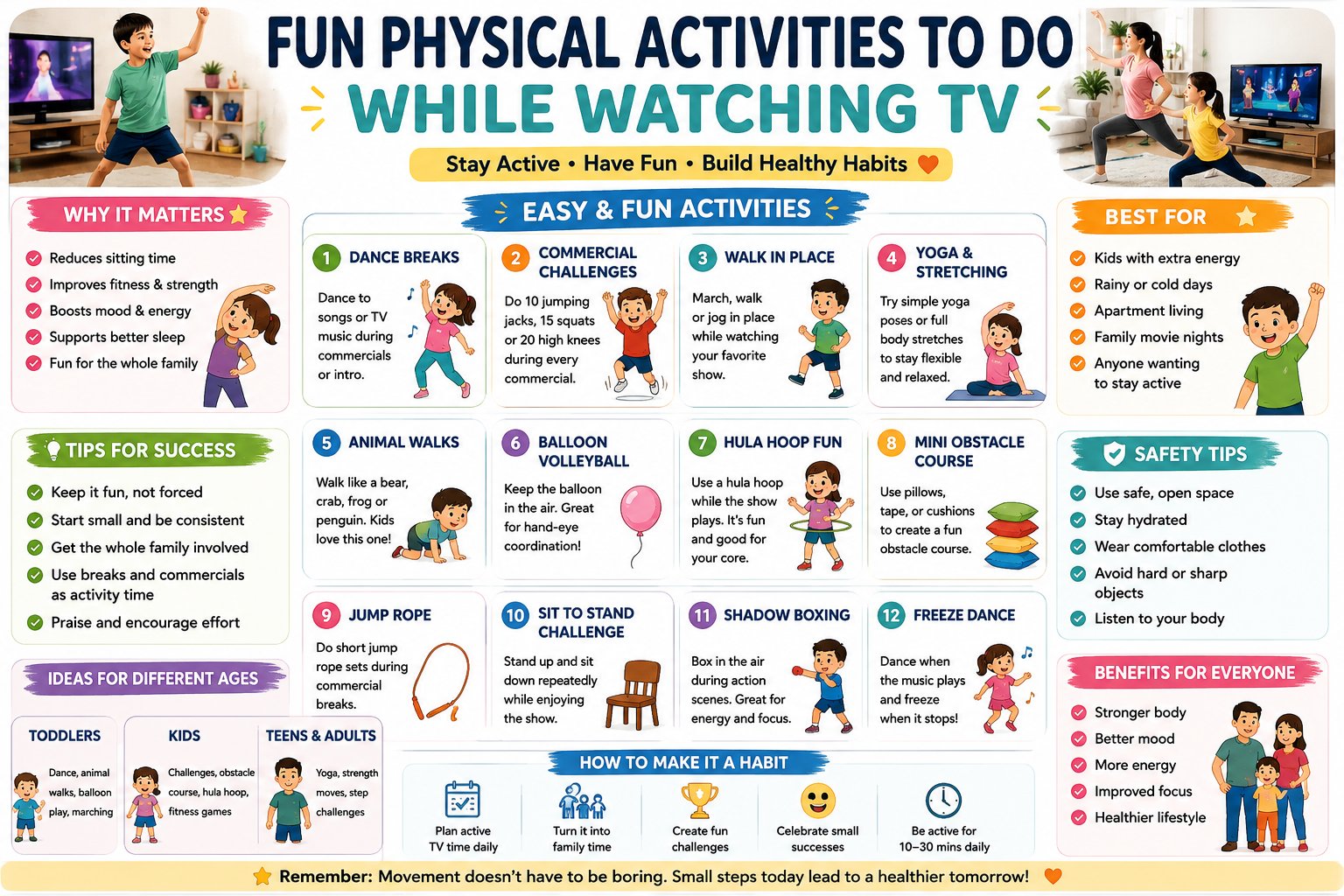
Let’s face it. Most of us watch more TV than we probably should. Whether it is binge-watching a drama series, keeping up with the news, or sitting through a football match, screen time adds up fast. And for a lot of people, watching TV means sitting completely still for hours on end.
But what if you could flip that around? What if TV time could actually become active time?
The good news is that you absolutely can. There are dozens of fun physical activities while watching TV that work for kids, adults, seniors, and the whole family together. You do not need a gym. You do not need special equipment. You just need your living room floor and a willingness to move.
In this guide, we are going to cover more than 30 physical activities you can do while watching TV. We will look at activities for different fitness levels, activities designed specifically for kids, ideas for the whole family, and tips for making active screen time a real habit rather than a one-day experiment.
This is not about guilt. This is about making your existing screen habits work harder for your health. And it is a lot more fun than it sounds.
Before we get into the activities themselves, it is worth understanding why this approach is actually effective — and not just wishful thinking.
Prolonged sitting is now widely recognised as a health risk independent of how much you exercise at other times. Research published in the Annals of Internal Medicine found that sitting for long, unbroken periods was linked to increased risk of heart disease, type 2 diabetes, and early death — even in people who exercised regularly. The key word is unbroken. Getting up and moving every 20 to 30 minutes makes a measurable difference to your metabolic health.
TV watching is one of the most sedentary activities in most people’s lives. The average adult in the UK watches around three hours of television per day. In the US, that figure is closer to four and a half hours. Across a week, that is a lot of time spent completely still.
Here is the thing about doing physical activities while watching TV: the distraction of the screen actually makes exercise feel easier. This is not just common sense — it is backed by research. A study from the Journal of Sport & Exercise Psychology found that people who exercised while watching television reported lower perceived effort and more enjoyment than those who exercised without any distraction. In other words, you work out for longer and enjoy it more when your brain is partly occupied by a show.
That is powerful. And it means that for a lot of people, combining TV time with fun physical activities while watching TV is not a compromise — it is genuinely an effective fitness strategy.
Even light activity during TV time makes a difference. If you do 20 minutes of movement across a two-hour viewing session — stretching, marching in place, doing bodyweight exercises during commercial breaks — you can add up to 100 to 150 extra minutes of physical activity per week without changing anything else about your routine. For someone who currently does very little exercise, that kind of change is genuinely significant.
These are perfect if you are just starting out, if you are recovering from injury, if you have mobility limitations, or if you just want something low-key you can do without getting too out of breath. All of these fun physical activities while watching TV can be done in your living room with no equipment at all.
This sounds too simple to be worth doing. It is not. Marching in place — lifting your knees, swinging your arms — gets your blood moving, burns calories, and is gentle enough for virtually anyone. You can do this seated or standing. Set a timer for the duration of an ad break and just march. You will be surprised how effective it is over time.
Stand behind the sofa and use the back for balance. Rise up onto your toes and slowly lower back down. Repeat for a full commercial break. This is excellent for lower leg strength and circulation, and it is so low-key you can essentially do it without thinking about it.
Sit on the edge of your sofa or a firm chair. Straighten one leg and hold it up for five seconds, then switch. This works your core and your hip flexors. It is one of the most accessible physical activities while watching TV for people with limited mobility, elderly viewers, or anyone easing back into movement after a long break.
Stand up and extend your arms out to the sides. Make slow, controlled circles — forward for 30 seconds, then backward for 30 seconds. This loosens up the shoulders, which tend to get very tight from prolonged sitting, and requires absolutely zero athletic ability.
Roll your shoulders back ten times, then forward ten times. Gently tilt your head from side to side and hold for a few seconds each way. These are not intense calorie burners, but they reduce tension, improve posture, and are particularly useful for people who sit at a desk all day and then sit in front of the TV at night. Think of them as essential maintenance.
Slide your back down a wall until your thighs are parallel to the floor. Hold. This is one of the best exercises for building lower body strength and endurance, and it requires nothing except a wall and a little determination. Start with 20 seconds and build up from there. A full commercial break wall sit is a solid challenge even for fit people.
Stand with feet hip-width apart and hands on hips. Slowly rotate your hips in large circles, ten times one way and ten times the other. This improves hip mobility and lower back flexibility — two areas that suffer enormously from prolonged sitting.
Ready to step things up a notch? These exercises require a bit more effort but are still completely doable in your living room. They are among the most popular fun physical activities while watching TV for people who want to see real results.
Stand with feet shoulder-width apart, lower yourself as if sitting into a chair, then drive back up. Squats are one of the best exercises you can do for your entire lower body — glutes, quads, hamstrings — and you do not need any equipment. Aim for three sets of 15 during ad breaks.
Step one foot forward and lower your back knee toward the floor. Push back up and alternate legs. Walking lunges across the length of your living room during commercial breaks will get your heart rate up quickly and work your legs and glutes effectively.
Get into a plank position on the floor and lower your chest toward the ground, then push back up. Can’t do a full push-up yet? No problem. Do them from your knees, or do them standing against a wall. Push-ups work your chest, shoulders, and triceps and require nothing except floor space.
Lie on your back with knees bent and feet flat on the floor. Lift your hips up until your body forms a straight line from knees to shoulders. Squeeze at the top and lower slowly. This is fantastic for the glutes and lower back, and it is a great TV floor exercise because you can do it lying down without taking your eyes off the screen for a second.
Get into a push-up position but hold yourself still. Keep your core tight, your hips level, and breathe steadily. A 30-second plank is a meaningful challenge for most people. Work up to 60 or 90 seconds during commercial breaks. Few exercises give you more core strength bang for your buck than a consistent plank hold.
A classic for good reason. Jumping jacks get your whole body moving, raise your heart rate fast, and can be done in a small space. They are one of the most recognizable fun physical activities while watching TV for both kids and adults. Do them during every ad break and you have an interval-style cardio session built right into your viewing evening.
March or jog in place, but drive your knees up as high as they will go with each step. High knees raise your heart rate significantly, engage your core, and burn a solid number of calories in a short time. Do them at full speed for 30 seconds, rest, repeat.
Lie on your back with hands behind your head. Bring your right elbow toward your left knee as you extend the right leg. Alternate sides in a slow, controlled pedalling motion. This is one of the most effective abdominal exercises you can do, and it is perfectly suited to TV floor time.
Sit on the edge of a sturdy chair or a low couch with hands gripping the seat beside your hips. Lower yourself down by bending your elbows, then push back up. Tricep dips strengthen the back of the arms and are easy to slot into an ad break. Just make sure the furniture you use is stable enough to support your weight.
Getting kids moving during TV time does not require turning it into a chore or a formal exercise session. Kids respond to play, games, and challenges. Here are some genuinely fun physical activities for children that make screen time active without feeling like a workout.
The moment the ads come on, everyone gets up and dances. No rules, no choreography — just move. This is one of the most effective and genuinely fun physical activities while watching TV for kids because it feels like pure play. Set a rule that the dancing stops the moment the show comes back on, and kids will actually start looking forward to commercial breaks.
Play music during ad breaks and dance freely. When the music stops — everyone freezes. Last one to freeze loses a point. This game keeps kids moving, improves listening skills and reaction speed, and is endlessly entertaining for younger children. It also works brilliantly as a group activity if you have more than one child.
Create a simple rule chart together before watching: every time a specific character appears on screen, everyone does five jumping jacks. Every time someone says a particular catchphrase, do ten squats. Every time there is a chase scene, run on the spot. This turns passive watching into an active game and makes the show itself the workout trigger.
A hula hoop is one of the best pieces of low-cost fitness equipment for kids. Most children can hula hoop while watching TV without too much difficulty once they get the hang of it. It works the core, improves coordination, and burns a surprising number of calories. Keep one by the sofa and challenge kids to hoop through an entire episode.
Build a simple living room obstacle course — crawl under the coffee table, jump over a pillow, hop on one foot to the door and back. Time your children and let them beat their own record. This is one of those physical activities while watching TV that kids invent themselves once you give them the idea, and it keeps them busy right through the ad break.
Challenge kids to stand on one foot for as long as possible during their favourite show. Who can balance the longest? Can they do it with their eyes closed? These simple balance activities build proprioception and core stability in children, and the competitive element makes it engaging enough to keep them interested.
There are some simple yoga poses that children can hold and switch through during TV time — tree pose, warrior one, downward dog, child’s pose. Make a little routine together that kids can flow through. Children’s yoga improves flexibility, body awareness, and calm focus — all things that benefit from being paired with screen time rather than purely passive watching.
If you have enough ceiling height and floor space, a skipping rope is a brilliant active screen time tool for children. Challenge them to skip as many times as they can during a commercial break. Count together, track records, and celebrate improvements. Skipping is one of the best cardiovascular activities for kids and requires almost no coordination once they get the basic rhythm.
Some of the best physical activities while watching TV are ones the whole family can do together. These build family connection, make movement a shared positive experience, and mean that nobody feels singled out for having to exercise.
Everyone gets into a plank position together. Who can hold it the longest? You can make this more fun by playing music and holding until the music stops, or doing it every commercial break and trying to beat the previous time. Planks together feel less brutal than planks alone.
Put on a longer show and dedicate the first ten minutes to a full family stretch. Take turns leading stretches — the kids will love being in charge. Cover the hamstrings, hips, lower back, shoulders, and calves. This is one of those physical activities while watching TV that feels gentle enough for everyone but leaves you feeling genuinely better at the end of it.
Lay out exercise mats or blankets and do a floor circuit as a family — sit-ups, leg raises, glute bridges, and stretches. Do each exercise for one minute, rest, and move on. This is a structured but relaxed approach to active TV time that works for mixed ages and ability levels.
Everyone wears a fitness tracker or uses a phone step counter. The challenge is to reach a certain number of steps before the episode ends — by marching in place, pacing during ad breaks, or doing laps around the coffee table. Whoever hits the target first wins. This gamification makes movement feel like a competition rather than a chore.
A small rebounder or mini trampoline in the living room is one of the best investments you can make for active screen time. Gentle bouncing while watching TV burns calories, improves lymphatic circulation, and is low-impact enough for children, older adults, and people with joint issues. It is also deeply enjoyable, which is why kids will actually do it voluntarily.
Sit-up high fives — one person does a sit-up and slaps hands with a partner at the top. Wheelbarrow walks across the room. Partner leg press. These exercises require two people, which means they work well as parent-child activities during ad breaks. They build relationship and fitness at the same time, which is a rare and valuable combination.
You do not need equipment to do physical activities while watching TV. But a few low-cost items can significantly expand what is possible and keep things interesting over the long term.
Resistance bands are cheap, compact, and versatile. You can do bicep curls, lateral leg raises, seated rows, and dozens of other exercises with a resistance band while sitting on the sofa or standing in front of the TV. They are one of the most cost-effective fitness tools available and take up virtually no storage space.
A pair of light dumbbells — three to five kilograms for most people — dramatically expands the range of exercises you can do during TV time. Bicep curls, overhead press, lateral raises, tricep extensions — all of these can be done standing or seated in front of a screen. Even light resistance over many repetitions adds up to a meaningful strength training session.
A foam roller is not a workout tool exactly, but it is one of the best things you can use during TV time. Rolling out tight muscles — the IT band, the calves, the upper back — improves flexibility, reduces soreness, and feels genuinely good. Keep one next to the sofa and roll while you watch. Your body will thank you.
Standing on a balance board while watching TV engages your core and lower leg muscles constantly, without you having to think about it. It turns passive standing into an active stability challenge. Some people use these while working at standing desks — there is no reason you cannot use one in front of the TV.
A good quality exercise mat makes floor exercises significantly more comfortable and reduces the barrier to getting down and doing them. If you have to find a mat every time, you probably will not bother. If it is already laid out in front of the TV, it becomes an invitation.
One of the most practical approaches to doing physical activities while watching TV is building a set commercial break routine that you follow automatically. Here is one that covers the whole body and takes about four minutes — the length of a standard UK or US ad break:
Minute 1: 30 seconds of jumping jacks + 30 seconds of high knees
Minute 2: 15 squats + 15 glute bridges on the floor
Minute 3: 10 push-ups (or wall push-ups) + 30-second plank hold
Minute 4: Full body stretch — hamstrings, hips, shoulders, and neck
If you do this routine every commercial break during a two-hour film, you get approximately three to four full circuits — around 12 to 16 minutes of genuine exercise without ever pressing pause on what you are watching. That is a solid workout built into an evening you were spending in front of the TV anyway.
For kids, replace the plank and push-ups with freeze dance and floor animal walks, and you have an active TV session that children will actually enjoy and look forward to.
The best exercise routine is the one you actually do. Here is how to make active TV time stick:
Do not commit to doing a full workout every TV session from day one. Start with one exercise per commercial break. Just one. Once that feels normal, add another. Small consistent actions build habits faster than big dramatic intentions that fizzle after a week.
If your resistance bands are in a drawer in the bedroom, you will not use them during TV time. If they are on a hook by the sofa, you will pick them up automatically. The environment you create determines the habits you build. Make active TV time the easy choice by putting everything within arm’s reach.
For children, turn active TV time into a points game. Every commercial break workout earns a sticker. Ten stickers earn a chosen activity at the weekend. This kind of low-pressure positive reinforcement makes physical activities while watching TV something children look forward to rather than resist.
Tell a friend about your active TV habit. Better yet, do it together when you are watching with other people. Social accountability dramatically increases follow-through. Even just mentioning it to a partner or housemate changes the dynamic and makes it more likely to happen.
Write down what you did each evening — how many commercial break circuits, how long you held the plank, how many squats you got through. Seeing progress over time is one of the most powerful motivators for continuing. You do not need an app. A page in a notebook is enough.
Some nights you will be exhausted and you will just sit there. That is fine. The goal is not perfection. The goal is doing more than you used to. One active TV session a week is better than none. Build the habit gradually and trust the process.
Yes, you genuinely can — especially if you are currently doing very little exercise. Consistent movement during TV time, particularly if you use commercial breaks for bodyweight exercises and maintain light activity throughout, can add up to 100 to 150 minutes of extra physical activity per week. That is enough to meaningfully improve cardiovascular health, strength, and flexibility over time, particularly for beginners or people returning to exercise after a break.
The easiest options are marching in place, standing calf raises, seated leg raises, shoulder rolls, and gentle stretching. These require no equipment, no preparation, and no significant athletic ability. They are excellent starting points for anyone new to active TV time, and they can be done while seated if standing is difficult.
The key is making it feel like a game rather than exercise. Try the TV show character workout (do jumping jacks every time a certain character appears), freeze dance during commercial breaks, or building a living room obstacle course during ad breaks. Competition, music, and humour all help. Do it alongside them — kids are much more likely to participate when a parent joins in.
Absolutely. Daily movement is the goal, and if combining it with TV time is what makes it happen consistently, that is a perfectly valid approach. The activities described in this guide are varied enough to work different muscle groups across the week. Just make sure you include rest days from more intense exercises like push-ups and squats while keeping lighter activities like stretching and marching going daily.
The commercial break workout routine in this article covers it well — jumping jacks and high knees for cardio, squats and glute bridges for the lower body, push-ups and planks for the upper body and core, and stretching to finish. That four-minute circuit hits every major muscle group and is timed perfectly to a standard ad break.
Yes, and it is particularly beneficial for them. Seated leg raises, calf raises standing behind a chair for balance, gentle shoulder circles, neck stretches, and slow marching in place are all accessible for older adults. Movement during TV time helps maintain circulation, joint mobility, and muscle tone — all of which are important for healthy ageing. Anyone with health conditions should check with their doctor first.
No. Every exercise in the beginner and intermediate sections of this guide requires zero equipment. A clear floor space and comfortable clothing are the only things you need to get started. If you want to add variety and intensity over time, resistance bands and light weights are inexpensive additions that significantly expand your options.
Active screen time means combining television or device watching with physical movement, rather than sitting or lying still throughout. It is a way of making screen time less sedentary without eliminating it. Physical activities while watching TV are the most common form of active screen time, and they are increasingly recommended by health organisations as a practical strategy for reducing the health risks of prolonged sitting.
It varies depending on the activity and the person, but here is a rough guide: marching in place burns approximately four to six calories per minute, jumping jacks around eight to ten calories per minute, and bodyweight squats around six to eight calories per minute. If you do three commercial break circuits of four minutes each during a two-hour film, you could burn 80 to 120 extra calories — without changing anything else about your evening.
For sustained exercise like marching or cycling, shows with fast-moving plotlines tend to work better because they keep your attention off the effort. Action series, reality TV, sports, and comedy all work well. For slower activities like yoga, stretching, or foam rolling, documentaries and drama series are ideal because the pace matches the calmer movement. The best content is whatever makes you want to keep watching — and therefore keep moving.
There is a simple truth at the heart of this whole guide: TV time is happening whether we like it or not. Most of us watch television every single day. The question is not whether to watch — it is whether to do anything while we are watching.
The fun physical activities while watching TV in this guide are not a replacement for proper exercise. They are not meant to substitute for running, strength training, or playing sport. What they are is an incredibly practical way to add meaningful movement to time that is currently completely sedentary.
For children, active screen time builds the habit of associating movement with enjoyment — a mindset that can last a lifetime. For adults, it reduces the health risks of prolonged sitting and adds up to real fitness gains over weeks and months. For families, it becomes a shared activity that brings people together rather than isolating everyone behind their own screen.
Start with one thing. Pick one exercise from this list and do it tonight during the next ad break. Then do it again tomorrow. Then add one more thing next week. That is how habits are built. That is how real change happens.
You do not have to choose between enjoying TV and taking care of your body. With the right approach to physical activities while watching TV, you can genuinely do both.