Physical Address
304 North Cardinal St.
Dorchester Center, MA 02124
Physical Address
304 North Cardinal St.
Dorchester Center, MA 02124

You know the moment. You are standing in the middle of the supermarket, or stuck in a motorway traffic jam, or just trying to get through the next twenty minutes until dinner is ready — and your toddler starts crying. Not a little sniffly cry. The full production. Tears, volume, floor involvement.
And your phone is right there in your pocket. You know that if you hand it over, the crying will stop within thirty seconds. And you also know, somewhere in the back of your tired brain, that you would rather find another way. You want to know how to distract a crying toddler without reaching for the screen every single time.
This guide is going to give you exactly that. Not vague advice about “connecting with your child” and “getting on their level.” Actual, specific, practical strategies that work fast — in the supermarket, in the car, at the doctor’s surgery, at the dinner table, and at home on a rainy Tuesday when you have already used every trick you know.
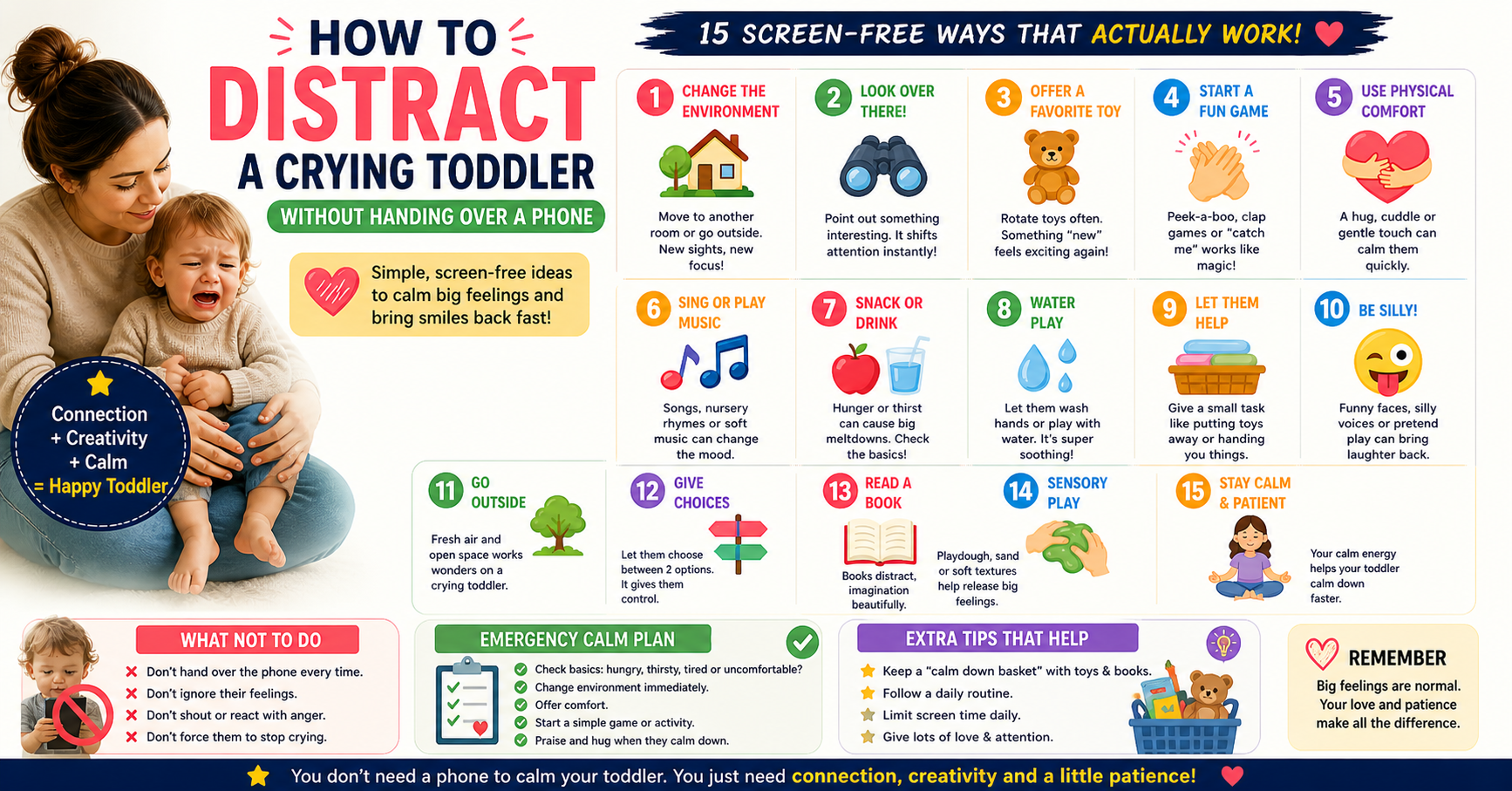
Fifteen proven strategies. Clear explanations of why each one works. Situation-specific advice for the hardest moments. And a complete FAQ covering every question parents ask about toddler tantrum distraction and crying toddler tips that actually make a difference.
Quick note: This guide is for parents of toddlers aged roughly 12 months to 4 years. The strategies are designed to be fast and practical — things you can actually do in the middle of a real situation, not just ideas that sound good in theory.
Before we get into how to distract a crying toddler, it helps to understand why they cry so intensely in the first place. Because when you understand the reason, the strategies make a lot more sense.
Toddlers between the ages of one and four are living through one of the most frustrating experiences of human development. Their brains are growing at a remarkable pace. They understand more and more about the world around them every single day. They have strong opinions, big feelings, and genuine desires.
But they do not yet have the language to express most of it. And they do not yet have the emotional regulation skills to manage the gap between what they want and what they can have.
That gap — between wanting something intensely and being unable to have it or express it — is where toddler crying lives. Every crying toddler episode is a child doing their best with a nervous system that is not finished developing yet. They are not being manipulative. They are not being naughty. They are genuinely overwhelmed, and crying is their most reliable tool for communicating that.
Knowing this helps you stay calm when it happens. It also helps you understand why certain distraction strategies work and others do not — because the goal is not to punish or ignore the feeling, but to give the brain something else to focus on while the feeling passes.
The toddler brain has a very different relationship with attention than the adult brain. Toddlers live almost entirely in the present moment. They have very limited ability to hold on to a feeling when something new and interesting appears in their sensory field. This is why toddler tantrum distraction works so reliably when it is done well — the brain quite literally switches focus when something novel enough appears.
This is not dishonesty or manipulation on the parent’s part. It is working with how the toddler brain actually functions. A new sight, sound, texture, or experience captures the sensory cortex and temporarily overrides the emotional response. The feeling does not disappear — it just pauses long enough for the child to regulate down from the peak.
And here is the important part: you do not need a phone to do this. Screens work for the same neurological reason as every other distraction — novelty and sensory engagement. The difference is that you have a phone on you most of the time, so it becomes the default. Once you build a mental toolkit of other options, the phone becomes far less necessary.
Not every instance of toddler crying calls for distraction. It is worth being clear about this because crying toddler tips that always default to distraction can accidentally teach a child that their feelings are something to escape rather than something to experience and move through.
Distraction is most appropriate when:
Distraction is less appropriate as a first response when:
The sweet spot is acknowledge first, then redirect. “I can see you are really upset. That was hard. Look — what is this?” The acknowledgement takes three to five seconds. The redirection follows. You are not skipping the feeling; you are honouring it briefly before moving on.
These strategies are tested by real parents in real situations. They are designed to be fast, low-effort, and available wherever you are. Keep reading because each one includes exactly why it works — not just what to do, but how to make it work best for your child.
This is one of the fastest and most reliable ways to distract a crying toddler — and it works precisely because it is so unexpected. When your toddler is mid-cry, drop your voice suddenly to a very quiet whisper and say something completely ordinary. “I think I can see a dog.” Or just: “What is that?” Or even just their name, whispered.
The toddler brain is wired to pay attention to sounds that are suddenly different. A whisper after noise is a significant auditory shift — it catches attention more reliably than a louder voice, because the brain flags it as something unusual that needs investigating.
When crying is loud and everything around is loud, a sudden whisper creates a moment of cognitive surprise that pauses the crying reflex. You only get a few seconds — use them immediately to introduce the next distraction or transition.
When to use it: Works best for mid-level crying and the early stages of a meltdown. Less effective once your toddler is at full volume — try it earlier in the escalation if you can.
Curiosity is one of the most powerful tools for crying toddler tips. The toddler brain cannot easily maintain high emotional arousal and active curiosity at the same time. When something genuinely novel and unidentifiable appears, curiosity competes with distress — and curiosity often wins.
The mystery object technique is simple. Pull something out of your bag, pocket, or the nearest shelf — something the toddler has not seen recently, or something slightly unusual — and begin examining it yourself with exaggerated interest. Do not offer it. Do not explain it. Just look at it very carefully, turn it around, maybe sniff it.
The toddler’s attention will typically shift toward you within seconds. “What is that?” is doing the work before they even say it. Once they reach for it, hand it over and let them investigate. The crying stops because the brain has a new job.
Good mystery objects to keep in your bag: a small smooth stone, a keyring with an unusual texture, a folded piece of foil, a small purse with a zip, a little figurine. Anything slightly unfamiliar and safe to handle.
If there is one item that earns its place in every parent’s bag based purely on distraction power, it is a small bottle of bubbles. Bubbles work to distract a crying toddler better than almost any other portable item, and the reason is genuinely interesting.
Bubbles combine multiple distraction triggers simultaneously: they move unpredictably, they catch light in an engaging way, they produce a soft sound when they pop, they float at a child’s eye level, and popping them requires physical action — which shifts the body out of the distress posture. They are also completely non-threatening and require no language to engage with.
Blowing bubbles also requires the parent to take a slow breath, which has a subtle calming effect on your own nervous system — genuinely useful when you are in the middle of a stressful public moment. This is not a coincidence; it is a bonus.
Important tip: Have the bubbles already accessible — not buried at the bottom of the bag. A bubble bottle clipped to the outside of your bag or in a front pocket is ready in three seconds. By the time you have dug through the bag, the moment has passed.
Running commentary is an underused toddler tantrum distraction technique that works particularly well in public spaces. When your toddler starts crying, begin narrating what is happening around you in a calm, interested voice. Not talking at the toddler — talking out loud as if you are a sports commentator describing the scene.
“Oh look, that man is carrying a very big box. I wonder what is in the box. Maybe toys. Or maybe pasta. Or maybe a really big hat.” Keep going. The slight absurdity of what you are saying, combined with the calm and interesting tone of your voice, begins to pull the toddler’s attention outward from their internal distress.
This technique has an extra benefit: it models language. Even when your toddler is not paying full attention, the language input is happening. Many speech and language therapists recommend running commentary specifically as a language development tool — the distraction effect is a bonus.
Start singing. Not a lullaby. Not something soothing. Something completely unexpected. The alphabet song in a silly voice. A made-up song about what your toddler is wearing. The theme tune to your favourite show, sung badly on purpose. The sudden, surprising presence of music and voice is one of the most reliable ways to distract a crying toddler — especially for children in the 12-to-24-month range who are deeply responsive to vocal tone and music.
The key is the unexpectedness. A calm, gentle lullaby can sometimes extend crying because it matches the emotional register. Something upbeat, surprising, or silly clashes with the distress and creates a cognitive mismatch that the brain wants to investigate.
Try this: Mid-cry, start clapping and singing “If you’re happy and you know it” at a fast, cheerful pace. The clapping adds physical rhythm. The familiar words pull at the toddler’s memory. And the gap between what the song says (“if you’re happy”) and what is happening creates a small, involuntary moment of cognitive humour that even very young toddlers respond to.
Sometimes the fastest way to distract a crying toddler is the most literal one: physically move them to a different place. Pick them up, walk to a different room, step outside, cross to the other side of the street. The change of environment delivers a burst of new sensory information — new sights, new sounds, new temperature, new smells — that the brain processes as a reset.
This is sometimes called the “doorway effect” in adults — walking through a doorway creates a moment of disorientation that resets working memory slightly. In toddlers, whose brains are far more reactive to environmental change, the effect is more pronounced. Moving to a new space is not running away from the problem; it is using the environment as a distraction tool.
Going outside works especially well. Fresh air and natural light have documented calming effects on the nervous system. Even standing in the doorway with the front door open, looking out at the street, can be enough to shift a crying toddler’s focus within thirty seconds.
Toddlers are extremely motivated by being given tasks — especially tasks that feel important or grown-up. In the middle of a crying toddler moment, handing your child a specific, defined job shifts their brain from passive distress to active engagement almost immediately.
In the supermarket: “I need you to hold this.” Give them something safe from the shopping — a tin of tomatoes, a packet of pasta. “You are in charge of carrying that. Very important job.” The toddler now has an identity (the carrier of the important thing) and a physical task (holding it carefully). Both compete with the crying.
At home: “Can you come and help me? I need someone really strong to help carry this cushion.” Or “I need you to be the door holder.” Or “Can you count those? I need to know how many there are.” The task does not need to be real — it needs to feel important and require their active involvement.
Direct sensory input — something new to touch, smell, or taste — is one of the most powerful crying toddler tips because it bypasses language entirely and goes straight to the nervous system. You do not need to explain a sensory distraction or convince your toddler to engage. You just need to offer it at the right moment.
Quick sensory distractions that are easy to access anywhere:
Sensory distractions work especially well for toddlers with sensory-seeking temperaments and for younger toddlers who are more pre-verbal. The direct physical sensation is more immediately engaging than a visual or verbal prompt for many crying toddlers.
Toddlers between 18 months and 4 years are often irresistibly compelled by certain types of questions — not complex ones, but ones that are concrete, visual, and slightly puzzling. In the middle of crying, asking the right question can trigger the investigative brain almost involuntarily.
Questions that work well to distract a crying toddler:
The question must be concrete and answerable. “How are you feeling?” is too abstract. “What is that?” pointing at something specific gets the attention shift you need.
Physical surprise — a sudden, gentle, unexpected movement — is a very fast way to interrupt toddler meltdown without phone involvement. Not rough or startling, but surprising. Pick them up and swoop them gently. Spin slowly on the spot. Bounce very slightly. Or crouch down suddenly and touch the floor with an exaggerated “oooh” — as if you have found something interesting.
The vestibular system — the balance and movement sensing system — has a direct connection to the emotional regulation centres of the brain. Gentle movement (swinging, rocking, gentle bouncing) is calming because it engages this system. Unexpected movement (the swoop, the spin, the sudden crouch) breaks the attention lock.
For very young toddlers still in arms, this is one of the most reliably effective crying toddler tips available. A parent who is calm, uses gentle movement, and maintains warm eye contact is using the vestibular system and the social connection system simultaneously — and both are powerful downregulators of the stress response.
The busy kit — or emergency distraction bag — is one of the most practical tools you can build to help distract a crying toddler on outings without reaching for a phone. The concept is simple: a small pouch inside your main bag contains three to five items that your toddler never sees except in genuine need-to-distract situations. The exclusivity and novelty make them significantly more effective than familiar toys.
What works well in a toddler distraction kit:
Rotate the items every few weeks to keep them fresh. Once a distraction kit item becomes familiar and accessible all the time, it loses its power. Keep it special by keeping it out of everyday reach.
Counting is a surprisingly effective quick toddler distraction technique because it provides structure, engages the language brain, and gives the toddler something concrete to do — pointing at things and counting along. Even pre-verbal toddlers respond to the rhythm and purpose of counting.
“Let’s count the red things.” Or “How many wheels does that car have? Let’s count.” Or simply start counting out loud — one, two, three — pointing at random objects around you. The combination of your calm voice, the rhythmic counting, and the purposeful pointing is surprisingly grounding.
For slightly older toddlers (two and a half and above), you can make it into a challenge: “I bet you can’t find five things that are blue before we get to the car.” The competition element and the clear success condition are deeply motivating — it is very hard to cry and count simultaneously.
We mentioned earlier that acknowledging the feeling before redirecting is important. This strategy makes it a deliberate two-step process rather than an optional extra. Name the feeling first — briefly, specifically, without a lecture — and then move directly into the distraction.
“You are really angry that we had to leave the playground. That is so hard. Come on, let’s see if we can spot a bus on the way home.” The first sentence acknowledges the feeling. The second sentence pivots. Done in under ten seconds, this two-step approach is gentler on your toddler’s emotional brain than pure distraction while still moving things forward fast.
Research from the field of emotion coaching consistently shows that toddlers who have their feelings named — even very briefly — regulate faster than those who are immediately redirected or told to stop crying. The acknowledgement does not need to be long. It just needs to be there. This makes all the crying toddler tips in this guide more effective when you lead with it.
Say your toddler’s name clearly, warmly, and then pause. No instruction, no follow-up sentence. Just the name. Then a pause. Then perhaps their name again.
This sounds almost too simple to be included in a guide about how to calm a toddler. But it is based on something real: hearing your own name in a familiar voice activates the social brain in a way that very little else does. It creates a moment of direct connection — “I see you, I am here, I am not overwhelmed” — that cuts through emotional noise before any words of instruction or explanation arrive.
Follow the pause with a warm, low-energy observation or a gentle offer. Not a command. Not a question. Just something present and calm. “Here I am.” Or just a gentle hand on their back. The name plus pause plus presence is a micro-version of emotional co-regulation — using your calm nervous system to help regulate their activated one.
When all else is failing and you are in a context where it is possible, food is one of the most reliable and honest quick toddler distraction techniques available. This is not bribery. It is biology.
Toddlers experience hunger much more acutely than adults because their blood sugar levels fluctuate more rapidly. A crying episode that seems completely irrational is very often happening against a background of mild hypoglycaemia — the kind of irritability and emotional fragility that comes from needing food. A snack addresses the root cause and provides a sensory engagement (the taste, texture, and physical act of eating) simultaneously.
The key is to offer a snack calmly, without framing it as a reward for crying or a fix for bad behaviour. Just produce it matter-of-factly: “I think it might be snack time.” A rice cake, a small box of raisins, a piece of banana — something with a mix of carbohydrate and natural sugar that raises blood sugar gently.
If your toddler is regularly very distressed in the late morning (around 10 to 11am) or mid-afternoon, try bringing the snack time earlier. In many cases, crying toddler episodes that feel behavioural are actually hunger-driven and resolve immediately with food.
The fifteen strategies above work in most situations — but some contexts are especially challenging. Here is a quick guide to the situations where distract a crying toddler strategies are most needed and which ones work best.
The supermarket is full of distraction tools that parents often forget to use because they are too busy managing the shopping list. Try:
Contained, stationary, and often bored — the car is a prime environment for toddler crying. The phone is especially tempting here because you cannot easily engage physically while driving. Alternatives:
Waiting rooms are challenging because they are unfamiliar, slightly scary environments with minimal distraction tools. Preparation is everything:
Bedtime crying toddler distress is different from daytime distraction situations — the goal is not just to stop the crying but to help the nervous system move toward calm and sleep. Bright, stimulating distractions are counterproductive here. Use:
Restaurants combine tiredness (often evening or end-of-day), waiting, and unfamiliar environments — a classic recipe for toddler distress. Manage this proactively:
The difference between a parent who reliably manages to distract a crying toddler without a phone and one who always reaches for the screen is often preparation rather than skill. Having the right items ready before you need them removes the decision-making load from the hardest moments.
Preparation takes twenty minutes once a week. It saves you hours of stress and means you are never in a situation where the only option to distract a crying toddler is handing over your phone.
Every strategy in this guide works better when you are calm. Not perfect — just calm enough. Because the single most powerful toddler tantrum distraction you have available is your own regulated nervous system.
Toddlers co-regulate with their primary caregivers. Their nervous system literally takes cues from yours. When you are panicked, rushed, or visibly frustrated, the toddler’s nervous system reads those signals and escalates. When you are calm — even a deliberate, slightly fake calm — their system starts to follow yours down.
You do not need to feel calm to appear calm. You need three things:
None of this is easy when you are tired, running late, or in a public place feeling judged. But the return on investing three seconds in your own regulation before responding to a crying toddler is enormous. Your calmness is the most effective tool you have.
The next time your toddler starts crying and the phone is within reach, you now have fifteen other options ready to go. That is not a small thing. Most of the strategies in this guide cost nothing, require nothing except your presence and a bit of practice, and get easier every time you use them.
The goal was never to distract a crying toddler perfectly every time, in every situation. The goal is to have enough tools that the phone is a genuine choice rather than a default. Some days you will use the bubbles. Some days you will use the whisper. Some days you will use the snack and not feel remotely bad about it. And some days you will hand over the phone anyway — and that is fine too.
What matters is the pattern over time. A parent who has fifteen strategies and uses them most of the time is doing something genuinely good for their child’s emotional development, their own sense of competence as a parent, and their family’s relationship with screens.
You already have everything you need. The rest is just practice.