Physical Address
304 North Cardinal St.
Dorchester Center, MA 02124
Physical Address
304 North Cardinal St.
Dorchester Center, MA 02124

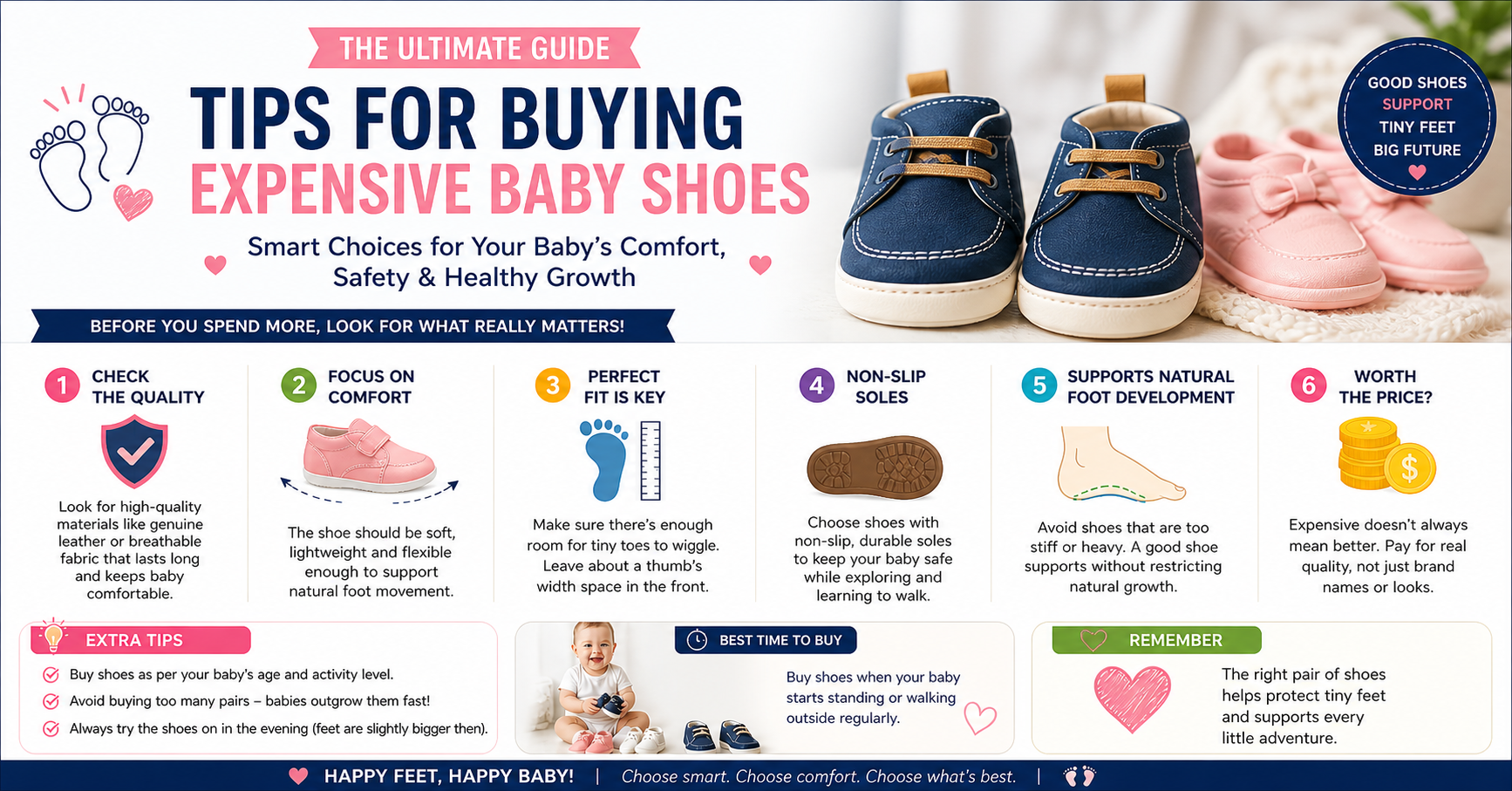
There is a particular moment every new parent knows. You are standing in a baby store or scrolling through an online boutique, and you stop in front of the tiniest, most adorable pair of shoes you have ever seen in your life. They come in soft suede. They have a little rubber duck stitched on the side. And they cost forty-five dollars. For shoes your baby will wear for approximately six weeks before outgrowing them.
You pick them up. You feel the weight of them — practically nothing. You look at the price tag again, then back at the shoes. And you think: are expensive baby shoes actually worth it?
It is one of the most asked questions in parenting communities, parent forums, and baby gear review sites. And the honest answer — the one that does not have a financial interest in selling you anything — is more nuanced than most articles will tell you. Because the truth about expensive baby shoes is not simply “yes, worth it” or “no, save your money.” It depends on the age of your baby, the material quality of the specific shoe, what your baby is doing developmentally, and whether the premium price is based on genuine construction quality or simply clever branding.
This article is going to break all of that down, plainly and honestly.
Before we talk about whether expensive baby shoes are worth buying, it is worth understanding why they are so expensive in the first place — because the answer reveals a lot about how this market operates.
Baby products in general command a significant emotional premium. Parents want the best for their children, and in the absence of clear objective information about what “the best” actually means, price becomes a stand-in for quality. If a pair of baby shoes costs sixty dollars, the assumption is that they must be better than a pair that costs twelve dollars. Sometimes that assumption is correct. Often it is not.
The baby and infant shoe market is heavily driven by aesthetics and brand recognition rather than functional design. A significant proportion of expensive baby shoes — particularly in the newborn to six-month category — are designed almost entirely around visual appeal. Mini versions of adult sneakers, leather moccasins with intricate stitching, tiny Chelsea boots in genuine suede. These are beautiful objects. They make for wonderful photos. And for a baby who cannot yet stand, let alone walk, that is genuinely all they are: photogenic objects.
This is not a criticism of parents who buy them — it is simply the reality of how baby shoe brands position and market their products. Understanding this distinction between aesthetic premium and functional premium is the foundation of making smart choices.
Pediatric podiatrists are surprisingly consistent on this point: babies do not need shoes until they are walking outdoors on surfaces that require foot protection. Before that point — for the first twelve months of life for most children — bare feet or soft socks are preferable to any shoe, regardless of price.
The American Academy of Pediatrics notes that allowing babies to move their feet freely without rigid footwear supports natural muscle development and sensory feedback. Every time a baby’s bare foot touches a surface, the sensory nerve endings in the sole send information to the brain that contributes to balance, spatial awareness, and motor learning. A thick rubber sole, however well-crafted, partially blocks that feedback.
Baby foot development in the first year is happening at a remarkable rate — but it is happening best without shoes on. This does not mean shoes are harmful at this stage; it simply means they are largely unnecessary for development purposes, which changes the question from “are these shoes good?” to “why am I buying these at all?”
Pediatric Note: The NHS, AAP, and most pediatric orthopedic guidelines agree: babies do not need shoes until they are walking outdoors. Pre-walking shoes are a lifestyle choice, not a developmental necessity.
Not all expensive baby shoes are expensive for the same reasons. Understanding what is driving the price in any given pair helps you evaluate whether that particular premium is worth paying.
Genuine leather, organic cotton, and natural rubber soles cost more to source and work with than synthetic alternatives. A pair of baby shoes made from full-grain leather with a natural rubber sole is genuinely more expensive to manufacture than a pair made from vinyl with a plastic sole — and the difference in quality, breathability, and durability is real. Leather breathes. It softens around the foot. It does not trap moisture the way synthetic materials do, which matters for baby foot development because infant feet sweat at a higher rate relative to their size than adult feet.
If you are paying a premium for genuine natural materials, that premium often has legitimate functional justification — especially for a walking baby who will be in those shoes for several hours a day.
At the opposite end of the spectrum are expensive baby shoes whose high price is driven almost entirely by brand equity. Mini Gucci sneakers. Tiny Prada boots. Infant Nike Jordans. These shoes cost what they cost because of the logo, not because of superior foot-health design. The materials may be decent — sometimes very good — but the price premium is brand-driven, not function-driven.
To be entirely clear: there is nothing wrong with buying designer baby shoes if it is within your budget and you enjoy the aesthetic. But do not confuse the price tag with developmental benefit. A ninety-dollar pair of infant Nikes will not do more for your baby’s baby foot development than a well-constructed fifteen-dollar pair from a lesser-known brand. The foot inside does not know what logo is on the outside.
Some expensive baby shoes genuinely earn their price through thoughtful biomechanical design. Brands like Stride Rite, See Kai Run, and Robeez have invested in research-backed last shapes (the internal form around which the shoe is built) that are designed around the actual anatomy of infant and toddler feet — wide toe boxes, flexible soles that bend at the ball of the foot, minimal heel elevation, and secure-but-adjustable fastenings.
These are not cheap to develop or produce correctly, and the price reflects that. When you are buying this type of expensive baby shoes, you are paying for genuine engineering. This is the category where the premium has the most direct functional relevance.
A growing segment of premium baby shoe brands charge more because of how and where their shoes are made — fair wage factories, certified organic materials, no toxic dyes, carbon-offset manufacturing. For parents who prioritize ethical consumption, this is a legitimate reason to pay more. It does not make the shoe more developmentally beneficial, but it is a real and transparent reason for the elevated price.
Parenting articles frequently cite studies without linking to them or accurately representing what the research found. Here is what the actual body of pediatric footwear research consistently shows:
Multiple studies published in the Journal of Foot and Ankle Research and similar peer-reviewed publications have found that children who spend more time barefoot develop stronger intrinsic foot muscles, better arch formation, and superior proprioceptive (balance and spatial awareness) ability compared to children who are habitually shod from an early age. This finding applies most strongly to indoor environments and safe outdoor surfaces.
This does not mean shoes are bad — it means that baby foot development is actively served by time without shoes, and that shoes should be chosen to interfere as little as possible with natural movement when they are necessary.
A study from the University of the Sunshine Coast found that the single most important physical attribute of shoes for developing feet is sole flexibility — specifically, the ability of the shoe to flex at the metatarsophalangeal joints (the ball of the foot) without significant resistance. This is not a feature that correlates strongly with price. There are flexible cheap baby shoes and rigid expensive baby shoes, and the flexible cheap ones will serve baby foot development better than the rigid expensive ones every single time.
Research consistently shows that toe boxes that narrow toward the tip force the toes into an unnatural compressed position, which over time can contribute to hallux valgus (bunion development) and other toe deformities. Many fashionable expensive baby shoes — particularly those styled after adult dress shoes or fashion footwear — have toe boxes that taper in ways that are inappropriate for infant and toddler feet, which are naturally much wider at the toes relative to the heel than adult feet.
A wide, round toe box is a genuine developmental feature. It is present in some expensive baby shoes and absent from others, and it is present in some affordable shoes as well. Price is not a reliable indicator.
High-top baby shoes with stiff ankle support are frequently marketed to parents under the premise that they help babies learn to walk by “supporting” the ankle. Pediatric research does not support this. In fact, multiple studies have found the opposite — that allowing free ankle movement is important for the development of the stabilizing muscles around the ankle joint. Artificially supporting an ankle that is capable of supporting itself simply delays the development of that natural strength.
High-top baby shoes are fine for aesthetics. But paying a premium specifically for ankle-supporting stiffness is paying for a feature that the research suggests is not beneficial and may be mildly counterproductive.
Let’s be direct about this. Here is how premium-priced and budget-priced baby shoes actually compare across the factors that matter:
| Feature | Expensive Baby Shoes (avg $40–$90+) | Cheap Baby Shoes (avg $8–$25) |
| Material quality | Often genuine leather, natural rubber, organic fabrics — genuinely better breathability | Variable — can be poor synthetics, but good budget brands use safe materials |
| Sole flexibility | Variable — not guaranteed by price alone | Variable — some budget shoes are very flexible |
| Toe box shape | Often well-designed, though fashion styles can be narrow | Budget walking shoes often have adequate toe room; fashion budget styles may not |
| Durability | Generally lasts longer — but baby feet grow fast, making durability largely irrelevant | May wear out faster, though this rarely matters given growth rate |
| Developmental design | Premium developmental brands (Stride Rite, See Kai Run) genuinely engineer for foot health | Basic budget walking shoes can meet developmental needs if sole is flexible |
| Safety (no toxic dyes) | Higher-end brands more likely to have certifications | Less reliable — always check CPSC compliance on budget buys |
| Width options | More likely to offer narrow/wide sizing | Usually standard width only |
| Value for money | Poor for non-walkers; reasonable for walking babies if quality-focused | Excellent for non-walkers; acceptable for walkers if developmental features are present |
Bottom Line: The honest comparison shows that expensive baby shoes win on material quality and are more likely to offer developmental engineering — but neither advantage matters for non-walkers, and flexible, safe budget shoes can absolutely serve walking babies well. The developmental gap between good cheap shoes and good expensive shoes is far smaller than the price gap suggests.
Here is where we give credit where it is due — because there are genuine scenarios where spending more on baby shoes makes real sense.
Standard-width shoes are built around average foot dimensions. If your baby has feet that are significantly wider or narrower than average — something you can identify by tracing their foot and measuring the ball width — budget shoes may not fit well at all. Premium baby shoe brands like Stride Rite and New Balance Kids offer multiple width fittings, which can make the difference between a shoe that fits correctly and one that causes discomfort or foot problems. For a baby with fit challenges, a more expensive shoe with the right width is worth every penny.
If your child’s pediatrician or a podiatrist has identified a foot health concern — hypermobility, pronation, toe-walking tendencies, or anything similar — then investing in developmentally appropriate footwear designed around that concern is absolutely justified. This does not mean designer shoes; it means shoes recommended by a specialist that may be in a premium price range.
If you are planning to hand shoes down to a younger sibling, the durability argument for expensive baby shoes becomes more relevant. A well-made leather shoe that survives one child’s six-week use can reasonably serve another child. At that point, the per-use cost calculation becomes more favorable for the premium option.
For a fifteen to twenty-four-month-old who is walking confidently and spending time outdoors on varied terrain, a quality shoe with a protective sole, secure fastening, genuine leather upper, and flexible construction is genuinely worth more than a flimsy budget option. This is the age range where material quality and construction matter most — and where some investment in best baby shoes is functionally justified.
Equally, there are clear situations where spending a premium on baby shoes delivers no meaningful benefit.
Full stop. A baby who is not yet standing and pulling to stand does not need shoes for developmental purposes. If you buy them, you are buying them for photos and aesthetics — which is fine, but be honest with yourself about what you are paying for. A twelve-dollar pair from a reputable budget brand will look just as adorable in photos as a forty-five-dollar pair from a boutique. Your baby will feel the same in both pairs: briefly confused before pulling them off.
Inside the house on clean, safe floors, bare feet or grip socks are better than any shoe, expensive or otherwise. If you feel the need for foot coverage inside — for warmth, for hygiene, for a family preference — soft-sole grip socks or basic cheap baby shoes serve the purpose perfectly well.
A christening, a wedding, a birthday party. Your baby will wear these shoes for three hours and then never again. Spending forty or fifty dollars on occasion-wear baby shoes is hard to justify on a pure value basis, regardless of how beautiful they are.
Within the expensive category, there is a significant difference between a fashion-driven brand charging a premium for aesthetics and a developmental brand charging the same premium for engineering. If you are going to spend money, spend it on the latter. A sixty-dollar pair of first baby shoes from Stride Rite or See Kai Run will serve your baby’s feet better than a sixty-dollar pair of mini designer adult-style shoes with a rigid sole, however gorgeous they may be.
If you have decided that some level of investment in baby shoes is right for your situation, here are the brands where the premium price is most reliably backed by genuine developmental design:
Stride Rite has been in the children’s footwear business since 1919, and their developmental line remains one of the most thoroughly researched in the market. They offer multiple widths, flexible soles designed for each developmental stage, and a last shape based on actual pediatric foot data. Their SRTech and Motion series in the infant and toddler range are particularly well regarded.
See Kai Run designs every shoe around a natural, anatomically correct foot shape, which means wide toe boxes, thin flexible soles, and minimal structure — the right approach for baby foot development. Their materials are high-quality, and the shoes are widely recommended by pediatric podiatrists. If you want expensive baby shoes that genuinely earn their price on developmental merit, this brand is a strong choice.
For babies who are not yet walking, Robeez soft-sole shoes strike a balance between foot coverage and developmental freedom that most other brands do not match. The soft leather sole allows full sensory feedback from the ground, the elasticated ankle keeps the shoe on without restricting movement, and the materials are breathable and durable. These are among the few expensive baby shoes for pre-walkers where the price reflects genuine quality rather than aesthetic premium alone.
Particularly strong in the UK and European market, Clarks offer a comprehensive fitting service with genuine width sizing and construction standards that have been consistent for decades. Their baby shoe brands offering in the infant and toddler range uses genuine leather in most styles and adheres to British Standard construction requirements for children’s footwear.
New Balance is the first name many pediatric specialists mention when parents ask about best baby shoes for wider feet. Their accuracy in sizing, width range from narrow to extra-wide, and durable construction make them especially valuable for babies and toddlers who do not fit average-width shoes.
Forget the price tag for a moment. Here is the framework for evaluating whether any baby shoes — expensive or cheap baby shoes — are genuinely worth buying:
Rule of Thumb: If the shoe passes all six points above, it is a good baby shoe at any price point. If it fails any of these — regardless of the brand or price — it is not worth buying.
Based on developmental research, pediatric recommendations, and an honest look at what different price points actually deliver, here is a practical spending framework for baby shoes at different stages:
| Stage | Age Range | Recommended Spend | Why |
| Non-walker | 0 – 10 months | $0 – $15 | No developmental benefit from shoes; bare feet or socks are best. Budget shoes for occasions only. |
| Pre-walker / Cruiser | 10 – 13 months | $15 – $30 | Light soft-sole coverage for outdoor or public spaces. Robeez-style soft soles are ideal here. |
| Early Walker | 13 – 18 months | $25 – $45 | This is where construction quality starts to matter. Invest in flexible soles and secure fastening. |
| Confident Walker | 18 months – 3 yrs | $30 – $55 | Full protection needed. Buy quality, but replace regularly. Good affordable options exist in this range. |
| Active Toddler | 3 – 5 years | $25 – $50 | Durability becomes more relevant. One to two quality pairs per season is the right approach. |
This comes up regularly in any discussion of expensive baby shoes — if the shoes were barely worn, are they safe to buy second-hand? The nuanced answer: it depends on the age of the original wearer and the condition of the shoe.
For non-walking babies, second-hand soft-sole baby shoes in excellent condition are generally fine. The shoes have not been subjected to meaningful wear patterns or sole compression.
For walking babies, the concern is real: shoes mold to the specific pressure patterns of the wearer’s gait. A baby who pronates will have left compression patterns in the insole and outer sole that can reinforce the same gait pattern in a different child. Most pediatric podiatrists recommend against second-hand shoes for regular daily wear in walking children, regardless of how lightly they appear to have been used.
The value argument for buying second-hand expensive baby shoes that were “barely worn” is therefore most legitimate for pre-walking babies — the very age group where spending significant money on shoes was arguably not necessary in the first place. An interesting contradiction.
Not automatically. The developmental quality of a baby shoe is determined by its sole flexibility, toe box shape, material breathability, and fit accuracy — not its price. Some expensive baby shoes are engineered with genuine developmental care; others are expensive purely for brand or aesthetic reasons. Meanwhile, some budget shoes pass all the developmental quality checks. The correct approach is to evaluate the shoe against specific quality criteria rather than using price as a proxy for quality.
No. Pediatric guidance from the AAP, NHS, and most pediatric orthopedic associations is clear on this: babies do not need shoes until they are walking on surfaces that require foot protection. Before walking, bare feet are preferable for development. Shoes before walking are a lifestyle and aesthetic choice, not a developmental necessity.
For a first walking shoe, look for a soft, flexible sole that bends at the ball of the foot, a wide rounded toe box, a firm heel counter, breathable materials, and a velcro or adjustable fastening. Brands like Stride Rite, See Kai Run, and Robeez are consistently recommended by pediatric specialists. The best baby shoes for first walkers protect the foot without restricting natural movement.
For developmental purposes: no. Designer baby shoe brands in the fashion category are priced for brand equity and aesthetics, not foot-health engineering. A baby’s feet do not benefit from a luxury logo. If you enjoy them and they fit within your budget, there is no harm in buying them — but do not conflate the price with developmental value.
Very quickly — and this is a key factor in the expensive baby shoes value calculation. Between six and eighteen months, babies can outgrow a shoe size every six to eight weeks. Between eighteen months and three years, the pace is roughly every two to three months. The faster your child grows, the less the durability advantage of premium shoes matters, and the stronger the case for buying affordable shoes more frequently.
Soft sole baby shoes — those with a thin, flexible leather or fabric sole — are ideal for pre-walkers and early walkers in indoor environments. They allow maximum sensory feedback and natural foot movement. Hard sole shoes provide more protection for outdoor use and become more appropriate once a child is walking confidently outside. For most early walkers, a semi-flexible sole that bends easily at the ball of the foot is the right middle ground between sensory access and protection.
Yes — but so can badly fitting expensive baby shoes. Fit accuracy matters far more than price. A shoe that is too narrow, too short, too rigid, or poorly shaped can cause toe compression, blistering, and altered gait regardless of what it cost. The risk with cheap baby shoes is that width options are limited and quality control can be more variable. The risk with expensive baby shoes is that fashion-forward designs sometimes prioritize aesthetics over anatomical correctness. In both cases, evaluate the fit rather than the price.
Generally no — especially on safe indoor surfaces. Bare feet on clean floors, rugs, and safe outdoor grass provide the most developmental benefit during the early walking phase. Shoes at home are fine when needed for warmth or floor protection, but should not be the default. If you want foot coverage inside, grip socks provide traction without restricting movement.
Genuine leather, organic cotton canvas, and natural rubber soles are the gold standard for baby shoe materials — breathable, non-toxic, and durable. Synthetic materials are not inherently unsafe, but lower-quality synthetic shoes may contain dyes, adhesives, or plasticizers that can be problematic for sensitive infant skin. Always look for CPSC (Consumer Product Safety Commission in the US) or CE compliance on budget shoes.
They make beautiful gifts, but if you want to be genuinely useful rather than just adorable: check the parents’ preferences first. A pair of size 3 designer booties for a newborn will be outgrown in weeks. If you want to give baby shoes as a gift, consider buying a size or two up from birth size in a high-quality developmental brand — something the baby will actually grow into and use. Alternatively, a gift card to a reputable baby shoe brand lets parents get the right size at the right time.
In terms of construction quality: generally yes, premium baby shoes are more durable. In terms of practical value: usually irrelevant, because baby feet grow faster than shoes wear out. A well-made shoe that your baby has outgrown in eight weeks has lasted longer than a poorly made shoe worn for the same period — but neither result is useful. The durability advantage of expensive baby shoes is most relevant when passing shoes down to a sibling, and even then only in excellent condition.
Most pediatric specialists point to the active walking phase — roughly thirteen to eighteen months onward — as the point where shoe construction quality begins to have real developmental relevance. Before that, bare feet are preferred and shoe quality is secondary to comfort and fit. After that, a flexible sole, correct fit, secure fastening, and breathable materials are all genuinely important for healthy baby foot development.
The research does not support the idea that high-top baby shoes improve ankle stability or help babies learn to walk more safely. Ankle support from rigid footwear can actually delay the development of the natural stabilizing muscles around the ankle. Low-cut shoes that allow free ankle movement are preferable for typical baby foot development. High-tops are a style choice, not a developmental one.
Robeez specializes in soft-sole leather baby shoes for the pre-walking stage. They are widely recommended by pediatric podiatrists for their thin, flexible sole that preserves sensory feedback, their elasticated ankle that keeps the shoe on without restricting movement, and their genuine leather construction. They are among the expensive baby shoes where the premium is most directly tied to genuine quality — particularly for babies aged three to twelve months.
Stand your baby up and press your thumb against the tip of the longest toe through the shoe — you should feel roughly one thumb’s width of space. Slide your little finger behind the heel — it should fit snugly without significant gap. The shoe should not twist or rotate sideways when you try to flex it side to side. And when your baby walks, there should be no visible heel slipping. These checks apply equally to expensive and cheap baby shoes alike — correct fit is the non-negotiable foundation.
Here is the honest summary, after everything:
For babies under 12 months: Expensive baby shoes are not worth it for developmental reasons. Buy cheap and cute, or skip entirely. Bare feet are better.
For early walkers aged 12–18 months: This is where quality starts to matter. You do not need to spend a fortune, but you should prioritize flexible soles, wide toe boxes, and breathable materials. Brands like Stride Rite and See Kai Run earn their premium here.
For toddlers 18 months and up: A moderate investment in quality shoes is justified — but buy for fit and construction, not for brand name. Replace regularly as feet grow.
For designer and fashion-focused expensive baby shoes: Buy them if you love them and can afford them. Just do not confuse price with developmental value. Your baby’s feet do not care about the label.
The truth about expensive baby shoes is this: price is not a reliable proxy for quality, and quality is most relevant at the walking stage, not before it. The best thing you can do for your baby’s feet is give them time to be bare, buy shoes that flex and fit correctly when shoes are needed, and not let the emotional pull of tiny adorable footwear convince you that spending more always means doing more.
Your baby’s feet will be just fine. Probably better than fine, actually — especially if they get to spend plenty of time without any shoes at all.