Physical Address
304 North Cardinal St.
Dorchester Center, MA 02124
Physical Address
304 North Cardinal St.
Dorchester Center, MA 02124

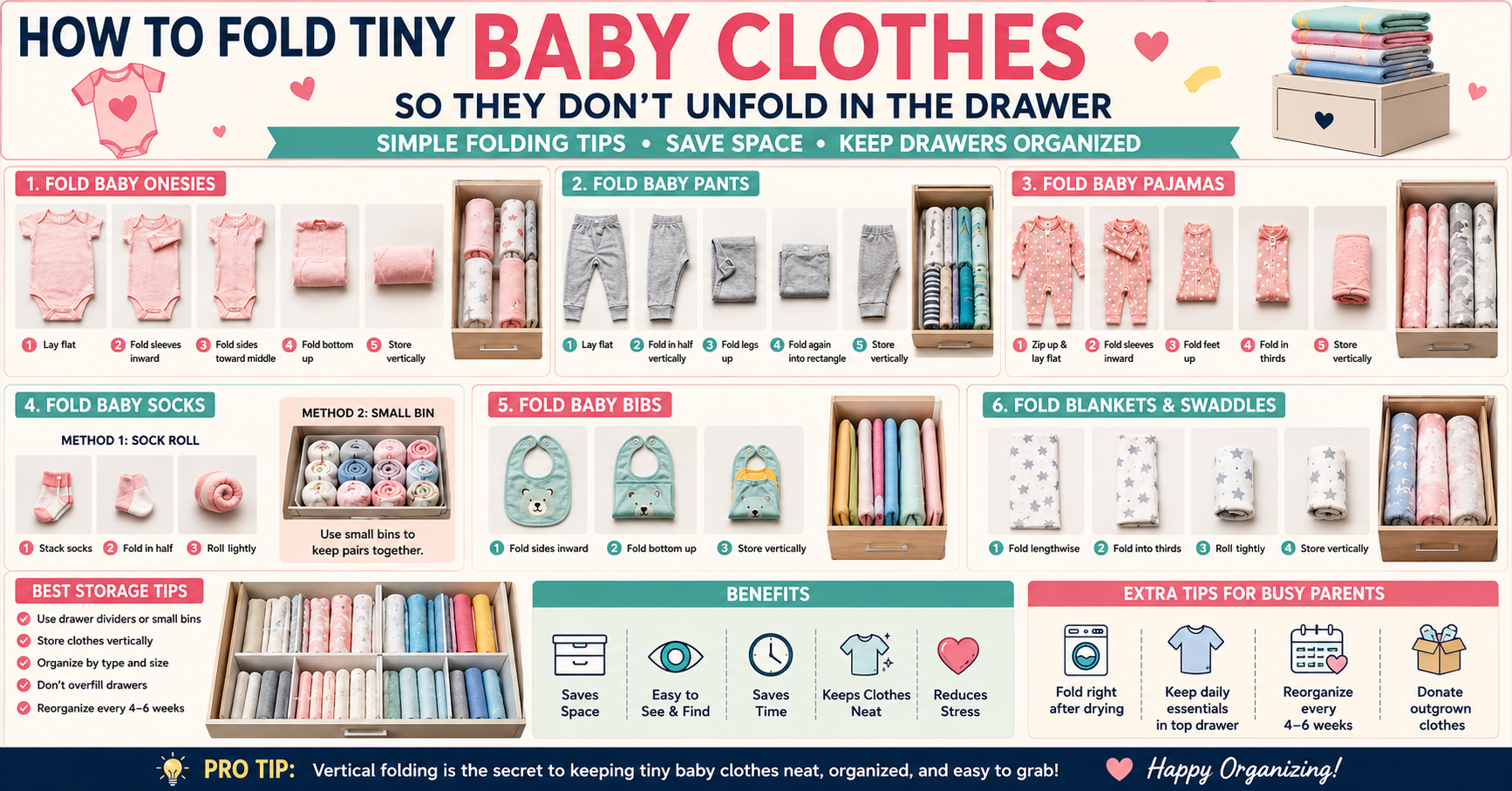
Every new parent knows the feeling. You spend twenty minutes carefully folding tiny baby clothes and putting them away neatly in the drawer. Then you open that drawer two days later and everything looks like a small tornado passed through it. Onesies are tangled together. Tiny socks have somehow escaped to the back. That cute little sleeper you were looking for is now buried at the bottom of the pile.
Learning how to fold tiny baby clothes so they don’t unfold in the drawer is one of those small parenting skills that makes everyday life much easier. It saves you time every morning. It saves you space in the nursery. And it means you can actually find what you are looking for without pulling out the entire drawer.
This guide will show you exactly how to fold tiny baby clothes using simple, easy-to-follow methods. Whether you have a drawer full of newborn onesies, tiny sleepers, little socks, or baby bodysuits, you will find the right folding technique here. We will also cover how to organise your baby’s drawer so everything stays in place, how to sort clothes by size, and some clever space-saving tricks that really work.
Let’s get started.
You might be wondering if the way you fold baby clothes really makes a difference. The honest answer is yes, it matters a lot — especially when you have a newborn.
When you know how to fold tiny baby clothes the right way, a few things happen. First, your baby’s drawer becomes more organised. You can see every item at a glance instead of digging through piles. Second, the clothes stay folded longer. The right fold creates a compact little package that holds its shape even when you slide other things next to it. Third, you save space. A drawer that is properly organised using good folding techniques can hold twice as many items as a drawer where things are just stacked on top of each other.
There is also a practical reason that new parents often overlook. When you are exhausted at 3 AM and need a clean onesie quickly, you do not want to spend five minutes searching through a messy drawer. A well-organised drawer means you can grab what you need in seconds. That matters more than you might think when you are sleep-deprived and dealing with a crying baby.
Baby clothes are also very small and oddly shaped compared to adult clothes. Tiny onesies have snaps at the bottom. Newborn sleepers have footies. Little bodysuits have wide necks. These features make regular folding methods less effective. The clothes tend to spring open or lose their shape. That is why specific baby clothes folding techniques were developed — to deal with these small, stretchy, oddly-shaped items.
You do not need any fancy tools to fold tiny baby clothes well. But a few simple things will make the process easier and help the clothes stay folded longer.
Always fold baby clothes on a flat, clean surface. A bed, a table, a clean floor — all work fine. Folding on an uneven surface makes it harder to get clean, tight folds, and the clothes are more likely to unfold when you put them away.
Drawer dividers are one of the best investments you can make for a baby’s nursery. They create small sections inside the drawer, so different types of clothes stay separate. They also help clothes stay upright when you use vertical folding methods (more on this below). You can buy specific baby drawer dividers, or you can use small cardboard boxes cut to size, repurpose the lids from shoe boxes, or use ziplock bags standing upright.
This sounds obvious, but good lighting really helps when you are working with very small clothes. A bright light helps you see the edges of tiny garments clearly, which makes folding more precise.
Sort your baby’s clothes by type before you start folding. Keep onesies together, sleepers together, socks together, hats together. This makes the folding process faster because you can use the same technique for each batch of similar items. It also makes the drawer easier to navigate later.
There are several proven ways to fold tiny baby clothes so they stay neat in the drawer. We will cover each method in detail so you can choose the one that works best for you.
The basic flat fold is simple and works for most types of baby clothes. It is a great starting point if you are new to folding tiny baby clothes.
How to do it:
The key here is the last step. Many people place folded clothes with the open edge facing up. This is why they spring open — the folded layers are not held in place by anything. When you place the folded edge up, the layers are tucked in and the whole package holds together much better.
This method works well for baby onesies, bodysuits, simple baby t-shirts, and baby leggings.
If you have heard of the KonMari method created by organising consultant Marie Kondo, you may know that it involves folding clothes into small rectangles and storing them vertically rather than stacking them on top of each other. This method is incredibly effective for tiny baby clothes.
The vertical or file folding method is probably the single best technique for anyone who wants to learn how to fold tiny baby clothes so they don’t unfold in the drawer. Here is why it works so well. When clothes are stacked horizontally, the weight of the items on top compresses the ones below. This pressure can actually push folds open over time. When you store clothes vertically, each item stands on its own. Nothing is pressing down on anything else. The folds stay in place much longer.
Vertical storage also makes it easy to see every item in the drawer at a glance, just like looking at file folders in a filing cabinet. You never have to unstack anything to find what you are looking for.
How to do the KonMari fold for tiny baby clothes:
For this method to work well, you need drawer dividers or some kind of container to hold the clothes upright. Without something supporting the sides, the little rectangles will topple over. Use drawer dividers, small boxes, or even rolled-up hand towels placed at the sides of sections to keep everything standing.
The burrito roll is a fun and surprisingly effective method for folding baby onesies and sleepers. It creates a tight, compact roll that is very unlikely to unfold.
How to do the burrito roll for tiny baby onesies:
The cuff at the bottom acts like a band that keeps the roll from unrolling. This is the secret that makes this method work so well. The finished result is a tidy little bundle that you can place in the drawer in rows. It is satisfying and very efficient.
The pocket fold is a slightly more advanced technique but it is very effective for keeping multi-piece baby outfits together and for folding baby bodysuits with poppers.
How to do the pocket fold:
This method is excellent for baby clothing sets because you can fold a vest and a pair of baby trousers together and tuck them into the pocket as one unit. When you go to dress your baby, you can just grab the whole pocket fold and both pieces come out together, already matched.
Baby socks are arguably the hardest baby items to keep organised. They are tiny, they come in pairs, and they have a terrible habit of getting separated in the wash or in the drawer. The roll method solves this.
How to roll tiny baby socks:
These little sock rolls can be stored in a small section of the drawer, in a basket, or in a small ziplock bag. Since pairs are always rolled together, you will never have a single sock problem.
The same rolling technique works well for tiny baby mittens, baby hats, and other small accessories.
Knowing how to fold tiny baby clothes is only half the job. The way you organise the drawer is just as important for keeping things tidy over time.
The most effective way to organise a baby clothes drawer is to keep different types of items in separate sections. Use drawer dividers to create distinct areas. One section for onesies, one for sleepers, one for socks and mittens, one for hats. This way, when you reach for a onesie you are only looking through the onesie section, not through every item in the drawer.
When different types of clothes are mixed together in the same section, it is very easy for things to shift and get mixed up, especially when you are pulling one item out and other items fall into the space.
If you have baby clothes in multiple sizes stored in the same drawer, organise them so the smallest sizes are at the front of each section and larger sizes are at the back. This way you always reach the smallest sizes first. As your baby grows out of one size, you move the next section forward. This approach saves a lot of time and prevents the frustration of pulling out clothes that are already too small.
Some parents prefer to store different sizes in different drawers or different labelled boxes. This works well too, especially if you have a lot of clothing in each size. The key is consistency — whatever system you choose, stick to it so you always know where to look.
We already mentioned the KonMari vertical fold, but the principle of vertical storage goes beyond just the folding technique. Wherever possible, store baby clothes so you can see them from above when you look down into the drawer. This is called vertical or file storage, and it makes a huge difference in how easy it is to find and access items.
With vertical storage, pulling out one item does not disturb the others around it. With horizontal stacking, pulling the top item often causes the ones below to shift and fall over. Vertical storage is just more stable and more functional, especially with the tiny garments that come with folding tiny baby clothes.
Think about which items you use most often. For most parents of newborns, this is onesies and sleep suits. These should be in the most easily accessible part of the drawer — at the front, at the top, or in the first section you encounter when you open the drawer.
Less frequently used items like special occasion outfits, swim suits, or clothes in the next size up can be stored in less accessible spots — at the back, in deeper sections, or in a separate drawer or storage box.
Different types of baby clothes have different features that affect how best to fold them. Here are specific tips for the most common baby garments.
Baby onesies are the most common item in any newborn’s wardrobe. They tend to be stretchy and snap at the bottom, which makes them a little tricky to fold neatly.
The best methods for folding tiny baby onesies are the basic flat fold or the burrito roll. Whichever method you use, the key is to start by folding the snap section up first. This creates a flat, even base for the rest of the fold and prevents the snaps from creating lumps and bumps in the middle of the folded garment.
When using the flat fold, aim for a final rectangle about the width of your palm. This size works well for most baby drawer divider sections and stores efficiently whether you place items flat or vertically.
Baby sleepers and footed pyjamas are longer than onesies and have footie sections that create extra bulk. The trick to folding these neatly is managing the legs and feet.
Lay the sleeper flat with the front facing down. Fold one leg over the other so they line up. Now treat the whole garment as if it were one flat piece. Fold in the sides as with the basic flat fold, then fold from the bottom up, keeping the foot section folded in rather than sticking out.
For extra-tiny newborn sleepers, you may find it easier to fold them with the feet tucked inside the body section before you start the main fold. This keeps the finished fold more compact and prevents the footies from unfolding.
Baby rompers are one-piece outfits with short or long legs. Baby dungarees have shoulder straps. Both can be tricky to fold neatly because of their unusual shapes.
For rompers, fold one leg over the other first. Then fold in the sides. Then fold from the bottom up to finish with a compact rectangle. The shoulder straps on dungarees should be folded down along the back of the garment before you start the main fold.
The pocket fold method works particularly well for rompers and dungarees because the pocket holds the awkward shape together and prevents things from springing open.
Baby trousers and leggings are actually the easiest baby garments to fold because they are a familiar shape. Lay them flat, fold one leg on top of the other, then fold in thirds from the waist down. Simple.
The KonMari vertical method works brilliantly for baby leggings because they fold into very neat, thin rectangles that stand up well. You can fit a lot of leggings in a small drawer space using vertical storage.
Baby hats are best simply folded in half and stored flat or stacked in a dedicated section. You can also fold them inside out so the fold is hidden inside.
Baby mittens are tiny and easily lost. The best approach is to pair them immediately after washing and roll them together using the sock rolling method described earlier. Store all mittens in one small section or container so they are always together.
Even with the best intentions, it is easy to make mistakes that cause baby clothes to unfold in the drawer. Here are the most common ones to avoid.
This is a very common mistake. When baby clothes are slightly damp, they feel soft and easy to fold. But as they dry, the fibres shift slightly and the folds open up. Always make sure baby clothes are completely dry before you fold them. If you are not sure, give them five more minutes in the dryer or hang them for another thirty minutes.
Folding tiny baby clothes beautifully and then just dropping them into an open drawer without any dividers is like pouring tidy files into a drawer without folders. The dividers are what hold everything in place. Without them, the items shift against each other and unfold. This is especially true for vertically stored items, which need support on all sides to stay upright.
It is tempting to pack as many baby clothes as possible into each drawer, especially when you have received a lot of baby gifts. But when a drawer is overfilled, the items at the sides and corners are under pressure and are much more likely to unfold. Leave a little breathing room in each section. A slightly less full drawer that stays tidy is far more useful than a packed drawer that you have to wrestle with every time you need something.
Flat stacking works for some items, but when you stack too many layers on top of each other, the weight of the top layers compresses the ones below and pushes folds open. Keep flat stacks to a maximum of four or five items. If you have more than that, use vertical storage instead.
Consistency matters more than you might think when it comes to folding tiny baby clothes. When everything is folded the same way and stored in the same orientation, the items fit together neatly and support each other. When some things are folded one way and others another way, the sizes are different and the items do not sit well together. Take a moment to decide on a method and stick to it for all similar items.
Babies come with a lot of stuff, and newborn clothes — while tiny — can take up a surprising amount of space if not stored efficiently. Here are some great space-saving strategies to use alongside your folding techniques.
Many people only use the front third of a drawer because that is what is most easily visible. But the full depth of the drawer is usable space. With vertical storage and drawer dividers that extend all the way to the back of the drawer, you can use all of it. Think of the drawer as having two or three rows of depth, each holding different sections of clothes.
For baby clothes your child is not currently wearing — either because they are out of season or because they are the next size up — vacuum storage bags are excellent. You fold the clothes, place them in the bag, and use a vacuum cleaner to remove the air. The clothes compress to a fraction of their normal volume. This is a great way to store baby clothes between sizes without taking up drawer or shelf space.
Place frequently used, currently fitting clothes in the front of drawers and less frequently used items (special occasion outfits, backup items) towards the back. This way your daily routine items are always at hand and the things you rarely need are stored efficiently in the back.
Some baby clothes are better hung than folded. Anything with a lot of structure — little dresses, tiny blazers, special occasion outfits — may hold its shape better on a hanger. Use small velvet or soft baby-sized hangers. Hanging these items frees up drawer space for the items that are better folded.
Baby wardrobes often have a double hanging section because baby clothes are so short. You can hang two rows of items — one at the top and one at the bottom — in the same vertical space that one row of adult clothes would use.
The best way to fold tiny baby onesies so they stay closed is to use the burrito roll method or the KonMari vertical fold. For the burrito roll, you create a cuff at the bottom using the snap section, roll the onesie tightly, and then wrap the cuff around the outside of the roll. This cuff acts as a band that holds the roll closed. For the KonMari fold, you store onesies vertically so nothing is pressing down on them from above and each one stays in place on its own.
The best way to fold newborn clothes to save space is to use the KonMari vertical folding method combined with drawer dividers. Fold each item into a small, compact rectangle and then stand them upright in the drawer in rows, like files in a filing cabinet. This method uses the full depth of the drawer instead of just building upward in a stack. Paired with drawer dividers to keep sections separate, this approach can nearly double the storage capacity of a standard baby clothes drawer.
Baby clothes keep unfolding in the drawer for several reasons. The most common is that they are placed with the open edges facing upward, so the folds are not held in place. Another reason is that the drawer is too full, which puts pressure on items at the sides and pushes folds open. Not using drawer dividers also causes items to shift and unfold when you open and close the drawer. Finally, stretchy fabrics have a natural tendency to spring open — using tighter folds and rolling methods helps combat this.
Yes, for most parents, the KonMari vertical folding method is significantly better for organising baby clothes. It allows you to see every item at a glance without disturbing other items. It uses drawer space more efficiently. And because nothing is stacked on top of anything else, clothes are less likely to unfold due to pressure from above. The main requirement is that you need drawer dividers or containers to hold the vertical items upright. Once you set this up, many parents say they will never go back to flat stacking.
The best way to keep tiny baby socks paired and organised is to roll them together immediately after they come out of the dryer, before they get put in a pile or a drawer. Place one sock on top of the other, roll from the toe end to the cuff, then fold the outer cuff back over the roll to hold it together. Store all sock rolls in one dedicated section or small basket in the drawer. You can also use a small mesh laundry bag specifically for baby socks during washing so pairs never get separated in the machine.
You can transition to more standard adult folding methods once your child is around 18 to 24 months old. At this point, clothes are larger and more similar in proportion to adult clothes, so they hold standard folds more reliably. However, many parents find they continue to use vertical KonMari-style storage for toddler clothes because it remains the most space-efficient and easy-to-navigate method regardless of the size of the garments.
Baby sleeping bags and wearable blankets are bulkier than regular baby clothes but can still be folded neatly. Lay the sleeping bag flat with the zip closed. Fold in the sides so you have a long rectangular shape. Then fold in thirds from the bottom up. Because these items are bulky, they are best stored flat rather than vertically. Keep them in a separate section of the drawer or on a shelf rather than mixing them with folded onesies and sleepers.
Yes, absolutely. You should always wash new baby clothes before folding and storing them, even if they have never been worn. New clothes often contain residual dyes, fabric softeners from manufacturing, and other chemicals that can irritate a newborn’s sensitive skin. Wash them in a gentle, fragrance-free baby laundry detergent on a gentle cycle. Make sure they are completely dry before folding. This also makes the clothes slightly softer and often easier to fold because any stiffness from packaging is removed.
The best drawer organisers for tiny baby clothes are adjustable fabric dividers or small bamboo drawer dividers. Adjustable dividers allow you to customise the width of each section to match the type and number of items you have. Fabric dividers are soft and will not snag delicate baby clothes. Many parents also have great success using small cardboard boxes (like gift boxes or the boxes from wipes packets) cut to size. The key is to have enough sections to separate different types of clothing and to hold vertically stored items upright.
Most parents find that doing a quick tidy of the baby’s clothes drawer once a week is enough to keep everything in order. This might take just five minutes — simply refolding anything that has come loose, pulling forward any items that have shifted to the back, and removing any clothes that your baby has now outgrown. Doing a full reorganisation once a month, when you also check sizes and move outgrown clothes to storage, keeps the system working well over time. The better your initial folding and organisation system, the less maintenance it will need.
Learning how to fold tiny baby clothes properly is one of those small parenting skills that pays off every single day. It might feel like a lot of information to take in at first, but the techniques themselves are simple once you practise them a few times.
Start with the method that feels most intuitive to you. Many parents begin with the basic flat fold and then switch to the KonMari vertical fold once they see how much more efficient it is. The burrito roll is popular for onesies because it is satisfying and the finished rolls look tidy and organised. The pocket fold is brilliant for keeping outfits together.
The most important thing is to be consistent. Once you choose a method for each type of garment, use it every time. Consistency is what makes a drawer stay organised over time. When everything is folded the same way and placed in the same section, the drawer naturally stays tidy even with regular use.
Combined with good drawer dividers, sorting clothes by size and type, and keeping the drawer from becoming overfull, these folding techniques will make your baby’s nursery much more functional and much less stressful.
Because at the end of the day, parenting a newborn has plenty of challenges. Your baby’s clothes drawer does not need to be one of them.