
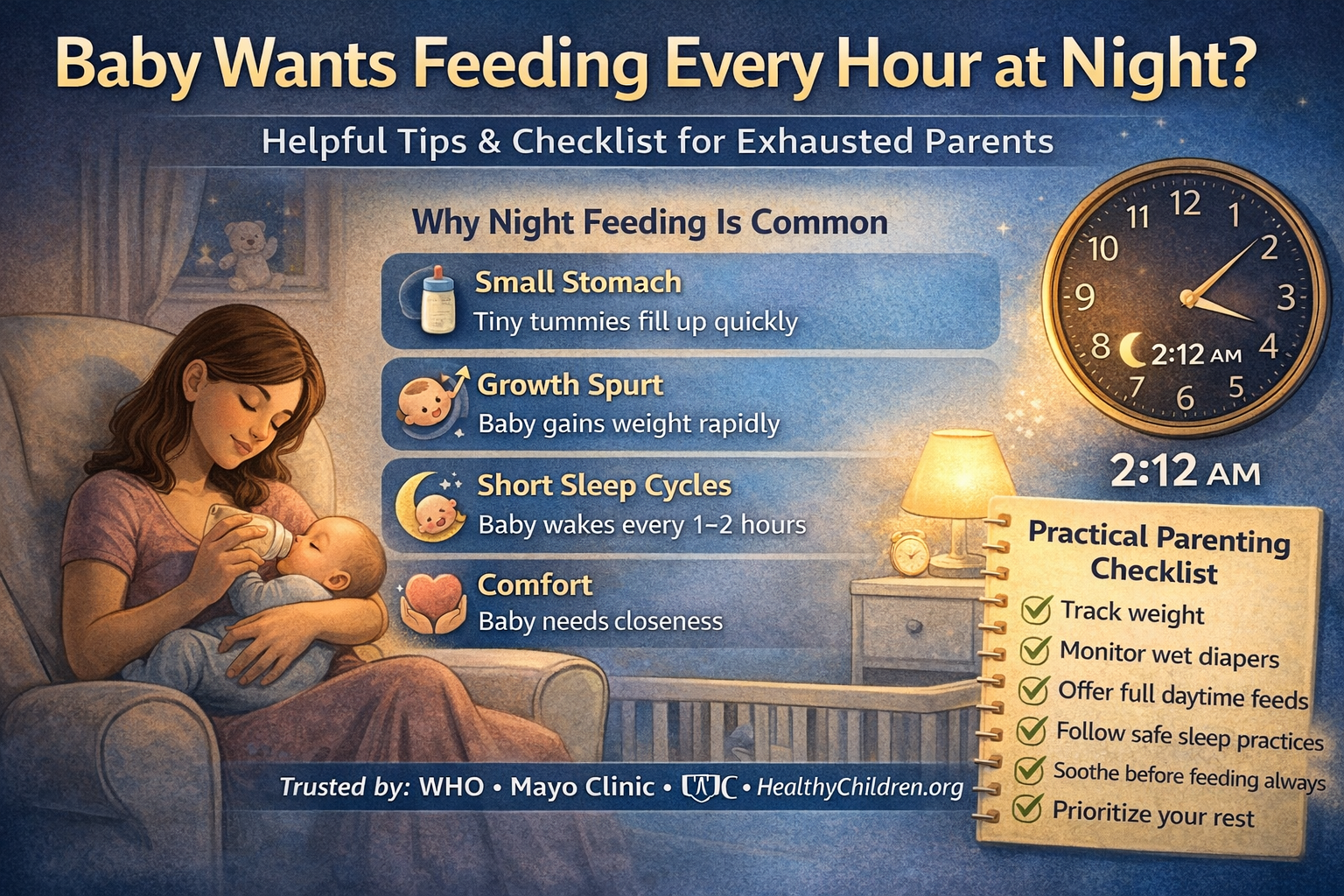
Introduction: When Your Baby Wants Feeding Every Hour at Night and You’re Barely Surviving
It’s 2:13 a.m.
You just closed your eyes… and your baby is crying again.
If your baby wants feeding every hour at night, you are not failing. You are not alone. And you are definitely not doing anything wrong.
Many parents whisper the same worried question into the dark: Why does my baby want to feed all night?
In this complete ParentNest guide, I’ll walk you through:
- Why hourly night feeds happen
- When it’s biologically normal
- When to check for concerns
- Gentle, science-backed ways to improve sleep
- How to protect your mental health
Let’s turn exhaustion into understanding.
Quick Answer: Why Baby Wants Feeding Every Hour at Night
If your baby wants feeding every hour at night, it is usually normal in newborns due to small stomach size, growth spurts, cluster feeding, or comfort needs. It can also happen during sleep regressions, teething, or developmental leaps. Frequent night feeding is common in the first months of life and often improves with age.
Table of Contents
Why Baby Wants Feeding Every Hour at Night (The Science)
When a baby wants feeding every hour at night, there is almost always a biological reason.
According to the World Health Organization (WHO), frequent feeding supports healthy growth, especially in the early months.
Newborns are wired to wake often. Their brains are immature. Their stomachs are tiny. Their nervous systems crave reassurance.
Frequent night feeding is survival design — not bad behavior.
Is It Normal If My Baby Wants Feeding Every Hour at Night?
Yes, in many cases.
The Mayo Clinic and HealthyChildren.org explain that newborns may feed 8–12 times in 24 hours. Some feed even more during growth spurts.
Hourly feeding is most common:
- In the first 6–8 weeks
- During cluster feeding phases
- Around developmental leaps
- During sleep regressions
If baby is gaining weight well and producing wet diapers, it’s often normal.
Newborn Stomach Size and Night Feeding
Here’s something many parents don’t realize.
A newborn’s stomach is very small.
| Age | Stomach Size | Feeding Pattern |
|---|---|---|
| Day 1 | Cherry-sized | Very frequent |
| Week 1 | Walnut-sized | Every 2–3 hours |
| 1 Month | Egg-sized | Still frequent |
Small stomachs empty quickly.
That’s one reason your baby wants feeding every hour at night.
Growth Spurts: Why Baby Wants Feeding Every Hour at Night Suddenly
Has your baby suddenly started waking every hour?
Growth spurts are likely the reason.
Common ages:
- 2–3 weeks
- 6 weeks
- 3 months
- 6 months
During these periods, babies cluster feed to increase milk supply.
The NHS notes that frequent feeding during growth spurts is temporary and supports brain development.
It usually lasts 2–4 days.
Cluster Feeding vs. Hunger
Cluster feeding often happens in the evening and early night.
Baby may:
- Feed for short periods
- Seem fussy
- Refuse to settle
- Want to stay latched
This does not mean low milk supply.
According to the CDC, frequent breastfeeding stimulates milk production and is a normal supply-building mechanism.
Sleep Cycles and Why Baby Wants Feeding Every Hour at Night
Babies have short sleep cycles — about 40–50 minutes.
At the end of each cycle, they partially wake.
If baby falls asleep while feeding, they may associate feeding with sleep.
When they wake between cycles, they seek the same condition.
This can look like hunger but may actually be sleep association.
Comfort Feeding vs. Nutritional Feeding
Sometimes baby wants feeding every hour at night for comfort, not calories.
Comfort feeding helps regulate:
- Heart rate
- Breathing
- Stress hormones
- Temperature
This is especially true in the first three months.
HealthyChildren.org explains that sucking releases calming hormones for babies.
Comfort is a biological need.
Medical Reasons to Rule Out
While frequent night feeding is often normal, check with a pediatric provider if:
- Poor weight gain
- Fewer than 6 wet diapers daily
- Persistent vomiting
- Signs of reflux discomfort
- Severe fussiness
The Mayo Clinic emphasizes that feeding concerns should be discussed if growth slows.
Trust your instincts.
Breastfed vs. Formula-Fed Night Feeding Patterns
Breastfed babies may wake more often.
Why?
Breast milk digests faster.
Formula-fed babies may sleep slightly longer stretches, but night waking is still common.
WHO supports exclusive breastfeeding for six months, but feeding choice should fit family health and wellbeing.
Both feeding methods can involve night waking.
Breastfed vs. Formula-Fed Night Feeding Patterns
Breastfed babies may wake more often.
Why?
Breast milk digests faster.
Formula-fed babies may sleep slightly longer stretches, but night waking is still common.
WHO supports exclusive breastfeeding for six months, but feeding choice should fit family health and wellbeing.
Both feeding methods can involve night waking.
If crying escalates, feed.
Step 4: Avoid Immediate Feeding for Every Stir
Pause for 30–60 seconds.
Sometimes baby resettles independently.
Step 5: Protect Your Sleep
- Sleep when baby sleeps
- Share night duties if possible
- Consider safe room-sharing
CDC recommends room-sharing without bed-sharing for safer sleep.
Practical Parenting Checklist
✔ Monitor weight gain
✔ Track wet diapers
✔ Feed responsively
✔ Encourage full daytime feeds
✔ Follow safe sleep guidelines
✔ Prioritize your rest
✔ Ask for help when overwhelmed
Common Mistakes Parents Make
- Thinking hourly feeding means low milk supply
- Comparing baby to others
- Dropping night feeds too early
- Ignoring their own exhaustion
- Forcing strict sleep training too young
Remember: newborn biology is not a sleep problem.
Expert Pro Tips
As a pediatric behavioral specialist, I often tell parents:
- The first 12 weeks are about survival, not schedules.
- Night feeding is protective against SIDS in early infancy.
- Emotional safety supports long-term independence.
Gentle consistency works better than sudden changes.
Recommended Helpful Tools for Parents
These tools may support better nights:
- White noise machine
- Blackout curtains
- Baby feeding tracker app
- Supportive nursing pillow
- Comfortable rocking chair
Realistic Statistics About Night Feeding
- 60–70% of newborns wake every 2–3 hours
- Around 40% of babies still wake at night at 6 months
- Growth spurts increase feeding frequency by 20–30%
- Breastfed babies average 8–12 feeds per day
- Safe sleep practices reduce sleep-related risks significantly (CDC)
Night waking is common — not rare.
Frequently Asked Questions
Why does my baby want to feed all night suddenly?
Most often due to growth spurts, developmental leaps, or sleep regressions.
Is hourly feeding normal at 2 months?
Yes, especially during cluster feeding phases.
Does frequent feeding mean low milk supply?
Not usually. Frequent feeding often increases supply.
When should I worry about constant feeding?
If baby has poor weight gain or fewer wet diapers.
Can I stop night feeds at 4 months?
Some babies are ready. Many still need 1–2 feeds.
Why does my baby only sleep after feeding?
Feeding becomes a sleep association.
Will my baby outgrow hourly night feeding?
Yes. Most babies gradually extend sleep as their nervous system matures.
Encouraging Conclusion: When Baby Wants Feeding Every Hour at Night
If your baby wants feeding every hour at night, it is not a sign of failure.
It is biology. It is development. It is temporary.
With time, your baby’s stomach grows. Sleep cycles mature. Feeding patterns stabilize.
You are not spoiling your baby. You are responding.
And one day soon, you will look back at these nights with pride — because you showed up with love.