
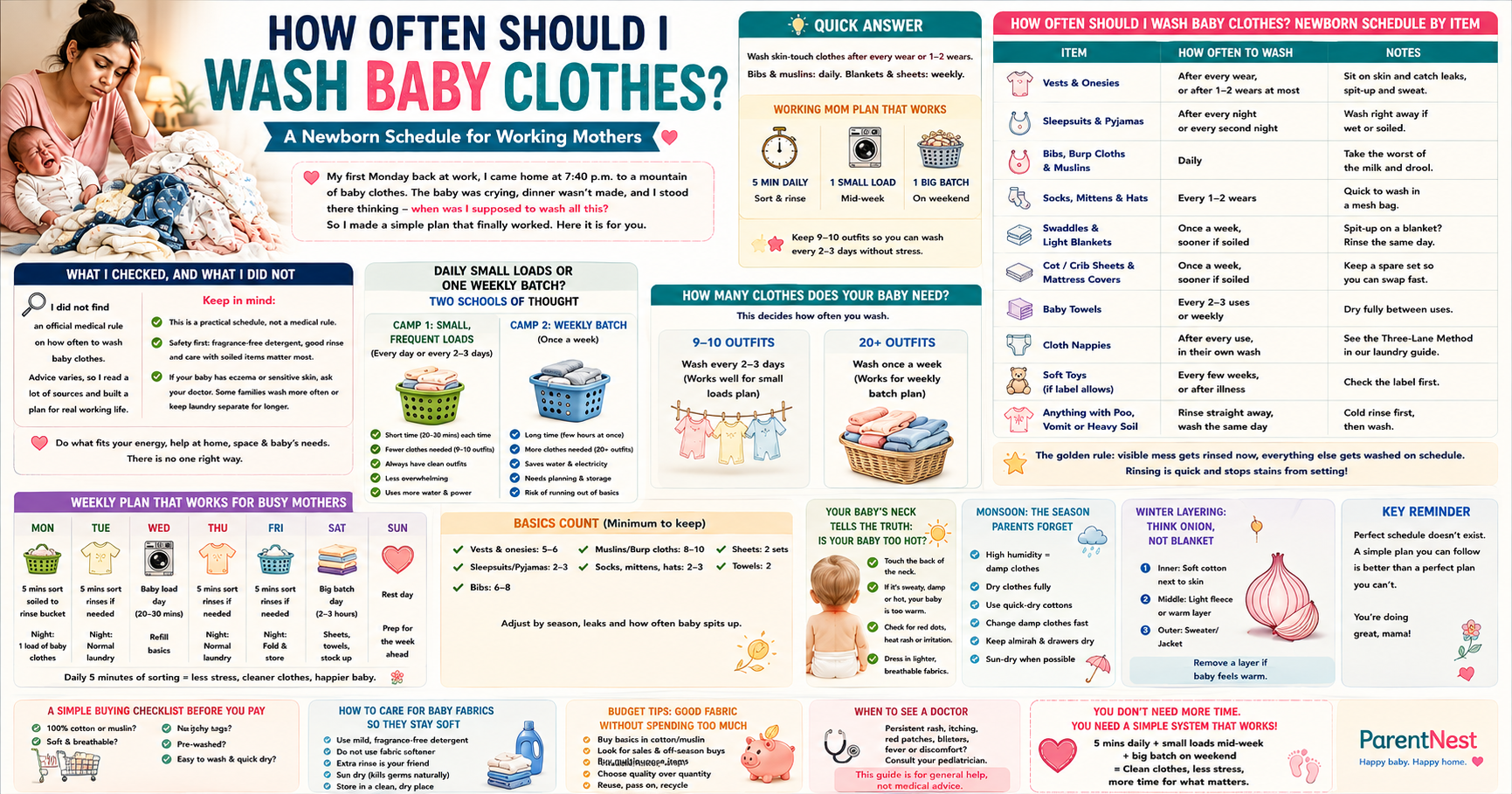
My first Monday back at work, I came home at 7:40 p.m. to a mountain.
It sat on the bed like a small, soft hill. Onesies. Muslins. Three bibs. A sleepsuit with a stain I couldn’t name. The baby was crying, dinner wasn’t made, and I stood there with my bag still on my shoulder, doing a very tired sum. When was I supposed to wash all this? Between a nine-to-six job, a commute and a newborn, where did laundry even fit?
I typed a question into my phone with one thumb: how often should I wash baby clothes newborn schedule? The answers were all over the place. “After every wear.” “Once a week.” “Every two to three days.” Nobody said how to do it when you work. So I made my own plan, and it was far simpler than I expected. This guide shares it, in plain words, with a clear table for how often to wash each item, a clothes count that decides your schedule, and a weekly plan for busy mothers in India. Get a cup of tea. The headings will help if the baby wakes.
How Often Should I Wash Baby Clothes Newborn Schedule
Quick answer: Wash clothes that touch the skin, like vests, onesies and sleepsuits, after every wear or two. Wash bibs and muslins daily, and blankets and sheets weekly. For working mothers, a simple plan works best: 5 minutes of sorting every day, one small baby load mid-week, and a bigger batch at the weekend. Keep about 9 to 10 outfits so you can wash every 2 to 3 days.
Table of Contents
What I checked, and what I did not
Let me be honest first.
I did not find an official medical rule on how often to wash baby clothes. There isn’t one that I could find. What exists is advice from parenting sites, baby clothing shops and brand blogs, and it varies. So I read many of them, noted where they agree, and then built a schedule around real working life. The time estimates here are planning guides. I did not time anyone’s laundry with a stopwatch.
Three things to keep in mind:
- This is a practical schedule, not a medical rule. Adjust it to your baby, your home and your energy.
- Safety still comes first. Fragrance-free detergent, a good rinse and care with soiled items matter more than the exact day of the week.
- If your baby has eczema or sensitive skin, ask your doctor. Some families wash more often, and some keep laundry separate for longer.
Now let’s answer the main question.
How often should I wash baby clothes? A newborn schedule by item
Here is the part most people want first. The sources agree on a few basics. Anything that touches the skin or catches milk, spit-up, wee or poo needs washing often. Things that stay cleaner can wait a little longer.
The table below shows what I suggest. Where sources were thin (like sheets and soft toys), these are my own suggestions, so treat them as a starting point.
| Item | How often to wash | Notes |
| Vests and onesies | After every wear, or after 1 to 2 wears at most | They sit on the skin and catch leaks and spit-up. |
| Sleepsuits and pyjamas | After every night or every second night | Wash right away if wet or soiled. |
| Bibs, burp cloths and muslins | Daily | They take the worst of the milk and drool. |
| Socks, mittens and hats | Every 1 to 2 wears | Quick to wash in a mesh bag. |
| Swaddles and light blankets | Once a week, sooner if soiled | A spit-up on a blanket needs a rinse the same day. |
| Cot or crib sheets and mattress covers | Once a week, sooner if soiled | Keep a spare set so you can swap fast. |
| Baby towels | Every 2 to 3 uses, or weekly | Dry fully between uses. |
| Cloth nappies | After every use, in their own wash | See the Three-Lane Method in our separate laundry guide. |
| Soft toys (if the label allows) | Every few weeks, or after illness | Check the label first. |
| Anything with poo, vomit or heavy soil | Rinse straight away, wash the same day | Cold rinse first, then wash. |
The golden rule is simple: visible mess gets rinsed now, and everything else gets washed on schedule. Rinsing is quick, and it stops stains from setting, as we explain in our spit-up stain guide.
Daily small loads or one weekly batch? Two schools of thought
When I read around, I found that parents usually fall into one of two camps.
Camp 1: wash a little every day or every two to three days. The load is small, nothing piles up, and you always have clean outfits.
Camp 2: wash everything once a week. You spend one block of time on laundry, and save water and power by running full loads.
Both can work. Here is how they compare for a working mother.
| Small, frequent loads | Weekly batch | |
| Time per session | Short (20 to 30 minutes of effort) | Long (a few hours at once) |
| Clothes needed | Fewer (about 9 to 10 outfits) | Many more (about 20 or more) |
| Stain risk | Low, because stains don’t sit | Higher, because messy items wait |
| Water and power | More runs, smaller loads | Fewer runs, fuller loads |
| Fits a 9-to-6 job? | Yes, if the load is tiny and you use a timer | Only if you also rinse stains daily |
| Fits the monsoon? | Easier, because small loads dry faster | Harder, because a big batch needs lots of drying space |
My honest view: for a newborn, pure weekly batching is hard, because a newborn makes a lot of mess and needs many outfits. The sweet spot for working mothers is a hybrid: a very quick daily habit, one small baby load in the middle of the week, and a bigger batch at the weekend. That is the plan I’ll show you in a moment.
How many baby clothes do I need? Your wardrobe decides your schedule
Here is a link most guides miss. How often you must wash depends on how many outfits you own.
Sources say newborns change clothes about two to three times a day on average, and up to five times on a very messy day. One popular rule of thumb is the 3-3-3 rule: three outfits a day, for three days, which is about nine outfits.
Here is a simple way to work it out. Take the outfits you use per day, multiply by the days between washes, then add two spares for bad days.
| How often you wash | Outfits to own (at 3 a day) | Good for |
| Every day | About 5 to 6 | A stay-at-home day, or a helper who washes daily |
| Every 2 to 3 days | About 9 to 11 | Most working mothers (the sweet spot) |
| Once a week | About 20 to 23 | Only if you also rinse stains daily and have lots of drawer space |
Notice what this means. If you only have 6 outfits, you can’t wash once a week. You’ll run out by Tuesday. And if you own 25 outfits, you can wash weekly, but you’ll have a very big pile and a lot of folding.
For most working mothers in India, I’d suggest 9 to 11 everyday outfits, plus a few spares in the baby bag. That gives you a washing rhythm of every two to three days, and it keeps the pile small.
A few Indian-home notes:
- In warm weather, thin cotton vests and light sleepsuits dry quickly. That makes small, frequent loads very easy.
- In the monsoon, add a few extra outfits, because drying takes longer.
- Don’t buy a huge wardrobe of newborn sizes. Babies grow fast, and extra clothes only mean extra laundry.
The working mother’s problem: where does laundry fit?
Let me describe a typical day. You may recognise it.
You wake up early, feed the baby, get ready and leave. You come home in the evening, take over baby care, cook or eat, feed again, and finally fall asleep. Where is the laundry?
It helps to look at your day as a time map. Here are the places where laundry can actually fit.
| Time slot | What can happen | Effort |
| Early morning, before work | Start a timed baby load, or hang yesterday’s load | 5 minutes |
| While you get ready | Machine runs on its own | 0 minutes |
| Lunch break | Ask a helper or family member to hang clothes (or plan to do nothing) | 0 to 5 minutes |
| Evening, 30 minutes after you come home | Rinse stains, sort baskets, hang the clean load | 5 to 10 minutes |
| Late night | Put a load on and set a delay start for morning, if your machine has it | 5 minutes |
| Weekend | The bigger batch and reset | About an hour of effort |
Look at that table. The key idea is that laundry is mostly waiting, not working. The machine does the washing. You only need short bursts at the start and end. Once I saw that, the mountain started to look smaller.
If your machine has a delay-start feature, you can load it at night and set it to finish when you wake up. Check your manual. It’s one of the most useful time-savers for a working parent.
The 5-20-60 Plan: a baby laundry schedule for working mothers
Here it is. I call it the 5-20-60 Plan, and it has three parts.
- 5 minutes, every day: the daily reset.
- 20 minutes, once in mid-week: the baby load.
- 60 minutes, at the weekend: the batch and refill.
That’s about two hours of real effort a week, not including the time the machine runs. Let’s look at each part.
The daily 5 minutes (daily laundry routine for baby)
This is the habit that makes everything else easy. It takes five minutes, and you can do it while the kettle boils.
- Rinse any stained item in cold water. Spit-up, milk, poo, food. Do it now, not later. (See our spit-up stain guide.)
- Put every item in the right basket. Everyday baby clothes in the baby basket. Soiled items in the lidded bucket. Family clothes in the family basket. (See the Three-Lane Method.)
- Hang or spread out anything that is damp so it doesn’t smell.
- Set out tomorrow’s outfits. Three for the baby, within reach.
- Wash your hands. Always after handling dirty laundry.
That’s it. If you only do this one habit, you’ll already be ahead.
The mid-week 20 minutes: the baby load
Once or twice a week (I like Tuesday or Wednesday evening, and Saturday if needed), run one small baby load.
- Gather the baby basket and any soaked items from the bucket.
- Load the machine with baby clothes, muslins and bibs. Use a mesh bag for small items.
- Use a fragrance-free detergent at the recommended dose, a gentle cycle at 30 to 40 degrees and an extra rinse. (Our washing machine settings guide explains this in detail.)
- Start it, or set a delay start so it finishes as you wake.
- Hang the clothes when it’s done. If you’re out, ask someone at home to hang them, or hang them first thing in the morning.
That’s about 20 minutes of your effort, and the machine does the rest.
The weekend 60 minutes: batch and refill
The weekend is for the bigger jobs.
- Wash the bigger items: sheets, swaddles, towels and blankets.
- Wash the family laundry, using the Baby-First Rule from our separate laundry guide.
- Clean the machine once a month with a tub-clean cycle.
- Fold and refill the drawers. Put away the clean clothes, and check that you have 9 to 11 outfits ready.
- Check sizes. Set aside anything the baby has outgrown.
- Restock: detergent, mesh bags, spare muslins.
Sixty minutes, once a week. That’s the whole plan.
A sample week for a 9-to-6 working mother
Here is how the plan can look across a week. Change the days to suit you.
| Day | Morning | Evening | Extra |
| Monday | Hang anything from last night | Daily 5 minutes | |
| Tuesday | Start the timed baby load | Hang it. Daily 5 minutes. | Mid-week 20 minutes done |
| Wednesday | Daily 5 minutes | ||
| Thursday | Daily 5 minutes. Optional second small load if outfits are low. | ||
| Friday | Daily 5 minutes. Sort the weekend pile. | ||
| Saturday | Weekend batch: sheets, swaddles, towels | Hang and fold | 60 minutes done |
| Sunday | Family load (baby first). Fold and refill. | Reset the baskets. Plan the week. | Machine clean once a month |
If it feels like too much, cut it down. Even the daily 5 minutes plus one weekend batch will do the job, as long as you own enough outfits.
Variations: if your life doesn’t look like that
Not every working mother has a nine-to-six job and a machine. Here are some changes for other situations.
| Your situation | How to change the plan |
| Work from home | Do the daily 5 minutes, and use small breaks to hang clothes. A load can run during a meeting. |
| Night shift or long hours | Use the delay start. Do the daily 5 minutes when you wake. Ask a family member to hang clothes. |
| A helper comes in the morning | Give them a clear card (see the handoff section below). Keep the soiled lane for yourself or a trusted person. |
| Joint family | Share the three lanes. Label the baskets. Ask who can own the weekend batch. |
| No washing machine (bucket washing) | Use two buckets: one for soaking, one for rinsing. Wash a small amount daily instead of a big batch. |
| Semi-automatic machine | Use the same plan. Wash the baby load first, and rinse extra in the second tub. |
| Very small flat | One small baby basket, one lidded bucket, one family basket. Use a foldable rack for drying. |
Batch washing baby clothes: how to do it safely
If you can only wash on the weekend, you can still do it. You just have to be careful with the middle of the week. Here is how to batch safely.
Use the lidded bucket for messy items. Rinse them in cold water, then drop them in a bucket with a lid, cool water and a spoonful of a fragrance-free detergent. This stops stains from setting and keeps smells in.
Don’t leave soiled items more than a day. Wet clothes grow smells and stains fast, especially in hot weather. If you can’t wash them, rinse them and hang them to dry before putting them in the basket.
Keep a stain-pail. A small bucket by the changing area is enough. You’ll thank yourself on the weekend.
Keep the baby basket breathable. A mesh hamper keeps air moving. A closed plastic bin traps damp and smell.
Don’t let it get too big. A giant pile means a giant job. If the basket is more than three-quarters full, do an extra small load.
Wash heavy loads in two batches. Overloading a machine means poor rinsing, and rinsing matters most for baby skin.
A weekly batch works best when you have many outfits, a lidded bucket and a daily rinse habit. Without those three things, small mid-week loads are safer.
Laundry hacks for new moms: 12 time-savers that actually help
These are the little things that make the difference. Pick two or three, not all twelve.
- Mesh bags for socks, mittens and bibs. Nothing gets lost, and nothing sticks to a sleeve.
- Pack full outfits together. Put a vest, bottoms and socks in a small zip bag, so changing the baby takes one grab.
- Spare outfits in three places. The nursery, the baby bag and the car (or your office drawer).
- Buy plain, light colours. Fewer colours means less sorting. A few pastel cottons can wash together.
- Use a delay start. Load at night, wash in the morning.
- Keep two cot sheets. When one is soiled, swap it and wash later.
- Limit the bib collection. Six bibs is plenty. More bibs just mean more laundry.
- Hang by size. On a hanger or drying rack, group items so folding is faster.
- Fold less. Roll vests and sleepsuits into drawer dividers. Folding perfectly is not required.
- Keep a “stain kit” beside the changing table. A bottle of cool water, a cloth and a small bar or bottle of detergent. (See our travel stain remover list.)
- Teach one other person the routine. A system that only you know is a system that tires you.
- Lower the bar. A clean, dry, slightly crumpled onesie is perfect. No baby has ever judged a wrinkle.
Laundry basket organization for the nursery
A good basket setup does half the work for you. Here is how to build one, even in a small room.
The three baskets. Use the Three-Lane Method from our separate laundry guide.
| Basket | What goes in | Type |
| Lane 1: Baby | Everyday clothes, muslins, bibs | Breathable mesh basket or hamper |
| Lane 2: Soiled and sick | Cloth nappies, vomit or poo items, sick-person laundry | Bucket with a lid, or a washable bag with a drawstring |
| Lane 3: Family | Everyone else’s laundry | Whatever you already use |
Where to put them.
- Keep the baby basket near the changing area, but away from the cot.
- Keep the soiled bucket near the bathroom, out of reach of a crawler.
- Keep the family basket in the usual place.
How to make it easy.
- Label each basket with tape or a sticker. Use colours if helpers or relatives help.
- Put a small hook on the wall for a drawstring bag, if floor space is tight.
- Keep a small “clean” drawer or shelf for tomorrow’s outfits.
How to keep it clean.
- Wipe plastic baskets every week with warm soapy water.
- Wash fabric liners with the baby load.
- Never put damp clothes in a closed basket. Let them air first.
- Never put clean laundry in a basket that had dirty laundry in it.
For small flats. If space is tight, use one small basket for baby, one bucket with a lid, and the family basket. You don’t need more.
[IMAGE: three labelled baskets in a small nursery corner]
Drying plan for working mothers (including the monsoon)
Washing is only half the job. Drying is the other half, and it’s where working mothers get stuck, because the clothes sit wet while you’re at the office.
In dry weather:
- Hang the load in the morning before you leave, in shade or sun. Baby cotton usually dries in a few hours.
- Use sun for white cotton, and shade (inside out) for coloured and printed items.
- Bring clothes in before evening, so they don’t pick up dust or damp.
In the monsoon:
- Use a higher spin speed for sturdy cotton, to get more water out. Use a low spin for wool and delicate items.
- Hang clothes indoors under a fan, with space between each item.
- Don’t hang clothes in a closed room with no air flow.
- Iron nearly dry clothes with a warm iron to finish drying (only after any stain is fully gone).
- Keep a few extra outfits so you can wait for clothes to dry fully.
If nobody is home to hang clothes:
- Don’t run the machine and leave wet clothes inside it all day. They’ll smell.
- Use a delay start so the load finishes just before you can hang it.
- Or ask a helper or family member to hang them.
Our monsoon drying guide goes deeper on this. Remember to never store damp clothes.
Sharing the load: partners, in-laws and helpers
Laundry shouldn’t be a one-person job. Many working mothers carry it alone, and it can feel heavy because nobody sees it. Here is how to share it.
Make the plan visible. Put the 5-20-60 card on the wall near the machine. When a plan is visible, anyone can help.
Give clear jobs. “Please hang the load at lunch” is easier to do than “help me with laundry”.
| Job | Who could do it |
| Daily rinse and sorting | You, or whoever changes the baby |
| Starting and hanging the mid-week load | You, a partner, or a helper |
| Weekend batch and folding | Partner, family member or both together |
| Machine clean and restocking | Partner or helper, monthly |
Give your helper a one-page card. Write in simple words (and in your helper’s language if you can): “Baby first. Fragrance-free detergent. No softener. Soiled items go in the bucket. Wash hands after.” Show it in person, not just on paper, and be kind about it. Treat it as a household habit, not a test.
Talk to relatives kindly. If elders do things a different way, a calm line helps: “The doctor said newborns need extra care for a few months.” Our separate laundry guide has more lines you can use.
Ask for help, and say thank you. A small routine, shared, takes less than a big routine done alone.
What to write on your wall card
A plan only works if you can see it. So write it down, and stick it where you do the laundry. Here is what I would put on the card. Keep it to one page, with big letters.
Every day (5 minutes)
- Rinse stains in cold water
- Right basket for every item
- Hang anything damp
- Set out tomorrow’s 3 outfits
- Wash hands
Mid-week (20 minutes)
- One small baby load
- Fragrance-free detergent, gentle cycle, extra rinse
- Delay start if the machine has it
- Hang in the morning
Weekend (60 minutes)
- Sheets, swaddles, towels
- Family load, baby first
- Fold and refill drawers (9 to 11 outfits)
- Machine clean once a month
Always
- Baby first
- No fabric softener
- Never store damp clothes
Take a photo of the card and send it to everyone who helps. That way, nobody has to ask you what to do when you’re not there.
A kinder way to think about laundry
I want to say something that no schedule can fix. Laundry will never be finished. You will wash the clothes, and the baby will wear them, and the clothes will need washing again. That isn’t failure. It’s what babies do.
When you work and care for a newborn, your energy is the real limit, not the machine. So the best baby laundry schedule is the one you can keep on a tired day. If a step makes you feel guilty or stressed, drop it. If a step makes your week easier, keep it.
A few gentle rules I try to follow:
- Done is better than perfect. A clean, dry onesie is a good onesie, even if it’s not folded.
- Ask for help early, before you’re exhausted.
- Spend a little to save a lot. An extra set of vests or a second cot sheet is cheaper than a week of stress.
- Review, don’t judge. If the plan isn’t working, change the plan, not yourself.
Your baby doesn’t know what day of the week the laundry gets done. They only know that you’re there.
When the schedule breaks (and it will)
Some days will go wrong. A blowout. A fever. A festival. A power cut. That’s normal, and the schedule is a guide, not a promise. Here is a simple Plan B.
| What happened | Plan B |
| A messy day with many outfit changes | Rinse everything in cold water, put it in the lidded bucket, and wash an extra small load the next day. |
| A sick baby (stomach bug, fever) | Wash their clothes and bedding in their own load, hot if the label allows. A fever in a baby under three months needs a doctor straight away. |
| Power cut | Hand wash the essentials (vests, muslins) in a bucket, rinse well and dry. Do the rest when power returns. |
| Water cut | Rinse stains with a little water, keep soiled items in the lidded bucket, and wash when the water returns. Keep extra outfits. |
| Travel or visiting family | Pack more outfits than you think. Carry a zip pouch for soiled items and a small bottle of detergent. |
| Festival week with many guests | Skip the weekend batch if you must. Do the daily 5 minutes and one small baby load. Ask for help. |
| You feel too tired | Do the daily 5 minutes only, and let the rest wait one day. Clean enough is clean enough. |
If your clothes run low, buy two or three extra outfits rather than skipping a wash. A few extra vests cost much less than a week of stress.
Before the baby comes: set up your laundry system early
If you are reading this while pregnant, you have a gift most of us didn’t: time. A little setup now makes the first weeks much easier.
- Wash the new baby clothes before the birth. Some sources suggest starting four to six weeks before the due date. Wash them with a fragrance-free detergent, dry them fully and put them away. (See our baby-safe detergent comparison.)
- Buy enough, not too much. Aim for 9 to 11 everyday outfits in the first size, plus a few muslins and bibs. Babies outgrow the smallest size quickly.
- Set up the three baskets in the nursery or near the changing area, and label them.
- Stock the basics: a fragrance-free detergent, a few mesh bags, a lidded bucket, a small stain kit and two spare cot sheets.
- Write the wall card and put it up near the machine.
- Talk about who does what. It’s much easier to agree on jobs before you are tired.
- Check your machine. Clean the drum, read the manual for delay start and gentle cycles, and run an empty tub-clean cycle.
If your baby has already arrived, don’t worry. You can set all of this up in an hour on a quiet evening, and it will pay you back within a week.
How the schedule changes as your baby grows
Your plan won’t stay the same. Here is how it usually shifts.
| Baby’s age | What changes |
| 0 to 3 months | Most outfit changes, lots of spit-up. Small loads every 2 to 3 days. Keep baby laundry separate if you can. |
| 3 to 6 months | Spit-up often eases. You can stretch to every 3 days if you have enough outfits. Many families start mixing loads if the skin is calm. |
| 6 to 12 months | Solids bring food stains. Bibs get more use. Add a second mid-week load if needed. |
| 1 year and older | Clothes get muddier and tougher. A weekly or twice-weekly family wash often works, with baby clothes mixed in. |
Review your plan every few months. If you’re always out of clean vests, you need more outfits or an extra small load. If you always have spare, you can wash less often.
Seven mistakes working mothers make with baby laundry
I’ve made most of these, and I’ve seen the rest in parenting groups.
- Waiting for a “big laundry day”. A newborn makes too much mess for that. Use small loads or the 5-20-60 hybrid.
- Not owning enough outfits. With too few outfits, you run out by midweek and panic-wash.
- Leaving soiled clothes in the basket for days. Stains set and smells grow.
- Running the machine and leaving wet clothes inside. They smell within hours.
- Doing everything yourself. A shared plan beats a perfect plan done alone.
- Skipping the extra rinse to save time. Rinsing is the step that protects baby skin.
- Making the plan too hard. If your system takes more than a few minutes a day, it won’t last.
The mountain on the bed
That Monday night, I did something I hadn’t done in weeks. I stopped.
I put down my bag. I rinsed the one stained sleepsuit under the tap. I sorted the pile into three baskets, which took four minutes. I put on one small load with a delay start for 5 a.m., wiped my hands and picked up the baby.
The next morning, the clothes were clean and ready to hang. The mountain was gone. It had never really been a mountain. It was a pile of small jobs that I’d been trying to do all at once, at the wrong time of day.
So here is how often I wash baby clothes now. Vests and onesies after every wear or two. Bibs and muslins daily. Blankets and sheets weekly. And the 5-20-60 Plan keeps it all in order. If you’ve been asking how often you should wash baby clothes on a newborn schedule that fits a job, I hope this helps. Start with the daily 5 minutes. Own enough outfits. Share the load. And forgive yourself on the days it all goes wrong.
You’re doing something very hard, and you’re doing it well.
Frequently asked questions
How often should I wash baby clothes?
Wash clothes that touch the skin, such as vests, onesies and sleepsuits, after every wear or two. Wash bibs and muslins daily. Wash blankets and sheets about once a week. Rinse messy items straight away. For a newborn, small loads every 2 to 3 days work well.
Should baby clothes be washed after every wear?
For items next to the skin, like vests and onesies, yes, or after one to two wears at most. Babies spit up, leak and drool often. Clothes that stay clean, like a hat or a light cardigan, can go a little longer.
Is it okay to wash baby clothes once a week?
It can be, but only if you have enough outfits (about 20 or more), rinse stains daily and keep soiled items in a lidded bucket. For a newborn, most working mothers find small loads every 2 to 3 days, plus a weekend batch, easier.
How many outfits does a newborn use per day?
Most sources say about 2 to 3 changes a day, and up to 5 on a messy day. A simple rule of thumb is the 3-3-3 rule: three outfits a day for three days, about nine outfits, so you can wash every 2 to 3 days.
How many baby clothes do I need if I wash once a week?
About 20 to 23 everyday outfits, because you need roughly three a day for seven days plus a few spares. If you wash every 2 to 3 days, 9 to 11 outfits is usually enough.
How often should I wash baby bibs, muslins and blankets?
Wash bibs and muslins daily, because they catch the most milk and drool. Wash swaddles and light blankets about once a week, or sooner if they are soiled. Rinse any messy item the same day.
How do working mothers manage baby laundry?
Use a simple hybrid: 5 minutes of rinsing and sorting daily, one small baby load mid-week, and a bigger batch at the weekend. Use a delay start, keep enough outfits, and share jobs with a partner, family member or helper.
Can I leave baby laundry for the weekend?
You can, if you rinse stains daily, keep messy items in a lidded bucket and own enough outfits. Don’t leave soiled clothes in a damp basket for days. If your basket gets full midweek, do a small extra load.