Physical Address
304 North Cardinal St.
Dorchester Center, MA 02124
Physical Address
304 North Cardinal St.
Dorchester Center, MA 02124

Before your baby arrived, doing laundry was a once-or-twice-a-week task that fit neatly into a Sunday afternoon. After your baby arrives, it becomes a full-time side job.
A newborn averages three to eight outfit changes per day. That’s onesies, sleepsuits, bibs, muslins, swaddle cloths, and bedding — all piling up faster than you can fold them. In the haze of new parenthood, laundry can feel like the one thing that’s always behind.
The solution isn’t doing more laundry. It’s building a simple, repeatable routine that runs almost on autopilot — even when you’re running on four hours of sleep and a cold cup of coffee.
This guide gives you exactly that: a practical, week-by-week baby laundry routine that new parents can actually stick to.
Quick answer: The best baby laundry routine for New Parents is a small, frequent one. Wash every 2-3 days using a fragrance-free detergent, keep a mesh bag in the nursery for easy collecting, and always run a double rinse. Set this up before baby arrives and it will run itself.
Let’s start with honest numbers, because this is where most new parents are caught off guard.
| Baby Age | Outfit Changes / Day | Laundry Loads / Week (Approx.) |
| Week 1-2 (newborn) | 5-8 (meconium + feeding) | 4-6 small loads |
| Weeks 3-8 | 3-6 (spit-up peaks) | 3-4 loads |
| 2-4 months | 2-4 (routine settling) | 2-3 loads |
| 4-6 months | 2-3 (solids beginning) | 2-3 loads |
| 6-12 months | 2-4 (weaning mess) | 3-4 loads |
The first two weeks are genuinely intense. Meconium nappies, feeding difficulties, reflux, and the shock of a new routine combine to create a laundry mountain that surprises even the most prepared parents. Plan for this in advance — it makes the first fortnight far less stressful.
The single most useful thing you can do before your baby comes home is set up a simple laundry station. It does not need to be elaborate. It needs to be functional at 3am.
💡 Tip: Set up the laundry station during week 36-38 of pregnancy, when you still have energy. Once baby is home, you’ll be grateful it’s already done.
The key to keeping baby laundry manageable is a 2-minute daily habit. You do not need to wash every day — you just need to collect every day.
| Time of Day | 2-Minute Task | Why It Helps |
| Morning feed (6-8am) | Drop overnight dirty items into the mesh bag | Prevents pile-up before the day starts |
| After bathtime (6-7pm) | Add today’s dirties to the bag, check if a load is ready | Keeps evening routine clean and contained |
| Before bed (9-10pm) | Start the machine if bag is full — set overnight if possible | Wakes up to clean laundry, no effort needed |
That’s it. Six minutes a day keeps the laundry from ever becoming a crisis. The actual washing happens automatically because the collection habit is in place.
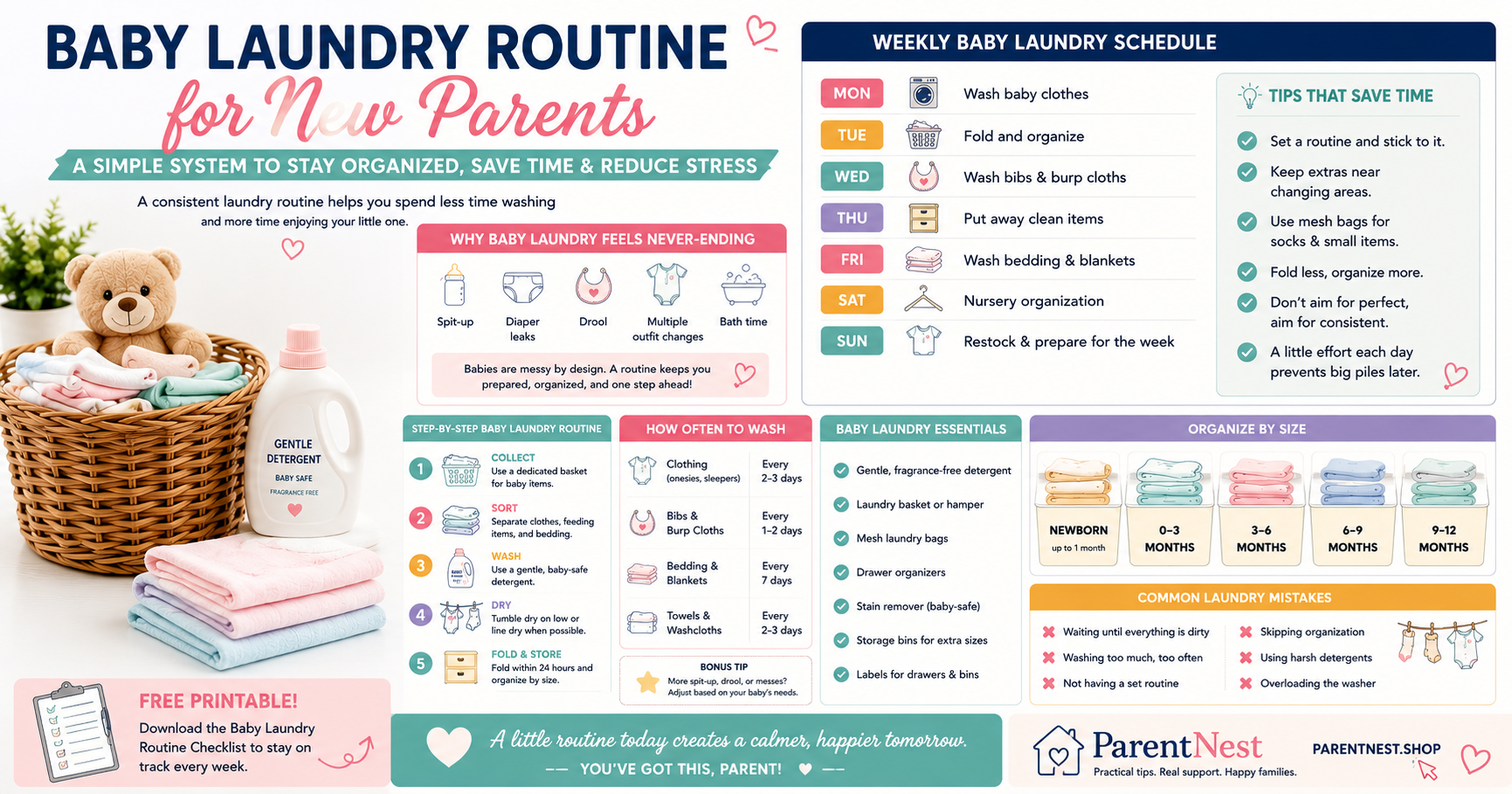
Here is a realistic weekly baby laundry schedule built around the actual needs of a newborn through to six months. Adjust days to fit your household rhythm — the structure matters more than the specific days.
| Day | Load Type | Detergent & Settings |
| Monday | Onesies, sleepsuits, bibs, socks | Fragrance-free baby detergent, 40°C gentle, double rinse |
| Wednesday | Muslins, swaddle blankets, burp cloths | Fragrance-free baby detergent, 40°C gentle, double rinse |
| Friday | Bedding, fitted sheets, sleep sack | Fragrance-free baby detergent, 40-60°C, extra rinse |
| Sunday (as needed) | Emergency blowouts, stained items | Cold pre-rinse, then 40°C with enzyme-free detergent |
| Rolling | Hats, mittens, soft toys (when needed) | 30°C delicate cycle, air dry only |
Survival mode tip: In weeks 1-2, skip the schedule entirely. Just run a load whenever the bag is full. A system requires energy — in the first two weeks, survival is the only goal. The routine can start in week three.
Detergent choice is one of the most confusing decisions new parents face, mostly because baby product marketing is designed to confuse. Here’s what actually matters.
For the first six months, use a detergent that is:
| Detergent Type | 0-6 Months | 6-12 Months | 12 Months+ | Notes |
| Fragrance-free baby detergent | Best choice | Good | Good | Check for optical brighteners |
| Natural plant-based (unscented) | Good | Good | Good | ‘Natural fragrance’ still means fragrance |
| Sensitive adult detergent (unscented) | Good if verified | Good | Good | Must confirm fragrance and dye-free |
| Regular family detergent | No | No | Yes (when ready) | Introduce gradually after 12 months |
| Fabric softener / dryer sheets | Never | Never | Caution | Skip for baby laundry entirely |
Most families transition baby laundry to their regular family detergent somewhere between 12 and 18 months, once the baby’s skin is less reactive. If your child has eczema or sensitive skin, stay on fragrance-free detergent indefinitely.
The transition approach that works best: mix one quarter regular detergent with three quarters baby detergent for two weeks, then move to half and half, then fully switch. This gradual approach catches any sensitivity reactions before they become an issue.
Every parent will encounter a blowout so spectacular it defies the laws of physics. The onesie is involved. Possibly the car seat. Definitely your top.
Here’s the damage-control system that actually works:
💡 Tip: Keep a wet bag in the nappy bag specifically for blowout casualties when you’re out of the house. Dump the item straight in, seal it, deal with it when you get home.
If your baby has been identified as eczema-prone or has particularly reactive skin, a stricter laundry routine from birth can make a significant difference to comfort and flare frequency.
| Standard Routine | Eczema-Sensitive Routine |
| One rinse cycle | Double or triple rinse cycle — always |
| Fragrance-free detergent | Fragrance-free AND preservative-free detergent |
| Wash new clothes once before use | Wash new clothes 2-3 times before first wear |
| Fabric softener avoided for 6 months | Fabric softener avoided indefinitely |
| Any cotton clothing | Organic cotton, bamboo, or muslin — avoid synthetic blends |
| Normal load size | Smaller loads — allows more rinsing and less detergent concentration |
The golden rule: if a rash appears after wearing freshly washed clothing, change the detergent before assuming it’s a fabric or allergen issue. Detergent residue is by far the most common culprit.
One of the most common new parent anxieties is whether they have enough. Here’s a reality-based count that accounts for the chaos of the newborn phase.
| Item | Minimum for Newborn Stage | Why |
| Onesies / bodysuits | 7-10 | Daily + 2-3 emergency changes |
| Sleepsuits (zip or snap) | 5-7 | Night + day, fast drying needed |
| Swaddle muslins | 6-8 | Multiple uses per day: feed, burp, sleep |
| Bibs | 10-12 | Spit-up volume is genuinely surprising |
| Fitted cot sheets | 3 | Allows washing + drying without going sheetless |
| Sleep sacks / sleeping bags | 2-3 | One on, one washed, one spare |
| Hats | 3-4 | Newborns lose heat fast; hats go on and off constantly |
With this minimum wardrobe, washing every 2-3 days keeps you comfortably ahead. If you find yourself washing daily, add 2-3 more onesies — it’s almost always the first item to run out.
A clean pile of baby clothes on the bedroom floor is almost as stressful as no clean clothes at all. A simple organization system makes the laundry routine feel finished.
💡 Tip: Use a simple label maker or masking tape to label nursery drawers by item type. When you’re sleep-deprived, ‘ONESIES’ written in large letters saves more time than you’d expect.
The first two weeks after birth are not the time for routines. They’re the time for survival. Here is the only baby laundry system you need in week one and two:
The goal in week one is not a routine. The goal is clean clothes for baby when they’re needed. The routine starts in week three when the fog begins to lift a little.
Use this as your ongoing reference once the newborn stage settles into a rhythm:
For newborns, washing every 2-3 days keeps you comfortably ahead of the pile. In the first two weeks, wash whenever the bag is full — daily is normal. By 3-4 months, most parents settle into a 3-times-per-week rhythm as outfit changes reduce.
For the first 3 months, wash baby items separately. Adult clothing carries fragrance residue, deodorant, and skin bacteria that transfer during washing. After 3 months, when baby’s skin is less reactive, most families combine loads. If your baby has eczema, keep washing separately for longer.
30-40 degrees C covers most baby clothing safely. Use 40 degrees C for heavily soiled items like onesies and bibs. Use 30 degrees C for delicates like knits and embroidered items. Go up to 60 degrees C for bedding if there’s illness or significant soiling — check care labels first.
Most families transition at 12-18 months. If your baby has eczema or sensitive skin, stay on fragrance-free detergent indefinitely. When you do transition, do it gradually over 2-3 weeks by mixing baby and regular detergent, then monitor for any skin reactions.
Use the overnight machine trick: load the machine in the evening during a calm feed, set it to run overnight, and hang it in the morning. The machine does the work while you sleep. The daily collection habit (2 minutes, twice a day) is the only active effort required.
Building a baby laundry routine does not require a spreadsheet, a Pinterest-worthy laundry room, or any kind of organizational genius. It requires three things: a mesh bag in the nursery, the right detergent in a labeled container, and the willingness to run a load every couple of days.
Set it up before baby arrives. Run it imperfectly in the first two weeks. Let it become habit by week four.
The laundry will always be there. The tiny clothes that need washing will not be tiny for long.