Physical Address
304 North Cardinal St.
Dorchester Center, MA 02124
Physical Address
304 North Cardinal St.
Dorchester Center, MA 02124

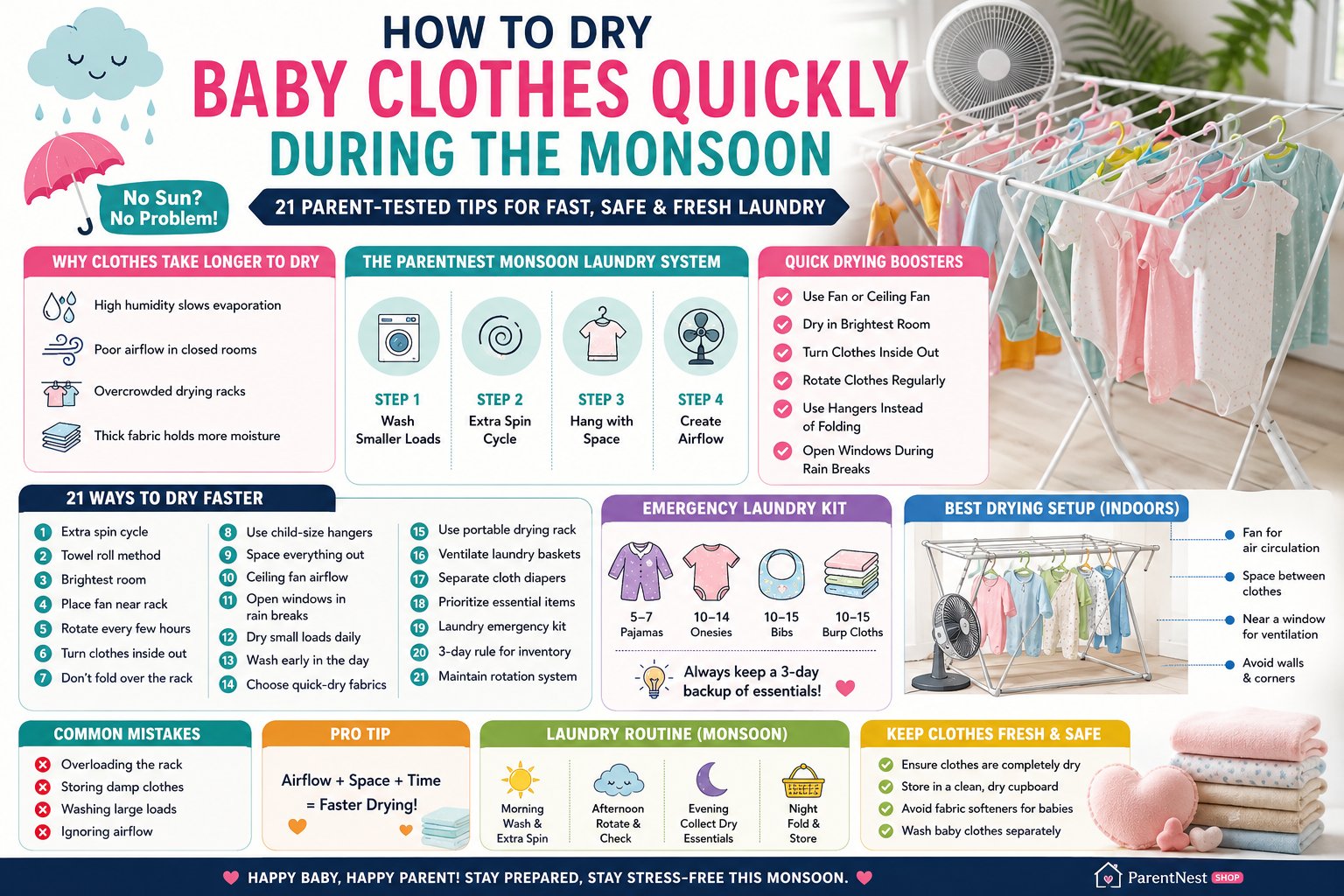
It’s 11pm. Your baby just had a blowout — the third one today — and you open the drawer to find… nothing. Every onesie is hanging limply on the drying rack, still damp from this morning’s wash. Outside, it’s been raining for six days straight.
If you’re in the middle of monsoon season with a baby, you already know this feeling. It’s the special kind of exhausted that only parents understand — laundry never ends, the sun never comes out, and somehow your baby’s tiny clothes multiply overnight while never actually drying.
Here’s the thing: you’re not doing anything wrong. Monsoon humidity makes drying clothes genuinely hard. We’re talking 80–90% relative humidity in many parts of India, Southeast Asia, and tropical regions — air so saturated with moisture that wet fabric has almost nowhere to release its water.
But after testing every trick, gadget, and grandma-approved hack in the book, we’ve found what actually works. This guide gives you practical, parent-tested methods to dry baby clothes quickly during monsoon season — no tumble dryer, no judgment, no impossible advice.
Before we get to the solutions, let’s quickly understand why this happens — because knowing the “why” helps you fix it smarter.
Clothes dry through evaporation: water molecules escape from wet fabric into the surrounding air. This process needs three things: heat, air movement, and low humidity.
Monsoon season removes all three. Temperatures drop. Air becomes heavy and humid. And with windows often closed to keep rain out, air circulation disappears entirely.
Baby clothes make this worse because:
The result? That frustrating half-damp state where clothes feel almost dry but still smell faintly musty an hour after you’ve dressed your baby.
Here’s how to break the cycle.
First, the crisis protocol. We’ve all been there. Use this when you’re out of clean options and can’t wait.
Step 1: Maximise the spin cycle. Put the wet clothes back in the washing machine and run a spin-only cycle at the highest speed the fabric allows (check labels — most baby cotton can handle 800–1000rpm). A proper high-spin cycle removes up to 30% more water than a standard spin, cutting drying time significantly.
Step 2: Roll, don’t wring. Lay each garment flat on a dry towel, roll the towel around it, and press firmly (don’t twist). The towel absorbs surface moisture in under a minute per item.
Step 3: Separate everything. Never stack or overlap clothes on a rack. Each garment needs its own airflow space. Even one item touching another can double the drying time.
Step 4: Target your ceiling fan. Hang clothes directly beneath your highest-speed ceiling fan — not just under it, but right where the airflow is strongest. The key is hanging clothes at the right height: too low and you’re under the main airflow, too high and the fan’s motor heat doesn’t help.
Step 5: Thin items first. Prioritise the garments baby needs most urgently (vests, onesies) and choose the thinnest ones. A muslin onesie hung under a ceiling fan in a warm room can be genuinely dry in 60–90 minutes.
Your washing machine’s spin cycle is your most underused monsoon tool. Most parents use a standard spin, but bumping up to 1000–1200 rpm (where fabric allows) can remove significantly more residual water — making every other drying method faster.
What to watch: Delicate newborn fabrics and woollens should stay at low spin speeds (400–600rpm). For everyday cotton onesies, bodysuits, and baby pants, higher spin is safe and highly effective.
A drying rack placed in the wrong spot is just furniture. Placement makes all the difference.
Best spots in order of effectiveness:
What NOT to do:
Pro tip: A tiered drying rack (the kind with 3 levels) is excellent for monsoon use. Put thin vests and muslin cloths at the top, medium items in the middle, and heavier items at the bottom. Check and rotate every 2 hours.
This is the biggest monsoon drying secret most parents don’t know: your AC actively removes moisture from the air. Even set to 28°C (just slightly cooler than room temperature), a running AC can drop relative humidity from 85% down to 50–60% — and at that humidity level, clothes dry far faster.
Set up your drying rack near (not directly in front of) an AC vent. Clothes that might take 8 hours to dry in a stagnant room can dry in 3–4 hours with the AC running.
Note: Don’t aim the cold air directly at newborn clothes if your baby is in the room. Focus the airflow on the rack itself.
Hang clothes in your bathroom with the exhaust fan running at full speed. The exhaust fan pulls humid air out of the space, creating the airflow that speeds up evaporation. This works especially well for smaller items like baby socks, washcloths, and muslin squares.
Bonus: bathrooms are often the warmest room in a flat — and warmth speeds drying.
Leave the door slightly ajar to allow fresh air in (exhaust fans work best with some cross-ventilation). Items hung here typically dry 30–40% faster than in a stagnant bedroom.
If you have a newborn and live in a high-humidity region, a compact dehumidifier is one of the best investments you’ll make during monsoon season. These devices pull moisture directly from the air — some models extract up to 1–2 litres of water per hour.
Place your drying rack in the room with the dehumidifier running. The air dries, the clothes dry. Many parents who invest in one never go back.
Budget-friendly note: Entry-level mini dehumidifiers start from around ₹2,000–₹3,500 online. For a family with a baby in a tropical climate, they pay for themselves in convenience within weeks.
For one or two urgent items, this takes under 5 minutes:
This removes a significant amount of surface water and can cut drying time by 20–30% compared to hanging a soaking-wet garment.
If you don’t have a ceiling fan overhead, a stand fan pointed directly at the drying rack is highly effective. The key is to aim the fan so it blows through the rack rather than at it — i.e., position it so air passes between the hanging garments.
Oscillating mode actually helps here — the sweeping airflow prevents moisture from building up around any single garment.
If your kitchen has a chimney or exhaust hood, it creates a natural upward draft that pulls air through the space. A small drying rack placed in a ventilated kitchen (with the exhaust on, at a safe distance from the hob) can be surprisingly effective.
This is particularly useful for very small flats where room options are limited.
This doesn’t speed drying, but it solves the biggest monsoon laundry complaint: that damp, musty smell that develops when baby clothes take too long to dry.
Add 2–3 tablespoons of baking soda to your wash cycle along with your regular baby detergent. Baking soda neutralises odour-causing bacteria before they have a chance to develop — so even if drying takes longer than you’d like, the clothes won’t smell.
Alternative: A capful of white vinegar in the rinse cycle works similarly. It evaporates completely during drying, leaving no vinegar scent.
Seems obvious, but most parents hang everything together and wonder why the thick hooded towels are still soaked 12 hours later. The issue is psychological — seeing half the rack dry makes you think everything is drying. It’s not.
Monsoon rule: Thick items (hooded bath towels, quilted sleep suits, double-layered bibs) need their own session. Either wash them separately and give them a dedicated drying run, or accept that they’ll need 12–24 hours regardless of method.
For daily laundry emergencies, stick to washing thin, quick-dry items: muslin onesies, cotton vests, lightweight rompers.
When a specific item absolutely must be dry and wearable in the next 30 minutes, ironing works. Use a steam iron on a low/medium setting appropriate for the fabric, ironing through a thin cloth if needed for delicate items.
The heat from ironing evaporates remaining moisture rapidly. A damp cotton onesie can be genuinely dry and wrinkle-free in 3–5 minutes of careful ironing.
Safety note: Only iron clothes that are intended for older babies and toddlers. Delicate newborn items should be ironed on the lowest setting or not at all. Always allow ironed clothes to cool completely and air out for 5 minutes before dressing your baby.
Rather than improvising every day, set up a dedicated monsoon drying station in your home for the season. This is the approach that saves the most time and stress.
The basic setup:
Having this station ready means every wash goes straight to a system — no daily decisions, no searching for space, no piling things on chair backs.
If you use cloth diapers, monsoon season is a whole separate challenge. Cloth diapers need to be completely dry — not just surface dry — to prevent bacterial growth and rashes. Here’s what works:
Pocket diapers and covers: Remove the inserts and dry them separately. Covers dry quickly (1–2 hours with a fan). Bamboo and hemp inserts are the hardest to dry — they need maximum airflow and the longest time.
All-in-one (AIO) diapers: These are the toughest to dry in monsoon. The multiple layers hold moisture stubbornly. Run a high spin, use the towel press method, then hang on an individual hook (not folded over a rung) under direct fan airflow.
Muslin/flat nappies: The easiest to dry — thin cotton dries in 2–3 hours with fan airflow even in high humidity.
Sun drying: Even indirect light through a window on a cloudy day helps. UV light also sanitises cloth diapers naturally. Position them near a window whenever possible, even without direct sun.
Important: Never use a cloth diaper that is even slightly damp. A damp diaper against baby’s skin causes rash, and the warm moist environment accelerates bacterial growth. When in doubt, give it another hour.
Newborn laundry runs 8–10 times a week in those early weeks. Here’s what’s different about drying newborn items specifically:
Instead of reacting to laundry chaos, build a system. Here’s a simple weekly monsoon routine:
| Day | What to Wash | Drying Method | Notes |
|---|---|---|---|
| Monday | Onesies, vests (thin items) | Fan + open window | Easiest day — clear backlog |
| Tuesday | Swaddles, muslin cloths | Bathroom exhaust fan | Thin, dry fast |
| Wednesday | Cloth diapers (inserts) | Fan + dehumidifier | Longest dry time needed |
| Thursday | Bibs, washcloths, socks | Kitchen exhaust method | Small items, quick |
| Friday | Baby outerwear, sleep suits | Fan + AC room | Thicker items, plan ahead |
| Saturday | Towels, hooded bath wraps | Longest drying day | Start early morning |
| Sunday | Rest / catch-up if needed | — | Don’t add to Sunday pile |
The key: Spread washing across the week. Doing everything in one big weekly wash is a monsoon disaster — you’ll have 30 wet items and nowhere to hang them.
(Approximate times under ceiling fan airflow in 75–80% humidity)
| Fabric Type | Typical Drying Time | Tips |
|---|---|---|
| Muslin | 2–3 hours | Fastest drying baby fabric |
| Thin cotton jersey | 3–4 hours | Most common onesie fabric |
| Terry towelling | 6–8 hours | Thick — needs extra fan exposure |
| Fleece | 5–7 hours | Doesn’t absorb much but dries slowly |
| Bamboo blend | 5–8 hours | Great for skin but holds water |
| Hemp diaper inserts | 10–14 hours | Slowest — plan ahead |
| Wool/knit | 8–12 hours (flat dry) | Never hang — reshape flat to dry |
Even with good drying habits, monsoon humidity sometimes wins. If clothes develop that faint musty smell even after drying:
Rewash method: Add ½ cup of white vinegar to the wash cycle, use hot water (check fabric label), and add 2 tablespoons of baking soda to the rinse. This kills odour-causing bacteria.
Sun rescue: Even 30 minutes of direct sunlight (on a break in the clouds) will kill odour bacteria and sanitise fabric naturally.
Do not: Spray fabric freshener on baby clothes and consider them “fine.” Musty smell = bacterial presence. Always rewash.
Prevention habit: Never leave washed clothes sitting in the washing machine for more than 30 minutes before hanging. That sitting time in a closed drum is where musty smell is born.
Yes, and this matters more for babies than adults.
Mold risk: Clothes left damp in a humid room for 8–12 hours can begin developing surface mold — particularly in folds and seams. Mold on baby clothing can irritate sensitive skin and in rare cases cause respiratory issues if baby is constantly in contact.
Hypothermia risk: Putting a newborn in clothes that are even slightly damp can cause rapid heat loss, as moisture conducts body heat away 25 times faster than dry air.
Rash risk: Damp fabric against baby’s skin (especially in diaper area) creates a perfect environment for fungal rashes.
The simple rule: If it feels even slightly cool or damp when you press it to your inner wrist, it’s not ready. Give it more time.
| Solution | What You Need | Cost | Effectiveness |
|---|---|---|---|
| Ceiling fan method | Fan you already have | Free | ★★★★☆ |
| Towel press | Dry towel you have | Free | ★★★☆☆ |
| Exhaust fan method | Bathroom exhaust | Free | ★★★★☆ |
| Stand fan + rack | ₹800–1,200 fan | Low | ★★★★★ |
| AC dehumidification | AC you may have | Free to use | ★★★★★ |
| Mini dehumidifier | ₹2,000–4,000 | Medium | ★★★★★ |
| Clothes dryer | ₹15,000–40,000 | High | ★★★★★ |
| Extra drying racks | ₹500–1,500 each | Low | ★★★★☆ |
Best value combo for most families: A good tiered drying rack + ceiling fan use + AC dehumidification covers 90% of monsoon laundry needs with minimal investment.
Use a combination of high-spin washing cycle, towel-press moisture removal, and hanging under a ceiling fan in a room with the AC running. This combo can dry thin baby cotton in 2–3 hours even in high humidity.
Use caution. A room heater can speed drying but creates very dry heat that can damage delicate baby fabrics. If using one, keep it at a safe distance from the rack and ensure good ventilation to prevent fire risk and overheating.
Musty smell develops when clothes dry too slowly and bacteria have time to multiply in the damp fabric. Rewash with white vinegar in the cycle, dry faster using the methods in this guide, and never leave clothes in the machine after washing.
For a newborn: aim for 15–20 onesies and vests minimum. For a 6–12 month old: 10–12 outfits is manageable. The more you have in rotation, the less laundry pressure you face on slow-drying days.
Yes — a ceiling fan on full speed creates excellent airflow for drying clothes hung directly beneath it. It’s one of the most effective free methods for monsoon drying.
Ensure they are completely dry before storing — even slight dampness leads to odour and bacterial growth. Use baking soda in the wash, dry inserts separately, and position them under direct fan airflow. White vinegar in the rinse cycle also helps.
No. Even slightly damp clothing can cause rapid heat loss in newborns and create conditions for skin rash. Always do the inner-wrist test: if it feels even marginally cool or damp, let it dry further.
Muslin is the quickest-drying baby fabric, followed by thin cotton jersey. Bamboo blends and terry towelling take significantly longer. During peak monsoon, favour muslin and thin cotton for your daily rotation.