Physical Address
304 North Cardinal St.
Dorchester Center, MA 02124
Physical Address
304 North Cardinal St.
Dorchester Center, MA 02124

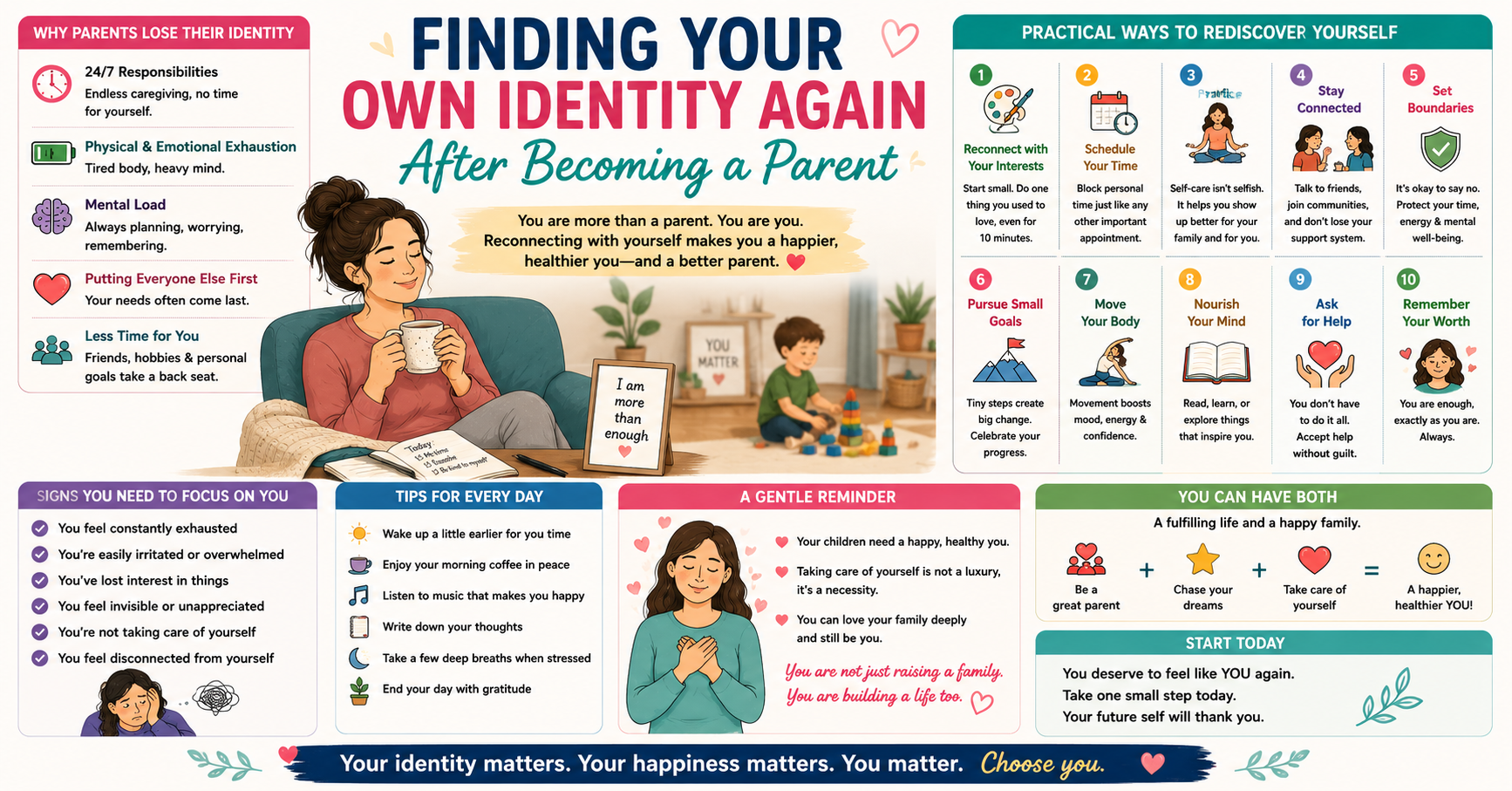
There is a version of yourself you remember from before. The person who had hobbies that nobody had to schedule around. The person who knew, more or less, who they were and where they were going. The person who could answer the question “what do you do for fun?” without pausing to think.
Then you became a parent — and somewhere between the sleepless nights, the endless feeding cycles, the school runs and the tantrums and the overwhelming, all-consuming love — that version of yourself started to feel very far away.
Finding your identity after becoming a parent is one of the most quietly urgent challenges of modern parenting. Nobody talks about it enough. Nobody puts it on the list of things to prepare for, the way they prepare you for labour or sleep deprivation. But it is real, it is significant, and it affects millions of parents every single year.
This post is for you if you have ever looked in the mirror and thought: I love my child completely — but where did I go? It is for you if the question “who am I now?” feels complicated in a way it never used to. It is for you if you are ready to start answering that question, one small, honest step at a time.
Finding your identity after becoming a parent does not mean undoing parenthood or walking away from who you have become. It means adding back in — adding back yourself, your interests, your voice, your needs — until the picture of who you are feels whole again.
Let us start at the beginning.
There is a word for what happens to a person’s identity when they become a mother: matrescence. Coined by anthropologist Dana Raphael in the 1970s and more recently brought into mainstream conversation by developmental psychologist Dr. Aurelie Athan, matrescence describes the profound psychological, emotional, hormonal, and social transformation a woman goes through when she becomes a mother.
The equivalent for fathers and non-birthing parents is sometimes called patrescence. But the concept is the same: parenthood is not just an addition to who you are. It is a transformation of who you are. And like all major transformations, it takes time, effort, and a great deal of self-compassion to navigate.
Finding your identity after becoming a parent starts with understanding this: what you are experiencing is not a personal failure. It is not weakness. It is not a sign that you are not cut out for parenthood. It is a normal, documented, deeply human response to one of the most significant transitions a person can make in their lifetime.
When you are pregnant or preparing to become a parent, people warn you about a lot of things. Sleepless nights. The cost of childcare. The way your social life will change. But very few people sit you down and say: your sense of self is going to shift dramatically, and that is going to be confusing and sometimes frightening, and you need to know that it is okay.
The identity shift that comes with parenthood is multi-layered. On one level, there is the practical loss of time — the hours you used to spend on things you loved, things that made you feel like yourself, are now consumed by care and logistics. On another level, there is a social identity shift: the way other people see you changes when you become a parent, and sometimes you internalize that change in ways that leave little room for the parts of yourself that existed before.
And then there is the deepest level: the existential shift. The questions that surface when you are alone at 3 a.m. with a crying baby, or sitting in the school car park with five minutes to yourself: Who am I now? What do I actually want? What happened to the dreams I had before this? Finding your identity after becoming a parent is, in part, the work of answering these questions — honestly, patiently, and without judgment.
Here is something important to hold onto as we go through this: finding your identity after becoming a parent is not about recovering a self that has been stolen from you. It is about discovering a self that has been through something transformative and is now different — not lesser, not broken, but different.
The you who existed before parenthood is still in there. Your interests, your personality, your sense of humour, your values — none of those things are gone. But they have been temporarily buried under the sheer weight of new responsibility. And the work of finding your identity after becoming a parent is the work of digging them back out, dusting them off, and seeing which ones still fit — and which ones have evolved.
Because here is the truth that identity conversations about parenthood often miss: you have also gained things. You may have gained a depth of empathy you did not have before. A capacity for love that surprised you. A resilience that you had not yet needed to call on. Finding your identity after becoming a parent is not just about reclaiming the old — it is about integrating the new.
Parental identity loss is extremely common. Research consistently shows that a significant number of new parents — mothers in particular — experience a loss of personal identity following the birth of a child. Studies published in journals including Developmental Psychology have found that the transition to parenthood is one of the most identity-disrupting life events a person can experience.
And yet it remains one of the most under-discussed aspects of new parenthood. Why? Because of a powerful cultural narrative that says: if you love your child, you should feel fulfilled. If you are a good parent, being a parent should be enough. Admitting that you miss your old self — that you are struggling with finding your identity after becoming a parent — can feel like a betrayal of your child, of parenthood itself.
That narrative is wrong. And it is doing enormous harm.
Parental guilt is one of the most corrosive forces in modern parenting culture. And one of the things parents feel most guilty about is wanting something for themselves — not just time, but identity. The sense that they are a person in their own right, separate from and in addition to their role as a parent.
This guilt keeps many parents silent about the very real struggle of finding their identity after becoming a parent. They do not mention it at mother and baby groups because they worry about being judged. They do not bring it up with their partners because they do not want to seem ungrateful. They push it down, tell themselves they should feel differently, and carry the weight of it alone.
But the silence does not make the struggle go away. It just makes it lonelier. And loneliness, in the context of postpartum identity loss, can be genuinely dangerous — a risk factor for postnatal depression and anxiety that often goes unrecognised because the surface picture of a family looks fine.
There is a pervasive cultural myth that good parents are parents who give everything to their children — every minute, every ounce of energy, every last piece of themselves. This myth is not just untrue. It is actively harmful.
Children do not need parents who have erased themselves. Children need parents who are present, engaged, emotionally available — and you cannot sustainably be any of those things if you have given away every part of yourself and kept nothing back. Finding your identity after becoming a parent is not selfish. It is, in fact, one of the most important things you can do for your child, because a parent who knows who they are and has some sense of personal fulfilment is a far more stable, warm, and present parent than one who is running on empty and resentment.
The research supports this clearly. Studies from institutions including the American Psychological Association consistently show that parental wellbeing is one of the strongest predictors of child wellbeing. When parents are mentally healthy and have a secure sense of self, their children benefit directly.Signs That You Are Losing — or Have Lost — Your Sense of Identity as a Parent
Finding your identity after becoming a parent requires first recognising that you have lost some of it. This sounds simple, but in the daily rush of parenthood it can be surprisingly hard to see clearly. Here are some of the most common signs that the question of identity is something you need to address:
Not something useful. Not something productive. Not something that also benefited your child or your family. Something purely, unashamedly for you — a hobby, a creative outlet, a conversation that had nothing to do with parenting. If the honest answer is “I genuinely cannot remember,” that is a significant sign that finding your identity after becoming a parent is work you need to do.
Many parents describe feeling confident and competent in their parenting role but completely lost in every other context. At a work event, a social gathering, a conversation with old friends, they feel like they have nothing to say — nothing that feels genuinely theirs. This is a classic sign of parental identity loss: the parent role has expanded to fill the entire space where self used to be.
When someone asks what you are into, what you enjoy, what lights you up — and your honest answer is a list of things you used to love before children — that is worth paying attention to. It does not mean those interests are gone. It means they have been pushed so far to the margins that they have started to feel like they belong to someone else. Someone you used to be.
Resentment is one of the most reliable signs of unmet needs. If you notice yourself feeling resentful — of your partner’s freedom, of childless friends, of the life you had before — that resentment is not a character flaw. It is information. It is telling you that something important to you is missing, and that finding your identity after becoming a parent is not a luxury but a genuine need.
Social connection is a core part of identity. When parenthood causes us to withdraw from friendships, interests, and communities that are not centred on children, we lose some of the relational mirrors through which we know ourselves. If your social world has shrunk entirely to other parents — or has shrunk to almost nothing — finding your identity after becoming a parent may require rebuilding some of those connections.
So where do you begin? Finding your identity after becoming a parent is not a dramatic reinvention. It is not a crisis that requires a complete life overhaul. It is a quiet, consistent, intentional process of reconnecting with who you are beneath the role of parent. Here is where to start.
This sounds so simple that it almost seems unnecessary to say. But for many parents — particularly mothers — it is genuinely the hardest step. You have to give yourself permission to matter as a person, not just as a parent. You have to allow yourself to want things, to have needs, to take up space in your own life.
Finding your identity after becoming a parent begins with this internal permission. Without it, every practical step you take will feel like something you have to justify or apologise for. With it, you have a foundation to build on.
When was the last time you felt truly like yourself? What were you doing? Who were you with? What interests have you quietly mourned since becoming a parent? If you had one afternoon entirely free — no responsibilities, no guilt — what would you honestly want to do?
These questions are not rhetorical. Get a piece of paper and answer them. Actually write the answers down. Finding your identity after becoming a parent is an active process, and writing is one of the most effective ways to surface what is genuinely true for you beneath the noise of daily life.
One of the reasons parents give up on finding their identity after becoming a parent is that they think it requires large amounts of time, money, or freedom that they do not currently have. But it does not have to. Identity is rebuilt in small moments as much as large ones.
Read ten pages of a book you love before bed. Put on the kind of music that has always felt like yours while you cook dinner. Take a different route on the school run just to see something new. Text a friend you have been meaning to reach out to for months. These things seem small. But they are acts of identity. They are you saying: I am here. I am still here.
Not a hobby you and your child do together. Not a class that fits around school hours. Something that is just yours. Finding your identity after becoming a parent often requires at least one anchor — one thing in your week that belongs entirely to you, that has nothing to do with your role as a parent.
It does not have to be time-intensive or expensive. It might be a weekly run, a pottery class once a fortnight, a book club, a drawing practice, a language app used for fifteen minutes each evening. The specifics matter less than the fact of it: a piece of your week that is non-negotiable because you matter.
One of the most disorienting parts of parental identity loss is that in many parenting circles, nobody knew you before. Everyone met you as a parent. Your old friendships — the ones where people knew who you were before children — are often the relationships most capable of reminding you of yourself.
Finding your identity after becoming a parent is easier when you have people around who can say, “You always used to love doing that” or “Remember when you were obsessed with this?” These conversations are not just pleasant nostalgia. They are acts of identity recovery.
If you have a partner, the conversation about finding your identity after becoming a parent needs to include them. Not as an accusation — not “you have stolen my identity” — but as an honest share: this is something I am struggling with, this is what I need, this is how I think we can support each other.
Many couples find that both partners are experiencing some version of parental identity loss simultaneously, in silence. Bringing it into the open often releases a pressure that has been building for months or even years — and opens the door to practical solutions that actually work for both of you.
The concept of matrescence has been transformative for many parents struggling with identity. Understanding that what you are experiencing has a name — that it is a recognised, studied, universal part of becoming a parent — can be profoundly relieving.
Matrescence, like adolescence, is a period of profound transformation. In adolescence, a young person moves from being a child to being an adult. Their identity shifts dramatically. They question who they are, who they want to be, what kind of life they want. They grieve parts of childhood they are leaving behind while stepping towards something new and unknown.
Matrescence works in a very similar way. Becoming a parent — particularly a mother — is a complete reorganisation of the self. Brain imaging research has actually shown that pregnancy causes significant changes in grey matter in certain regions of the brain, changes that persist for years and are associated with the development of the parenting bond. Your brain is physically different after you become a parent. No wonder your sense of identity is different too.
Finding your identity after becoming a parent, through the lens of matrescence, is not about going back to who you were. It is about integrating who you were with who you are now — creating a self that holds both the person you were before and the parent you have become, without asking you to choose between them.
While the term matrescence specifically describes the maternal transition, the psychological experience of identity transformation is not exclusive to mothers. Research on paternal identity — sometimes explored through the lens of patrescence — shows that fathers also experience significant identity shifts when they become parents.
Non-birthing parents often face a particular challenge: their identity transformation is less acknowledged culturally. There is less language for it, fewer support structures around it, and often a social expectation to simply “get on with it.” Finding your identity after becoming a parent is important for every parent, regardless of gender or parenting role, and the silence around non-maternal identity struggles deserves to be broken.
Here is something the wellness industry will not tell you: bubble baths and face masks are not going to fix parental identity loss. Self-care, in the superficial sense that the term has come to mean, addresses the symptoms of depletion without touching the root cause.
Finding your identity after becoming a parent requires something deeper than self-care. It requires what psychologists sometimes call “self-regard” — a genuine, consistent, non-negotiable regard for yourself as a person with inherent worth and needs that are independent of your role as a parent.
This is not about being selfish. It is about being whole. And a whole parent is a better parent — not in a performative, try-harder way, but in a genuinely sustainable, present, connected way.
Research into parental identity and wellbeing points to several approaches that genuinely support the process of finding your identity after becoming a parent:
One of the most effective things you can do for your identity as a parent is to spend time in communities that are not defined by parenthood. A book group, a sports team, a professional network, a volunteering group, a faith community, a creative class — anywhere that you show up as yourself first and as a parent second.
These spaces remind you that you are a whole person with interests, opinions, skills, and a presence that has nothing to do with your children. Finding your identity after becoming a parent often accelerates dramatically when parents find even one community outside of their parenting world.
If you are parenting with a partner, the process of finding your identity after becoming a parent is something that affects your relationship as much as it affects you individually. And the conversations you have — or do not have — about identity will shape both of your experiences of parenthood significantly.
Many couples in the early and middle years of parenthood are operating in what I think of as “parallel survival mode.” Both parents are exhausted, both are giving everything they have, both have quietly set aside parts of themselves that used to matter — and neither has told the other, because there is no time, and because it is scary to admit.
You do not need to have a perfectly structured conversation. You just need to start one. Here are some prompts that have helped many couples open up about identity without it becoming a blame conversation:
These are not grand therapy-style interventions. They are just conversations between two people who love each other, trying to figure out how to hold their individual identities and their shared life at the same time. Finding your identity after becoming a parent is often easier when you know your partner is on the same journey and that you are not competing for the finite resource of time and space to be yourselves.
After the conversation comes the logistics. If finding your identity after becoming a parent requires time — and it does — then that time has to be created, allocated, and protected. This means having honest conversations about scheduling: not just childcare duties, but protected time for each partner to invest in their non-parenting self.
This might look like Sunday mornings where one parent takes the children while the other does whatever feeds their soul. Or a standing arrangement where each parent has one evening a week that is genuinely theirs. The specifics will vary by family. What matters is that it is explicit, that it is equitable, and that both partners understand why it matters.
Finding your identity after becoming a parent is not a one-time task. It is an ongoing process that evolves as your children grow and your life changes. And it looks different at different stages of parenthood.
This is typically when the identity shift is most acute and most disorienting. Sleep deprivation, physical recovery from birth, breastfeeding demands, and the sheer novelty and intensity of new parenthood mean that finding your identity after becoming a parent can feel almost impossible. If this is where you are: be very gentle with yourself. This stage is temporary. It does not define the rest of your parenting life.
As children become more independent and sleep (usually) improves, small windows of time open up. This is often when parents first begin to actively work on finding their identity after becoming a parent — reclaiming small pieces of themselves, testing out old interests, trying new ones. This stage, while still exhausting, offers more room to breathe.
When children start school, a significant shift happens: parents suddenly have several hours each day that are notionally their own. This can be wonderful — and it can also be deeply disorienting. Many parents who were entirely focused on their children find that when the structure of constant care is lifted, they do not know who they are or what they want. Finding your identity after becoming a parent can actually become more pressing at this stage, not less.
As children move towards independence, many parents face another identity crisis: the loss of the active parenting role itself. The child who needed you constantly now needs you much less. Finding your identity after becoming a parent at this stage means being ready for this transition — having enough self outside of parenting that you do not collapse when the parenting role contracts.
Completely normal, and far more common than most parents realise. The experience of losing a sense of self after having children is so well-documented that it has its own psychological term — matrescence (for mothers) and patrescence (for fathers). It does not mean you are struggling as a parent. It means you have been through one of the most transformative experiences a human being can have, and your identity is in the process of reorganising itself.
There is no fixed timeline. For some parents, the most acute sense of identity loss passes when the newborn stage ends and life becomes a little more structured. For others, finding their identity after becoming a parent is a longer process that extends across years. What matters is not the speed but the direction — consistently, intentionally moving back towards yourself.
Yes, parental identity loss is a recognised risk factor for postnatal depression and postpartum anxiety. When parents feel that they have lost themselves entirely, and when this is combined with isolation, sleep deprivation, and the cultural pressure to appear fine, the conditions for depression can quickly develop. If you are struggling significantly, please speak to your doctor or contact Postpartum Support International (postpartum.net) for support.
Stay-at-home parents often face this challenge most acutely, because the role of parent has literally replaced all other professional and social roles. Start by acknowledging that your identity is not your job — or your role as a parent. Find at least one activity, community, or interest that is entirely yours. Seek out peer support with other parents who are having honest conversations about identity. And if possible, invest some time in therapy or counselling to help you reconnect with who you are beneath the role.
Matrescence is the psychological, hormonal, physical, and social transformation a woman goes through when she becomes a mother. It was coined by anthropologist Dana Raphael and more recently championed by developmental psychologist Dr. Aurelie Athan. It matters for parental identity because it reframes the identity shift of motherhood not as a problem to be solved but as a developmental transition — like adolescence — that takes time, support, and self-compassion to navigate.
The most important things are to listen without judgment, to take the concern seriously, and to create practical space for your partner to invest in their non-parenting self. This means taking on childcare so they have protected time for their own interests, having honest conversations about what they are missing and what they need, and not minimising their experience by telling them they “should” feel grateful or fulfilled. Finding your identity after becoming a parent is a joint project in a partnership.
No. This is one of the most damaging myths in parenting culture, and it deserves to be challenged directly. Wanting to exist as a person in your own right — alongside your role as a parent — is not selfish. It is healthy. Research consistently shows that parents who maintain a sense of personal identity and wellbeing are more emotionally available, more present, and better able to meet their children’s needs than parents who have given everything and kept nothing back.
The best activities are the ones that feel genuinely yours — not what worked for someone else. But research and experience point to a few categories that are particularly effective: creative expression (writing, painting, music, pottery, photography), physical activity (running, yoga, swimming, team sports), learning something new (a language, an instrument, a professional skill), and community involvement (volunteering, joining a club, attending a regular class). What they have in common is that they position you as a full person with interests, skills, and a presence that exists independently of your children.
If you are experiencing sustained low mood, feelings of hopelessness, loss of interest in things you used to enjoy, significant anxiety, or thoughts of harming yourself, please seek professional support now — from your doctor, a therapist, or a crisis service. Beyond that threshold, therapy is a genuinely useful resource for any parent who feels significantly lost in their identity and wants support in finding their way back to themselves.
Yes — and this is backed by research, not just intuition. Studies consistently show that parental wellbeing and self-efficacy are among the strongest predictors of positive child outcomes. A parent who has a secure sense of identity, who has some of their own needs met, and who is not running entirely on empty, is more emotionally available, more patient, more able to attune to their child, and more resilient when parenting gets hard. Finding your identity after becoming a parent is not separate from good parenting. It is part of it.
I want to leave you with something I genuinely believe, not something designed to wrap this post up neatly.
Finding your identity after becoming a parent is not a straight line. It is not a problem you solve once and never think about again. It is a relationship you build with yourself over time — a relationship that requires attention, honesty, and the same patience and kindness you extend to your children when they are finding their way.
You are still in there. The person who loved things before parenthood, who had opinions and dreams and a sense of humour and a particular way of seeing the world — that person has not gone anywhere. They have just been very busy. Very needed. Very stretched.
Finding your identity after becoming a parent starts with turning towards yourself with the same warmth you turn towards your child. It starts with deciding that you matter — not instead of your children, but alongside them. It starts with a single question asked honestly and a single small step taken towards the answer.
You do not have to do it all at once. You do not have to do it perfectly. You just have to begin. And when you do — when you start showing up in your own life as a person in your own right, alongside the extraordinary parent you already are — something shifts. Not overnight. But it shifts. And the person who comes through the other side of that shift is someone worth knowing: a parent who knows who they are, which makes them better at everything, including loving.