Physical Address
304 North Cardinal St.
Dorchester Center, MA 02124
Physical Address
304 North Cardinal St.
Dorchester Center, MA 02124

Let me paint you a picture.
You’ve been planning this beach trip for weeks. You’ve loaded the car, driven the two hours, found parking, wrestled the stroller over the sand, set up your spot — and you reach into the bag for the sunscreen. And it’s not there. It’s sitting on the bathroom counter at home, right next to the swim diapers you also forgot and the rash guard you were certain you’d packed but apparently only thought very hard about packing while you were doing seventeen other things.
Your toddler is already trying to eat sand. The sun is already fully committed to burning everyone. And the beach trip you were so excited about is now running on stress and improvisation.
If you have done this even once, you already know: packing for a beach trip with a toddler is its own category of challenge. Not because beach trips are complicated in theory — they’re glorious in theory — but because a toddler at the beach requires an astonishing amount of equipment to have even a moderately smooth experience. And because most of that equipment only becomes obvious by its absence.
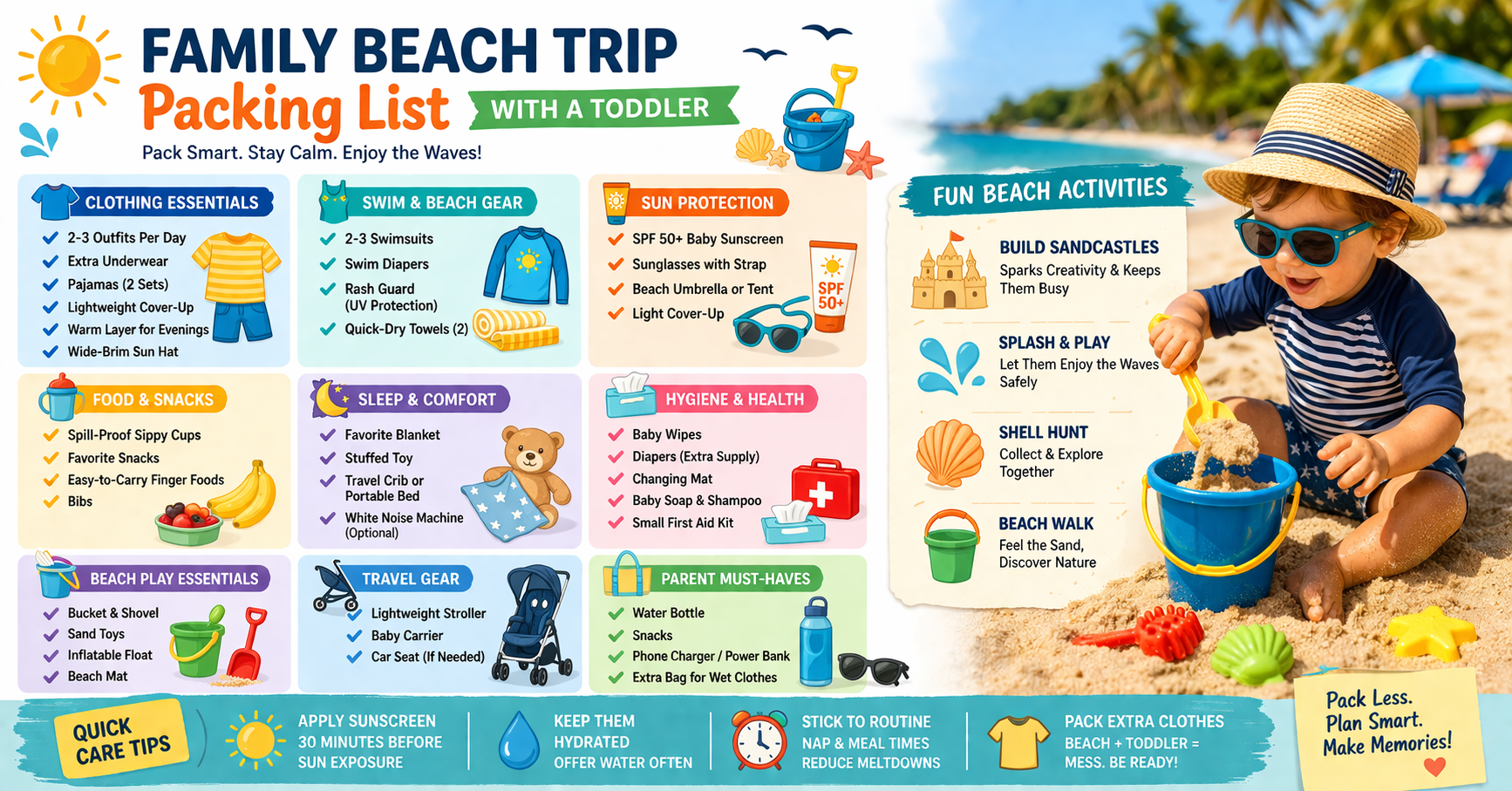
This guide exists to prevent that. It’s the packing list built from real experience — from the trips that went beautifully and the ones that went sideways in completely avoidable ways. It covers everything: the sun protection, the beach gear, the food, the safety, the comfort, the things you wouldn’t think of until you desperately needed them. Use it. Adapt it to your family. And then actually enjoy the beach.
Here is the first thing to accept about packing for a beach trip with a toddler: you are not packing light. Whatever minimalist beach fantasy you’re holding from your pre-child days — one tote bag, a towel, some sunscreen, a book — that is not this season of life. This season of life requires a different approach, and the sooner you make peace with it, the better your beach trip will be.
The good news is that there is a version of this that is organized and manageable rather than chaotic and overwhelming. The difference is a good list and a good system — knowing what you’re bringing, where it’s packed, and why each item earned its place in the bag.
The second thing to accept is that not every beach trip with a toddler is going to be a glossy Instagram moment. Some of them are going to involve a meltdown at 11am and a nap in the car by noon. Some are going to be shorter than planned. Some are going to be wildly, unexpectedly perfect in ways you didn’t see coming. Your goal is not a flawless execution. Your goal is to be prepared enough that when things go sideways — and they will, periodically — you’re not derailed by something you could have prevented.
Okay. Let’s pack.
This is the most important section. Toddler skin is significantly more sensitive to UV radiation than adult skin, and a bad sunburn on a young child is not just painful — it’s a genuine health risk and a trip-ender. Sun protection is not something to approximate or leave to chance.
Mineral sunscreen, SPF 50 or higher For toddlers, mineral sunscreen — which uses zinc oxide or titanium dioxide as active ingredients — is consistently recommended over chemical sunscreens, which can cause irritation on sensitive skin. Look for broad-spectrum protection and water resistance. Pack more than you think you need. You will reapply more often than you expect, and sunscreen that runs out at 11am in a beach town where the only drugstore is twenty minutes away is a special kind of miserable.
Buy a dedicated bottle for the beach bag and leave it there. Don’t bring the bottle from home that’s been in the medicine cabinet for two years. Check the expiration date. It matters.
A wide-brimmed sun hat — and a backup Toddlers have small heads and strong opinions, and the combination means that hats come off at inopportune moments and occasionally get taken by wind. A chin-strap hat is your best bet for staying power. Bring the hat they actually tolerate wearing, not the one that looks cuter. Pack a backup hat if you have one. A toddler with an unprotected head in direct sun is a recipe for overheating and misery for everyone.
Rash guard or UV-protective swimwear A rash guard that covers the shoulders and torso reduces the surface area that needs sunscreen, which is a meaningful practical consideration when you’re trying to apply sunscreen to a moving toddler. Look for UPF 50+ fabric. Long-sleeve options exist and are worth considering, especially for very fair-skinned children or unusually strong sun.
Baby sunglasses with UV protection These are often skipped because they’re seen as optional. They’re not really optional — toddlers’ eyes are more susceptible to UV damage than adults’, and the habit of protecting their eyes from the sun is worth starting early. The challenge is getting them to stay on, which is why a strap attachment is essential. Wraparound styles stay on better and provide more coverage.
UV beach tent or pop-up shade shelter This is the single most valuable piece of gear you can bring to the beach with a toddler. A pop-up UV tent or shade canopy creates a dedicated shaded space where your toddler can nap, eat, take a break from the sun, and generally have somewhere to go that isn’t full-blast UV exposure. Look for one that is UPF 50+ rated, has ventilation, and can be staked down (beach wind is real). Some have a built-in floor, which is useful for keeping sand slightly more contained.
The tent is the item most parents who have done a few beach trips with toddlers wish they’d brought sooner. Once you have it, you can’t imagine the beach without it.
Cooling towel or wet cloth in a zip-lock bag Toddlers overheat quickly and don’t always know how to communicate that they’re getting too hot before it becomes a problem. A cooling towel or a damp cloth in a sealed bag gives you an immediate tool for bringing their temperature down. Run it over the back of the neck, the wrists, and the face — it works quickly and toddlers usually find it either refreshing or hilarious, both of which are good outcomes.
A large beach blanket or mat Skip the thin towel-as-blanket approach. Get a proper beach blanket — something that stays flat, dries quickly, and is large enough that a toddler can move around on it. Sand-free mats have become popular and genuinely do reduce the amount of sand that ends up on everything, which is worth considering if sand-in-the-snacks drives you crazy.
Beach chairs — the right kind If you’re bringing beach chairs, the kind with a low-slung profile or the kind that can recline are most useful with toddlers because they keep you closer to ground level where the child is operating. A chair that puts you at a comfortable height to supervise without constantly craning is worth the slightly bulkier pack.
A beach wagon or cart If your beach has any real distance from the parking area — and most do — a beach wagon is a game-changer. It carries the tent, the chairs, the cooler, the bag, and occasionally the toddler themselves. Collapsible models fit in car trunks and make the haul from car to sand dramatically less painful. This is one of those items that seems like an extravagance until you’re using it, and then it feels like the most essential thing you own.
A small beach umbrella for layered shade Even with a UV tent, a beach umbrella gives you flexible, movable shade for those moments when you want to be somewhere other than the tent — when your toddler is digging just outside the shelter, when you want to be near the water’s edge while still under cover. A lightweight, sand-anchor style umbrella is easiest to manage solo.
A portable toddler outdoor chair or travel booster Something for your toddler to sit in that isn’t directly on the sand is useful for eating, for applying sunscreen, for the moments when you need them to be contained and relatively still. Some parents use a deflated inflatable swimming ring as an impromptu toddler seat in the sand. Whatever works for your specific child.
Swim diapers — more than you think you need Pack at least twice as many swim diapers as you think you’ll use. They don’t work the same way as regular diapers — they’re designed to contain solids but will not swell or hold liquid, which means they need to be changed more frequently than parents sometimes expect. Reusable swim diapers are an option worth considering for longer trips.
A regular backup diaper supply Beyond swim diapers, bring your usual supply of regular diapers for before and after water time and for nap time. Don’t assume the beach shop will have your brand or size. Pack more than you need for the day.
Baby/toddler life jacket or swim vest For water time, a Coast Guard-approved life jacket is essential. The fit is critical — it should be snug enough that it doesn’t ride up over the child’s chin when you lift them by the front. Check the weight range carefully before purchasing. Inflatable water wings and puddle jumpers are popular but are not Coast Guard-approved as life-saving devices. For any water contact where there’s meaningful risk, a proper life jacket is the right call.
A mesh bag for wet items Wet swimsuits, sandy towels, and soaked rash guards need somewhere to go that isn’t contaminating the rest of your dry belongings. A mesh bag or a large zip-lock bag handles this nicely and can be hung or stowed easily.
Extra swim clothes Toddlers who are wet and sandy and happy are also toddlers who need multiple changes. Pack at least two full sets of swimwear and a comfortable dry outfit for the drive home. The dry outfit at the end of the day — when everyone is sandy and tired and done — is not a luxury. It’s essential.
Waterproof sandals with a back strap Hot sand burns toddler feet fast. The sun-baked sand between the parking lot and the shoreline can reach temperatures that are genuinely painful for small, unprotected feet. Waterproof sandals with a heel strap — not flip-flops, which come off and get lost immediately — protect the feet and stay on reliably enough to be worth it.
A good insulated cooler The size of cooler you need depends on how long you’re staying and how many people you’re feeding, but for a full beach day with a toddler, a medium-sized soft-sided cooler with good insulation is usually the right call. Pack it with ice packs rather than loose ice — the food stays drier and colder longer, and you don’t end up with a bag of cold water at the end of the day.
Water — more than you think Toddlers at the beach dehydrate faster than adults because of sun exposure, physical activity, and the fact that they’re generally bad at noticing and communicating thirst before it becomes a problem. Pack significantly more water than you think you’ll need. A spill-proof toddler water bottle that they can operate themselves reduces the number of times you’ll be pouring water into a cup while also trying to watch them near the surf.
Easy, beach-appropriate snacks The beach is not the place for snacks that melt, crumble, require utensils, or are difficult to eat with sandy fingers. The best beach snacks are simple, robust, and easy to contain. Goldfish crackers, cut fruit in a sealed container, pouches, cheese sticks, crackers, dried fruit, and cereal bars all work well. Avoid anything chocolate (it melts), anything that attracts seagulls aggressively (generally strong-smelling foods), and anything that requires refrigeration and fails badly if the cooler isn’t perfect.
Pack snacks in individual serving containers or small sealed bags so that sandy hands don’t contaminate the entire supply. If sand gets into the main snack bag, you’re going to have a sad toddler and a lot of wasted food.
Lunch that survives the heat If you’re staying past noon, plan a real lunch rather than relying on snacks to carry you through. Sandwiches in sealed containers, wraps, pasta salad, and similar items travel well in a good cooler. Pre-portion everything at home so that serving lunch at the beach requires as little effort as possible — the simpler the logistics, the more likely lunch actually happens calmly.
Bib or clip-on tray Eating on the beach with a toddler involves sand in everything no matter what you do — but a clip-on tray or a silicone bib with a catch pocket reduces the chaos somewhat. It’s also useful for keeping food at least partially off the sandy blanket and in the general vicinity of the child’s mouth.
Utensils, napkins, and wet wipes — a lot of them Pack a dedicated set of toddler utensils, more napkins than you’ll think necessary, and an entire pack of wet wipes. Wet wipes are the Swiss Army knife of the beach day — they clean sandy hands before eating, wipe faces, remove sunscreen from eyes, clean up spills, and handle the inevitable mid-beach diaper situation. Never underpack wet wipes. This is not negotiable.
A solid sand toy set The classic bucket-and-spade set remains the gold standard for beach entertainment, and for good reason — give a toddler a bucket, a spade, and wet sand, and you’ve bought yourself thirty to forty-five minutes of genuinely absorbed independent play. Look for sets that include a variety of molds and tools rather than just one of each. Bright colors make them easier to spot when they inevitably get buried.
One important note: sand toys always come home sandy. Rinse them in the ocean, shake them out, put them in a mesh bag — there will still be sand in them when you get home. This is the law of beach toys and there is no defeating it. Make peace with it now.
A water table alternative: a large plastic bin Some parents bring a shallow plastic storage bin or tub to the beach, which they fill with water at the shoreline and set up as a contained water play area near the shade tent. This gives toddlers who are wary of the waves a safe, manageable water experience. It’s also useful for rinsing feet before getting back on the blanket. Low-tech and genuinely excellent.
Bubbles Bubbles work almost everywhere and the beach is no exception. A small container of bubbles is light, cheap, and can rescue a restless toddler moment reliably. Wind at the beach makes bubble-chasing even more entertaining than usual.
A familiar comfort toy or lovey (in a mesh bag) For toddlers who nap with a comfort toy or security object, bring it — but keep it in a mesh bag that can be rinsed and dried. If the lovey gets wet and sandy and can’t be cleaned, you’ll have a very difficult drive home.
Board books for the shade tent A couple of favorites for quiet time in the shade tent: nothing with loose pieces, nothing precious, nothing you’d be heartbroken to see develop a subtle saltwater warp. Sturdy board books are the right call.
A small first aid kit Pack a basic kit: adhesive bandages in multiple sizes, antiseptic wipes, antibiotic ointment, gauze, medical tape, and tweezers for splinters. Sand and beach environments can introduce small injuries that aren’t serious but need immediate management. Having the kit in the bag means you handle it on the spot rather than packing up and leaving.
Children’s pain reliever and antihistamine Both in age-appropriate dosages, both clearly labeled. Sunburn discomfort, a bee sting, an unexpected allergic reaction, or the fever that sometimes emerges when a toddler has had too much sun — these can happen on beach days. Being without medication when you need it is avoidable. Pack it.
A digital thermometer Small, lightweight, and invaluable if you’re concerned about heat exhaustion or fever. Toddlers who are overheated can escalate quickly. A thermometer removes the guesswork.
Insect repellent for children Depending on your beach location, insects — particularly at dawn and dusk, and in areas near dunes or marsh — can be a genuine issue. EPA-registered insect repellents are safe for children over two months when used as directed. DEET-free options exist and work well for most environments. Check the label for age recommendations.
Aloe vera gel — the real kind Even with your best preparation, toddlers sometimes get sun exposure. Keep aloe vera gel in your beach bag — the real, high-aloe-content kind, not the tinted after-sun lotion. It lives in the beach bag and is always there when you need it.
A small waterproof phone case or dry bag Your phone is your camera, your navigation, your emergency communication device, and your way of looking up the nearest pediatric urgent care if something goes wrong at the beach. Protecting it from water and sand is not vanity. It’s practical. A small waterproof case or a zip-lock bag in the main compartment of your beach bag does the job.
A large waterproof mat or old towel for the car Car seats and wet, sandy toddlers are not friends. A waterproof mat or thick old towel laid over the car seat protects it from the inevitable post-beach dampness and reduces the sand excavation required when you get home. Some parents keep a beach-dedicated car seat cover for exactly this purpose.
A portable rinse shower or large water container A simple garden sprayer or portable camping shower filled with clean water — kept in the car — is one of the most useful things you can bring to the beach. Rinse sandy feet and hands before loading everyone into the car. It takes two minutes and saves you an hour of sand removal from the vehicle and from the children later.
A full set of dry clothes for everyone For each child and for yourself. After a beach day, everyone wants to be dry and comfortable for the drive home. Changing a toddler from their sandy swim gear into a clean dry outfit at the car, before the drive, reduces the crankiness of the transition and makes the car ride home significantly more pleasant for everyone.
Plastic bags for wet and sandy items Multiple large plastic bags — or better, large zip-lock bags — for wet swimsuits, sandy shoes, damp towels, and anything else that shouldn’t go directly into a dry bag or luggage. Label them if you’re organized that way. They’re also useful for containing a post-beach diaper situation that arises in the parking lot.
A travel-sized bottle of baby powder Sand removal tip that actually works: dry baby powder brushed over sandy skin removes sand more effectively than trying to wipe it off wet. Keep a small bottle in the car for the post-beach transition. Dust it over feet and legs, let it absorb moisture briefly, then brush off — the sand comes with it. It feels like a magic trick the first time you try it.
Portable travel crib or play yard If your toddler still naps or sleeps in a crib, a portable travel crib is essential. Don’t rely on accommodations having one — always call ahead, and if there’s any uncertainty, bring your own. A tired toddler who can’t nap in a familiar sleep environment will make the second day of your beach trip much harder than necessary.
Familiar sleep items from home White noise machine, sleep sack, favorite stuffed animal, the specific pillow they’ve become attached to — whatever makes sleep work at home, bring it. Toddler sleep in new environments is already disrupted by novelty. Familiar sleep cues and comfort items reduce the disruption significantly.
A complete medication kit For multi-day trips, expand the first aid kit. Add any prescription medications, extra sunscreen, extra wet wipes, extra everything. The nearest pharmacy may not have what you need, may not be close, and may not be open when you need it.
Laundry supplies or a plan for swimwear Multiple beach days means multiple sets of wet swimwear that needs to dry and ideally be washed between uses. Pack more swimwear than you think you need, bring a small bottle of travel laundry detergent, and plan for a daily rinse of rash guards and swim diapers.
Sun Protection
Beach Setup
Swim and Water Gear
Food and Drinks
Entertainment
Health and Safety
Car and Transition
Every experienced beach parent has a personal list of things they learned to pack the hard way. Here are the ones that come up most consistently:
The second hat. You will think one is enough. It won’t be.
A trash bag. The beach generates more trash than you expect — food wrappers, wet wipes, empty sunscreen bottles, sandy diapers. Having a dedicated bag for trash keeps your setup clean and makes departure faster.
Cash. Some beach snack bars and parking areas are cash-only. Even if you don’t end up needing it, a small amount of cash in the beach bag removes a potential source of stress.
A change of clothes for yourself. You will end up soaked. Either from the ocean, from your toddler, from the portable rinse shower, or from some combination of all three. Dry clothes for yourself are not a luxury.
Sunscreen lip balm. Adults forget this one constantly. The lips are some of the most sun-sensitive skin on the body, and a day at the beach without lip protection is something you feel for days afterward.
A bag clip or chip clip. For keeping snack bags closed against the wind, which will otherwise send your crackers across the beach with impressive efficiency.
Entertainment for the drive home. A fully exhausted toddler in a car seat for two hours after a beach day can go either perfectly or catastrophically. A downloaded show or a new small toy kept in the car specifically for the drive home is cheap insurance against the catastrophic option.
Go early. The single best move for beach trips with toddlers is arriving early — before the hottest part of the day, before the crowds, before the parking situation becomes a problem. An 8am arrival at the beach with a toddler is a fundamentally different experience from a noon arrival. The light is softer, the sand is cooler, and you’re usually gone before the afternoon heat hits its peak.
Build in the nap. Whatever your toddler’s nap situation is at home, plan around it for the beach. A toddler who misses their nap at the beach is usually a toddler whose afternoon falls apart completely, and no amount of good preparation can salvage a truly overtired toddler who hasn’t slept. Leave the beach by nap time, or plan for the tent nap. Both work. Missing the nap and hoping for the best generally doesn’t.
Let the water take time. The ocean is big, loud, and cold. Many toddlers need significant time — sometimes the whole first day — before they’re willing to get near the water. Don’t push it. Set up near the shoreline, let the waves come to them while they play in the sand, and follow their lead. The child who is allowed to approach water at their own pace usually ends up loving it. The child who is rushed or carried into the surf before they’re ready often doesn’t.
Lower your expectations on the first day. The first beach day is almost always the hardest. Everyone is adjusting — to the sun, the sand, the sound, the scale of everything. The second and third days are usually dramatically smoother. If the first day is rough, don’t give up. Tomorrow will be better.
Mineral sunscreens containing zinc oxide or titanium dioxide are recommended for toddlers because they sit on top of the skin rather than being absorbed, and they’re less likely to cause irritation. Look for SPF 50 or higher, broad-spectrum protection, and water resistance of at least 80 minutes. Reapply every two hours or immediately after water play, whichever comes first. Avoid spray sunscreens for young children — lotion or stick formulas give more reliable coverage and less risk of inhalation.
Yes — for any water contact where there’s a meaningful risk of submersion, a Coast Guard-approved life jacket in the correct weight range for your child is essential. The fit must be checked carefully: the jacket should not ride up above the chin when you lift the child by the front straps. Water wings and puddle jumpers are not substitutes for an approved life jacket when the stakes are high. Even at the shoreline, supervision is more important than any flotation device.
Shade is your most important tool — a UV-rated pop-up tent or large umbrella creates a cool retreat. Keep fluids coming consistently even if your toddler doesn’t ask for them. Schedule breaks in the shade every 30–45 minutes. Dress them in light-colored, loose UPF clothing and keep a damp cloth or cooling towel in the bag for quick temperature reduction. Plan to leave the beach before the hottest part of the day, usually between noon and 3pm.
Prioritize foods that don’t melt, don’t crumble badly into the sand, survive in a cooler, and are easy to eat with less-than-clean hands. Good options include fresh fruit in a sealed container, pouches, cheese sticks, goldfish crackers, crackers, wraps or sandwiches cut into pieces, and dried fruit. Avoid chocolate (melts), strong-smelling foods (attract seagulls), and anything requiring refrigeration beyond what your cooler can reliably provide. Always bring more water than you think you’ll need.
The most effective method is dry baby powder — dust it generously over sandy skin, wait a few moments for it to absorb surface moisture, then brush off. The sand comes away with the powder far more effectively than trying to wipe off wet sandy skin. A portable garden sprayer or camping shower filled with clean water is useful for a preliminary rinse before using the powder method. Have a dedicated set of dry clothes ready at the car for the post-beach change.
Sun protection — specifically, mineral sunscreen, a wide-brimmed hat with chin strap, a rash guard with UPF protection, and a UV pop-up shade tent. These four items collectively do more to protect your toddler and allow a longer, more comfortable beach stay than anything else on the packing list. If you forget everything else and have these, you can improvise. If you forget these, the day is limited in ways that nothing else can compensate for.
As early as you can practically manage — ideally before 9am. Early morning gives you cooler sand, softer UV light, fewer crowds, and the best chance of getting a parking spot close to the beach access. Toddlers who are fresh from sleep also tend to be in their best mood in the morning, which helps. The beach experience for a toddler at 8am is genuinely different from the experience at noon, and overwhelmingly better.
Don’t rush it. Set up at a comfortable distance from the water, let the sound and sight of the waves become familiar, and allow your child to initiate any movement closer at their own pace. Dig in the sand near the shoreline so the waves can occasionally reach your setup — let the water come to them rather than taking them to the water. Follow every lead they give. Some toddlers need the whole first day before they’re willing to touch the water, and that’s completely normal and fine. Forced exposure to the water before they’re ready often extends the fear rather than resolving it.