Physical Address
304 North Cardinal St.
Dorchester Center, MA 02124
Physical Address
304 North Cardinal St.
Dorchester Center, MA 02124

And then the baby arrived — and the money started disappearing in ways nobody had warned you about.
Not the obvious stuff. Not the crib or the pram or the hospital bill. The other things. The Rs. 3,000 nursing pillow that was supposedly essential and ended up under the couch by week three. The lactation consultant at 2 a.m. because breastfeeding was not going the way the books said it would. The fourth type of formula you tried because the first three did not agree with your baby. The baby monitor you upgraded because you were convinced the first one was lying to you about your baby’s breathing.
This post is about those costs. The hidden costs of the first year of baby’s life — the ones that don’t show up in any ‘how to prepare financially for a baby’ calculator, but show up very clearly on your bank statement.
We have pulled together real numbers, real categories, and honest conversations about what the first year actually costs — in India, in rupees, in the middle of the night when you’re making your fourth Amazon order of the week.
No judgement here. Just honesty, and a roadmap so you can be better prepared than most.
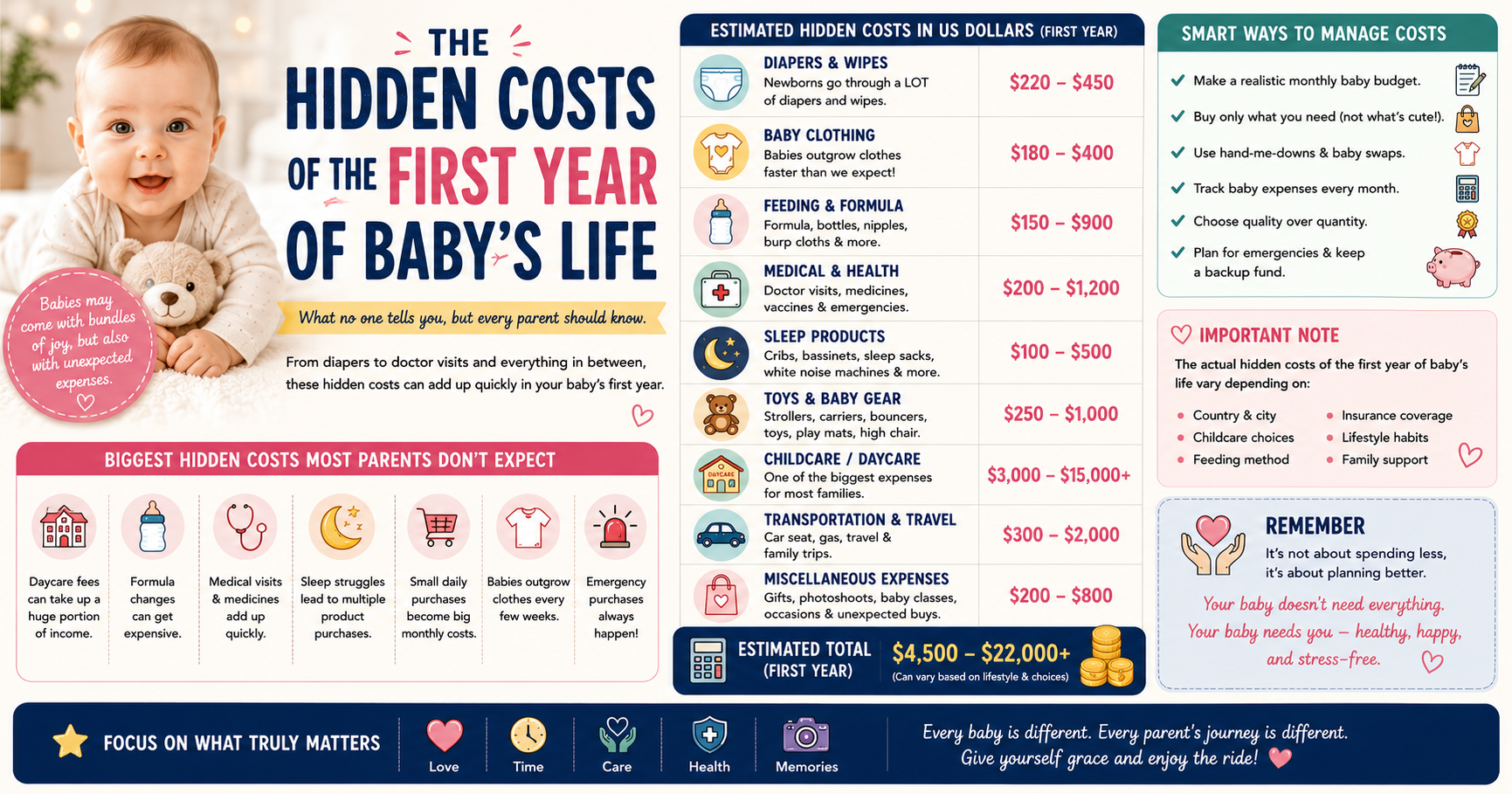
Before we get into the hidden costs specifically, here is the total picture — because understanding the full financial scale helps you see where the hidden costs live.
| Category | City (Metro) | Tier 2 City | Premium/Private |
| Delivery + hospital | Rs. 25,000–2,50,000 | Rs. 5,000–35,000 | Rs. 80,000–4,00,000+ |
| Diapers (full year) | Rs. 12,000–18,000 | Rs. 8,000–12,000 | Rs. 18,000–30,000 |
| Formula (if not breastfeeding) | Rs. 30,000–60,000 | Rs. 20,000–40,000 | Rs. 50,000–90,000 |
| Clothing (all sizes) | Rs. 3,000–6,000 | Rs. 2,000–4,000 | Rs. 6,000–15,000 |
| Baby gear (crib, pram, etc.) | Rs. 15,000–40,000 | Rs. 8,000–20,000 | Rs. 40,000–1,20,000 |
| Medical / vaccines | Rs. 8,000–20,000 | Rs. 3,000–8,000 | Rs. 20,000–50,000 |
| Childcare / ayah | Rs. 24,000–72,000 | Rs. 12,000–36,000 | Rs. 60,000–1,50,000 |
| HIDDEN COSTS (see below) | Rs. 20,000–50,000 | Rs. 10,000–30,000 | Rs. 50,000–1,50,000+ |
| TOTAL ESTIMATE | Rs. 1,37,000–5,16,000 | Rs. 68,000–1,85,000 | Rs. 3,24,000–10,05,000+ |
Notice that last row: hidden costs. Depending on your situation, those hidden costs range from Rs. 10,000 to Rs. 1,50,000 or more. That gap is what this entire post is about.
These are not theoretical costs. These are real expenses from real families — the things that show up on credit card statements and cause genuine financial stress precisely because nobody planned for them.
Feeding a baby in the first year is the single largest source of hidden costs for most families. Here is what the standard baby budget calculator misses completely:
Most parents budget for vaccinations. Most parents do not budget for everything else.
Sleep deprivation does something very specific to your decision-making: it makes you buy things. The sleep product industry knows this and prices accordingly. Here are the hidden costs of the first year of baby’s life that live in the sleep category:
Here is what every new parent discovers within the first four months: babies grow at a pace that makes clothing budgets irrelevant. You will buy clothes in a size. They will wear them for three weeks. You will donate them.
| Clothing Size Stage | Estimated Cost (India) |
| Newborn (0–1 month) | Rs. 1,500–3,000 (often wasted — skip this size) |
| 0–3 months | Rs. 2,000–4,000 |
| 3–6 months | Rs. 2,000–4,000 |
| 6–9 months | Rs. 2,000–4,500 |
| 9–12 months | Rs. 2,500–5,000 |
| Seasonal additions (monsoon/winter) | Rs. 3,000–7,000 |
| TOTAL CLOTHING YEAR 1 | Rs. 13,000–27,500 (if buying new) |
| TOTAL CLOTHING (secondhand / gifted) | Rs. 3,000–8,000 (the smarter approach) |
This is the one that genuinely derails family finances in the first year — and it is the most underdiscussed hidden cost of the first year of baby’s life.
This is the section that is completely absent from every other baby cost article — and it is arguably the most important one.
Postpartum depression and anxiety affect approximately 1 in 5 new mothers in India, and rates of paternal postpartum depression are estimated at 5–10%. Untreated, these conditions affect the entire family. Treated, they cost money — and that is the part we need to talk about openly.
The gear upgrade trap is a pattern specific to first-time parents, and it deserves its own section because it silently doubles many baby budgets.
Here is how it works: you buy the entry-level version of something. It almost works. At 3 a.m. with a screaming baby, ‘almost’ is not enough. You buy the mid-range version. That almost works too. You buy the premium version. You resent the premium version for costing Rs. 8,000 when the Rs. 2,000 version would have been fine if you had just been more patient.
| Gear Upgrade Category | Typical Total Spent |
| Baby carrier | Rs. 1,500–6,000 × 2–3 tries = Rs. 5,000–18,000 |
| Breast pump progression | Rs. 1,500 → Rs. 4,000 → Rs. 12,000–25,000 |
| Bouncer + swing combo | Rs. 6,000–32,000 total |
| Monitor upgrade path | Rs. 2,000 → Rs. 8,000 → Rs. 18,000–25,000 |
| Formula trials (2–4 brands) | Rs. 5,000–15,000 in unused tins |
| Steriliser upgrade | Rs. 1,500 → Rs. 8,000–15,000 |
| TOTAL GEAR UPGRADE TRAP (avg) | Rs. 25,000–85,000 across first year |
For Indian families, there is an entire category of costs that no Western baby budget guide mentions — and even Indian guides tend to underestimate.
These are small, irritating, and completely invisible until they’re on your credit card statement.
Now that you know what is coming, here is how to reduce the financial shock without living in anxiety about it.
Most financial advice says ‘save 3 months of expenses before the baby arrives.’ That advice ignores the hidden costs entirely. Instead, build two separate funds: your known baby expenses fund (crib, pram, initial supplies) and a separate hidden costs buffer of at least Rs. 25,000–50,000 for a tier-2 city family or Rs. 50,000–1,00,000 for a metro family. Touch the buffer only for things that were not in your original plan.
Baby clothes, bouncers, swings, bottles (replace nipples), play gyms, and most soft goods can be bought secondhand for 20–40% of new price. In India, Facebook Marketplace groups, OLX, and local community WhatsApp groups have thriving secondhand baby gear markets. Never buy secondhand car seats, breast pump motor units, or anything with recalled safety history. Save the new-purchase budget for gear that cannot be compromised on.
Before buying any new baby item, ask: what problem am I solving, and have I tried solving it without buying something first? Babies often stop needing something within 2–4 weeks of you buying it. The one-in one-out rule — if you buy a new gear item, you commit to selling the one it replaces — keeps gear accumulation under control and recovers some of your investment.
Before buying a Rs. 6,000 UV steriliser, a Rs. 4,000 probiotic course, or a Rs. 3,000 specialty formula, call your paediatrician. Many of the most expensive baby health purchases are driven by anxiety rather than medical need. A five-minute phone call saves thousands of rupees regularly.
If you know that namkaran, annaprashana, and mundan are in your cultural tradition, price them out before the baby arrives. These costs are entirely predictable — they just feel surprising because nobody includes them in baby budget calculators. Set aside a ceremonies fund of Rs. 20,000–60,000 depending on your family’s scale and social circle. This prevents the ceremonies from going on a credit card.
Here is the timeline — because the hidden costs of the first year of baby’s life do not arrive all at once. They are staggered in a way that makes them feel manageable until they are not.
| Timeline | Hidden Costs That Typically Appear |
| Month 0–1 | Hospital stay (unexpected extra days), lactation consultant, emergency feeding supplies, initial admin (birth certificate), postpartum recovery costs, household help setup |
| Month 2–3 | Formula trial period (if applicable), colic treatments, first sick visit, baby carrier trial #1, white noise machine purchase |
| Month 3–4 | Baby clothes size 3–6 months (full refresh), first round of vaccinations with private paed, sleep regression begins — sleep consultant interest starts |
| Month 4–5 | Breast pump upgrade, carrier trial #2, bouncer or swing purchase, baby monitor upgrade consideration, baby massage class enrollment |
| Month 5–6 | Introduction to solids prep: blender, bowls, high chair, bibs. Naming ceremony or annaprashana in Indian families. Childcare research and deposit costs. |
| Month 6–8 | Daycare starts (if applicable): Rs. 5,000–25,000/month begins. Clothing refresh again. Medical costs from first major illness typically hit here. Postpartum therapy often starts as the adrenaline of early parenting fades. |
| Month 8–10 | Baby proofing: cabinet locks, corner guards, stair gates, socket covers. Rs. 2,000–8,000. Sleep regression #2 — sleep training costs resurface. |
| Month 10–12 | First birthday planning begins. Clothing for 12-month size. Annual insurance renewal with child added to policy. Year-end photos and photobooks. Developmental toys and activity sets. |
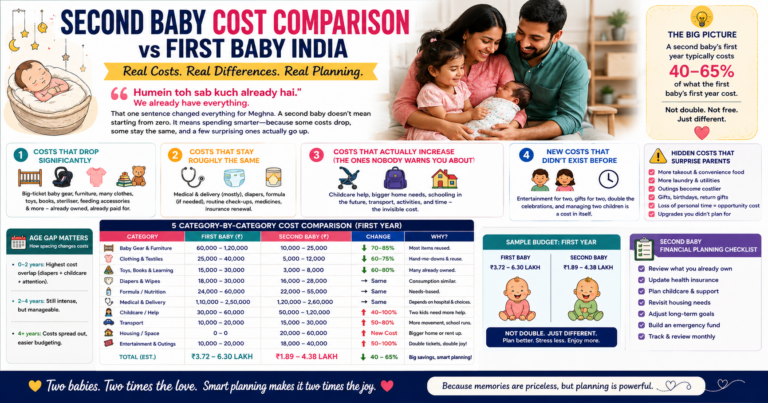
The total cost of a baby’s first year in India ranges from Rs. 68,000 for a modest setup in a tier-2 city to Rs. 10,00,000 or more for a premium, metro experience with private hospital delivery, premium childcare, and international formula. The most realistic number for a middle-class family in a tier-2 city like Raipur, Nagpur, or Bhopal is Rs. 1,50,000–3,50,000 across the full year, including all hidden costs. The hidden costs alone — the ones nobody budgets for — typically run Rs. 20,000–80,000 depending on your circumstances.
The five biggest unexpected costs that parents consistently report are: formula trial costs (trying multiple brands before finding one that works), the gear upgrade trap (buying the same type of item multiple times as you upgrade), childcare setup costs (ayah salary or daycare deposit), lactation consultant fees (often needed urgently but never budgeted), and cultural ceremony costs in Indian families (namkaran, annaprashana, and associated gatherings). Together, these five categories account for the majority of hidden first-year baby costs.
A practical minimum saving target before the baby arrives is Rs. 1,50,000–2,50,000 for a middle-class family in a tier-2 Indian city, or Rs. 3,00,000–5,00,000 for a metro family. This covers your known costs plus a hidden costs buffer of Rs. 30,000–80,000. Critically, this is savings in addition to your emergency fund (which should remain untouched) and any employer-provided maternity or paternity benefits. If you are planning a private hospital delivery in a metro city, add Rs. 1,00,000–3,00,000 to your target specifically for the birth.
You can safely cut: newborn-size clothing (skip entirely or buy 2–3 items maximum), brand-new baby furniture (buy secondhand except the mattress), premium brand formula when a generic works fine for your baby, UV sterilisers (a basic steam steriliser or boiling is medically equivalent), and most branded baby skincare when fragrance-free adult moisturisers are often gentler and cheaper. You should not cut: car seat quality, crib mattress safety standards, paediatrician visits, vaccinations, and postpartum mental health support if you need it.
Yes — and it is one of the most underestimated hidden costs of the first year of baby’s life. If your baby is fully formula-fed from birth to 12 months, you will spend approximately Rs. 30,000–60,000 on formula in a tier-2 Indian city (using mid-range brands like Enfamil or Similac) or Rs. 50,000–90,000 on premium imported formula. On top of this, the formula trial period — where you try 2–4 brands before finding one your baby accepts — adds Rs. 5,000–15,000 in wasted tins. Families who breastfeed exclusively avoid this cost, but face the hidden costs of lactation support instead.
The gear upgrade trap is the pattern where you buy an entry-level version of a baby product, it doesn’t fully meet your needs, and you upgrade — sometimes two or three times. It happens with monitors, carriers, breast pumps, swings, and sterilisers. The average Indian family affected by the gear upgrade trap spends an extra Rs. 25,000–85,000 across the first year on gear they would not have needed if they had bought the right item first time. To avoid it: read 200+ reviews on any item over Rs. 2,000 before buying, ask a parent with a baby 6 months older than yours what they actually use, and buy secondhand first when possible to test without losing full purchase value.
Absolutely real — and among the most important costs to budget for. Postpartum depression and anxiety affect roughly 1 in 5 Indian mothers and an estimated 1 in 10 Indian fathers. Private therapy in India costs Rs. 800–3,000 per session. A realistic 10-session course costs Rs. 10,000–30,000. Many families also find value in postpartum doula support (Rs. 1,500–5,000 per visit) or couples counselling (Rs. 2,000–4,000 per session). Budget a minimum of Rs. 15,000–30,000 for mental health support in your first-year baby budget, and consider it as important as the crib.
For most Hindu and many other Indian families, yes. The namkaran alone can cost Rs. 8,000–30,000 when you factor in the pandit, food, decorations, and outfits for family members. The annaprashana at 6 months can range from Rs. 10,000–50,000. These are not optional in most families — they are expected. The hidden cost here is that these ceremonies come during a period of reduced household income (if the primary caregiver is on leave) and increased expenses (all the new baby costs). Budgeting for them separately, well in advance, is essential
Here is the honest conclusion: the hidden costs of the first year of baby’s life will surprise you, no matter how prepared you think you are. That is not a failure of planning. It is just the nature of a completely new experience.
But knowing what is coming — even approximately — changes everything. You stop feeling blindsided. You stop adding things to the credit card and wondering how they got there. You start making intentional decisions about where to spend and where to save.
The parents who navigate the first year financially well are not the ones with the biggest savings accounts. They are the ones who planned for the unexpected, bought secondhand where it was safe, avoided the gear upgrade trap by doing research first, and were honest with themselves about the emotional costs of the year — including budgeting for their own mental health support if they needed it.
Your baby does not need the most expensive version of anything. They need you — present, well-rested enough, financially secure enough to not be chronically stressed, and genuinely there for the small moments that make up the entire first year.
Budget for the hidden costs. Give yourself the buffer. And enjoy the year that will go faster than anything you have ever experienced.