Physical Address
304 North Cardinal St.
Dorchester Center, MA 02124
Physical Address
304 North Cardinal St.
Dorchester Center, MA 02124

If your mornings with a toddler feel like you are trying to herd a small, emotionally unpredictable cat while simultaneously finding your own keys, making packed lunches, and answering a work email, you are not doing it wrong. You are just doing it without a proper morning routine for toddlers. And that single missing piece makes more difference than almost anything else you could change about your day.
The morning routine for toddlers is one of those things that sounds like it should just happen naturally. Wake up, get dressed, eat breakfast, leave the house. Simple. But any parent who has spent twenty minutes trying to get a two-year-old to put on their shoes while simultaneously chasing them around the kitchen and watching the clock tick towards the drop-off deadline knows that none of it is simple unless you have a system.
This guide is about building that system. Not a rigid, joyless military schedule. A real morning routine for toddlers — one that fits your actual family, accounts for the reality of toddler behaviour, gives your child enough autonomy to stay cooperative, and gets everyone out of the door without the kind of morning that leaves everyone feeling like the day is already ruined before it starts.
We will cover why routines matter so much for toddlers specifically, what a good toddler morning routine actually looks like step by step, how to build a visual routine chart your child will genuinely engage with, age-specific advice for different stages from eighteen months to three and a half years, the most common mistakes that make morning routines fall apart, what to do when the routine goes wrong, and how to manage the morning as a working parent with a toddler in tow.
If you have tried morning routines before and they have not stuck, this guide will also tell you exactly why — because the reasons are almost always the same, and they are all fixable.
Before we get into the how, it is worth spending a moment on the why. Because when you understand what is actually happening in a toddler’s brain during a morning routine — or during the absence of one — the strategies in this guide make a lot more sense.
The toddler years — roughly eighteen months to around three and a half — are characterised by enormous developmental leaps. Language is exploding. Independence is growing. The world is getting bigger and more complex every day. And the part of the brain responsible for managing all of this stimulation and uncertainty is not yet developed. Toddlers have an immature prefrontal cortex, which is the part of the brain that handles planning, decision-making, impulse control, and emotional regulation.
What this means in practice is that when there is no predictable structure to the day, a toddler’s nervous system is under constant low-level stress. Every transition — waking up, getting dressed, leaving the house — requires them to figure out what happens next. And figuring out what happens next is hard work for a brain that is already stretched to capacity.
A consistent morning routine for toddlers removes most of this uncertainty. When a toddler knows that after breakfast comes getting dressed, and after getting dressed comes putting on shoes, and after putting on shoes comes going to daycare — they do not have to figure it out. Their brain can stop managing uncertainty and start actually engaging with each step. That is why children with consistent routines tend to be calmer, more cooperative, and more independent than children without them. The routine itself does the heavy lifting.
Toddler meltdowns in the morning are almost always triggered by one of two things. Either the transition between steps is unexpected — the toddler did not know that playtime was about to end and getting dressed was about to start — or the toddler has no sense of control over what is happening to them, which triggers resistance and defiance as a way of asserting themselves.
A well-structured morning routine for toddlers addresses both of these triggers. When each step follows predictably from the last, transitions stop being surprises. And when the routine includes small choices within each step — which cup to use for breakfast, which pair of socks to wear, whether to put the left shoe or right shoe on first — toddlers get the sense of control they need without derailing the whole schedule.
You cannot eliminate toddler meltdowns entirely. But you can dramatically reduce how often they happen in the morning, and how severe they are when they do, simply by having a consistent and thoughtfully constructed morning routine.
The morning routine for toddlers is not just about making today’s morning easier. It is about building the foundation for every morning of your child’s childhood. Children who grow up with consistent morning routines develop stronger executive function skills — the ability to plan, sequence tasks, manage time, and regulate their own behaviour. These are skills that directly support academic performance, social relationships, and mental health throughout life.
The toddler years are the ideal time to establish these patterns because young children are at peak routine-absorption capacity. They are watching everything, imitating everything, and building the neural pathways that will form their habits for decades. A morning routine established at two years old does not just get your toddler to daycare on time. It teaches them how mornings work, what self-care looks like, and what it means to prepare for the day ahead. That is a genuinely valuable life lesson — delivered through the completely ordinary act of brushing teeth and finding the other shoe.
A good morning routine for toddlers is not complicated. But it does need to be consistent, age-appropriate, and built around your specific child rather than copied wholesale from someone else’s Instagram grid.
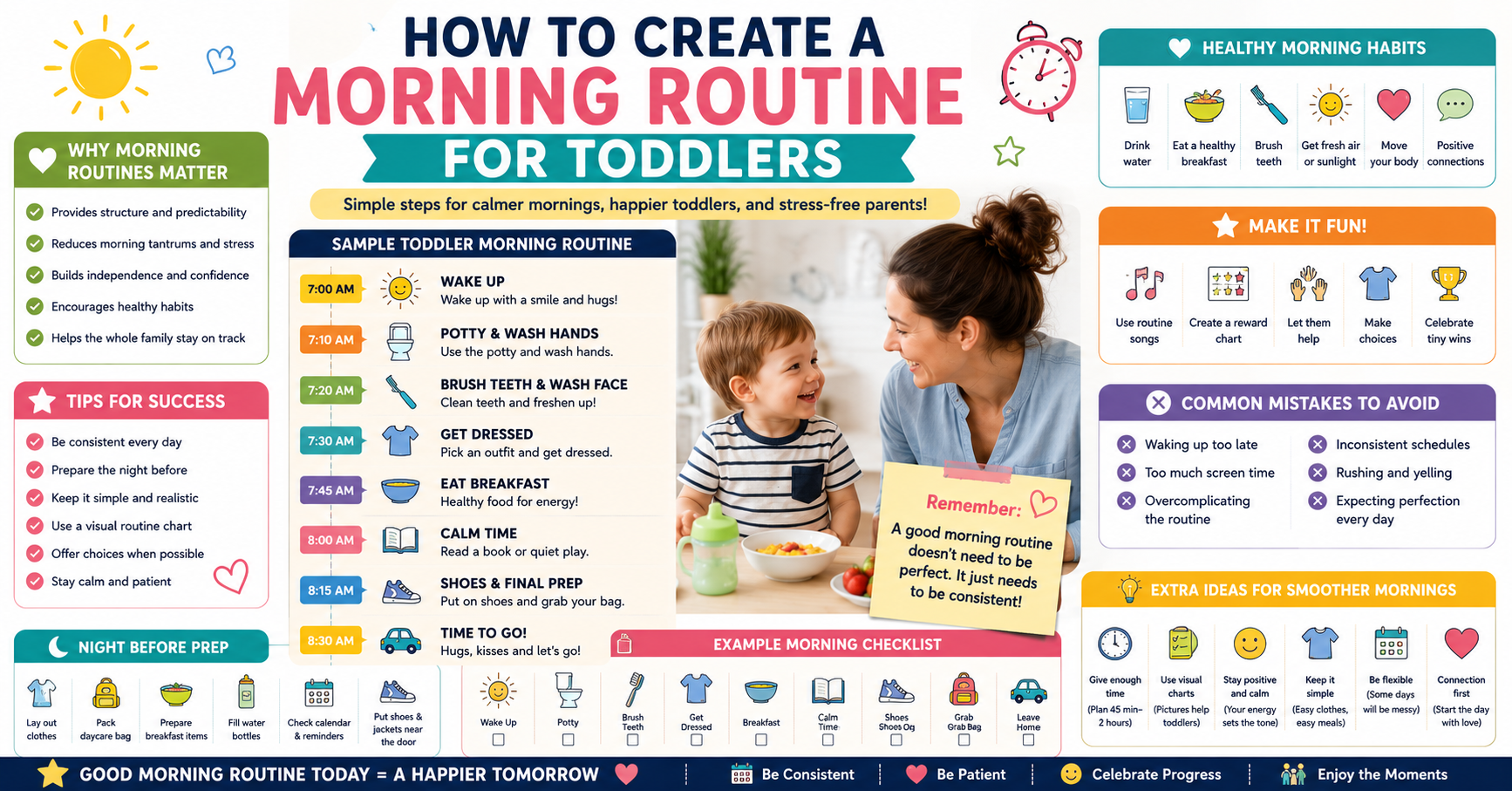
Here is what a solid toddler morning routine looks like in practice, broken down step by step. We will follow this with advice on how to adapt it for different ages and different family situations.
The morning routine for toddlers starts the night before — at bedtime. A consistent bedtime that gives your toddler enough sleep is the single biggest factor in how the morning goes. A toddler who wakes up naturally after a full night of sleep is a fundamentally different morning proposition to one who is dragged out of bed overtired.
Most toddlers between eighteen months and three years need between eleven and fourteen hours of sleep in every twenty-four hour period. If your toddler is waking significantly before you need them to, or is very difficult to rouse at the time you need them up, the night-time sleep setup is worth reviewing. Early morning waking is often linked to an undertired or overtired toddler — counterintuitive but common.
Whatever wake-up time you are working with, give yourself a buffer. If drop-off is at eight-thirty and the journey takes fifteen minutes, you need to leave at eight-fifteen. Work backwards from there, adding realistic time for each step, plus ten minutes for the unexpected. Set your alarm accordingly. Many parents who struggle with morning routines are simply trying to do too much in too little time.
✅ A toddler clock or light-based alarm clock — the kind that changes colour at the set wake-up time — is a brilliant investment for toddler morning routines. It gives your child a clear, visual signal that it is morning time that does not require you to be the one who has to tell them. Many parents report that a toddler clock alone reduces early-morning bedroom invasions significantly.
Many parents make the mistake of launching straight into the morning routine for toddlers the moment they get out of bed. Get up, get dressed, get downstairs, get breakfast. Go, go, go. And their toddler digs their heels in before they have even left the bedroom.
The reason is simple. Toddlers, like most humans, need a transition period between sleep and full engagement with the day. Those first ten to fifteen minutes of waking are when toddlers are at their most physically and emotionally vulnerable. They have just emerged from sleep. Their blood sugar is low. Their sensory system is adjusting. They need a gentle on-ramp.
Build a short period of low-key, quiet connection into the very start of your morning routine. This might be five minutes of cuddling in bed before getting up. It might be letting your toddler sit and look at a book while you get dressed. It might be a calm, slow walk to the bathroom together rather than a brisk march. This transition period costs you almost nothing in time but it dramatically changes the energy of the morning that follows.
The bathroom section of the morning routine for toddlers includes the same tasks every day — toileting, washing face and hands, and brushing teeth. These three tasks done in the same order every morning become such a familiar sequence that most toddlers can do them largely independently once the routine is well established.
The key is consistency of order. Always toilet first, then wash, then teeth — or whichever order works for your bathroom setup. After a few weeks of the same sequence, the routine itself guides the toddler through each step. They do not need prompting for every individual action because each action cues the next one.
Make the bathroom setup work for your toddler’s independence. A step stool at the basin. A low hook for their towel. A toothbrush in a holder at their height. Soap in a pump dispenser they can operate themselves. When a toddler can access everything they need without asking for adult help, they are far more likely to engage willingly with each step.
💡 Toothbrushing is the morning routine step that causes the most conflict in toddler households. If it is a battle in your house, try giving your toddler the toothbrush first to have a go themselves, then you take a turn. Most dentists agree that the parent needs to do the actual cleaning — but letting the toddler go first gives them the sense of control that makes the whole interaction calmer.
Getting dressed is where morning routines for toddlers most frequently fall apart. The toddler wants to wear the dinosaur t-shirt. The dinosaur t-shirt is in the wash. Cue nuclear meltdown. Or the toddler decides they want to dress themselves — which they cannot quite do yet — and time runs out while they wrestle with a sock for eight minutes.
The solution is preparation and managed choice. Preparing clothes the night before removes the in-the-moment decision-making that causes conflict. If the outfit is already laid out when your toddler wakes up, there is no debate about what to wear today because that conversation already happened yesterday evening when there was no time pressure.
Managed choice means that within the morning routine, your toddler gets to make real choices — but only within the options you have pre-selected. Not ‘what do you want to wear?’ — that is too open and leads to the dinosaur t-shirt problem. Instead: ‘Do you want to wear the blue jumper or the red jumper today?’ Both are weather-appropriate. Both are ready to go. Your toddler gets genuine autonomy and you do not lose fifteen minutes to a wardrobe crisis.
For toddlers who want to dress themselves — which is most of them from around twenty-four months onwards — choose clothing that is genuinely easy to manage independently. Elasticated waistbands rather than buttons. Slip-on shoes or velcro rather than laces. Wide-necked t-shirts that do not require wrestling to get over the head. The easier the clothing is to put on, the more your toddler can genuinely do independently, which means less friction and a faster morning all round.
⚠️ Never lay out clothes you are not happy for your toddler to choose from. If you put out two choices and one is a special outfit you do not want to be worn to daycare, your toddler will choose it. Only put out options you genuinely do not mind them wearing. Keep the special clothes in a separate section of the wardrobe or drawer where they are not part of the morning choice.
Breakfast in a toddler morning routine is non-negotiable. A toddler who leaves the house without eating is going to have a harder morning at daycare and a harder time settling. Blood sugar matters enormously for toddler mood and behaviour. Do not skip breakfast even when time is tight.
The breakfast section of the morning routine for toddlers works best when it is as simple and consistent as possible. Toddlers do not need a different breakfast every day. Most toddlers actively prefer eating the same few familiar things. Having a small rotation of two or three quick, nutritious breakfasts — porridge, scrambled eggs on toast, yoghurt with fruit — means breakfast is fast to prepare and predictable enough that it does not become another decision point that slows down the morning.
Where possible, set up breakfast while your toddler is doing their bathroom routine. When they come to the table, everything is already there. This removes the waiting time that is a prime trigger for toddler restlessness and table-abandonment.
Let your toddler do as much of their breakfast independently as possible. Pouring their own cereal from a small jug of milk. Spreading their own bread with a blunt knife. Choosing their own cup. These moments of independence make breakfast feel like something they are doing, not something being done to them. That small distinction matters a lot to a toddler who is working hard on building autonomy.
Shoes and coats are where the morning routine for toddlers most frequently comes off the rails in the final stretch. You are almost out of the door. The toddler decides they need to bring a specific toy. Or they suddenly need the toilet again. Or they take their shoes off the moment you have put them on and think it is hilarious.
Have a consistent shoes-and-coat routine. Same spot to sit for shoes every day — a step, a particular chair, a spot on the floor by the door. Shoes already at that spot from the night before. Coat on its hook at their height so they can get it themselves. When everything is in the same place every day, the process becomes automatic rather than a fresh negotiation.
If your toddler is capable of putting on their own shoes — velcro shoes are usually manageable from around two years old — let them do it. Yes, it takes longer. But a toddler who puts their own shoes on is far less likely to immediately take them off than one whose shoes were put on for them. Ownership of the action = investment in keeping it done.
✅ Give your toddler a five-minute warning before it is time for shoes and coats. This transition cue — ‘Five more minutes, then shoes on’ — reduces the shock of suddenly having to stop what they are doing. You can reinforce it with a timer they can see or hear. Toddlers who know a transition is coming handle it significantly better than ones who are simply interrupted mid-play.
The final step of the morning routine for toddlers is leaving the house. And if your toddler goes to daycare, this includes the drop-off goodbye. We have covered drop-off in depth in other guides — but the short version is: have a consistent goodbye ritual, keep it warm and brief, and leave with confidence even if you are not feeling it.
The way you leave the house in the morning sets the emotional tone for your toddler’s whole day. A calm, warm, predictable goodbye — even after a slightly rocky morning — gives your toddler what they need to walk into daycare in a settled state. A frantic, stressed, guilt-ridden goodbye makes everything harder.
Build the goodbye into the morning routine as one of its steps. It is not an afterthought. It is part of the sequence. When it is predictable and consistent, even toddlers who find drop-off hard begin to process it as a normal part of morning rather than an unexpected and traumatic event.
One of the most effective tools for creating a consistent morning routine for toddlers is a visual routine chart. This is simply a sequence of pictures showing each step of the morning routine in order — and it is genuinely transformative for most toddler households.
Toddlers are pre-literate and often pre-verbal in many areas of abstract thinking. Telling a toddler ‘after breakfast you need to brush your teeth and then get dressed’ requires them to hold a sequence of future events in their working memory — which is a skill that is still very much under development at this age.
A visual chart removes this cognitive demand entirely. Your toddler does not need to remember the sequence because they can see it. The chart is the external memory. The chart is also the authority — which is enormously useful for parents. Instead of you being the person who tells your toddler what comes next, the chart is. ‘What does the chart say comes next?’ is a very different conversation to ‘I am telling you, you need to get dressed now.’
Toddlers who resist instructions from adults often accept the same instruction from a visual chart without any resistance at all. This sounds too good to be true. It is not. It works because the chart is neutral — it is not a power struggle with a parent, it is just information. Children feel less controlled by information than they do by direct instructions.
Making a morning routine chart for toddlers does not require any special skill or materials. Here is what works.
Many parents add a small velcro dot or a moveable clip that marks the current step. When the toddler completes a step, they move the clip to the next picture themselves. This physical action of marking their own progress is enormously motivating for toddlers and creates genuine investment in getting through the routine.
🔖 Let your toddler help make the chart. Take photos of them doing each step. Let them stick the pictures on. This ownership makes them far more likely to engage with the chart once it is up. A chart they helped create feels like their chart, not yours.
The most effective placement for a toddler morning routine chart is in the bathroom, where multiple steps of the routine happen in sequence. Some parents put one chart in the bathroom and a second simplified version by the front door as a final checklist before leaving.
Bedroom charts work well for the getting-dressed step. Kitchen charts help with breakfast and morning snack routines. The key is placing the chart where it will be seen at the moment it is relevant — not on the kitchen door if the step it covers happens in the bathroom.
If you only take one practical tip from this entire guide about morning routines for toddlers, let it be this: the morning routine starts the night before. What you do in the twenty minutes before you go to bed has more impact on how the morning goes than almost anything you do in the morning itself.
Twenty minutes of night-before preparation removes the majority of the decision-making and searching that causes morning stress. When the morning starts with everything already in its place, the whole routine flows at a completely different pace.
The core structure of a morning routine for toddlers stays broadly the same from eighteen months to three and a half years. But the level of independence your toddler can manage, and the strategies that work best, change significantly as they develop.
At this age, your toddler needs a great deal of adult scaffolding. They understand far more than they can express, and they are beginning to develop clear preferences and strong opinions — but their ability to carry out steps independently is still limited.
The focus at this age is on consistency and participation rather than independence. You are doing most of the practical work but you are doing it with your toddler, not to them. Narrate each step as you do it: ‘Now we are washing our face. Now we are putting on your blue jumper.’ This constant narration builds the toddler’s understanding of the sequence and prepares them for the independence that comes in the next stage.
Keep the morning routine for toddlers at this age very short and very simple. Five or six steps maximum. The simpler the routine, the more consistently you can deliver it, and consistency is everything at this age.
Total realistic time: 40 to 55 minutes. Build your morning accordingly.
This is the age where independence starts to really drive the morning routine. Two-year-olds want to do everything themselves — often everything they are not yet capable of, and nothing they are being asked to do. The morning routine for two-year-olds is all about harnessing that drive for independence and making it work within the structure of the routine.
At this age, managed choices become your most powerful tool. Two choices for clothes. Two choices for breakfast. Two choices for which step to do first within a section. The toddler’s sense of control is satisfied and the morning still moves in the right direction.
Start introducing the visual chart at this age if you have not already. Two-year-olds respond brilliantly to picture-based charts because they are at the stage where making sense of symbols and sequences is genuinely exciting.
Morning timeline for two-year-olds:
Total realistic time: 45 to 58 minutes.
By three years old, many toddlers can carry out most of the morning routine with minimal adult direction, given the right environment and the right preparation. The visual chart is now something they may be able to follow largely independently. Getting dressed, washing, and even putting on shoes may be achievable without help if the clothing choices are right.
The morning routine for three-year-olds is about shifting from adult-led to child-led, with adults as a warm, present support rather than the person driving each step. This does not happen overnight. It is a gradual handover that happens step by step over weeks and months. But by three and a half, many children are genuinely capable of going through the morning routine themselves while a parent is in the room and available — which is a very different experience from the eighteen-month-old version.
At this age, introduce a simple reward system if you feel it would help — not sweets or sticker charts for every single step, but something like: ‘When you have done all the steps on the chart, you get five minutes of your favourite book before we leave.’ The reward is part of the routine, not a bribe layered on top of it.
Morning timeline for three-year-olds:
Total realistic time: 40 to 50 minutes — slightly shorter than earlier because independence has genuinely increased.
Most guides about morning routines for toddlers seem to be written for people who have an hour and a half and a cup of tea that is still hot by the time they drink it. Many families do not have that. If you are both working parents or a single working parent, the morning routine needs to be designed for the actual conditions you are working in.
If you genuinely have less than forty-five minutes for the toddler morning routine because of work start times, commute lengths, or shared childcare logistics — do not try to squeeze a sixty-minute routine into forty-five minutes. That is a recipe for a stressful morning every single day.
Instead, strip the routine to its absolute minimum. What are the non-negotiables? Toileting, dressed, fed, shoes on. Everything else — a slightly rushed wash, skipping the five-minute wind-up period — is a nice-to-have that can flex on days when time is short. Know which steps can shrink and which cannot. That clarity alone takes significant pressure off the morning.
Night-before preparation becomes even more essential when morning time is short. If you are preparing formula, packing the daycare bag, choosing clothes, and making your own lunch in the morning, you will run out of time before you run out of tasks. Do as much as humanly possible the evening before.
If there are two adults in the household on a typical morning, having a clear division of responsibility is worth the five minutes it takes to discuss. When both adults share the morning tasks without a clear plan, you get duplication, confusion, and the sense that no one quite knows what they are supposed to be doing. With a clear plan — one adult does bathroom while the other does breakfast — the whole morning is faster and calmer.
Write the plan down and stick to it for at least two weeks before revising. Consistency in adult roles is part of what makes the morning routine for toddlers work. If your toddler does not know which parent does which step, they will make that uncertainty into an opportunity for negotiation and delay — which is the last thing you need at seven-fifteen in the morning.
Some families have irregular start times — shift work, variable school runs for older children, or freelance schedules. A morning routine for toddlers can still work with variable adult timing, but the toddler’s portion of the routine needs to stay consistent regardless of what the adult schedule looks like on any given day.
This means the toddler’s wake-up time, their routine sequence, and their drop-off time should be the same every day even if who is doing it and what time you yourself need to leave changes. Children’s routines are for children. The adult schedule flexes around them, not the other way around.
No morning routine for toddlers works perfectly every day. Some mornings the toddler wakes up in a full emotional storm before they have even reached the bathroom. Some mornings you are the one who is running on empty. Some mornings everything that can go wrong does. That is normal and it does not mean your routine is failing.
When a toddler melts down during the morning routine, the temptation is to abandon the routine and just manage the meltdown. This is understandable but it teaches your toddler that a meltdown successfully pauses the routine — which makes future morning meltdowns more likely, not less.
Instead, acknowledge the feeling briefly and warmly — ‘I can see you are really upset right now. That is hard.’ — and then gently continue the routine. You do not ignore the feelings. You acknowledge them and move forward anyway. ‘I know you are sad about the dinosaur jumper. It is in the wash. Let us put the red one on and you can wear the dinosaur one tomorrow.’ Brief, warm, matter-of-fact. Then move to the next step.
On a genuine meltdown morning where the toddler is clearly overtired, unwell, or particularly dysregulated, give yourself permission to slow the routine down, drop to the minimum steps, and accept that today is just a hard morning. It happens. It does not mean the routine is not working.
Running late with a toddler in the morning is particularly challenging because urgency makes toddlers slower, not faster. The more stressed and rushed you become, the more your toddler picks up on that energy and mirrors it back at you in the form of resistance, silliness, or emotional dysregulation.
When you realise you are running late, take one deliberate slow breath before you do anything else. This sounds impossible and it genuinely helps. Then mentally triage: what are the absolute minimum steps that must happen before leaving? Do those. Skip the rest. A toddler who arrives at daycare without having brushed their teeth once will survive. A toddler who arrives having watched their parent spiral into frantic stress will have a much harder morning.
💡 If you are regularly running late with your toddler morning routine, the solution is almost never to move faster. It is to start earlier. Set your alarm fifteen minutes earlier for one week and see how different the morning feels. The problem is almost always an insufficient time buffer, not a flawed routine.
The refusal day is when your toddler, for reasons entirely their own, decides today is the day they will not cooperate with a single step of the morning routine. They refuse to get dressed. They refuse to eat. They sit on the floor and look at you with the serene confidence of someone who knows exactly what they are doing.
Do not meet a refusal day with escalation. Meet it with calm, limited choices, and a bit of playfulness. ‘Are you going to hop to the bathroom or walk like a penguin? You choose.’ Silliness disarms toddler refusal far more reliably than authority or frustration. A toddler who is laughing is a toddler who is moving.
If a particular step becomes a consistent point of refusal across several days, look at whether that step has enough toddler autonomy built into it. Consistent refusal of a specific step is usually a sign that the toddler does not feel enough control over it. Rebuild that step with more choice and you will usually find the refusal dissolves.
Most morning routine struggles are caused by a small number of very common mistakes. Here they are, clearly named, so you can avoid them.
This is the number one reason morning routines for toddlers fall apart. The time budget was unrealistic from the start. Map out every step and its realistic time. Add ten minutes. Set the alarm for that time. A morning routine that has enough time built into it is a completely different experience from one where the clock is always against you.
Every decision your toddler has to make in the morning — what to wear, what to eat, which cup to use, which shoes — uses up decision-making energy and creates potential conflict. Move as many decisions as possible to the night before. Keep morning decisions to managed binary choices: this or that, never open-ended.
A morning routine for toddlers only works as a routine if the sequence is the same every day. If you do breakfast before getting dressed one day and getting dressed before breakfast the next, your toddler cannot build the automatic sequence of actions that makes the routine self-sustaining. Pick an order. Keep it. The first two weeks of a new routine feel slightly rigid. After that, it starts to feel natural.
A two-year-old cannot dress themselves completely independently in five minutes. A three-year-old cannot be trusted to brush their teeth effectively without adult oversight. Expecting more than your toddler’s developmental stage allows leads to frustration on both sides. Know what your specific toddler can actually do independently and build the routine around that, not around what you wish they could do.
Parents who skip night-before preparation and rely entirely on morning efficiency always end up with harder mornings. The night-before preparation is not optional. It is the foundation that the morning routine for toddlers rests on. Do it every evening, and the morning becomes manageable. Skip it regularly and the morning routine will never feel stable.
The ideal wake-up time for a toddler morning routine depends on your family’s daycare or nursery drop-off time and how much time your toddler needs to move through the morning comfortably. Most toddlers between eighteen months and three years need between forty-five minutes and sixty minutes to complete a morning routine without rushing. If drop-off is at eight-thirty, your toddler ideally needs to be up by seven-thirty at the latest — earlier if they wake up slowly or need a longer transition period. Toddlers who wake naturally after a full night of sleep tend to handle morning routines better than those who are woken before they are ready. A consistent bedtime that gives your toddler eleven to fourteen hours of sleep will naturally produce a more cooperative morning.
Morning meltdowns in toddlers are almost always caused by one of four things: not enough sleep, too many unexpected transitions, too little sense of control, or too much adult urgency creating anxiety. The most effective approach is to address all four simultaneously. Ensure a consistent and early enough bedtime. Use a visual routine chart so transitions are never a surprise. Build managed choices into every step so your toddler feels genuinely in control of their morning. And slow your own energy down — toddlers mirror adult stress immediately and amplify it. A calm parent is the single biggest predictor of a calm toddler morning.
A realistic morning routine for toddlers takes between forty and sixty minutes for most age groups. Toddlers under two years old are typically at the slower end because more adult input is required for each step. Three-year-olds who have had consistent routines for several months can sometimes complete their morning in closer to thirty-five to forty minutes. If your morning routine is consistently taking over an hour and feeling rushed, the solution is almost always an earlier wake-up time or more thorough night-before preparation rather than a faster routine.
Reward charts can be useful for toddler morning routines but work best when the reward is part of the routine rather than something added on top of it. For example, completing all the morning chart steps earns five minutes of a favourite book before leaving — not a sweet or a screen reward that creates its own negotiation. For toddlers under two, reward charts are generally less effective because the concept of deferred reward is not yet fully developed. For two to three year olds, simple chart completion with immediate, low-key celebration works well. Keep it light and positive rather than withholding or punitive.
Consistent refusal to get dressed is one of the most common morning routine challenges for toddlers and it almost always comes down to a lack of felt control over the process. Try giving your toddler two genuine choices — not ‘do you want to get dressed’ but ‘do you want to put the top on first or the trousers?’ Let them choose which item first. Lay clothes out the night before together and let the choice happen then rather than in the morning under time pressure. Try making it playful — a silly getting-dressed song, a race against the timer, or narrating it as a superhero getting their costume on. If specific clothing is the problem, ensure only genuinely acceptable options are available on the morning choice list.
Yes, a visual routine chart is one of the most consistently effective tools for managing a morning routine for toddlers. The evidence for this comes from both practical parenting experience and child development research. Visual charts reduce power struggles because the authority comes from the chart rather than the parent. They reduce transition anxiety because the next step is always visible. They build independence because the toddler can check their own progress. The chart works best when it is introduced properly — shown enthusiastically, placed at the toddler’s eye level, and used consistently as a reference point for every step of the morning. Within one to two weeks of consistent use, most parents notice a measurable improvement.
The keys to a quick, smooth breakfast in the toddler morning routine are simplicity, consistency, and preparation. Choose two or three breakfasts your toddler reliably eats and rotate between them rather than offering something different each day. Prepare breakfast while your toddler is doing their bathroom routine so everything is ready when they sit down. Let your toddler pour their own cereal or stir their own yoghurt — involvement increases willingness to eat. If your toddler is a slow or reluctant breakfast eater, try moving breakfast earlier in the routine so there is no time pressure on it. A toddler who is rushed through breakfast eats less, not more.
Early waking is a very common toddler issue and it is often linked to either too early a bedtime for the child’s sleep needs, an overtired child who is waking due to elevated cortisol, or environmental factors like light or noise waking them prematurely. A toddler clock that stays on night mode until the designated wake-up time can help enormously — your toddler learns that the routine does not start until the light changes. If early waking is consistent and significant, it may be worth reviewing the overall sleep schedule with your health visitor or GP. Using the early waking time as undemanding quiet time — books in the bedroom, quiet play — rather than launching straight into the routine can also help the transition.
The best approach for families with a mix of daycare and non-daycare days is to keep the core morning routine consistent on all days. Wake up at the same time. Do the same bathroom steps. Eat breakfast. The difference is simply what comes after — on daycare days, shoes, coat, and leaving. On non-daycare days, free play or a different activity. Keeping the morning routine itself consistent means your toddler’s body clock and expectations are aligned on every day, rather than having to switch modes between weekday and weekend mornings. Weekend lie-ins are lovely but a consistent wake-up time makes Monday mornings dramatically easier.
When a previously working morning routine for toddlers suddenly stops working, it is almost always due to a developmental leap, a life change, or a gradual drift in consistency. Developmental leaps — the growth spurts in language, autonomy, and cognitive development that happen throughout the toddler years — temporarily disrupt all routines as the child adjusts to new capabilities and a new sense of self. Life changes — a new sibling, moving house, changing rooms at daycare — have the same effect. Gradual drift happens when the routine has slowly changed over weeks in small ways that have accumulated into a significantly different morning. The solution in all cases is to reset: go back to the full routine as you originally built it, reintroduce the visual chart if it has fallen out of use, and give it ten days of strict consistency before evaluating whether anything needs changing.
A morning routine for toddlers is not something you build once and then have forever. It is something you build, refine, rebuild, and adjust as your child grows and as your family circumstances change. The eighteen-month-old routine will look nothing like the three-year-old routine. The daycare morning will look different from the weekend morning. That is not a flaw. That is just what real family life looks like.
What stays constant is the principle. Predictability. Enough time. Age-appropriate independence. Night-before preparation. A visual chart that puts the routine in your toddler’s hands rather than yours. Warmth and calm from the adults, even on the hard mornings — especially on the hard mornings.
The toddler years are simultaneously the most exhausting and the most formative period of childhood. The habits you establish now — waking up with a routine, caring for yourself as part of the morning, knowing what comes next — will stay with your child long after they have stopped needing the visual chart on the wall.
And there will come a morning, sooner than you might think, when your toddler gets up, goes through every step of the morning routine with barely a word from you, and is ready to go before you are. That morning will feel like a small miracle. You will have built it, one consistent morning at a time.