Physical Address
304 North Cardinal St.
Dorchester Center, MA 02124
Physical Address
304 North Cardinal St.
Dorchester Center, MA 02124

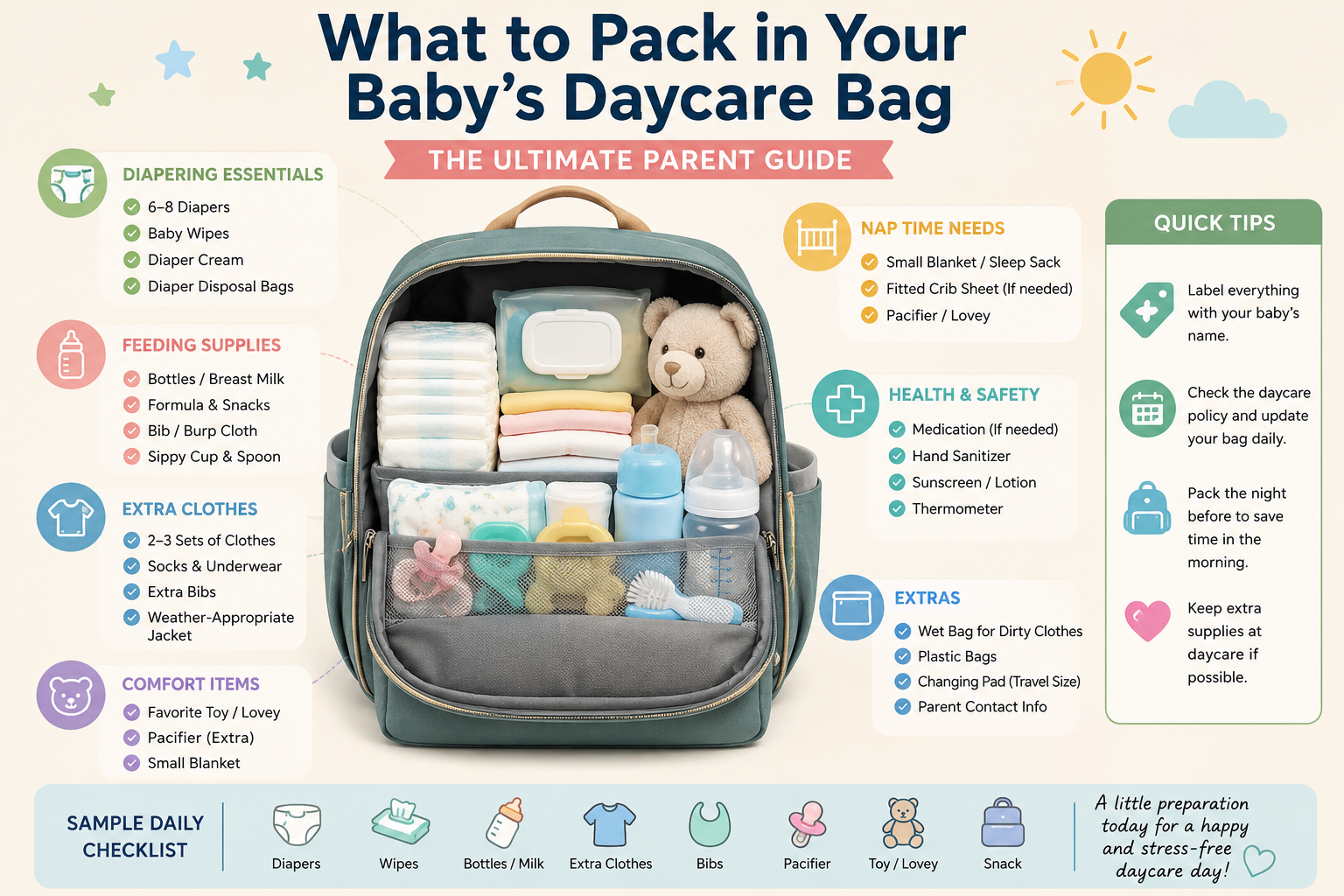
The night before your baby’s first day at daycare, you will probably stand in front of an open bag wondering whether you have packed everything, packed too much, or forgotten the one thing the centre specifically asked for. You will repack it twice. You will then text a friend who has done this before and ask if two changes of clothes is enough or if you need four.
Knowing what to pack in your baby’s daycare bag is one of those things that sounds simple until you are actually doing it. Because it is not just about throwing nappies and a spare vest in a tote bag. It is about sending your child off with everything they need to be fed, changed, comforted, and cared for by people who do not yet know them as well as you do. Getting the bag right is one of the most practical and loving things you can do to set your baby up for a good first week.
This guide covers everything — and we do mean everything — you need to know about what to pack in your baby’s daycare bag. We have included a complete daycare bag checklist broken down by category, age-specific advice for babies at different stages, tips on labelling, organisation, and what to restock each day, common mistakes parents make when packing the daycare bag for the first time, and a section on what not to pack.
Whether your baby is three months old or your toddler is two and a half, this guide will make sure that bag is ready — every single morning.
You might be thinking this is just a bag. Pack some nappies, a bottle, done. But parents who have been through the first week of daycare will tell you that the bag is more important than it looks.
When you know what to pack in your baby’s daycare bag and you pack it thoughtfully, a few things happen. The daycare staff can care for your child smoothly because they have everything they need within easy reach. Your baby has familiar items close by — the bottles they know, the dummy they prefer, the comfort toy that smells like home — which genuinely reduces settling anxiety in a new environment. And you get through your morning without the low-level panic of wondering whether you forgot something important.
A poorly packed daycare bag creates friction in all directions. Staff have to improvise or call you. Your baby may be missing something that matters for their routine. And you spend your morning at work or at home distracted by the nagging feeling that you forgot the nappy cream.
This is not about being the most organised parent in the car park. It is about setting up the day to go well. And a well-packed daycare bag is a huge part of that.
This is the complete daycare bag checklist. Every item in this list has a reason for being here. We will explain each category in detail in the sections that follow — but if you are here for a quick reference, this is your full list.
🔖 Label the bag itself with your child’s full name and a contact number. Bags get left at drop-off all the time, especially in the chaos of the first week. A labelled bag finds its way back.
Nappies are the non-negotiable foundation of what to pack in your baby’s daycare bag. Getting this wrong is one of the most common and most avoidable mistakes on the first day of daycare.
For a full day at daycare — roughly seven to nine hours — pack a minimum of six to eight nappies for babies under six months. Young babies can go through a nappy every one to two hours. For babies between six and twelve months, six nappies for a full day is usually enough. For toddlers over one year who are not yet toilet training, four to six nappies is a reasonable guide.
Always round up, not down. Running out of nappies at daycare means staff have to use emergency supplies or call you — neither is ideal. The cost of an extra nappy or two in the bag is nothing compared to the disruption of being caught short.
If your baby is in the early stages of toilet training, speak to the centre about what they need. Usually this means extra changes of underwear and trousers, a wet bag for soiled items, and clear communication about where your child currently is in the process.
If your baby regularly uses nappy cream or barrier cream, it needs to go in the bag. Daycare centres cannot apply products that are not provided by parents and are not labelled with the child’s name and a signed permission note.
Put the cream in a small sealed pot or the original tube, label it clearly with your baby’s name, and write the word ‘apply at every change’ or ‘apply only if rash present’ on a sticky note attached to it. Some centres have a standard form for this — ask when you do your settling-in visits.
⚠️ Many parents forget nappy cream entirely on the first day, then wonder why their baby comes home with irritated skin. It is one of those small things that has a big impact. Add it to the bag tonight.
Send a full packet of baby wipes or a sealed portion of one. Label the packet with your child’s name. Most centres will have emergency supplies but they should not be relying on shared supplies for your individual child’s changes.
Some centres ask for nappy sacks or small bags so used nappies can be individually wrapped before disposal. Check your centre’s policy and pack accordingly. If they do ask for nappy sacks, a small roll in the side pocket of the bag is easy to keep stocked.
Spare clothes are where most first-time daycare parents underpack. They send one change of clothes thinking ‘how messy can one day be?’ Then they get to pick-up and their baby is wearing an outfit that belongs to the centre because the two spare outfits they packed were both used by eleven in the morning.
When you are thinking about what to pack in your baby’s daycare bag in terms of clothing, the rule is always pack more than feels necessary. Here is why.
For babies under six months: pack three to four full outfit changes. Babies at this age have explosive nappy situations, spit up frequently, and can drench a bib and a vest in a single feed. Three changes gives enough buffer for a full day without the centre running out.
For babies between six and twelve months: two to three full changes. Weaning makes mealtimes spectacularly messy. Food goes on clothes, on bibs, in hair, and somehow on socks. Pack accordingly.
For toddlers over twelve months: two changes of clothes is usually enough unless your child is in the middle of heavy sensory play, toilet training, or has been unwell recently. In any of those cases, go up to three.
Always include a full change — top, bottom, vest, and socks. A change of just the top is rarely enough. When babies and toddlers have a clothing incident at daycare, it is usually thorough.
Pack practical, comfortable clothes that are easy to put on. Avoid anything with too many buttons, complicated fastenings, or very tight necks. Staff are changing multiple children and do not have time for fiddly outfits. Stretchy, simple clothing in the right size is ideal.
Do not send your child’s best or most loved clothes in the daycare bag. The chances of something you adore coming home stained, inside out, or belonging to another child are unfortunately high. Keep beautiful clothes for weekends and family occasions. Send daycare in things that can get properly messy without breaking your heart.
✅ Keep a small permanent set of spare clothes at the daycare in a labelled bag. Many parents do this in addition to the daily spare outfit pack. It means that even if you forget to restock the bag after an extra-messy day, there is always a backup at the centre.
Every single item of clothing that goes to daycare must be labelled with your child’s name. Every sock. Every shoe. Every bib. Every hat. The daycare lost property box fills with unlabelled items extraordinarily quickly. Labelled items find their way back. Unlabelled items disappear.
Use iron-on name labels, stick-on fabric labels, or a laundry marker pen. For very small items like socks, a permanent marker on the sole of each sock is fast and effective. For shoes, write the name on the inside tongue. For hats, write inside the brim. This takes twenty minutes to do for a whole wardrobe and saves enormous frustration over the following months.
Feeding is the most complex part of packing a daycare bag for babies, because the requirements depend heavily on age, feeding method, and what the daycare provides. Get this section right and everything else is manageable.
If your baby is formula fed, you need to send enough milk for every feed during the daycare day, plus one extra feed as a buffer. Most centres prefer pre-prepared formula bottles that are ready to warm. This is safer than sending formula powder and asking staff to prepare feeds, though some centres do accept powder — always check the policy first.
Prepare formula bottles following safe preparation guidelines. Use cooled boiled water and fresh formula powder. Prepared formula should be refrigerated immediately and used within 24 hours. Label every bottle with your baby’s full name, the date it was prepared, and the volume. Do this even if you think it is obvious — in a room full of babies, it is not.
Pack the bottles in an insulated cool bag within your daycare bag if your centre does not have refrigeration for incoming milk. Ask your centre how they store parent-provided formula on arrival.
✅ Make one extra bottle beyond what you calculate your baby needs. If your baby has a growth spurt day, or a particularly long morning, that extra bottle is the difference between a settled baby and a very unhappy one. Extra milk prepared safely and not used just goes back with you at the end of the day.
If you are breastfeeding and expressing milk for daycare, the logistics require a little more planning but are entirely manageable once you have a system.
Store expressed breast milk in sterilised bottles or sealed storage bags. Label every container with your baby’s name, the date it was expressed, and the volume. Breast milk can be kept in the fridge for up to five days. If you are freezing and defrosting, label with the date it was frozen and use within 24 hours of defrosting.
Pack breast milk in an insulated cool bag with ice packs for the journey. Ask your centre how they store and warm breast milk — most quality centres have a clear protocol for this and will handle it with care.
If you are both breastfeeding and formula supplementing, communicate this clearly to the key worker and on any written feeding instructions. Write down which comes first, in what quantities, and under what circumstances formula is offered. Do not assume anything will be remembered from a verbal conversation.
⚠️ Never send unlabelled breast milk or formula bottles to daycare. This is a genuine safety issue. In a busy baby room with multiple children, unlabelled bottles cannot be matched to the right child. Label everything, every time, with no exceptions.
If your baby has started weaning or your toddler eats solid food, the feeding picture changes quite a bit. Most daycare centres provide meals for older babies and toddlers — but what they provide and when varies between settings.
During your settling-in visits, ask your centre exactly what food is provided, at what times, and whether you need to send anything additional. Some centres have full kitchen facilities and provide breakfast, lunch, and afternoon snack. Others provide snacks only and ask parents to send a packed lunch. Most will send a daily sheet telling you what your child ate.
If you are sending food from home, pack it in clearly labelled, sealed containers. Write your child’s name and the date on every container. Include a small spoon if your child is still learning to self-feed. Check whether the centre has any policy on food types — many nurseries are nut-free environments.
If your baby uses a dummy, send at least two in a sealed, labelled container. Dummies get dropped, get mixed up between children, and can take a while to locate in a busy baby room. Two gives staff an easy backup.
Send a spare feeding cup or sippy cup, labelled, if your baby or toddler is transitioning from bottles. If your baby uses a specific teat type they prefer, mention this in your written feeding notes and make sure spare teats are included if the bottle design allows for it.
This section is about the softer side of what to pack in your baby’s daycare bag — the items that are not strictly functional but make an enormous difference to how settled and safe your baby feels during the day.
If your baby or toddler has a comfort object — a soft toy, a piece of blanket, a muslin they have become attached to — it goes in the bag. Every day. Without fail.
Comfort objects carry the smell and feel of home and the primary carer. For a baby in a new environment, surrounded by unfamiliar sounds and faces, a familiar comfort object is a genuine source of reassurance. The key worker can use it to soothe your baby during moments of distress. At nap time, it provides the sensory cues your baby associates with falling asleep. It is one of the most impactful items in the whole daycare bag.
If your child does not yet have a strong attachment to a comfort object, consider introducing one in the weeks before starting daycare. A small soft toy or piece of muslin that you sleep with for a few nights takes on your scent and becomes familiar to your baby. This is a very simple and effective way to help with daycare settling.
🔖 Some parents send a piece of their own worn clothing — a clean but slept-in t-shirt folded into the bag — so their baby has their scent nearby. This is not strange. It is a brilliant and evidence-backed approach to reducing separation anxiety. Many daycare key workers will suggest exactly this.
Most daycare centres have their own safe sleep environment for babies — cots, sleep mats, or rest areas. Check what your centre provides and what they allow parents to bring.
If your baby uses a sleep sack or a particular sleeping bag for naps at home, send it in the bag. Familiar sleep associations — the weight and feel of a known sleeping bag — help babies settle to sleep in unfamiliar places more easily. Label the sleep sack clearly with your baby’s name.
If your baby naps with a particular muslin or lightweight blanket, send it along. Many centres are happy for familiar sleep items from home, but always check the policy. Safe sleep guidelines apply in daycare settings just as they do at home.
This is the category that catches the most first-time daycare parents out. You have thought about nappies and bottles and clothes. Then day three arrives and your baby is teething and you have not sent teething gel and the centre cannot give it without your permission in writing.
Any medication your baby takes regularly — antihistamines, prescribed creams, reflux medication — needs to go to daycare in its original packaging, labelled with your child’s name, with a written note from you giving permission to administer, detailing the dose, and explaining the circumstances under which it should be given.
Most daycare centres have a standard medication consent form. Get a copy during your settling-in visits and fill it in for any medication your baby regularly needs. Keep the form with the medication in a clearly labelled zip-lock bag inside the daycare bag.
For over-the-counter products like teething gel or teething granules, the same rules apply. The centre cannot apply or administer any product without written parental consent and without it being provided by the parent in its original, labelled packaging. Do not send a random tube of cream without a label and expect staff to know what it is or when to use it.
If your baby is attending daycare during spring or summer months, sunscreen is part of what to pack in your baby’s daycare bag. Send it in its original tube or bottle, label it with your child’s name, and include a written note giving permission to apply it before outdoor time.
Some centres ask parents to apply sunscreen at home before drop-off rather than having staff apply it. Ask about your centre’s policy. If you do apply it at home, use a high-factor, broad-spectrum baby sunscreen and reapply it at lunchtime if your child will be outside again in the afternoon.
This is especially important for babies who are not yet verbal. Your written routine sheet tells the key worker everything they need to know about your baby’s typical day — what time they usually nap, how they like to fall asleep, how many ounces they take at each feed, what soothes them when they cry, any known allergies or sensitivities, and anything else that helps staff understand your individual baby.
Write this up before the first day and update it whenever something changes. Keep a copy at the centre and a copy in the daycare bag. This document is genuinely one of the most valuable things in the whole bag because it enables the key worker to care for your baby in a way that feels familiar rather than generic.
The physical bag you choose to send your baby’s things in is part of what to pack in your baby’s daycare bag — not an afterthought. The right bag makes the daycare staff’s job easier and makes the morning routine smoother for you.
The best daycare bag is not the most expensive one or the most beautiful one. It is the one that is easiest to use under real-world conditions. You are looking for a bag that opens fully and clearly so staff can see exactly what is inside without rummaging. Multiple sections or zipped compartments mean feeding items, clothing, and nappies can be kept separate and found quickly. Wipe-clean material is a practical choice because daycare bags get messy.
The bag should be big enough to hold a full day’s supplies without being stuffed so full it is hard to close. It should have a clear, visible spot for your child’s name — either a name tag slot, a label panel, or a place where you have stuck a luggage label.
Many parents use a standard backpack-style bag with interior pockets. Others use a dedicated nappy bag. Either works. The key is that the bag has a consistent system — feeding items always go in the same pocket, clothing changes always go in the same section — so staff can find things without asking.
Use small zip pouches or dry bags to keep categories of items together within the main bag. A small pouch for nappy changing supplies. A small bag for feeding items. A separate bag or roll for spare clothing. These internal pouches can be labelled with simple labels — ‘nappies’, ‘feeding’, ‘clothes’ — so even a member of staff who has not met your child before can find what they need quickly.
The wet bag is a non-negotiable accessory. This is a waterproof zip bag that goes inside the daycare bag and is used to bring soiled clothing home at the end of the day. A wet bag contains smells and mess and keeps the rest of the bag’s contents clean. Send one every day and wash it each night.
The specifics of what to pack in your baby’s daycare bag change quite significantly as your child grows. Here is a quick age-by-age breakdown.
At this age, the daycare bag is almost entirely about nappies and feeding. A baby under six months changes frequently, feeds frequently, and has very simple needs beyond that.
At this age your baby is likely starting to wean, becoming more mobile, and developing clearer preferences. The bag gets slightly more complex.
Toddlers eat more, move more, and get messier. The feeding picture simplifies slightly but the clothing situation often gets more complicated, especially during weaning and early toilet training.
At this age your toddler is eating most things, likely in the middle of or approaching toilet training, and developing strong opinions. The bag becomes simpler in terms of feeding but communication and comfort become more important.
✅ By age two, most children enjoy having a small say in what goes in their bag. Letting them choose which comfort toy comes to daycare today creates a tiny sense of ownership and control that can actually help with morning drop-off resistance.
Equally important to knowing what to pack in your baby’s daycare bag is knowing what to leave out. Some things create problems for staff. Others create safety issues. And some just get lost and cause unnecessary heartbreak.
Most daycare centres ask parents not to send toys from home. The reasons are practical — toys get lost, toys cause arguments between children, and toys distract children from engaging with the resources the centre provides. The exception is a single comfort object for babies and very young toddlers, which most centres actively encourage.
If your child is attached to a particular small toy and you feel they need it for settling, speak to the key worker. Most centres will make a case-by-case exception for a specific comfort item that a child genuinely needs, especially in the first few weeks.
Do not send food from home without checking your centre’s policy first. Most nurseries and daycare centres are nut-free environments because of allergy risks. Many have policies about the types of food that can be brought in — no sweets, no processed snacks, no whole grapes or cherry tomatoes without being halved. Check the policy before you send anything and stick to it.
Daycare is not the place for your baby’s special teddy from the hospital, the beautiful knitted cardigan from their grandparents, or the shoes that cost more than your groceries. These things get stained, get lost, and sometimes just disappear into the daycare universe. Keep precious items at home and send daycare with the practical, everyday stuff.
This is less about specific items and more about a category. Do not send anything to daycare that is not labelled with your child’s name. Nothing. Not the extra hat you tucked in the side pocket. Not the spare dummy in the zip pocket. Not the extra bottle of nappy cream. Everything must be labelled. Everything.
Overpacking is a real thing and it creates problems. A daycare bag that is so stuffed it is hard to open, with items buried under other items and no clear organisation, makes the staff’s job harder. Pack what is needed, keep it organised, and resist the urge to pack every contingency. The centre will manage the day. You do not need to send everything your child owns.
Packing the bag once is the easy part. Keeping it consistently stocked and organised across weeks and months of daycare is where most parents struggle. Here are the habits that actually work.
The single most impactful habit for keeping your baby’s daycare bag right is packing it the night before. Not the morning of. Not halfway through breakfast while your baby is crying and you are trying to find your keys. The night before.
Make it a five-minute routine after your child goes to bed. Check what came back in the bag that day. Restock nappies and wipes. Rinse and prepare bottles. Put in fresh clothes. Check that the comfort object is in there. Zip it up and leave it by the front door. That is it. Five minutes that saves you twenty minutes of panicked searching at seven-thirty in the morning.
Keep a small basket or box near where you pack the daycare bag that contains everything you need to restock it — spare nappies, wipes, a spare comfort object, extra dummies, name labels. This means you never have to search the house for supplies when you are doing your evening pack. Everything is in one place, ready to go.
Once a week — Sunday evening works well for most families — do a more thorough check of the bag. Check that clothes still fit. Check that the written routine sheet is still accurate. Check expiry dates on any medicines or nappy cream. Remove anything that has accumulated at the bottom of the bag that should not be there. This weekly audit keeps the bag genuinely useful rather than gradually turning into a portable rubbish bin.
As mentioned in the clothing section, keeping a small labelled bag of spare supplies at the daycare centre is one of the most underrated daycare bag hacks. It means that even on the days when you forget to restock, there is backup. At the very minimum, keep two spare outfits and a packet of nappies on a shelf in your child’s room at the centre. Ask your key worker if this is possible — most centres are happy to accommodate it.
Labelling comes up throughout this guide on what to pack in your baby’s daycare bag because it really is that important. Let us give it the full attention it deserves.
Everything. Clothes, socks, shoes, hats, mittens, sleep sacks, bags, bottles, cups, dummies, dummy containers, comfort toys, food containers, spoons, bibs, nappy cream tubes, sunscreen bottles, medication containers, the bag itself. Every single item.
✅ Order a batch of personalised name labels before daycare starts — not the week before. Services that produce iron-on and stick-on name labels often have a turnaround time of several days. Order early and label everything in one sitting over a weekend. It takes longer than you expect and you will wish you had done it sooner.
For babies under six months, send eight to ten nappies for a full day. Young babies can go through a nappy every hour to two hours. For babies between six and twelve months, six to eight nappies is a safe number. For toddlers over twelve months who are not yet toilet training, four to six nappies is usually enough for a full day. Always round up — running out of nappies at daycare creates unnecessary disruption. The cost of extra nappies is always worth the peace of mind.
Yes. Label every single item that goes to daycare with your child’s first name and ideally their surname initial. Clothes, socks, shoes, bottles, cups, containers, dummies, comfort toys, bibs, hats, sleep sacks, and the bag itself. Daycare settings care for multiple children simultaneously, and unlabelled items cannot be matched to the right child. The daycare lost property box fills rapidly with unlabelled items that never find their way home. Labelled items almost always do.
Yes, you can absolutely send breast milk to daycare. Store expressed breast milk in sterilised bottles or sealed storage bags. Label every container with your baby’s full name, the date it was expressed, and the volume. Breast milk can be kept in the fridge for up to five days at four degrees Celsius or below. Transport it in an insulated cool bag with ice packs. Your centre should have a clear protocol for storing and warming breast milk — ask about it during your settling-in visits.
For a very young baby, the most effective comfort item is something that carries the smell of their primary carer. A piece of muslin that has been slept with by a parent, a small soft toy that has been held close, or even a clean worn t-shirt folded small enough to tuck into the bag — all of these carry familiar scent cues that are genuinely comforting to babies in a new environment. If your baby already has a strong attachment to a particular object, that is the one to send. If not, introduce something in the weeks before starting daycare so it can build familiarity.
This varies between settings. Most nurseries and daycare centres provide meals for toddlers who eat solid food — usually breakfast, lunch, and an afternoon snack. Some centres ask parents to send a packed lunch or additional snacks. During your settling-in visits, ask your centre exactly what food is provided, at what times, and what — if anything — they ask parents to send. Always check the allergy policy before sending any food from home. Most centres are nut-free environments.
Most daycare centres ask parents not to send toys from home because they can cause conflict between children, get lost, or distract from the centre’s own resources. However, most centres make an exception for a single comfort object — a soft toy or a piece of blanket — for younger children who need it for settling. If your toddler is attached to a particular toy, speak to the key worker rather than just sending it. A conversation about why it helps will usually result in a practical solution that works for everyone.
Your daily routine sheet for the daycare should include feed times and quantities, nap times and how your baby falls asleep, any known allergies or sensitivities, what soothes your baby when upset, any particular preferences or dislikes, names of immediate family members and how to reach them, and any relevant medical information. Keep it concise but specific. Update it whenever something significant changes. This document genuinely helps key workers care for your baby in a way that feels consistent with home, which makes settling much smoother.
The most effective habit for keeping the daycare bag stocked is to pack it the night before, every single night, as a non-negotiable part of your evening routine. After your child goes to bed, check what came back in the bag that day, restock everything that was used, prepare fresh bottles, and leave the bag by the door. Keep a small restock box at home with all your daycare bag supplies so you never have to search. Do a more thorough weekly audit on Sunday evenings to check clothing sizes, update the routine sheet, and check expiry dates on any health products.
If your child attends daycare during spring or summer months and will spend time outdoors, yes, send sunscreen. Use a high-factor, broad-spectrum baby sunscreen in its original packaging, label it with your child’s name, and include a written note giving permission for staff to apply it before outdoor time. Some centres ask parents to apply sunscreen at home before morning drop-off and then provide a top-up themselves. Ask your centre’s policy so you know what is expected from your side.
The best daycare bag is one that opens fully, has multiple clearly organised sections, is made from wipe-clean material, and is easy for both you and daycare staff to navigate quickly. Many parents use a standard backpack with internal pockets, others use a dedicated nappy bag. Either works well as long as the contents are organised consistently — feeding items always in the same pocket, clothes always in the same section — so staff can find what they need without searching. Inside the bag, use small zip pouches or labelled dry bags to separate categories: nappies, feeding, clothing, health items. A wet bag for soiled clothes should always be included.
Getting the daycare bag right is one of those small practical wins that makes the whole experience of starting daycare slightly less overwhelming. It will not stop the drop-off tears — yours or your baby’s. It will not make the first week easy. But it will mean that when you walk away from that daycare door, you know your baby has everything they need to be well cared for through the day.
The complete daycare bag checklist in this guide is built from real experience — the things that genuinely matter, the things that people always forget, and the things that are worth the extra minute of organisation the night before. Use it on day one and then adapt it to what works for your specific child and your specific centre as you settle into the routine. Because that is the thing about knowing what to pack in your baby’s daycare bag — it changes. As your baby grows, as their needs change, as the seasons shift, and as you get to know the daycare routine better, the bag evolves. The nappies get fewer. The comfort toys change. The bottles disappear and the snacks appear. But the principle stays the same: pack thoughtfully, label everything, restock the night before, and trust that a well-packed bag is one small but genuine act of love for the little person you are sending into the world each morning.