Physical Address
304 North Cardinal St.
Dorchester Center, MA 02124
Physical Address
304 North Cardinal St.
Dorchester Center, MA 02124

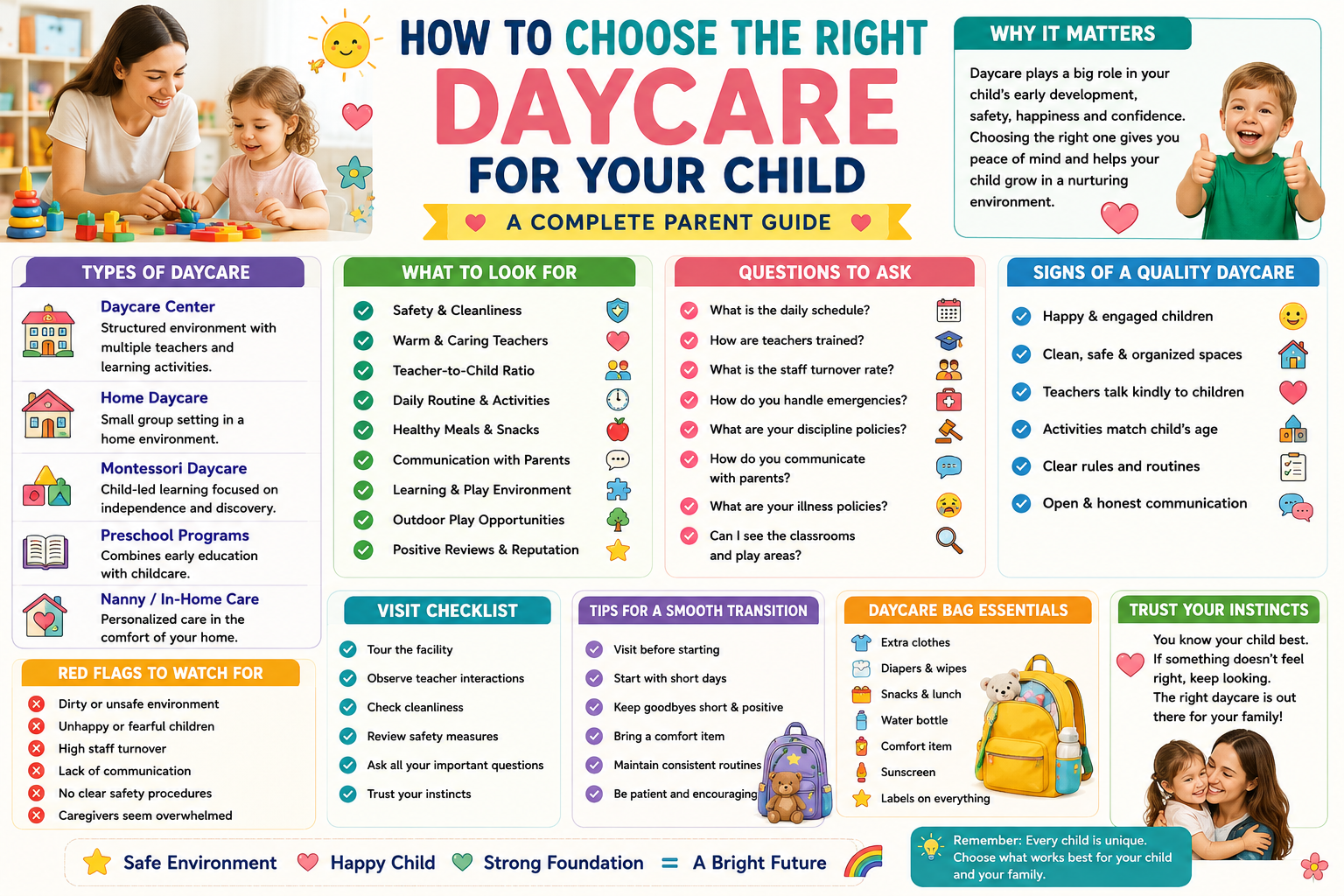
If you are trying to figure out how to choose the right daycare for your child, you are probably already feeling the weight of the decision. This is not like choosing a pushchair or a sleep method. This is choosing the place where your child will spend a significant chunk of their waking hours. The place where they will eat, sleep, play, cry, and grow. The people who will shape some of their earliest experiences of the world outside your home.
No pressure, right?
The truth is that knowing how to choose the right daycare for your child is genuinely one of the most important parenting decisions you will make in the early years. And it is also one of the most confusing. There are so many options, so many opinions, and so many things to consider that many parents end up either paralysed by the choice or rushing into a decision because they are running out of time before going back to work.
This guide is different from most of what you will find online. It does not just give you a generic list of things to look for. It explains why those things matter, what they look like in practice, what the difference is between a daycare that sounds good and one that actually is good, and what the red flags are that many first-time parents miss entirely on a first visit.
By the end of this guide, you will know exactly how to choose the right daycare for your child — not just in theory, but in practice, on the day you walk through that door.
Before we get into the practical how-to, it is worth spending a moment on why this decision matters as much as it does. Because understanding the why will help you make sense of everything that follows.
The first five years of a child’s life are the most significant period of brain development they will ever experience. In those years, more neural connections form than at any other point in a human life. The experiences children have, the relationships they build, and the environments they are in during this period have a direct and measurable impact on their cognitive development, emotional regulation, social skills, and long-term health.
This is not meant to terrify you. It is meant to put the choice of daycare in its proper context. When you are choosing the right daycare for your child, you are choosing an environment that will contribute — genuinely contribute — to who your child becomes. That is worth taking seriously.
The good news is that high-quality daycare does not just avoid harm. It actively supports development. Research consistently shows that children who attend quality early childhood settings show stronger language development, better school readiness, and more positive social behaviour than those who do not. Quality matters enormously — which is why knowing how to identify quality is the heart of this guide.
This might seem obvious, but it is worth saying clearly because many parents approach the choice of daycare assuming that all licensed or registered daycares meet a basic standard that makes them broadly equivalent. This is not true.
While registration and inspection requirements do set a minimum standard, there is an enormous range of quality within that minimum. A daycare that passes its inspection and a daycare that is genuinely excellent are not the same thing. The difference lies in the details — the warmth of the staff, the quality of the interactions with children, the consistency of the routine, the outdoor space, the approach to communication with parents, the way difficult moments are handled. These things do not always show up on an inspection report. But they show up every day in your child’s experience.
Learning how to choose the right daycare for your child means learning to see these details clearly.
To choose the right daycare for your child, you first need to understand what options are available to you. Childcare comes in several different forms and each has distinct characteristics, advantages, and limitations.
A daycare centre or nursery is a purpose-built childcare setting that cares for groups of children, usually from a few months old up to school age. These settings are staffed by multiple carers and typically operate in separate rooms or areas for different age groups.
The advantages of a daycare centre include consistency — if one staff member is off sick, there are others to cover. There is usually a structured daily routine, a range of activities and resources, and a socialisation opportunity for children from a young age. Many daycare centres follow a recognised early years curriculum, which means the care your child receives has an educational dimension.
The potential disadvantages include the larger group sizes compared to home-based care, which can be overwhelming for some children. Staff turnover in daycare centres can also be higher than in other settings, which affects the consistency of relationships for your child.
A childminder is a qualified, registered carer who looks after a small number of children in their own home. The setting is more home-like than a daycare centre, the group is smaller, and the relationship between the childminder and each child is typically closer and more individual.
Childminders can be an excellent option for children who find larger group settings overwhelming, or for families who want a more flexible and personalised arrangement. The main risk with a childminder is continuity — if the childminder is unwell or goes on holiday, you need backup childcare. The quality also varies enormously between individual childminders.
A nanny or au pair provides care in your own home, either on a full-time or part-time basis. This option offers the highest level of individual attention and flexibility but is typically the most expensive form of childcare. Nannies are not usually subject to the same regulatory framework as daycare centres or childminders, so checking qualifications and references is especially important.
There is no universally correct answer to this question. The right childcare option depends on your child’s temperament, your family’s schedule and budget, your values around early childhood, and what is actually available in your area. Many families use a combination of options at different stages.
This guide focuses primarily on how to choose the right daycare for your child in a centre or nursery setting, but many of the principles apply equally to other forms of childcare.
One of the most common mistakes parents make when trying to choose the right daycare for their child is starting to look too late. In many areas — particularly cities — good daycare centres have waiting lists of six months to a year or longer. Some families put their names on waiting lists before their child is even born.
If you are pregnant or have a baby under six months, start researching now. You do not have to make a final decision immediately, but beginning to gather information, visiting settings, and getting onto waiting lists gives you far more options than if you start looking when you have six weeks of maternity leave remaining.
Starting early also gives you time to take the process seriously. Visiting a daycare once in a rush is very different from visiting it twice, at different times of day, with a list of questions and your eyes wide open. The parents who feel most confident in how to choose the right daycare for their child are almost always the ones who gave themselves time to do it properly.
This is the heart of the guide. When you visit a daycare, you are looking for evidence of genuine quality — not just tidy surfaces and friendly words. Here is what really matters.
If you take only one thing from this entire guide on how to choose the right daycare for your child, make it this: the quality of the staff matters more than anything else. More than the facilities. More than the location. More than the curriculum framework on the wall. More than the brightly painted rooms.
Children develop through relationships. The most important thing in any childcare setting is the quality of the interactions between children and the adults caring for them. Warm, responsive, knowledgeable staff who genuinely enjoy being with young children will do more for your child’s development in a modest building with basic resources than indifferent staff in a beautifully equipped centre.
When you visit a daycare, watch the staff carefully. Watch how they talk to the children. Do they get down to the children’s level? Do they make eye contact? Do they respond to what children say and do, or do they manage from a distance? Do they seem genuinely present and engaged, or do they seem distracted and just maintaining order? Do they speak to children warmly, using their names? When a child is upset, how is it handled?
These observations tell you more about the quality of a daycare than any brochure or inspection report ever will.
💡 The single best indicator of a high-quality daycare is staff who look genuinely happy to be there and who talk to children as though they find them fascinating. That warmth is not something you can fake consistently, and children feel it immediately.
Staff ratios tell you how many children each staff member is responsible for at any given time. These ratios are regulated in most countries and vary by age group. In England, for example, the ratio for children under two is 1:3 — one adult for every three children. For two-year-olds it is 1:4, and for children aged three and over it is 1:8 or 1:13 depending on the qualifications of the staff present.
The legal minimums are just that — minimums. When you are choosing the right daycare for your child, look for settings that consistently operate at or better than the minimum. Ask not just what the stated ratio is but what it looks like in practice. A ratio of 1:4 on paper means very little if there are regularly staff absences that push it higher.
Ratios matter most for very young children. A baby who needs feeding, changing, comforting, and stimulating throughout the day simply cannot get the care they need if one adult is responsible for too many babies at once. For babies under one year, a ratio of 1:2 or 1:3 should be the standard you are looking for.
Ask directly about staff qualifications. In a quality daycare, the majority of staff should hold a relevant early years or childcare qualification. At least one person on the premises at all times should hold a paediatric first aid certificate. The setting should have a named safeguarding lead who has completed formal safeguarding training.
Beyond formal qualifications, ask about ongoing training. Quality daycare centres invest in keeping their staff up to date with the latest thinking in early childhood development, safeguarding, special educational needs, and food safety. A setting where the manager cannot tell you what training staff have completed in the last twelve months is a setting that is not investing seriously in the quality of its provision.
This is a question many parents do not think to ask, but it is one of the most revealing things you can find out when you are trying to choose the right daycare for your child. Staff turnover in the childcare sector tends to be higher than average — the work is demanding and historically underpaid. But there is a significant difference between a setting where staff stay for several years and one where faces change constantly.
High staff turnover is harmful to children because young children build trust slowly. They need consistent relationships with familiar adults. When staff change frequently, children have to start the process of building trust over and over again. For very young children, this is especially disruptive.
Ask how long the current staff have been working there. Ask how many staff members left in the last twelve months and why. A manager who answers this question openly and can explain clearly is a manager who understands why it matters.
After the staff, the physical environment of the daycare is the next most important thing to assess. You are looking for a space that is safe, clean, well-organised, and designed specifically with young children in mind.
The rooms should be well lit, ventilated, and at a comfortable temperature. Resources and toys should be stored at child height so children can access them independently, which promotes autonomy and confidence. There should be clearly defined areas for different types of play — a quiet corner for books and puzzles, an active area for physical play, a creative area for art and messy play. The outdoor space should be secure, accessible daily regardless of weather, and large enough for children to run and move freely.
Cleanliness is important but context matters. A daycare that is in the middle of a busy morning and has some paint spills and blocks on the floor is completely normal. A daycare that smells of cleaning chemicals and has nothing out of place during active hours is a different kind of concern — it suggests the environment is being managed for adult comfort rather than children’s use.
⚠️ A suspiciously tidy daycare during session hours is sometimes a sign that children are not given genuine freedom to explore and make a mess. Mess is a normal and healthy part of learning for young children. If everything looks perfect during a visit, ask yourself whether children are actually allowed to play freely.
Ask to see a typical day’s schedule. A good daycare for young children balances structured activities with free play. Both matter. Free play — where children choose what they do and explore at their own pace — is how young children learn best. Structured activities — storytime, music, outdoor play, art — provide enrichment and variety.
Be cautious of daycare centres that are very heavily structured, with children moving through timed activities with little choice or autonomy. This approach is more appropriate for older school-age children and does not match the developmental needs of babies and toddlers. Equally, a setting with no structure at all — where children just roam with no adult engagement or planned activities — is unlikely to offer the stimulation your child needs.
Ask about outdoor play specifically. Daily outdoor time is essential for young children’s physical development, mental health, and sensory experience. A daycare that keeps children indoors because of minor weather concerns is not prioritising your child’s physical wellbeing.
How a daycare communicates with parents tells you a great deal about its values and its relationship with families. Quality daycares see parents as partners, not as customers to be reassured. They share information openly, invite questions, and tell you the difficult things as well as the good ones.
Ask about how daily updates are communicated. Does the centre use an app, daily sheets, verbal handovers, or a combination? How will they contact you if something goes wrong? What is the process if your child is unwell during the day? How are concerns raised and addressed?
Also notice how staff talk to you as a prospective parent during your visit. If they are engaging, informative, and welcoming, that is likely how they engage with current parents. If they are dismissive of questions or give vague answers, that tells you something important.
In countries where daycare settings are inspected by a regulatory body — Ofsted in England, Care Inspectorate in Scotland, NCCA in Ireland, licensing agencies in the USA — inspection reports are publicly available and worth reading carefully.
However, use them as one piece of information, not the only piece. Inspections are snapshots taken on specific days. A good inspection rating reflects a setting that was meeting standards on the day of inspection. It does not necessarily reflect what the setting is like on an ordinary Tuesday morning. Use the inspection report to identify any areas of concern, but always combine it with your own direct observation during a visit.
Visiting a potential daycare is your most powerful tool for choosing the right one for your child. Here is how to make the most of it.
Research the setting before you go. Read the inspection report if one is available. Look at the website and social media, not to be dazzled by the photos but to understand the setting’s stated values and approach. Prepare your questions in advance — write them down so you do not forget anything important in the moment. Try to arrange visits at different times of day if possible. A morning visit shows you drop-off time and morning activity. An afternoon visit shows you post-lunch, which is often when the real character of a setting shows — are tired children well cared for or just managed?
When you walk in, notice your instinctive reaction before you start thinking analytically. Does this place feel warm? Does it feel like somewhere you would be comfortable leaving your child? Your instinct is not infallible, but it is processing a lot of information quickly — smell, noise level, the energy of the room, the faces of the children and staff. It is worth paying attention to.
Then shift into observation mode. Watch the staff-child interactions closely. Watch whether children look happy, engaged, and comfortable. Notice whether children who are upset are quickly comforted or left to manage alone. Ask your prepared questions and notice not just the answers but how the manager or key worker responds — with openness, with defensiveness, with genuine enthusiasm?
Ask to spend time in the room your child would be in, not just the reception area or the meeting room. Any daycare can make its entrance hall look impressive. The room your child will actually be in is what matters.
💡 Bring your child with you to at least one of your visits if possible. Watch how staff interact with your child. Watch how your child responds to the environment. You are not looking for instant happiness — that is unrealistic. You are looking for curiosity, and for staff who notice your child and engage with them naturally.
After every daycare visit, write notes while your memory is fresh. Record your answers to your questions, your gut reactions, anything that stood out positively or negatively. If you are visiting multiple settings — which you should be, ideally at least three — these notes will be invaluable when you sit down to compare them.
It can also be worth calling back with any follow-up questions that occurred to you after the visit. How the setting responds to follow-up questions — whether they are prompt, clear, and helpful — tells you about the communication culture you will be part of as a parent.
Take these questions with you on every visit. The answers will tell you a great deal.
Just as important as knowing what to look for when choosing the right daycare for your child is knowing what to walk away from. These are the red flags that should give you serious pause.
Staff who are on their phones, talking amongst themselves, or managing children from across the room rather than engaging with them — this is the single biggest red flag when choosing the right daycare for your child. It does not matter how beautiful the facilities are. If the staff are not genuinely present with the children, the environment is not serving those children well.
A good daycare has nothing to hide. Staff and managers in quality settings welcome questions and are happy to show you any area of the building. If a manager becomes defensive when you ask about inspection reports, staff qualifications, or daily routines — or if there are parts of the building you are told you cannot see — treat this as a serious warning sign.
⚠️ If anyone tells you that you cannot speak directly with the staff who would care for your child, or discourages you from visiting more than once, walk away. Transparency is a non-negotiable quality in a setting you are trusting with your child’s safety and wellbeing.
If the manager tells you that several staff members have left in the last few months, or if you notice that most staff seem new or unsure, ask directly why. High turnover is often a sign of poor management, a stressful working environment, or low wages — all of which affect the quality of care children receive. Children need consistency, and you cannot have consistency with constantly changing faces.
Daily outdoor play is not a luxury. It is a developmental necessity for young children. A daycare that cannot provide daily outdoor access, or that cites British weather or risk assessments as reasons why children go outside rarely, is not prioritising child wellbeing. Every child needs fresh air, physical activity, and sensory experience outdoors every single day.
Every daycare has challenges. Children cry. There are difficult days. Staff sometimes disagree. Policies need reviewing. A manager who presents only a perfect picture is either not being honest with you or genuinely does not have the self-awareness to know what their setting’s weaknesses are. Neither of these is reassuring. You want a manager who can say ‘this is something we are working on’ as naturally as they say ‘this is what we do really well’.
Safeguarding is the framework that protects children from harm. Every registered childcare setting must have a safeguarding policy and a named safeguarding lead. If a manager gives you a vague answer when you ask about their safeguarding procedures, cannot name their safeguarding lead, or seems to treat the question as overly cautious on your part, take this very seriously. Safeguarding should be the thing a daycare manager can speak about most clearly and confidently of all.
Even the most wonderful daycare in your area is not the right daycare for your child if it costs more than your salary, requires a forty-five minute commute each way, or closes at four o’clock when your work day ends at five-thirty. Practical factors matter when choosing the right daycare for your child and there is no shame in letting them shape your decision.
Daycare is expensive in most countries. In the UK, government-funded free hours are available for eligible children from nine months old, expanding significantly from 2024 onwards. Tax-Free Childcare and childcare vouchers can reduce costs for working parents. In the USA, the Child and Dependent Care Tax Credit can offset some childcare costs.
When comparing costs between settings, look at the full picture — not just the headline hourly or weekly rate. Ask about registration fees, deposit requirements, meal charges, nappy supply costs, and any additional charges for activities or outings. The true cost of childcare often looks different from the advertised rate.
Also ask about the fee structure for days your child does not attend due to illness or holiday. Some settings charge full fees regardless of attendance. Others offer some flexibility. This matters more than parents often realise in the first year, when children frequently get sick.
A daycare that is slightly further away but significantly better quality is generally worth the extra travel time — within reason. A ten or fifteen minute longer journey is manageable. A daycare that adds forty-five minutes to your commute each way is going to grind you down quickly and can affect the quality of your morning drop-off.
Also consider the route. A daycare on the way to work is significantly more convenient than one in the opposite direction. Consider what the journey will look like in winter. Consider car parking if you need it. These practical details have a real impact on daily stress levels, which in turn affects the quality of your drop-off experience.
Make sure the daycare’s hours genuinely align with your working hours, including travel time at both ends. Ask about their late pick-up policy — most settings charge for late collections and some terminate places if late collections become a pattern.
Ask about holiday closure periods. Many daycare centres close for two weeks over Christmas and one week over Easter in addition to bank holidays. If you work full-time, you need to plan how you will cover these periods. Ask early so you are not caught out.
All the research, all the questions, all the checklists — they are tools. But at the end of the process of choosing the right daycare for your child, there is something that no checklist can fully capture, and that is your instinct as a parent.
After visiting a setting, sit with the feeling you are left with. Not the rational analysis — you will do that too — but the feeling. Do you feel reassured? Do you feel like the people there genuinely care about children? Can you picture your specific child being happy there? Does something feel off even if you cannot articulate exactly what it is?
Your instinct is not infallible and it should not override clear factual evidence. But it is not nothing either. Many parents who have later regretted a daycare choice describe having had a vague feeling of unease that they dismissed because everything looked fine on paper. Other parents describe walking into their eventual choice and feeling a specific, quiet certainty that this was the right place.
Give your instinct a seat at the table when you are making this decision. It has access to information your rational mind does not always consciously process.
You have visited your shortlist of settings. You have notes. You have gut feelings. Now you need to actually choose. Here is a straightforward way to work through it.
List your top two or three settings and compare them across the factors that matter most to you. Staff quality, location, cost, hours, outdoor space, communication approach, inspection rating. Do not try to make this a perfectly equal analysis — weight the factors according to what actually matters most for your child and your family. Staff quality should always be at the top.
If you are genuinely torn between two settings, go back for a second visit to each. Go at a different time of day. Try to go on a day when the manager or director you met on your first visit is not specifically expecting you — not to catch anyone out, but to see the setting in a more ordinary moment. This is when you often pick up the information that confirms your decision one way or the other.
Ask the setting whether they are able to connect you with any current parents who are willing to talk with prospective families. Not all settings do this, but many quality ones do. Speaking to a parent who has a child in the setting can give you a perspective that no amount of visiting and questioning can fully replicate. Ask them what they wish they had known before starting. Ask them about any concerns they have. Ask them whether they feel they are treated as partners by the staff.
At some point you have to make the choice. No daycare is perfect. The right daycare for your child is not the one with no weaknesses — it is the one whose strengths match your child’s needs and whose weaknesses are things you can live with and work around. Once you have chosen, commit to the choice. Give the setting a proper chance. The first month of any childcare arrangement is an adjustment for everyone. Reserve your reassessment for after a genuine settling period, unless something specific gives you cause for concern before that point.
Visit at least three daycare settings before making your decision. Visiting only one gives you nothing to compare it to. Visiting two or three — ideally four or five if your schedule allows — gives you a much richer sense of what quality looks like and what different settings offer. The contrast between settings is often what crystallises the decision. After visiting three or more places, most parents find that one setting starts to stand out clearly.
The quality of the staff and the warmth of their interactions with children is the single most important thing to look for when choosing the right daycare for your child. Better than any facility, any inspection rating, or any curriculum framework on the wall is the presence of adults who genuinely love working with young children and who interact with them with warmth, patience, and genuine engagement. Everything else matters, but this matters most.
This depends on your specific situation. A daycare close to work has the advantage of being easy to reach quickly in an emergency and reducing the total journey time on work days. A daycare close to home makes it easier for the rest of your support network — a partner, a grandparent, a childminder — to do drop-offs and pick-ups on days when you cannot. Neither option is universally better. Think through your specific family logistics for both work days and non-work days and make the choice that suits your real-world situation.
A key worker system means that each child in the daycare is assigned a specific named member of staff who has primary responsibility for building a relationship with that child and for knowing their individual needs, preferences, and development. The key worker is the person who gets to know your child best, who notices when something is off, and who is your main point of contact for updates and concerns. A strong key worker system is one of the hallmarks of a quality daycare setting. Ask every setting you visit whether they have a key worker system and how it works in practice.
Signs that your child’s daycare is a good one include your child settling in within a reasonable period and beginning to show comfort and enjoyment there. Staff can tell you specific things about your child’s day — particular moments, things they said, activities they liked — rather than giving vague generic updates. You feel comfortable asking questions and are responded to openly. Your child mentions children’s or staff names at home. The daycare flags developmental observations or concerns proactively rather than waiting for you to raise them. Trust your instincts post-start just as you did before.
An Ofsted Outstanding rating — or its equivalent in other countries — is a strong indicator of quality at the time of inspection. However, it is not a guarantee of current quality. Inspections happen infrequently and settings change over time. Staff may have changed since the last inspection. Management may have changed. Use the inspection report as one important data point, but always combine it with your own direct visits and observations. A Good-rated setting you felt wonderful about during your visit may serve your child better than an Outstanding-rated one that made you uneasy.
Yes. Changing daycare is disruptive and ideally you want to get it right first time. But it is absolutely possible and sometimes necessary. Children are more adaptable than parents often fear. If you have given a setting a genuine chance — at least two to three months — and you remain concerned about the quality of care, or if something specific happens that changes your confidence in the setting, it is entirely reasonable to look at alternatives. Your child’s wellbeing comes first. No deposit or sense of loyalty to a setting should override a genuine concern about the quality of care your child is receiving.
Available financial support for daycare costs varies by country. In England, eligible working parents can access 15 to 30 hours of government-funded childcare per week from nine months of age from September 2024. Tax-Free Childcare allows working parents to receive a government top-up on childcare costs. In Scotland, all children are entitled to 1,140 hours of funded early learning per year from age three. In the USA, the Child and Dependent Care Tax Credit and various state subsidy programmes are available. Always check what you are entitled to — many parents underclaim.
There is no single right age to start daycare. Children can settle successfully from a few months old right through to three or four years. The most important factor is the quality of the setting and the quality of the key worker relationship, not the child’s age at starting. That said, many parents find that children who start between twelve and eighteen months settle relatively well because they are mobile, social, and developing language rapidly. Babies under six months can also settle beautifully with the right key worker and a small group ratio. Trust your knowledge of your own child above any general advice.
Choosing the right daycare for your child does a significant part of the emotional preparation work. When you genuinely trust the place and the people you have chosen, the first day is still hard — but it is manageable hard rather than terrifying hard. Beyond that, allow yourself to feel whatever you feel. Grief, guilt, relief — all of these are normal. Connect with other parents who have been through it. Keep yourself busy during the day. Ask the daycare for a quick update call or a photo in the morning. And know that most children settle far faster than their parents do. By the time you have made it back to your car in tears, there is a very good chance your child has already found the sandpit.
There is no perfect daycare. There is no checklist that removes all uncertainty or guarantees the right outcome. But there is a process — a thoughtful, eyes-open, gut-trusting process — that gives you the best possible chance of making a good choice for your specific child.
Start early. Visit more than one setting. Watch the staff. Ask the hard questions. Trust the discomfort you feel as much as the confidence. And when you find a place where you can imagine your child being genuinely happy, cared for, and known — where the staff speak to children with warmth and notice you as a partner in your child’s care — that is probably your answer.
Knowing how to choose the right daycare for your child does not make the process effortless. But it makes it something you can approach with clarity rather than anxiety. And your child will feel the difference between a parent who is anxious about the choice they made and a parent who is quietly, genuinely confident in it. Take the time. Do the visits. Ask the questions. And then trust yourself to know.