You have cooked the meal. Everyone is seated. The food is on the table. And then — silence. Or phones. Or the low hum of the television from the next room. Sound familiar?
You are not alone. One of the most common things parents say is that they want dinner to feel like a real family moment but it somehow ends up feeling like five people eating in the same room. The kids are quiet, the adults are tired, and before anyone has had their second mouthful the whole thing has become a logistical exercise rather than a genuine connection.
Family dinner conversation starters for kids are one of the simplest and most effective tools for changing that. Not because conversations need to be engineered or forced — but because sometimes, especially with children, the right question is all it takes to unlock a thirty-minute conversation that nobody wanted to end.
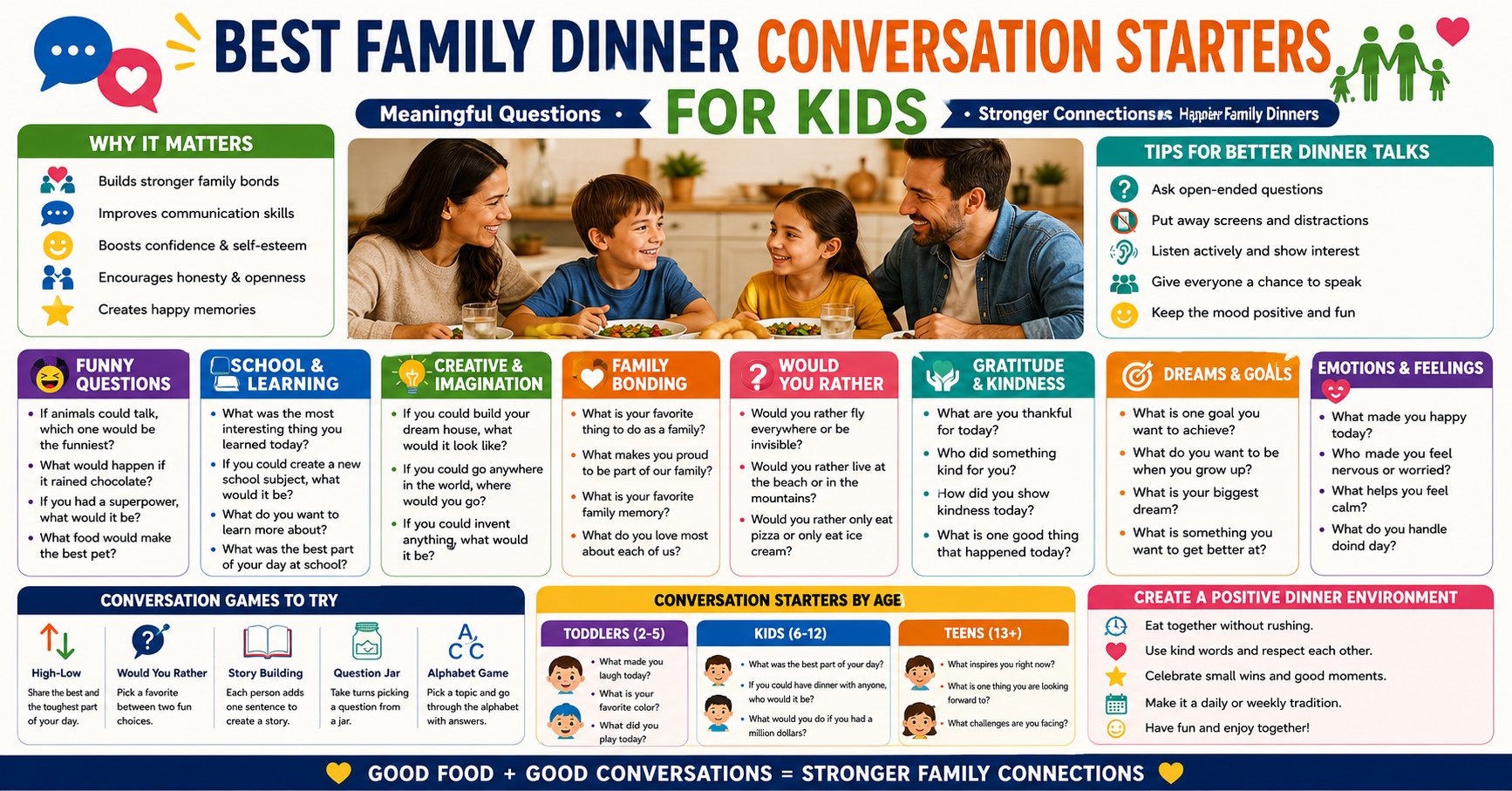
This guide gives you more than 100 family dinner conversation starters for kids, organised by age, theme, and mood. It also covers the research behind why family meals matter, how to make conversation feel natural rather than interrogative, and practical ways to build talking at dinner into your family’s regular routine.
Whether your children are three or thirteen, whether your family is quiet by nature or loud and chaotic, there are ideas here that will work for you.
Table of Contents
Why Family Dinner Conversation Starters for Kids Actually Matter
Before we get into the questions themselves, it is worth understanding why family mealtime conversation is so well-researched and so consistently positive in its effects. Because this is not just a nice idea — the evidence for family meals is genuinely strong.
The Harvard Research
Harvard University researchers, particularly through the Family Dinner Project, have spent years studying the impact of shared family meals. Their findings are striking. Children who eat regular family dinners — and crucially, who have real conversations during those meals — show significantly better outcomes across multiple areas including academic performance, emotional wellbeing, communication skills, and resilience. The family dinner table is, according to this research, one of the most powerful classrooms in a child’s life.
Language Development
For young children especially, the dinner table is an extraordinary language environment. A study published in the New Directives for Child Development journal found that family mealtimes exposed children to more rare and complex vocabulary than reading aloud or any other home activity. When parents and children talk at the dinner table — about their days, about ideas, about silly hypothetical scenarios — children are absorbing language patterns, argumentation structures, storytelling techniques, and new words at a remarkable rate.
Family dinner conversation starters for kids do not just make dinner more fun. For young children, they are actively building vocabulary and communication skills.
Emotional Intelligence and Resilience
Children who are regularly asked how they feel, what they think, and what matters to them develop stronger emotional intelligence. They get better at identifying and naming their own emotions. They get better at understanding other people’s perspectives. They learn that their thoughts and feelings are worth sharing — which builds confidence and self-worth.
The dinner table is one of the few environments in modern family life where this kind of reflective, emotionally oriented conversation can happen naturally, repeatedly, and without an agenda. It is a gift that many families give their children without fully realising what they are doing.
Mental Health
Research from the National Center on Addiction and Substance Abuse at Columbia University found that teenagers who ate dinner with their families five or more times per week were significantly less likely to use drugs, alcohol, or cigarettes. They also showed lower rates of depression and were more likely to report high academic motivation. Correlation, yes — but the consistency of the finding across multiple studies over many years is hard to dismiss.
Family dinner conversation starters for kids are not a magic solution to every challenge a family faces. But they are a genuine and meaningful contribution to the conditions in which children thrive.
Family Identity and Belonging
When families tell stories at the dinner table — family history, funny memories, things that went wrong and became legend — children develop a strong sense of family identity. They understand where they come from. They feel they belong to something larger than themselves. Psychologist Marshall Duke of Emory University found that children with a strong knowledge of their family history — gained largely through dinner table storytelling — showed greater resilience in the face of hardship. The family dinner table is where that identity is built, one conversation at a time.
Family Dinner Conversation Starters for Toddlers and Pre-Schoolers (Ages 2–5)
Young children are not great at open-ended questions. Ask a three-year-old how their day was and you will usually get a shrug or a one-word answer. But ask them a question with a silly premise, a colour in it, or a favourite character and they will talk until bedtime.
The key for this age group is keeping questions simple, imaginative, and fun. Here are some of the best family dinner conversation starters for young kids:
💬 If you could have any animal as a pet — even a dinosaur — what would you choose and what would you name it?
💬 What is your absolute favourite food in the whole world? What is the yuckiest?
💬 If you could fly like a bird, where would you go first?
💬 What made you laugh today?
💬 If you had a magic wand, what would you change about tomorrow?
💬 What colour do you think love is? What about happiness?
💬 If you could be any animal for a day, what would you be and why?
💬 What is the funniest thing that happened at nursery or school today?
💬 If we had a family superpower, what do you think it should be?
💬 What is your favourite thing about our family?
A few tips for this age group specifically: follow their lead once they start talking. The question is just a door — once they walk through it, let them take the conversation wherever they want. Do not correct or redirect too quickly. Young children who feel that their answers are genuinely listened to will talk more, not less.
Family Dinner Conversation Starters for Primary School Children (Ages 6–11)
Children in this age group are developing opinions, working things out, and starting to form a real sense of identity. They enjoy being taken seriously, love slightly absurd hypothetical questions, and respond well to questions that give them a chance to demonstrate knowledge or express preference.
The best family dinner conversation starters for this age group mix fun with substance — questions that are playful enough to engage them but meaningful enough to lead somewhere real.
Fun and Imaginative Questions
💬 If you could only eat one food for the rest of your life, what would it be? What would you miss most?
💬 If you could swap lives with any person — real or fictional — for one day, who would you choose and why?
💬 You have just discovered a new island. What do you name it? What rules does it have?
💬 If animals could talk, which one do you think would have the most interesting things to say?
💬 What superpower would make your life the most different? Not the coolest — the most different.
💬 If you could invent something that would help people, what would it be?
Reflective and Emotional Questions
💬 What is something you are proud of that nobody really knows about?
💬 What is one thing you wish was different about school?
💬 What is the nicest thing a friend has done for you recently?
💬 What do you think makes a really good friend?
💬 When do you feel most like yourself?
💬 What is something you have been thinking about a lot lately?
World and Values Questions
💬 If you could change one thing about the world, what would it be?
💬 What do you think is the most important job in the world and why?
💬 Is it ever okay to break a rule? If so, when?
💬 What does fairness mean to you? Can you give an example of something that feels unfair?
With children in this age group, the dinner table conversation can go in unexpectedly deep directions if you allow it. Do not shut down big questions or complicated feelings. Some of the most important conversations parents and children have happen over half-finished plates at dinner, because the casual setting makes it feel safe to say things that might feel too big in a more formal context.
Family Dinner Conversation Starters for Teenagers (Ages 12–17)
Teenagers are a different challenge. The direct approach — asking them about their day — often produces the minimum possible response. But teenagers are not uninterested in conversation. They are deeply interested in ideas, in fairness, in how the world works, in what adults really think. They just do not want to be interrogated.
The best family dinner conversation starters for teenagers are ones that feel like genuine questions — questions the parent is also curious about, questions that do not have a right answer, questions that treat teenagers as equals in the conversation rather than subjects of it.
Opinion and Debate Starters
💬 If you could change one law — any law — what would it be and why?
💬 Do you think social media does more good or more harm overall? What makes you say that?
💬 Is it possible to be truly good friends with someone who has completely different values to you?
💬 If you had to live without your phone or without the internet — which would you choose?
💬 Do you think school actually prepares you for adult life? What do you wish it taught instead?
💬 What do you think is the biggest challenge your generation will have to deal with?
Identity and Future Questions
💬 If you could be known for one thing in your lifetime, what would you want that to be?
💬 What is something you have changed your mind about in the last year?
💬 What does success actually look like to you? Not what other people say — what does it feel like to you?
💬 Is there something you believe that most people around you disagree with?
💬 What is one thing about yourself that you think most people misunderstand?
Lighter Conversation Starters for Teens
💬 If you could only watch one TV show or film for the rest of the year, what would you choose?
💬 What is the most underrated thing — food, place, activity — that you think more people should know about?
💬 If you could have dinner with any three people from history, who would you choose?
💬 What is the best piece of advice you have ever been given?
A note on using conversation starters with teenagers: the worst thing you can do is pull out a list of questions and work through them mechanically. The best approach is to drop one question casually into the conversation, contribute your own genuine answer first, and then invite theirs. When parents share real opinions and real stories — not just ask questions — teenagers respond with far more openness than most parents expect.
Themed Family Dinner Conversation Starters for Kids
Themed question sets are a great way to create a weekly dinner ritual. Choose a theme for each night — Gratitude Monday, Would You Rather Wednesday, Storytelling Sunday — and make it part of the family routine. Here are themed family dinner conversation starters for kids that work across different age groups.
Gratitude Conversation Starters
Gratitude-focused dinner questions have a measurable positive effect on wellbeing. Research consistently shows that people who regularly reflect on what they are grateful for report higher levels of happiness and lower levels of anxiety. Starting this habit at the family dinner table builds it into children’s daily thinking.
💬 What is one thing that happened today that you are glad happened?
💬 Who is someone in your life you do not say thank you to enough?
💬 What is something about our home or family that you are grateful for?
💬 What is one small thing that always makes your day a little better?
💬 Name three things from this week that made you smile.
Would You Rather Conversation Starters
Would You Rather questions are gold for families with children of mixed ages. Everyone can participate, there are no wrong answers, and they reliably produce laughter and follow-up questions. These are some of the best family dinner conversation starters for kids who are reluctant talkers.
💬 Would you rather be able to speak every language in the world or play every musical instrument?
💬 Would you rather always know when someone is lying to you, or be able to make anyone like you?
💬 Would you rather go back in time or travel to the future? Where and when?
💬 Would you rather have a personal chef who cooked anything you wanted, or a personal trainer who made you incredibly fit?
💬 Would you rather explore the deep ocean or outer space?
💬 Would you rather be famous for something you are proud of, or anonymous while doing the most good?
Storytelling Conversation Starters
Storytelling at dinner builds memory, narrative skill, and family identity. These prompts get everyone contributing to a story — either their own or a shared family one.
💬 Tell us about a time when something went really wrong and it turned out okay in the end.
💬 What is the earliest memory you have? Describe it in as much detail as you can.
💬 If our family had a theme song, what would it be and why?
💬 What is the funniest family story you know? The one you could tell a hundred times?
💬 Tell us about a time you were really brave — even if nobody noticed.
Dream and Ambition Starters
These questions open up a different kind of conversation — about hope, aspiration, and the future. They work across age groups and give children a chance to dream out loud in a safe, supported environment.
💬 If you could be any job in the world — with no limits — what would you be?
💬 Where is one place in the world you really want to go before you grow up?
💬 What is something you want to learn how to do that you have not started yet?
💬 If you could design your perfect day — from waking up to going to sleep — what would it look like?
💬 What do you want people to say about you when you are old?
How to Make Family Dinner Conversation Starters a Real Habit
Having a hundred great questions is only useful if you actually use them. Here is how to make family dinner conversation starters for kids a consistent part of your mealtime rather than something you try once and forget.
Create a Question Jar or Card Deck
Print or write your favourite questions on individual cards or slips of paper and keep them in a jar on the dinner table. Each night, one person draws a question. This creates a simple ritual that children often start to look forward to and even remind parents about. The physical act of drawing a question makes it feel like a game rather than an exercise, which dramatically improves buy-in from reluctant participants.
Let Kids Write the Questions
Give children a blank notepad and ask them to write five dinner questions for the week. This builds ownership — they are much more invested in a conversation that starts with their own question. It also tells you a lot about what is on their minds. The questions children choose to ask are sometimes the most revealing conversations starters of all.
Start With Yourself
The most effective thing a parent can do to encourage dinner table conversation is to answer the question first — and answer it genuinely. Not a safe, predictable answer but a real one. When children see adults being vulnerable, funny, thoughtful, or surprising in their answers, they are far more likely to engage fully themselves. Model the conversation you want to have.
No Devices, No Exceptions
Every piece of research on family mealtime conversation points to the same finding: screens at the table reduce conversation quality and quantity significantly. This applies to parents as much as children. The most important rule for making family dinner conversation starters for kids work is that everyone’s phone is elsewhere during the meal. Make it a family agreement, not just a rule for children.
Keep It Light on Bad Days
Some evenings everyone is tired, someone has had a hard day, and a heavy conversation question is the wrong move. Keep some very light, silly questions in reserve for these evenings. The goal is not depth every night — it is connection. Even a five-minute laugh about a Would You Rather question on a tough Tuesday is a worthwhile moment. Consistency matters more than intensity.
Follow the Energy
When a question leads somewhere genuinely interesting — when someone says something that opens a door — let the original question go and follow the conversation where it wants to go. The best dinner table conversations are not the ones that followed the planned question. They are the ones that started from a question and ended somewhere nobody expected. That is the real prize.
Dinner Table Games That Spark Conversation for Kids
Sometimes a question alone is not enough to get things going. These simple dinner table games weave family dinner conversation starters for kids into a fun structure that gets everyone participating without it feeling forced.
Two Truths and a Lie
Each person shares three statements about themselves — two true and one false. Everyone else has to guess which is the lie. This game is fantastic because it naturally generates further questions and stories as people explain the truths behind their statements. It works from about age six upwards and is genuinely engaging for teenagers and adults.
Rose and Thorn
A classic and beautifully simple dinner ritual. Each person shares one ‘rose’ — something good from their day — and one ‘thorn’ — something difficult or frustrating. Some families add a ‘bud’ — something they are looking forward to. It takes less than five minutes and gives every family member a chance to be heard. It also gives parents a daily window into their children’s emotional lives that they would not otherwise have.
The Alphabet Game
Choose a category — animals, foods, places, famous people — and work around the table in alphabetical order. Each person names something in the category that starts with the next letter. This game keeps young children engaged because it requires thinking and everyone participates equally. It can also lead to funny tangents and conversations that feel entirely natural because they emerge from the game.
Story Consequences
One person starts a story with one sentence. The next person adds a sentence. Continue around the table. The story becomes increasingly chaotic and funny as each person takes it in an unexpected direction. This game is one of the best dinner table activities for families with young children because there are no rules to understand — you just make up the next bit. It also builds listening skills and collaborative creativity.
The Question Challenge
One person asks a dinner conversation question and everyone has to answer — including the adults. The catch is that the person who asked the question must answer last. This makes the question-asker think carefully about what they ask, because they know they will have to answer it too. It levels the playing field between parents and children in a way that children find deeply satisfying.
Family Dinner Conversation Starters for Kids on Special Occasions
Special occasions — birthdays, holidays, Sunday dinners with grandparents, New Year’s Eve meals — are natural moments for deeper and more memorable family dinner conversations. Here are some starters specifically designed for these moments.
Birthday Dinner Conversation Starters
💬 What is the best birthday memory you have — yours or someone else’s in the family?
💬 What is one thing you have learned in the past year that you did not know before?
💬 What do you hope the next year brings for our family?
Holiday and Christmas Dinner Conversation Starters
💬 What is one family tradition that you really hope we keep forever?
💬 What is the most memorable holiday meal we have ever had together?
💬 If you could add one new family tradition, what would it be?
New Year Dinner Conversation Starters
💬 What is one thing from this year that you are genuinely proud of?
💬 What is one thing you want to do differently next year?
💬 What is one word you would use to describe this year as a family?
Sunday Family Dinner Conversation Starters
💬 What is one thing about this week that surprised you?
💬 What is one thing you are looking forward to in the week ahead?
💬 If you could do one thing from last week again, what would it be?
Frequently Asked Questions
What are the best family dinner conversation starters for kids of different ages?
The best approach is to tailor conversation starters to the developmental stage of each child. For toddlers and pre-schoolers, use imaginative and sensory questions — animals, colours, favourite foods, and silly scenarios. For primary school children, mix fun hypothetical questions with more reflective prompts about friendship, fairness, and their inner lives. For teenagers, go for opinion and debate-style questions that treat them as equals. If you have a mixed-age family, themed rounds — such as gratitude questions or Would You Rather — work well because everyone can answer at their own level.
How do I get reluctant kids to talk at dinner?
The single most effective thing you can do is answer the question yourself first — and answer it with genuine thought and even a little vulnerability. Children who see their parents being real and interested are far more likely to open up. Also, avoid yes or no questions and questions with a right answer. Questions that start with ‘Would you rather…’ or ‘If you could…’ are brilliant for reluctant talkers because there is no pressure to give the correct response. Keep it playful, follow their energy, and never make talking at dinner feel like a test.
How often should families use conversation starters at dinner?
There is no magic number, but research suggests that even three or four family meals with real conversation per week makes a measurable difference to children’s emotional and academic outcomes. You do not need to use a formal conversation starter every night. The goal is to make talk at dinner normal and expected, not scripted. A question jar that kids can draw from whenever they feel like it is more sustainable than a rigid nightly ritual.
Are conversation starters at dinner helpful for teenagers?
Yes, when used correctly. The key with teenagers is not to make the questions feel like an interrogation or a parent-led exercise. The best approach is to drop a question into conversation casually, answer it yourself with genuine honesty, and then invite their view — not require it. Questions that have no right answer and that acknowledge teenagers’ perspectives as worth taking seriously are most effective. Topics around social media, fairness, identity, and the future tend to engage teenagers more than questions about school or their immediate day.
Can family dinner conversations actually improve children’s mental health?
The research strongly suggests yes. Regular family meals with real conversation are associated with lower rates of anxiety, depression, and substance use in children and teenagers. The mechanism is partly about belonging — children who feel genuinely listened to and valued at the family table have higher self-esteem and stronger resilience. It is also about emotional vocabulary — children who regularly discuss feelings and experiences in a safe environment get better at understanding and managing their own emotions over time.
What should I do when the dinner table conversation goes quiet?
Silence at the dinner table is not a failure — it is just a pause. Resist the urge to fill every moment with talk. Some of the best family moments happen in comfortable silence. If you want to restart a conversation, try a completely different type of question from what you just asked. If you have been asking reflective questions and got minimal response, switch to something absurd and imaginative. If a serious topic has gone heavy, lighten it with a Would You Rather. Having a variety of question types available gives you flexibility to match the room.
How do I make family dinner conversations feel natural rather than forced?
The most important thing is to be genuinely curious rather than performing curiosity. If you ask a question because you actually want to know the answer, children can tell. If you ask it because you feel you should have a conversation, children can tell that too. Share your own stories and opinions freely. Let conversations wander. Let people talk over each other a little. Let someone tell a story that goes on too long. Natural conversation is messy and warm and tangential. The best family dinner conversation starters for kids are ones that disappear once the conversation starts.
Are there conversation starters specifically for single-parent families?
Absolutely. The research on family meal conversation applies to all family structures — single-parent families, multigenerational households, blended families, and everything else. If it is just you and one child at dinner, the conversation can actually go deeper because there is no sibling competition for attention. One-on-one dinner conversations between a parent and child are some of the most powerful bonding opportunities available, and the question starters in this guide work perfectly in that context.
What is the Rose and Thorn method for family dinners?
Rose and Thorn is a simple dinner ritual where each family member shares one positive thing from their day — the rose — and one challenge or frustration — the thorn. Some families add a third element, a bud, which is something they are looking forward to. It is one of the most widely recommended family dinner conversation starters because it is quick, easy for all ages, and gives every family member a daily opportunity to share both joy and difficulty. Over time, it creates a culture in which children feel safe talking about hard things as well as good ones.
Can I use conversation starters at other family meals besides dinner?
Of course. Breakfast, weekend brunch, and even snack time can all benefit from conversation starters. Breakfast works particularly well for lighter, forward-looking questions — what are you looking forward to today, what do you hope happens. Dinner tends to suit reflective and imaginative questions because the day is done and there is more time. The important thing is not the meal — it is the moment of shared attention. Any meal where devices are away and everyone is present together is a potential family conversation.
At ParentNest, our mission is to provide parents with reliable, practical, and easy-to-understand information about parenting, baby safety, and child development.