Physical Address
304 North Cardinal St.
Dorchester Center, MA 02124
Physical Address
304 North Cardinal St.
Dorchester Center, MA 02124

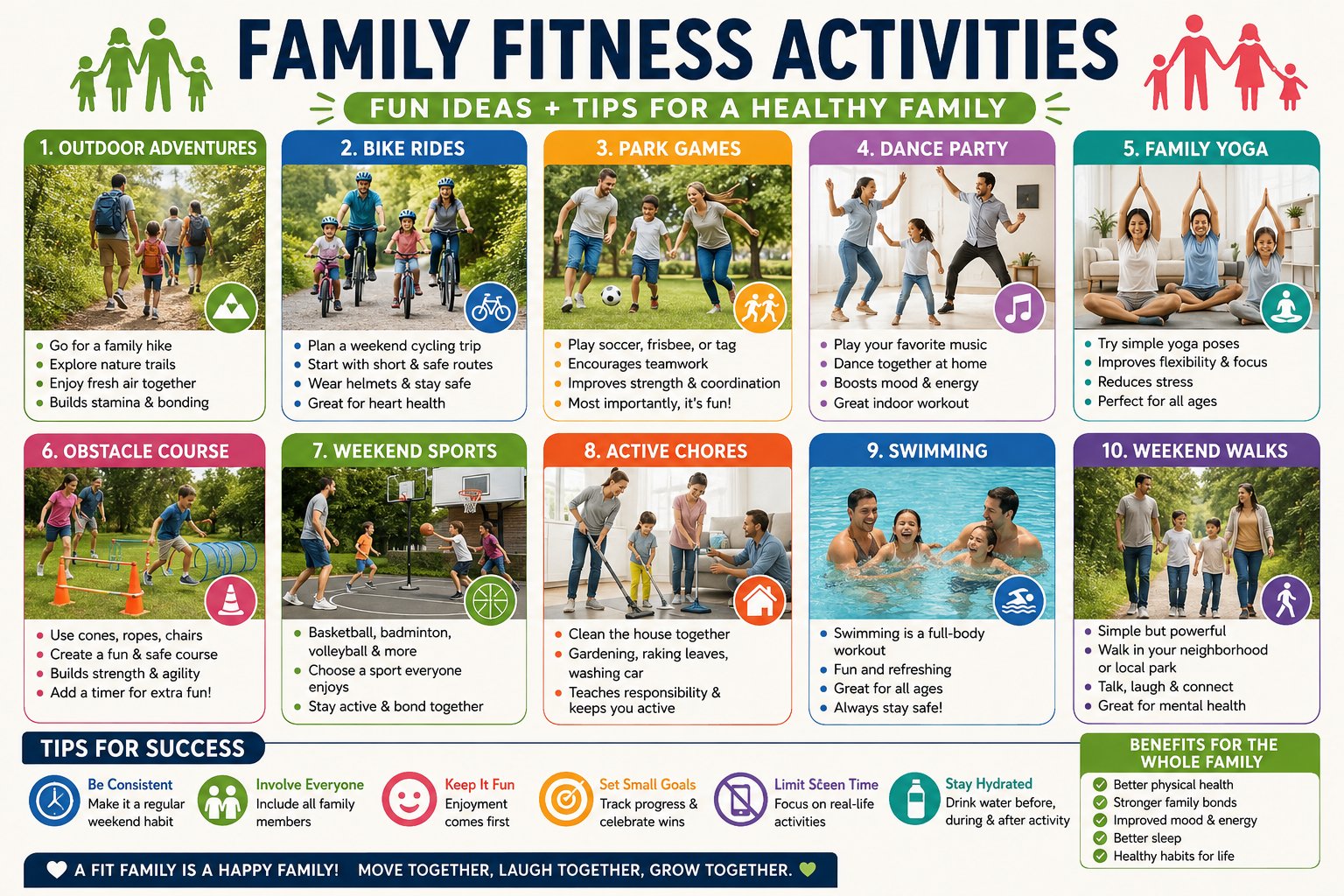
Weekends are golden. They are the two days in the week when the alarm does not go off at six, the school run does not happen, and the whole family is actually in the same place at the same time.
So what do most families do with that time? If we are being honest, a lot of it gets swallowed by screens, errands, and just trying to catch up on rest after a packed week. That is completely understandable. But here is the thing — some of the most powerful memories a family can build happen during shared active experiences. And the weekend is the perfect window for exactly that.
The best family fitness activities for the weekend are not about signing the kids up for classes or turning Saturday into a gruelling training session. They are about finding ways to move together that feel so enjoyable, nobody even notices they are getting exercise.
This guide covers more than 35 family fitness activities organised by type, age group, and setting. Whether you have a garden, live near countryside, are based in a city, or are stuck inside because of the weather, you will find ideas here that actually work for real families with real kids of different ages and energy levels.
Let’s get into it.
Before we get into the activities themselves, it is worth spending a moment on the why. Because when you understand what shared fitness actually does for a family — beyond just burning calories — it becomes a lot easier to prioritise it.
Children need at least 60 minutes of moderate to vigorous physical activity every day, according to the World Health Organization. Yet studies consistently show that most children in developed countries fall short of this. Weekdays are packed — school, homework, meals, bedtime. The weekend is often when families have the best chance of filling that gap.
Adults need at least 150 minutes of moderate activity per week. If you have two active weekend days, you can hit a large chunk of that target through family activities that do not feel like exercise at all — hiking, swimming, playing in the garden, cycling.
Physical activity is one of the most well-evidenced treatments for anxiety and low mood in both children and adults. Exercise releases endorphins, reduces cortisol, improves sleep, and builds self-esteem. Doing it as a family multiplies the benefit because you also get the emotional warmth of shared experience, laughter, and connection.
Research from the University of Michigan found that children who participated in regular physical activity with their parents showed higher levels of self-confidence, better peer relationships, and lower rates of anxiety compared to children who exercised alone or not at all. That is a compelling reason to make family fitness activities for the weekend a regular priority.
Family meals get a lot of attention in the parenting research literature. But shared physical activity also builds family bonds in a unique way. You face challenges together, you celebrate each other’s effort, you see each other outside of the usual parent-child roles. A parent who cheers their child up a steep hill or gets beaten in a sprint by a ten-year-old is a parent their child will remember fondly. These moments matter.
Children who grow up in active families are significantly more likely to be active adults. The habits and attitudes toward physical activity that form in childhood tend to last. When a child associates weekend time with movement, adventure, and fun — rather than passivity — that association shapes their lifestyle for decades. The best family fitness activities for the weekend are not just good for this Saturday. They are an investment in the next thirty years.
Let’s start with the great outdoors, because outdoor activity combines physical benefit with fresh air, nature exposure, and the kind of open space that children genuinely thrive in. These are some of the most popular and effective outdoor family fitness activities for the weekend.
Hiking is one of the best all-round family fitness activities you can do. It works the legs, the cardiovascular system, and the core — and it does all of this while you are walking through beautiful scenery with your family. There is no specialist equipment needed beyond good footwear, and the difficulty can be scaled to any age group by choosing appropriate trails.
For younger children, keep hikes short — two to three kilometres — with interesting features along the way: a stream to cross, a hill to climb, a viewpoint to reach. For older children and teenagers, longer routes with more elevation and more reward at the top are ideal. Build in picnic breaks and give kids a trail map to follow. When children feel like navigators rather than passengers, their enthusiasm for hiking goes up dramatically.
Pack a simple scavenger hunt list — a bird feather, a round stone, a yellow flower, a spider’s web — and the walk becomes a game. Geocaching apps turn hiking trails into treasure hunts. These small additions transform a walk from something children tolerate into something they request.
Cycling is another of the best family fitness activities for the weekend because it covers ground quickly, involves variety, and is genuinely enjoyable for children from about age four onwards. Most areas have cycling trails that are suitable for families — away from traffic, relatively flat, and interesting enough to hold children’s attention.
If children are too young to ride confidently, balance bikes, tag-along bikes, or child seats on adult bikes are all options that allow even very young children to participate. For older kids, the challenge of a longer route or some gentle hills gives them something to work toward.
Set a destination that serves as motivation: a café for a hot chocolate, a playground halfway along the route, a lake where you stop to eat lunch. The destination gives the ride a purpose beyond exercise, which makes children far more willing to participate.
Swimming is one of the best full-body workouts available, and outdoor swimming adds a sense of adventure and novelty that a pool simply cannot match. Lakes, rivers with safe swimming spots, outdoor lidos, and beach swimming are all options depending on where you live.
Children are almost universally enthusiastic about water, which makes outdoor swimming one of those rare family fitness activities where you do not need to persuade anyone to participate. Safety is important — always check current conditions, swim in designated areas, and ensure all children are supervised — but within those parameters, wild swimming is an extraordinary family experience.
Even just paddling, exploring rock pools, and playing in shallow water counts as physical activity. The important thing is the movement, the fresh air, and the shared experience.
Parkrun events happen every Saturday morning in parks across the UK, Ireland, Australia, and increasingly around the world. They are free, untimed in the sense that there is no pressure, family-friendly, and enormously welcoming to all abilities. Children as young as four can participate in junior parkrun events. Adults can walk, jog, or run — whatever their current fitness level allows.
The communal atmosphere of a parkrun is one of its greatest strengths. Children see adults of all ages and body types moving together and having a good time. That normalises physical activity in a powerful way. Many families who start parkrun together continue going for years, and it becomes a cherished weekend ritual.
For younger children especially, scooters are an incredibly effective and enjoyable form of physical activity. Scooting works the legs, the core, and coordination — and most children will do it for hours without any prompting whatsoever. Find a smooth path, a safe car park, or a skate park and let them go.
Older children and teenagers who are interested in skateboarding are engaging in an activity that requires significant balance, coordination, and core strength. It is also enormously motivating because there is always a new trick to learn, a new obstacle to navigate, a new personal challenge to conquer.
A ball, an open space, and a family are all you need for a genuinely great family fitness activity. Football, touch rugby, frisbee, rounders, cricket — these games are high energy, highly social, and easy to adapt for different ages and abilities. Let younger children have slightly larger goals or easier catches. Keep the rules relaxed. The goal is movement and laughter, not serious competition.
Joining a local weekend football session or junior sports club takes this a step further. Many areas have free or low-cost family sports sessions on weekend mornings — basketball courts, tennis wall practice, badminton in parks. All of these count as excellent family fitness activities for the weekend.
There is growing research on the benefits of time in natural environments — what researchers call ‘green exercise.’ Being in nature while exercising reduces stress hormones more than exercising indoors or in urban environments. For families, forest exploration combines this benefit with a sense of wonder and discovery that children find deeply engaging.
You do not need a national park. Any woodland area, nature reserve, or even a canal towpath provides enough natural stimulus to give the experience a different quality to urban exercise. Let children lead, pick up sticks, climb low branches, and investigate things. The movement will take care of itself.
Not every weekend allows for a long outing. Sometimes you are at home, the weather is mixed, and you need activities that work in a garden or backyard. These ideas are some of the best family fitness activities for the weekend when staying closer to home.
Use whatever you have available — garden chairs, hula hoops, skipping ropes, flower pots, old tyres, cardboard boxes — to build an obstacle course around the garden. Include crawling under things, jumping over things, balancing along a line of stepping stones, and running between markers. Time the children and let them beat their own records. This is one of those family fitness activities that children will ask to do again and again once you have set it up the first time.
Set up a round-robin tournament with different garden sports: badminton, boules, frisbee, croquet, or garden bowls. Give everyone points, keep a tally, and crown a champion at the end. The tournament structure gives the afternoon shape and keeps energy and motivation high across multiple games.
All you need is a length of rope and a garden. Tug of war is one of the most physically demanding games relative to its simplicity. It works the arms, core, legs, and grip strength simultaneously and produces enormous amounts of laughter. Children as young as three can participate on a team, and the teams can be arranged to balance size and strength. It is a brilliant whole-family workout disguised as pure silliness.
Hula hoops are cheap, versatile, and fantastically effective for improving core strength, coordination, and hip mobility. Challenge family members to see who can hoop the longest, who can pass a hoop around a circle without hands, or who can jump in and out of a series of hoops the fastest. These activities work well for all ages and are genuinely competitive enough to hold teenagers’ attention.
On warm weekends, water balloon activities are among the most entertaining and active things a family can do in the garden. Tossing and catching, keeping a balloon in the air, or the chaotic joy of a full water balloon fight all involve more running, jumping, and active movement than most children or adults realise. It is fitness masquerading as pure summer fun — and there is nothing wrong with that.
Skipping rope is one of the most effective cardiovascular exercises that exists. For children, it is also a skill-building activity that improves coordination and timing. Turn it into a family challenge: who can skip the most times without stopping? Can you do double Dutch? Can you teach Grandma to skip? The generational dimension of skipping challenges adds warmth and fun to what is already a great physical activity.
Rain, cold, or just a preference for staying indoors — there are plenty of excellent family fitness activities for the weekend that work perfectly well inside.
Yoga is accessible to all ages, all fitness levels, and all body types. A simple family yoga session on a Saturday or Sunday morning — mats on the living room floor, a free video on YouTube, everyone in their pyjamas — sets a positive, calm tone for the whole day. Children are naturally flexible and tend to enjoy the challenge of balancing poses. Partner yoga poses, where family members balance and support each other, add a cooperative and comedic dimension that everyone enjoys.
Put together a family playlist with everyone’s favourite songs and dance. No choreography required. Just movement, music, and as much silliness as possible. Dancing is excellent cardiovascular exercise and an outstanding mood lifter. Children who are reluctant to ‘exercise’ will dance enthusiastically for 30 or 40 minutes without realising they are working hard.
You can add structure with freeze dance rules, a dance-off competition, or by learning a simple routine together from a video. But even unstructured family dancing is one of the best indoor family fitness activities for the weekend, particularly for younger children.
Set up a bowling lane in a corridor or large room using plastic bottles filled with a little water as pins and a soft ball. Each family member gets two rolls per turn. Keep score and build a small tournament. This works the arms and core, requires focus and coordination, and is engaging for children from about age three upwards.
Blow up a balloon and string a piece of rope or tape a line across the middle of a room. Play volleyball using the balloon — no letting it touch the floor. This game requires constant movement, good coordination, and teamwork. It is remarkably tiring for something that looks gentle, and it is safe to play inside without risk of breaking anything.
Platforms like Nintendo Switch Sports, Just Dance, Ring Fit Adventure, and Beat Saber offer genuinely physical gameplay that gets the whole family moving. This is not passive gaming — these games require running in place, throwing, punching, jumping, and sustained physical effort. For families with older children or teenagers who are resistant to traditional exercise, active video games can be a genuinely useful bridge to a more active lifestyle.
If you live in a multi-storey home, stairs are a piece of fitness equipment hiding in plain sight. Race up and down, challenge each other to specific numbers of flights, do step-ups on the bottom stair, or create a stair-based obstacle course. Stair climbing is an excellent cardiovascular and lower body exercise and requires absolutely nothing additional to what you already have in your home.
Design a simple circuit of five or six exercises — jumping jacks, squats, push-ups, plank holds, high knees, and star jumps — with 30 seconds on and 15 seconds rest between. Do the circuit two or three times together. Put on a playlist, designate a different family member as the ‘trainer’ for each round, and make it competitive. This kind of structured family workout session teaches children what exercise looks like while burning real calories and building real strength.
Different ages need different approaches. Here is how to think about family fitness activities for the weekend across the full family age range:
At this age, movement is play and play is movement — there is no distinction in a young child’s mind. The best family fitness activities for toddlers are unstructured, sensory, and full of novelty. Rolling down grassy hills, splashing in puddles, chasing bubbles, climbing low playground equipment, dancing to music, and running freely in open spaces are all excellent. The key principle is letting them lead and following their energy. A toddler who is engaged will run and jump and climb for astonishing amounts of time. The parent’s job is to be present, enthusiastic, and willing to get silly.
Children in this age group are ready for structured challenges, rules, scoring, and skill development. They want to get better at things, to beat their previous record, to win a competition. Family fitness activities for this age group work best when they have a clear goal — reach the top of the hill, score ten goals, finish the obstacle course faster than last week. Introduce them to a variety of sports and activities, because this is the window when lifelong sport preferences are often formed.
Teenagers are the most challenging family fitness demographic, but they respond well when they feel respected and have some agency over the activity. Ask rather than tell. Let them choose the activity sometimes. Frame it as something you want to do with them rather than something they should do for their health. Teenagers often respond well to activities with a social dimension — a family sport that involves friends, or joining a community event together. Many teenagers who resist family activities will participate readily if they feel their preferences are genuinely considered.
The best family fitness activities for the weekend with a wide age range are ones where everyone can participate at their own level. Hiking, swimming, cycling, and garden games all allow this. The key is choosing activities where younger children are not left behind and older children and adults are not bored. Splitting into ability groups for parts of the activity — adults tackle the harder trail section while younger kids explore a stream — then reuniting works well.
Spring is ideal for getting back outdoors after winter. Start with shorter hikes and cycling trips as fitness levels rebuild. Kite flying gets the whole family outside and adds an element of skill and excitement. Gardening together — digging, planting, raking — is more physically demanding than it looks and gives children a tangible sense of purpose and achievement.
Summer expands the options enormously. Open water swimming, beach cricket, surfing or bodyboarding lessons, kayaking, paddleboarding, outdoor yoga, and long cycling routes all become accessible. Summer mornings and evenings are ideal for active time because the midday heat can be intense. Build activity into the cooler parts of the day and use the middle of the day for rest and lighter movement.
Autumn is arguably the best season for outdoor family fitness activities. The heat is gone, the scenery is spectacular, and nature provides endless interest — conker collecting, leaf jumping, fungi spotting, blackberry picking. Hiking in autumn woodland is a genuinely magical experience that children remember. The falling leaves and changing colours make even a familiar local walk feel new and interesting.
Winter requires a slight shift in thinking — more indoor activity, more weather-appropriate outdoor activity. Ice skating, sledging, snowball fights, and building snowmen on winter days are wonderful family fitness activities that children associate with joy rather than exercise. Indoor swimming pools, sports halls, and climbing walls all come into their own in winter. The key is maintaining the habit of active weekends rather than letting the cold become an excuse for total inactivity.
Planning one great family fitness weekend is easy. Making it a regular habit that sticks across months and years is where most families struggle. Here is practical advice that actually works:
Weekend family fitness activities compete with errands, birthday parties, lazy mornings, and the endless pull of screens. If you do not schedule them, they often simply do not happen. Treat your Saturday morning family walk or Sunday cycle the same way you treat a dentist appointment. It is in the calendar, it is happening, and it requires a genuine reason to move.
One person’s favourite thing is another person’s reluctant participation. Rotate who chooses the weekend family fitness activity. When it is their turn, children invest more effort and enthusiasm in the activity they chose. When it is not their turn, they learn the social skill of participating in activities chosen by others — which is a genuinely valuable life skill.
When families talk about physical activity as something they do for their health, children associate it with obligation. When families talk about it as an adventure, a game, an exploration, or a challenge — children associate it with excitement. The language you use around family fitness activities shapes how children feel about physical activity for years to come.
Pack a good picnic for the end of the hike. Stop for an ice cream after the cycle. Make a big breakfast together after the morning run. Food as a reward for shared physical effort is not bribery — it is ritual. Rituals are what turn one-off events into habits. The anticipation of that post-activity treat makes the activity itself feel more worthwhile and more memorable.
Some weekends the weather is terrible, someone is tired, plans fall apart. Do not abandon the active weekend entirely in those circumstances. A 20-minute garden game, a short walk around the block, or even a living room dance session is better than nothing. The habit is more important than any individual session. Keep the streak alive even on the hard days, even if it looks different to what you planned.
Make a deliberate point of celebrating everyone’s effort regardless of speed, skill, or ability. The parent who lagged behind on the hill, the child who fell off the bike and got back on, the toddler who walked the whole loop without being carried — these efforts deserve recognition. When every family member feels genuinely valued for their participation, they want to come back and do it again.
Active weekends do not have to be expensive. Some of the best family fitness activities cost very little or nothing at all:
When budget does allow for a small investment, items like a family Parkrun membership, a set of garden sports equipment, resistance bands, or a second-hand bike for a child offer outstanding long-term value relative to their cost. Active weekends are one of the most cost-effective things a family can invest in.
For families with young children, the best weekend fitness activities are ones that feel like play rather than exercise. Hiking on short, interesting trails, cycling on family paths, swimming, park visits with active play, backyard obstacle courses, and garden games all work brilliantly. The key with young children is keeping activity fun, flexible, and relatively short with interesting things to discover along the way. Avoid making fitness the stated goal — focus on the adventure instead.
Teenagers respond best when they feel respected and have genuine input. Ask them to choose the activity sometimes. Frame it as something you want to do with them rather than an obligation. Look for activities that have a social element — a family sport that occasionally includes their friends, a cycling route that ends somewhere cool, a climbing wall that offers a real skill challenge. Active video games, skate parks, and parkour areas also appeal to many teenagers who resist more conventional exercise.
Indoor options are plentiful. Family yoga, living room dance sessions, indoor bowling, balloon volleyball, active video games, circuit training, and stair climbing challenges all work indoors. For families willing to brave the outdoors in any weather, a waterproof layer and wellington boots open up hiking, splashing in puddles, and even woodland exploration in the rain — which children often enjoy more than fair-weather walks.
The World Health Organization recommends that children aged 5 to 17 get at least 60 minutes of moderate to vigorous physical activity every day. If weekdays are limited by school and homework, weekends are an opportunity to top up that total. Two active weekend days with one to two hours of family fitness activities each day can go a long way toward meeting the weekly recommendation.
Outdoors tends to offer more variety, more space, and the added benefits of fresh air and nature exposure. Research shows that green exercise — physical activity in natural environments — produces greater reductions in stress and greater improvements in mood than the same exercise done indoors. However, indoor activity is always better than no activity. The best family fitness activities are the ones that actually happen, regardless of setting.
Very little, in most cases. Many of the best family fitness activities — hiking, running, parkrun, garden games, dancing, yoga — require no specialist equipment beyond comfortable clothes and appropriate footwear. A football, a few hula hoops, a skipping rope, and a garden ball set cover a huge range of options. For cycling, you need bikes and helmets. For swimming, you need swimwear and access to water. That is genuinely all you need to get started.
Yes, for many people they can — particularly for cardiovascular health and general wellbeing. A two-hour weekend hike, a long family cycle, an active morning of garden games and swimming all provide meaningful cardiovascular and muscular benefits. If specific strength training or sport-specific conditioning is a goal, a gym has advantages. But for general health, the physical activity that comes from consistent weekend family fitness is highly effective and often more sustainable because it is genuinely enjoyable.
The most important thing is to lead with enjoyment rather than fitness as the explicit goal. Plan activities that the whole family genuinely likes rather than what you think they should like. Build in rewards — a favourite snack, a chosen film that evening, a small prize for the obstacle course winner. Keep sessions appropriate in length — better to leave everyone wanting more than to push past the point of enjoyment. And participate yourself with real enthusiasm. Children are extraordinarily good at detecting when adults are going through the motions.
The cheapest — and often the best — are hiking on public footpaths, parkrun, garden and park games with equipment you own, dancing at home, family yoga with free videos, and woodland or nature exploration. These cost nothing or very little and are among the most effective and enjoyable family fitness activities available. Active weekends do not require financial investment. They require time, a little planning, and willingness to get up and go.
Put active time in the calendar the same way you schedule other family commitments. Rotate who chooses the activity to give everyone ownership. Use simple rituals — the same weekend breakfast before the activity, the same post-walk snack spot, the same playlist for the car journey — to build a recognisable routine. Start small and celebrate consistently showing up, even when the session is shorter or easier than planned. Habit is built through repetition, not perfection.