Physical Address
304 North Cardinal St.
Dorchester Center, MA 02124
Physical Address
304 North Cardinal St.
Dorchester Center, MA 02124

Every parent has that quiet moment of worry.
You see another baby rolling sooner. Or talking earlier. Or walking confidently while yours still crawls.
You start asking: what are the different stages of baby development, and is my baby on track?
Take a deep breath.
Baby development is not a race. It is a beautiful, complex journey shaped by biology, environment, and love.
In this complete ParentNest guide, you will learn:
Let’s walk through this together.
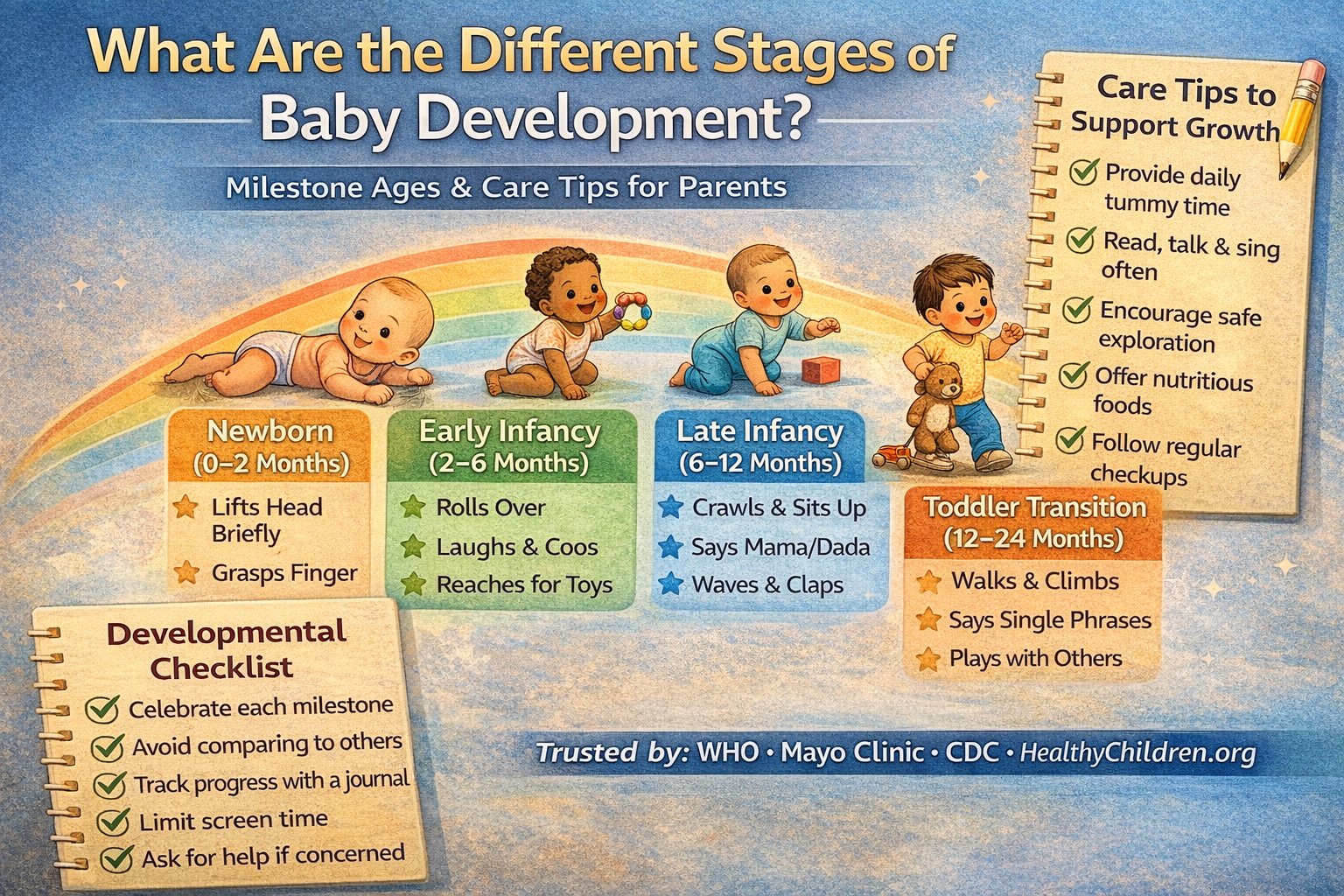
The different stages of baby development include newborn (0–2 months), early infancy (2–6 months), late infancy (6–12 months), and toddler transition (12–24 months). During these stages, babies develop physically, cognitively, emotionally, socially, and linguistically at predictable but flexible rates.
When parents ask, what are the different stages of baby development, they usually mean milestones.
But development is more than milestones.
It includes:
According to the World Health Organization (WHO), early childhood development lays the foundation for lifelong health and learning.
Understanding these stages builds confidence.
Knowing what to expect helps you:
The CDC and HealthyChildren.org both emphasize early awareness as key to supporting developmental health.
You are not meant to guess your way through parenting.
Newborns are adjusting to life outside the womb.
The brain is rapidly forming neural connections.
Newborns recognize voices and smells.
The Mayo Clinic explains that early bonding supports long-term emotional security.
At this stage, survival and attachment are primary goals.
This stage feels magical.
You see smiles. Laughter. Purposeful movement.
The NHS highlights that responsive caregiving strengthens emotional regulation during this stage.
This is the mobility explosion stage.
According to HealthyChildren.org, separation anxiety at this stage is a sign of healthy attachment.
This stage is powerful and intense.
The CDC notes that toddlers learn best through exploration and repetition.
Structure plus freedom works well here.
Motor skills develop in predictable order:
This follows the head-to-toe pattern of neurological growth.
Babies build strength gradually.
Brain growth is fastest in the first year.
Research from WHO suggests that over 80% of brain growth occurs before age two.
Cognitive skills include:
Simple play supports these skills more than expensive toys.
Babies are emotional learners.
From birth, they observe facial expressions.
Responsive parenting teaches:
The Mayo Clinic emphasizes that secure attachment predicts better mental health outcomes.
Here is a simplified chart:
| Age | Language Stage |
|---|---|
| 0–3 months | Cooing |
| 4–6 months | Babbling |
| 7–12 months | First words |
| 12–24 months | Word combinations |
Reading daily supports language growth.
Many factors shape development:
The CDC notes that early stimulation improves cognitive outcomes.
However, over-stimulation can cause stress.
Balance is key.
Consult a pediatric professional if:
Early intervention improves outcomes dramatically.
✔ Provide daily tummy time
✔ Read aloud every day
✔ Talk during routines
✔ Encourage floor play
✔ Limit screen exposure
✔ Offer safe exploration
✔ Attend regular checkups
Development is a range, not a deadline.
As a developmental behavioral specialist, I suggest:
Attachment builds confidence.
Consider:
(WHO, CDC, Mayo Clinic)
Newborn, early infancy, late infancy, and toddler transition.
Between 6–10 months typically.
Yes, some babies move directly to standing.
Around 9–12 months.
Talk, read, play, and respond consistently.
If milestones are significantly missed or skills regress.
Excess screen time may delay language and social skills.
If you’ve been asking, what are the different stages of baby development, now you know.
Development unfolds in stages — physical, cognitive, emotional, and social.
Each baby moves at their own pace.
Your love, responsiveness, and presence matter more than perfection.
Trust the process. Stay informed. And remember — progress is powerful, even when it’s slow.