Physical Address
304 North Cardinal St.
Dorchester Center, MA 02124
Physical Address
304 North Cardinal St.
Dorchester Center, MA 02124

The baby development 3 months stage often surprises parents. Suddenly, your once-sleepy newborn is smiling, cooing, and studying your face like a tiny scientist.
Yet this phase also brings questions.
Is my baby developing normally? Why are naps unpredictable? Should they be rolling already?
If you feel excited but unsure, you are not alone.
This comprehensive 3 Month Baby Development Guide will help you understand exactly what to expect, how to support your baby’s growth, and when to seek reassurance. By the end, you will feel confident, calm, and deeply connected to your baby’s incredible journey.
At 3 months, babies develop stronger neck control, social smiles, cooing sounds, improved vision, and longer sleep stretches. They begin batting at toys, recognizing caregivers, and showing emotional responses. Consistent tummy time, responsive feeding, and gentle interaction support healthy development during this stage.
The third month is often called the awakening phase.
Your baby transitions from reflex-driven newborn behavior to purposeful interaction with the world.
Key developmental domains include:
Experts from organizations like World Health Organization emphasize that early months shape long-term cognitive and emotional outcomes through responsive caregiving.
In simple terms:
👉 Your baby learns through YOU.
Every smile, cuddle, and conversation builds their brain.
By 3 months, most babies can:
This reflects strengthening neck and shoulder muscles.
A major highlight of baby development 3 months is discovering hands.
You may notice:
This marks early hand-eye coordination.
Some babies begin:
However, rolling is a wide-range milestone.
Absence of rolling is normal.
At 3 months, your baby’s brain forms millions of neural connections daily.
According to Centers for Disease Control and Prevention developmental research, responsive interaction strongly influences cognitive development.
The genuine social smile appears around this stage.
Your baby smiles in response to:
This marks emotional bonding and social awareness.
At 3 months, babies show:
Emotional regulation begins through caregiver co-regulation.
Your soothing teaches emotional safety.
Language begins long before words.
The conversational turn-taking you practice now builds future speech.
Professionals from HealthyChildren.org recommend talking frequently even if babies cannot reply verbally.
Sleep often improves but remains variable.
| Sleep Type | Average Duration |
|---|---|
| Total sleep | 14–17 hours |
| Night stretch | 4–6 hours |
| Naps | 3–5 naps |
However, regression-like patterns may still occur.
Both feeding methods support development.
At 3 months babies typically:
Guidance from Mayo Clinic notes that responsive feeding cues are more reliable than strict schedules.
Growth spurts commonly occur around 3 months.
These spurts support:
They usually last 2–4 days.
Tummy time remains one of the most powerful activities during baby development 3 months.
Experts from NHS highlight tummy time as essential for motor development.
Play is learning.
At 3 months babies can:
Babies respond to:
Touch remains the dominant learning channel.
Skin-to-skin and cuddling regulate stress hormones.
While development varies, consult a professional if baby:
Early support leads to best outcomes.
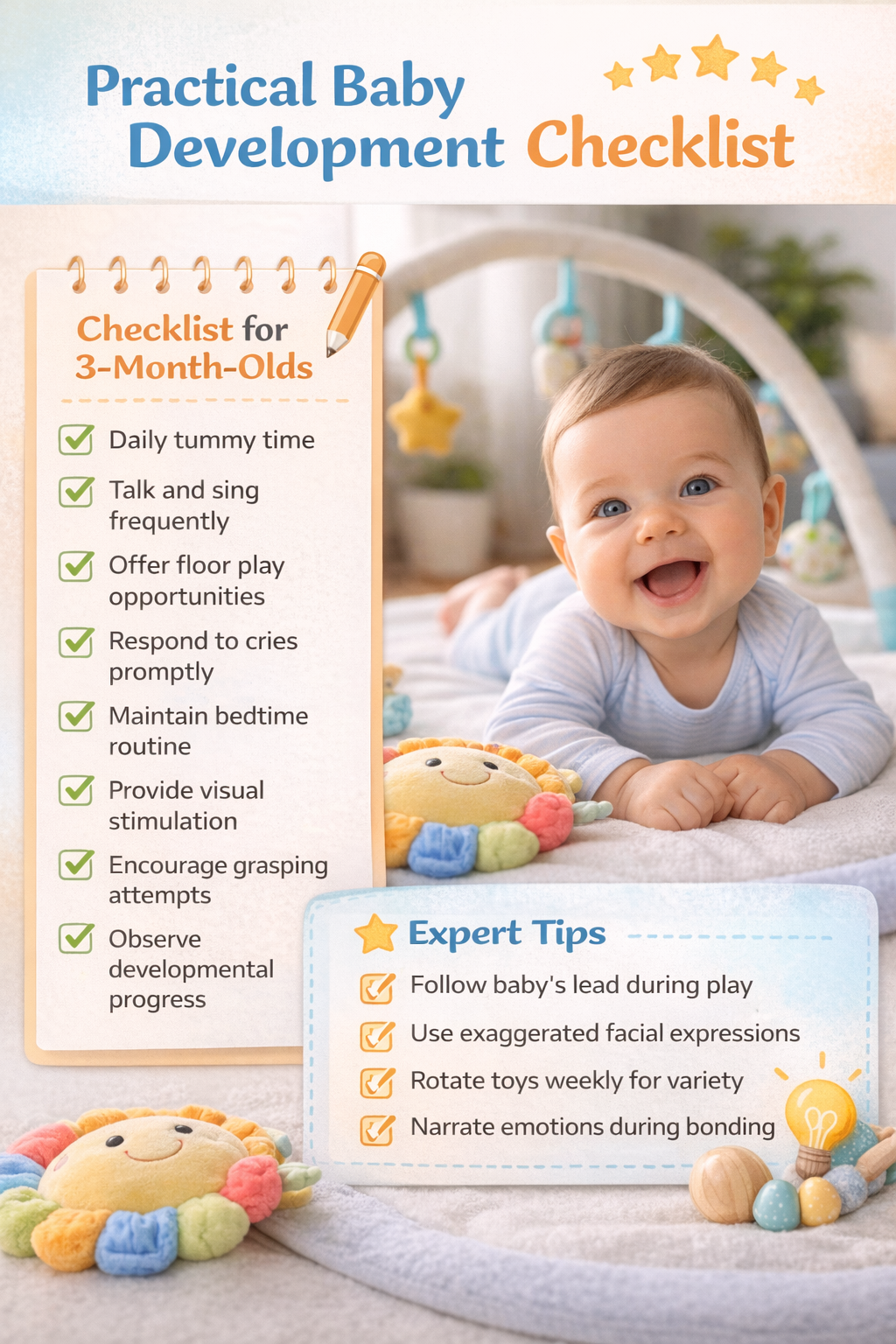
✔ Daily tummy time
✔ Talk and sing frequently
✔ Offer floor play opportunities
✔ Respond to cries promptly
✔ Maintain bedtime routine
✔ Provide visual stimulation
✔ Encourage grasping attempts
✔ Observe developmental progress
Development varies widely.
Swings and seats limit movement.
Your presence is the best toy.
Babies develop naturally through play.
Concern is valid.
These micro-interactions profoundly shape development.
(Soft recommendation section)
The goal is not more products — but intentional use.
These statistics reinforce the importance of early interaction.
Most babies smile socially, coo, lift their head, track objects, and show curiosity about surroundings.
Some babies roll tummy-to-back, but many do not yet. Variation is normal.
Total sleep typically ranges between 14–17 hours daily with multiple naps.
Drooling increases due to salivary gland development, not necessarily teething.
Aim for several short sessions daily totaling 30–60 minutes over the day.
Yes, babies recognize caregivers by voice, face, and smell.
Laughter often appears between 3–4 months, so absence at exactly 3 months is usually normal.
The baby development 3 months stage is filled with magical firsts — social smiles, curious eyes, stronger movements, and deeper bonding.
While milestones matter, connection matters more.
Your responsiveness, warmth, and presence are the most powerful developmental tools available.
So celebrate the smiles, enjoy the coos, and trust the process.
You are not just raising a baby — you are shaping a lifelong learner.