
Introduction
Where to put baby monitor is one of the most important safety decisions new parents make—but surprisingly, many get it wrong.
A poorly placed monitor can create safety risks, blind spots, or even false alarms that disrupt your baby’s sleep. Whether you’re setting up a nursery for the first time, transitioning to a toddler room, or traveling with your baby, proper monitor placement ensures both clear visibility and a safe sleep environment.
According to pediatric safety guidelines from organizations like the American Academy of Pediatrics (AAP), maintaining a hazard-free sleep space is critical for reducing risks such as suffocation and entanglement. That means your baby monitor setup must be both strategic and safe.
In this complete guide, you’ll learn:
- The safest distance for monitor placement
- Wall mounting options (with and without drilling)
- Placement tips for toddler rooms, cars, and travel setups
- Common mistakes to avoid
Let’s break it down step by step so you can monitor your baby with confidence.
✅ Quick Answer Box
Where to put baby monitor:
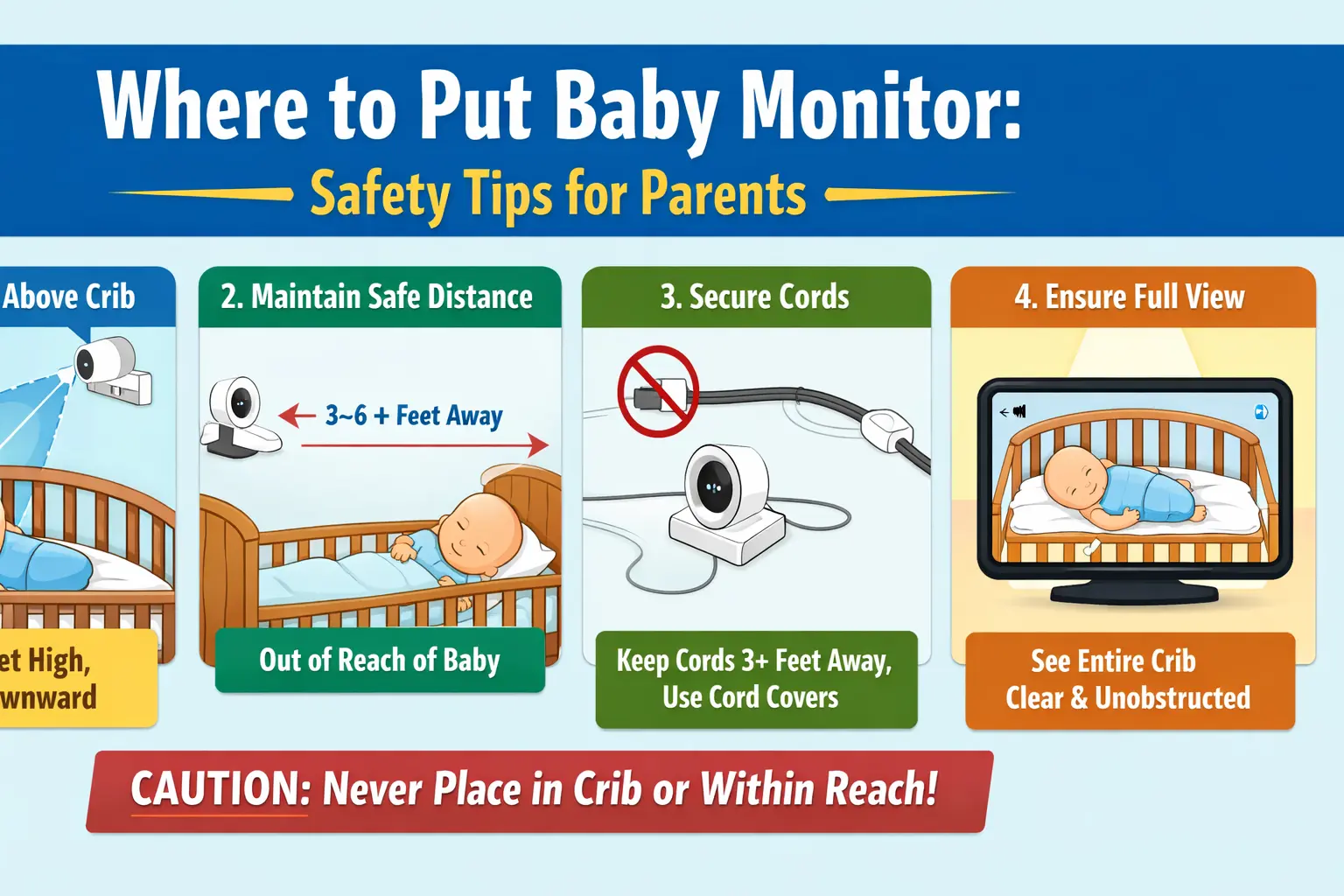
Place the baby monitor at least 3–6 feet (1–2 meters) away from your baby, positioned above crib level, angled downward for a full view. Avoid placing it inside the crib or within reach. Wall mounting is ideal for safety and visibility.
🧠 Why Baby Monitor Placement Matters
The location of your baby monitor directly affects:
- Safety: Prevents choking or strangulation hazards
- Visibility: Ensures full crib coverage
- Sleep quality: Avoids unnecessary disturbances
- Accuracy: Reduces false alerts from movement or shadows
Poor placement can block airflow, create blind spots, or allow cords to become dangerous.
📍 Where to Put Baby Monitor Safely (Step-by-Step)
Step 1: Choose the Right Height
Place the monitor above crib level, ideally:
- 5–7 feet high
- Angled downward
Step 2: Maintain Safe Distance
Keep it:
- At least 3–6 feet away
- Completely out of baby’s reach
Step 3: Ensure Full Visibility
Your camera should capture:
- Entire crib
- Baby’s face and body
- No obstructions
Step 4: Secure All Wires
- Keep cords at least 3 feet away
- Use cord covers if needed
📏 How Far Should Baby Monitor Be from Baby
Optimal Distance Guide
| Distance | Safety Level | Visibility |
|---|---|---|
| 1–2 feet | ❌ Unsafe (too close) | Too zoomed |
| 3–6 feet | ✅ Ideal | Clear full view |
| 7+ feet | ⚠️ Acceptable | May reduce detail |
Expert Insight:
The American Academy of Pediatrics recommends keeping all cords and electronics out of reach to prevent accidental strangulation.
🧱 Where to Put Baby Monitor on Wall
Mounting on the wall is the best option for safety and stability.
Ideal Wall Placement:
- Above crib center
- Corner angle for wide view
- Minimum 5 feet height
Benefits:
- Eliminates tipping risk
- Keeps cords hidden
- Provides consistent angle
🔧 How to Mount Baby Monitor on Wall Without Drilling
If you rent or prefer damage-free setups:
No-Drill Options:
- Adhesive wall mounts
- Command hooks
- Flexible monitor stands
- Shelf placement
Tips:
- Ensure weight support
- Double-check stability
- Avoid heat or humidity areas
🧸 Where to Put Baby Monitor in Toddler Room
Toddlers move more, so placement must adapt.
Best Positions:
- High wall mount (out of reach)
- Corner view of entire room
- Away from climbing furniture
Parenting Example:
If your toddler climbs out of bed, a corner-mounted camera helps track movement without blind spots.
🏕️ Where to Put Baby Monitor in SlumberPod
Travel setups require creative placement.
Recommended Placement:
- Outside the SlumberPod viewing window
- Elevated surface or tripod
- Angle through ventilation panel
Avoid:
- Placing inside (heat + limited airflow)
🚗 Where to Put Baby Monitor in Car
Monitoring your baby during travel adds peace of mind.
Safe Placement:
- Attach to headrest facing baby
- Use car-specific baby mirrors with camera
- Secure tightly to avoid movement
Safety Reminder:
Never adjust the monitor while driving.
⚠️ Common Mistakes Parents Make
- Placing monitor inside crib
- Keeping cords within reach
- Mounting too low
- Blocking airflow
- Using unstable surfaces
💡 Expert Tips
- Use wide-angle lens monitors
- Test night vision before use
- Regularly check positioning
- Use dual monitors for larger rooms
🏥 Safety & Health Notes
Guidelines from trusted organizations:
- CDC: Safe sleep reduces infant risk
- WHO: Maintain hazard-free sleep area
- Mayo Clinic: Avoid loose objects near baby
Key Safety Rule:
👉 “Bare crib is safest crib”
FAQ Section (SEO Optimized)
Where to put baby monitor for best view?
Place it 3–6 feet away, above crib level, angled downward.
Where to put baby monitor on wall safely?
Mount 5–7 feet high, centered or corner for full visibility.
How far should baby monitor be from baby?
At least 3 feet, ideally up to 6 feet.
Can I put baby monitor inside crib?
No, it creates safety hazards.
Where to put baby monitor in toddler room?
High wall corner for full room coverage.
How to mount baby monitor without drilling?
Use adhesive mounts or stands.
Where to put baby monitor in SlumberPod?
Outside, aligned with viewing window.
Where to put baby monitor in car?
Attach securely to headrest facing baby.
Read Also
- How Can I Safely Use a Baby Monitor for My Newborn? 9 Expert Tips
- The Ultimate Baby Cry Detection Monitor Guide: Sleep Peacefully & Respond Faster
- 7 Powerful Reasons Every Parent Needs a Child Safety Monitor
- Swaddle vs sleep sack safety guide
- Newborn sleep schedule tips
External Authority Sources
- World Health Organization (WHO)
- Centers for Disease Control and Prevention (CDC)
- Mayo Clinic
- American Academy of Pediatrics (AAP)
- American College of Obstetricians and Gynecologists (ACOG)
Conclusion
Understanding where to put baby monitor can make a huge difference in your baby’s safety and your peace of mind. By maintaining the right distance, choosing secure mounting options, and avoiding common mistakes, you create a safer and more effective monitoring setup.
Always prioritize safety over convenience—and remember, the best monitor placement is one that keeps your baby visible without introducing any risk.
Medical Disclaimer
This article is for informational purposes only and does not replace professional medical advice. Always consult your pediatrician for personalized guidance.