
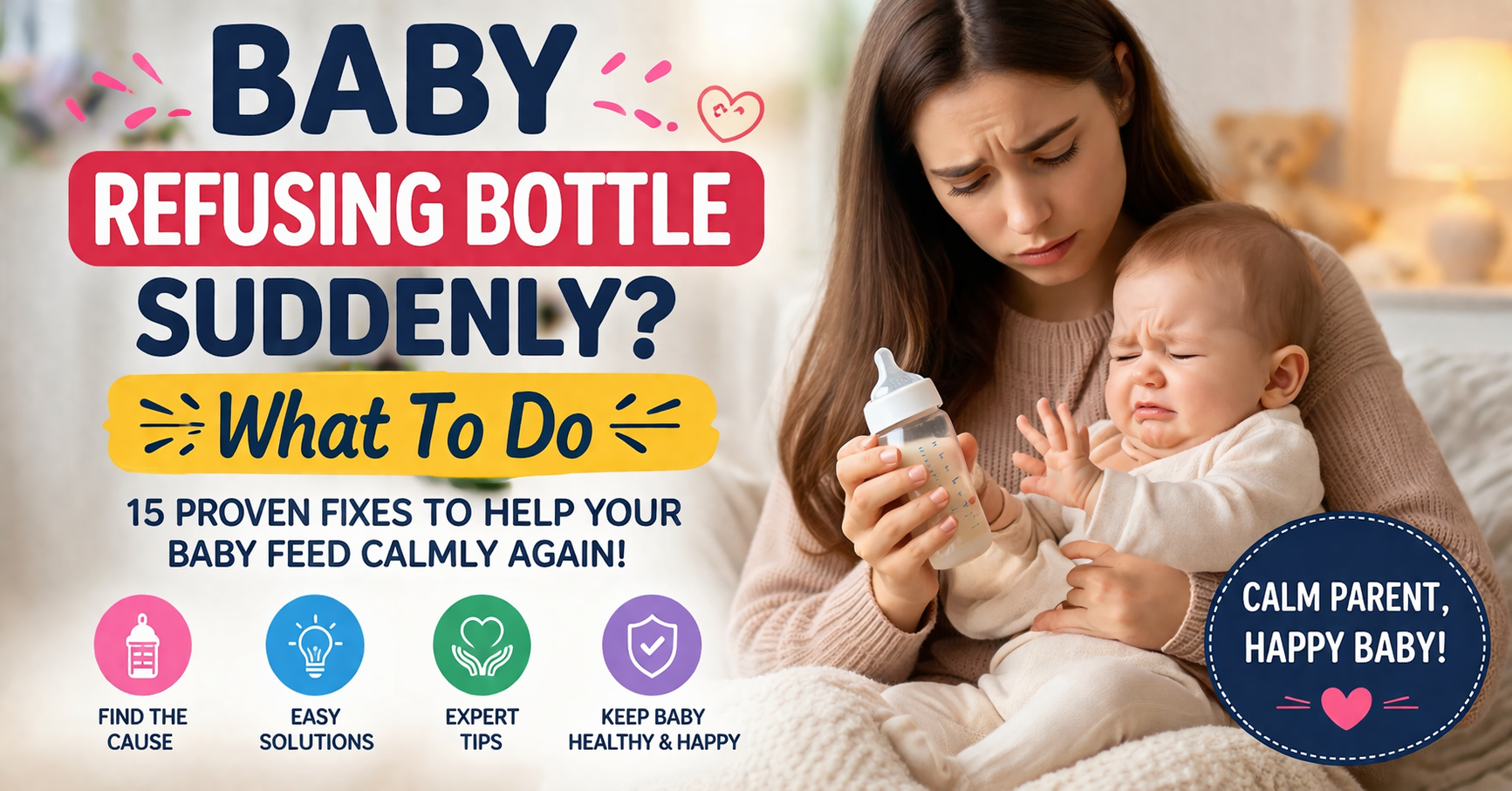
Baby Refusing Bottle Suddenly What to Do: Complete Parent Survival Guide
Baby refusing bottle suddenly what to do is one of the most stressful questions parents search when feeding suddenly becomes a battle instead of a bonding moment.
One day your baby drinks happily.
The next day, they turn their head, cry, push the bottle away, or clamp their mouth shut.
If you’re feeling confused, anxious, or even guilty — you are not alone.
This in-depth guide explains:
- Why babies suddenly refuse bottles
- What it means medically
- Step-by-step solutions that actually work
- When to worry
- When to call a doctor
- How to prevent it from happening again
Backed by guidance from trusted organizations like the World Health Organization, Centers for Disease Control and Prevention, American Academy of Pediatrics, Mayo Clinic, and American College of Obstetricians and Gynecologists.
Let’s fix this calmly and confidently.
Quick Answer Box
If your baby is refusing bottle suddenly, common causes include teething, illness, nipple flow issues, distraction, growth spurts, or feeding aversion.
What to do immediately:
- Stay calm — don’t force feed.
- Check nipple size and milk temperature.
- Try feeding in a quiet, dim room.
- Rule out illness (fever, congestion, ear pulling).
- Offer smaller, more frequent feeds.
- Consult your pediatrician if refusal lasts more than 24–48 hours.
Table of Contents
Why Is My Baby Refusing Bottle Suddenly?
Sudden bottle refusal can feel shocking, especially if feeding was previously smooth.
But in most cases, it’s temporary.
Common causes include:
- Teething pain
- Ear infections
- Cold or nasal congestion
- Growth spurts
- Overfeeding
- Flow rate problems
- Separation anxiety
- Distraction (especially 3–6 months)
- Feeding aversion
According to the American Academy of Pediatrics, feeding patterns often shift during developmental milestones.
Early Signs Before Full Bottle Refusal
Many parents miss the early warning signals.
Look for:
- Taking longer to finish feeds
- Fussing halfway through
- Arching back
- Pulling off nipple repeatedly
- Clicking sounds while sucking
- Only feeding while sleepy
Catching these early helps prevent full feeding strikes.
Baby Refusing Bottle Suddenly What to Do: Step-by-Step Action Plan
If you’re wondering again, baby refusing bottle suddenly what to do, follow this structured approach:
Step 1: Stay Calm
Babies sense stress.
Pressure worsens refusal.
Instead:
- Pause
- Take deep breaths
- Try again in 10–15 minutes
Step 2: Check Bottle & Nipple
Ask yourself:
- Is milk too hot or too cold?
- Is nipple clogged?
- Is flow too fast or too slow?
Baby Refusing Bottle Suddenly What to Do About Nipple Flow
If milk drips constantly → flow too fast.
If baby sucks hard but little milk comes → flow too slow.
Try:
- One size up for older babies
- Slower flow for gagging
- Different bottle brands
Step 3: Rule Out Illness
Check for:
- Fever
- Cough
- Runny nose
- Ear pulling
- White patches in mouth (possible thrush)
The Centers for Disease Control and Prevention advises monitoring hydration if feeding drops.
Call your pediatrician if:
- Fewer than 4 wet diapers/day
- Lethargy
- Persistent crying
Step 4: Change Environment
Babies 3–6 months become highly aware.
Try feeding:
- In dim lighting
- With white noise
- In a quiet room
- During drowsy moments
Step 5: Adjust Feeding Schedule
Sometimes refusal is simple:
Your baby is not hungry.
According to the World Health Organization, overfeeding can disrupt natural hunger cues.
Try:
- Smaller feeds
- Longer intervals
- Watching hunger signs (rooting, hand-to-mouth)
Medical Causes You Should Not Ignore
While most cases are harmless, watch for:
1. Ear Infection
Pain increases during sucking.
2. Reflux
Baby arches, cries, spits up frequently.
3. Oral Thrush
White patches inside cheeks.
4. Teething
Gums swollen, drooling, chewing hands.
The Mayo Clinic recommends medical evaluation if refusal lasts beyond 48 hours.
Feeding Aversion Explained
Feeding aversion happens when baby associates feeding with stress or pressure.
Signs:
- Crying when seeing bottle
- Tensing body
- Feeding only asleep
- Very short feeds
It often develops after:
- Force feeding
- Repeated pressure
- Overly scheduled feeding
Comparison Table: Cause vs What To Do
| Cause | Signs | What To Do |
|---|---|---|
| Teething | Chewing nipple | Offer chilled teether first |
| Fast flow | Choking, coughing | Switch to slower nipple |
| Slow flow | Frustration | Increase nipple size |
| Illness | Fever, congestion | See doctor |
| Distraction | Looking around | Quiet feeding room |
| Overfeeding | Pushing bottle away | Follow hunger cues |
| Feeding aversion | Crying at bottle sight | Remove pressure |
Common Mistakes Parents Make
When baby is refusing bottle suddenly, what to do becomes urgent — but mistakes can worsen it.
Avoid:
- Forcing nipple into mouth
- Feeding while baby is crying
- Constantly switching formulas
- Feeding too frequently
- Panic-googling worst-case scenarios
Real-Life Parenting Example
Anita, mother of a 4-month-old, noticed sudden bottle refusal.
She:
- Increased nipple flow too early
- Fed every 2 hours
- Tried feeding louder to distract
Problem: Baby was overstimulated and overfed.
Solution:
- Fed in dark room
- Extended intervals
- Switched back to slower flow
Within 3 days, feeding normalized.
Safety & Health Notes
Monitor hydration:
Signs baby is dehydrated:
- Sunken soft spot
- Dry lips
- No tears when crying
- Fewer wet diapers
The American Academy of Pediatrics recommends immediate care if dehydration signs appear.
Expert Tips for Bottle Refusal
✔ Offer bottle when sleepy
✔ Try paced bottle feeding
✔ Let another caregiver feed
✔ Warm nipple slightly
✔ Try skin-to-skin
✔ Burp midway
✔ Keep feeds calm and pressure-free
FAQ: Baby Refusing Bottle Suddenly What to Do
Why is my baby refusing bottle suddenly at 3 months?
Likely distraction phase or growth spurt.
Baby refusing bottle suddenly what to do during teething?
Offer cold teether first, then feed gently.
Should I force feed if baby refuses bottle?
No. This increases feeding aversion.
How long can baby go without bottle?
Depends on age. Contact pediatrician if refusal lasts 24–48 hours.
Is bottle refusal normal?
Yes, temporary refusal is common.
Can reflux cause bottle refusal?
Yes. Arching and crying are key signs.
Does formula taste change?
Improper storage may alter taste.
Baby refusing bottle suddenly what to do at night?
Feed in dim light when baby is sleepy.
Should I change bottle brand?
Try if flow or latch seems issue.
When should I worry?
If baby shows dehydration or weight loss.
Read Also
- Baby Not Rolling at 5 Months What to Do
- Safe Sleeping Temperature Guide
- Best First Foods for Babies
- Tracking Baby Growth Milestones
- Signs of Teething in Babies
Conclusion
If you’re still asking, baby refusing bottle suddenly what to do, remember this:
Most cases are temporary and fixable.
Stay calm.
Remove pressure.
Adjust environment.
Check health signs.
Trust your instincts.
Feeding is not just nutrition — it’s connection.
You are doing better than you think.
Medical Disclaimer
This article is for informational purposes only and does not replace medical advice. Always consult your pediatrician for diagnosis and treatment.