
Introduction: When Tiny Changes Become Big Wonders
The baby development 3 months stage often surprises parents. Suddenly, your once-sleepy newborn is smiling, cooing, and studying your face like a tiny scientist.
Yet this phase also brings questions.
Is my baby developing normally? Why are naps unpredictable? Should they be rolling already?
If you feel excited but unsure, you are not alone.
This comprehensive 3 Month Baby Development Guide will help you understand exactly what to expect, how to support your baby’s growth, and when to seek reassurance. By the end, you will feel confident, calm, and deeply connected to your baby’s incredible journey.
✅ Quick Answer Box
At 3 months, babies develop stronger neck control, social smiles, cooing sounds, improved vision, and longer sleep stretches. They begin batting at toys, recognizing caregivers, and showing emotional responses. Consistent tummy time, responsive feeding, and gentle interaction support healthy development during this stage.
Table of Contents
Understanding Baby Development at 3 Months
The third month is often called the awakening phase.
Your baby transitions from reflex-driven newborn behavior to purposeful interaction with the world.
Key developmental domains include:
- Motor development
- Brain and sensory development
- Emotional bonding
- Communication attempts
- Sleep rhythm organization
Experts from organizations like World Health Organization emphasize that early months shape long-term cognitive and emotional outcomes through responsive caregiving.
In simple terms:
👉 Your baby learns through YOU.
Every smile, cuddle, and conversation builds their brain.
Physical Milestones in Baby Development 3 Months
1. Improved Head and Neck Control
By 3 months, most babies can:
- Lift their head during tummy time
- Hold head steady when supported
- Push up on forearms
This reflects strengthening neck and shoulder muscles.
How to support it
- Daily tummy time sessions
- Floor play instead of prolonged containers
- Face-to-face interaction during tummy time
2. Hand Awareness and Coordination
A major highlight of baby development 3 months is discovering hands.
You may notice:
- Hands opening more
- Watching fingers
- Attempting to grasp toys
- Bringing hands to mouth
This marks early hand-eye coordination.
3. Early Rolling Attempts
Some babies begin:
- Rocking side-to-side
- Rolling from tummy to back
However, rolling is a wide-range milestone.
Absence of rolling is normal.
Cognitive Growth and Brain Development
At 3 months, your baby’s brain forms millions of neural connections daily.
According to Centers for Disease Control and Prevention developmental research, responsive interaction strongly influences cognitive development.
Signs of cognitive growth
- Tracking moving objects
- Recognizing familiar faces
- Showing curiosity
- Anticipating routines
Simple brain-building activities
- Talk during caregiving
- Narrate daily actions
- Offer contrasting toys
- Provide gentle variety
Social and Emotional Milestones
The Magical Social Smile
The genuine social smile appears around this stage.
Your baby smiles in response to:
- Your face
- Your voice
- Playful interaction
This marks emotional bonding and social awareness.
Emotional Expression
At 3 months, babies show:
- Excitement
- Fussiness
- Calm states
- Early laughter
Emotional regulation begins through caregiver co-regulation.
Your soothing teaches emotional safety.
Language and Communication Skills
Language begins long before words.
At 3 months, babies often:
- Coo
- Make vowel sounds
- Respond to voices
- Pause during conversation
The conversational turn-taking you practice now builds future speech.
Professionals from HealthyChildren.org recommend talking frequently even if babies cannot reply verbally.
Sleep Patterns at 3 Months
Sleep often improves but remains variable.
Typical sleep expectations
| Sleep Type | Average Duration |
|---|---|
| Total sleep | 14–17 hours |
| Night stretch | 4–6 hours |
| Naps | 3–5 naps |
Why sleep improves
- Neurological maturation
- Feeding efficiency
- Emerging circadian rhythm
However, regression-like patterns may still occur.
Feeding and Nutrition Needs
Breastfed and Formula-Fed Babies
Both feeding methods support development.
At 3 months babies typically:
- Feed every 3–4 hours
- Become more efficient feeders
- Show distracted feeding
Guidance from Mayo Clinic notes that responsive feeding cues are more reliable than strict schedules.
Hunger cues include:
- Rooting
- Hand sucking
- Fussiness
- Alertness
Growth Spurts Explained
Growth spurts commonly occur around 3 months.
Signs
- Increased feeding
- Shorter naps
- Fussiness
- Clinginess
These spurts support:
- Brain growth
- Muscle development
- Sleep consolidation
They usually last 2–4 days.
Tummy Time and Movement Development
Tummy time remains one of the most powerful activities during baby development 3 months.
Benefits
- Prevents flat head
- Builds motor strength
- Supports rolling
- Encourages exploration
Ideal routine
- 5–6 sessions daily
- 1–5 minutes each initially
- Gradual increase
Experts from NHS highlight tummy time as essential for motor development.
Play Ideas That Boost Baby Development 3 Months
Play is learning.
Best activities
- Mirror play
- Singing songs
- Gentle tickling
- Texture exploration
- High-contrast cards
Why play matters
- Stimulates sensory systems
- Builds attachment
- Strengthens brain connections
- Encourages movement
Sensory Development
Vision
At 3 months babies can:
- See across room distances
- Recognize caregivers
- Track moving toys
Hearing
Babies respond to:
- Tone variation
- Familiar voices
- Music
Touch
Touch remains the dominant learning channel.
Skin-to-skin and cuddling regulate stress hormones.
Red Flags Parents Should Know
While development varies, consult a professional if baby:
- Does not smile at people
- Cannot hold head up
- Shows very stiff or floppy body
- Does not track objects
- Rarely makes sounds
Early support leads to best outcomes.
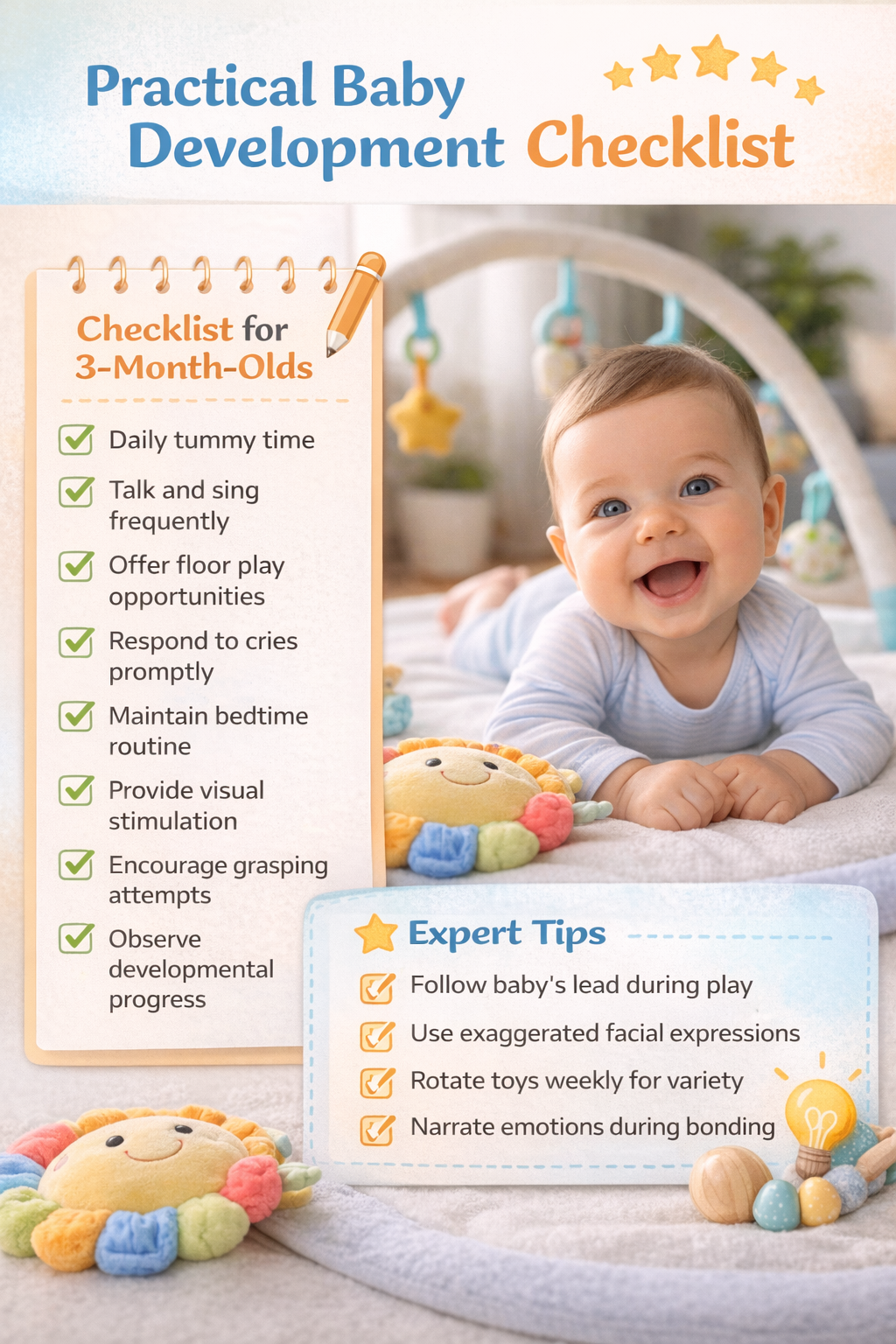
✅ Practical Parenting Checklist
✔ Daily tummy time
✔ Talk and sing frequently
✔ Offer floor play opportunities
✔ Respond to cries promptly
✔ Maintain bedtime routine
✔ Provide visual stimulation
✔ Encourage grasping attempts
✔ Observe developmental progress
Common Mistakes Parents Make
1. Comparing babies excessively
Development varies widely.
2. Overusing containers
Swings and seats limit movement.
3. Underestimating interaction importance
Your presence is the best toy.
4. Pushing milestones
Babies develop naturally through play.
5. Ignoring parental intuition
Concern is valid.
⭐ Expert Pro Tips
- Follow baby’s lead during play
- Use exaggerated facial expressions
- Practice “serve and return” interaction
- Narrate emotions
- Protect sleep windows
- Rotate toys weekly
These micro-interactions profoundly shape development.
Recommended Helpful Tools for Parents
(Soft recommendation section)
Development-supportive essentials
- Play gyms
- Soft mirrors
- High-contrast cards
- Baby carriers
- Tummy time pillows
- White noise machines
The goal is not more products — but intentional use.
Baby Development Statistics
- Babies form over 1 million neural connections per second in early life.
- Around 90% of brain growth occurs before age five.
- Approximately 80% of babies smile socially by 3 months.
- Average babies double birth weight by 4–6 months.
- Responsive caregiving improves language outcomes by up to 40%.
These statistics reinforce the importance of early interaction.
Frequently Asked Questions
What should my baby be doing at 3 months?
Most babies smile socially, coo, lift their head, track objects, and show curiosity about surroundings.
Can a 3-month-old roll over?
Some babies roll tummy-to-back, but many do not yet. Variation is normal.
How much should a 3-month-old sleep?
Total sleep typically ranges between 14–17 hours daily with multiple naps.
Why is my baby drooling so much at 3 months?
Drooling increases due to salivary gland development, not necessarily teething.
How often should tummy time happen?
Aim for several short sessions daily totaling 30–60 minutes over the day.
Do babies recognize parents at 3 months?
Yes, babies recognize caregivers by voice, face, and smell.
Should I worry if my baby is not laughing yet?
Laughter often appears between 3–4 months, so absence at exactly 3 months is usually normal.
Conclusion: Celebrate the Tiny Triumphs
The baby development 3 months stage is filled with magical firsts — social smiles, curious eyes, stronger movements, and deeper bonding.
While milestones matter, connection matters more.
Your responsiveness, warmth, and presence are the most powerful developmental tools available.
So celebrate the smiles, enjoy the coos, and trust the process.
You are not just raising a baby — you are shaping a lifelong learner.