
Feeling Anxious Every Time Your Baby Cries?
You finally fall asleep… and then you wake up wondering, Did I miss the baby crying? It solution is baby cry detection monitor
Many parents live in this constant state of alert. You want rest, but you also want to respond instantly to your baby’s needs. That tension is real.
A baby cry detection monitor can reduce that stress. It helps you hear and understand your baby’s cries—even when you’re in another room or sleeping.
In this ParentNest guide, you’ll learn:
- How a baby cry detection monitor works
- Whether it’s safe
- What science says about infant crying
- How to choose the best one
- And how to use it without becoming overly dependent
Let’s make nights calmer—for you and your baby.
Quick Answer: What Is a Baby Cry Detection Monitor?
A baby cry detection monitor is a smart device that listens for your baby’s cries and alerts you instantly. Advanced models use sound analysis to detect cry patterns, reduce background noise, and sometimes classify cry types. It helps parents respond quickly while supporting safer sleep and peace of mind.
What Is a Baby Cry Detection Monitor?
A baby monitor is more advanced than a traditional baby monitor.
Instead of just transmitting sound, it:
- Detects crying automatically
- Filters background noise
- Sends instant alerts
- Sometimes analyzes cry intensity or pattern
Some smart models even use artificial intelligence to recognize differences between hunger cries and discomfort cries.
But remember—no device replaces a parent’s intuition.
Why Babies Cry: The Science Behind It
Before choosing a baby cry detection monitor, it helps to understand why babies cry.
According to the World Health Organization, crying is a newborn’s primary form of communication.
Common Reasons Babies Cry:
- Hunger
- Wet diaper
- Gas or discomfort
- Fatigue
- Need for comfort
- Temperature changes
The Mayo Clinic explains that newborns may cry 1–3 hours per day. Around 6–8 weeks, crying often peaks.
That’s normal.
A baby cry detection monitor does not stop crying—but it ensures you hear it clearly and respond calmly.
How a Baby Cry Detection Monitor Actually Works
Most baby cry detection monitor systems use:
1. Sensitive Microphones
They detect high-pitched infant cries.
2. Sound Pattern Recognition
Advanced models compare sound waves to cry databases.
3. Noise Filtering Technology
They ignore fans, white noise, and background conversations.
4. Instant Alerts
Notifications may come through:
- Parent unit
- Smartphone app
- Vibration alerts
- Smart home systems
Some integrate with sleep tracking apps.
Types of Baby Cry Detection Monitor Systems
Not all baby monitor cry detection devices are the same.
| Type | How It Works | Best For |
|---|---|---|
| Audio-only | Detects and transmits cry sounds | Budget-friendly families |
| Video + Cry Detection | Alerts + live camera view | Visual reassurance |
| Smart AI Monitor | Cry classification & analytics | Data-driven parents |
| Wearable-linked | Connects to breathing monitors | High-anxiety situations |
Each type serves different needs.
Key Features to Look For in a Baby Cry Detection Monitor
When choosing a baby cry detection monitor, focus on safety and reliability.
Must-Have Features
- Adjustable sensitivity
- Secure signal encryption
- Clear audio quality
- Low EMF design
- Long battery life
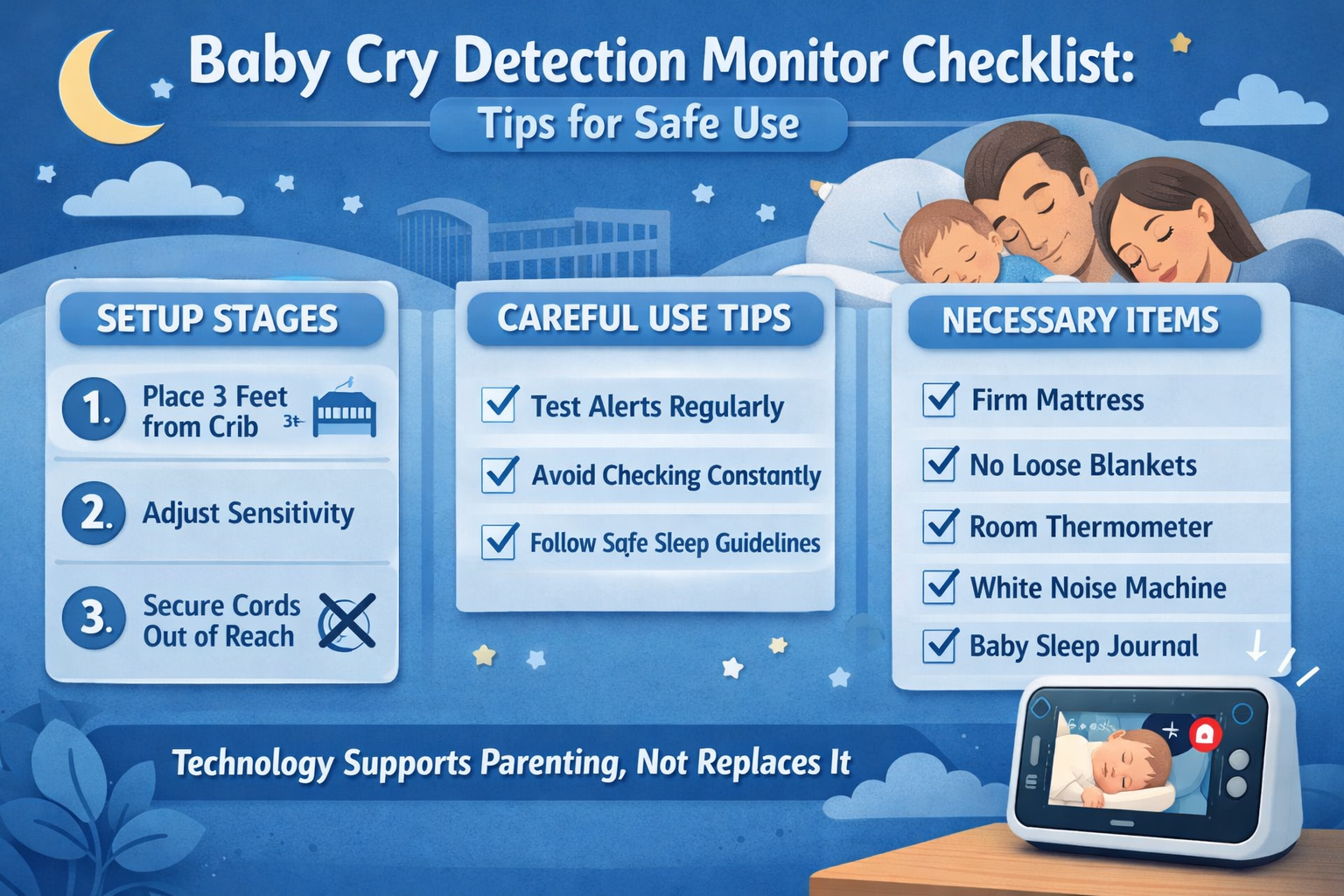
The HealthyChildren.org advises placing monitors at least 3 feet away from the crib to reduce risks.
Nice-to-Have Features
- Cry analytics dashboard
- Sleep pattern tracking
- Two-way talk
- Temperature sensors
- White noise integration
But more features do not always mean better parenting.
Is a Baby Cry Detection Monitor Safe?
Safety is the top concern.
According to the CDC, safe sleep practices are the most important factor in reducing sleep-related risks—not technology.
A baby cry detection monitor is safe when:
- It is placed away from the crib
- Cords are out of reach
- It does not replace safe sleep guidelines
- It does not increase parental anxiety
The NHS also emphasizes that room-sharing (without bed-sharing) supports infant safety in early months.
Monitors are tools—not substitutes for supervision.
Can a Baby Cry Detection Monitor Reduce Parental Anxiety?
Research in parental mental health suggests that reassurance tools can lower stress when used properly.
Many new parents report:
- Sleeping more deeply
- Checking the crib less often
- Feeling confident responding quickly
However, over-monitoring can increase anxiety.
If you check the app every 5 minutes, the tool is not helping.
Healthy balance matters.
When Do You Really Need a Baby Cry Detection Monitor?
A baby cry detection monitor is especially helpful when:
- Your baby naps in another room
- You live in a multi-level home
- You have hearing difficulties
- You are a deep sleeper
- You have postpartum anxiety
It may be less necessary if:
- You room-share
- Your home is small
- You wake easily to soft sounds
Trust your environment and your instincts.
How to Set Up a Baby Cry Detection Monitor Correctly
Proper setup improves accuracy.
Step-by-Step Guide:
- Place monitor at least 3 feet from crib.
- Avoid placing near fans or windows.
- Adjust sensitivity to avoid false alarms.
- Test by speaking softly from crib distance.
- Secure all cords safely out of reach.
A poorly placed baby cry detection monitor can miss cries—or over-alert.
Practical Parenting Checklist
Use this before relying on your baby cry detection monitor:
✔ Crib follows safe sleep guidelines
✔ Firm mattress
✔ No loose blankets
✔ Room temperature comfortable
✔ Monitor placed safely
✔ Sensitivity tested
✔ Alerts volume adjusted
Technology supports safety. It does not replace it.
Common Mistakes Parents Make
Even experienced parents make these errors:
- Placing monitor too close
- Ignoring software updates
- Relying only on visual checks
- Using it as a medical device
- Checking constantly and increasing anxiety
Remember: calm response is more important than instant reaction.
Expert Pro Tips
From years of observing parent behavior patterns:
1. Use Night Mode Wisely
Lower brightness to protect your sleep.
2. Combine with Routine
A consistent bedtime routine reduces unnecessary crying.
3. Learn Cry Differences
Over time, you will know the difference between:
- Fussing
- Real distress
- Sleep transitions
4. Set Boundaries for Yourself
Do not obsessively check the app.
Recommended Helpful Tools for Parents
A baby cry detection monitor works best when paired with:
- White noise machine
- Swaddle (if age-appropriate)
- Blackout curtains
- Room thermometer
- Baby sleep tracking journal
These tools support healthy sleep habits.
You might also want to Read our complete baby care guide for deeper insights.
And don’t miss Read our newborn sleep schedule guide to create better nighttime rhythms.
For emotional support, explore Read our guide to managing new parent anxiety.
Baby Cry Statistics You Should Know
- Newborns cry 1–3 hours daily (Mayo Clinic).
- Crying peaks around 6–8 weeks.
- Most colic improves by 3–4 months.
- Parents lose significant sleep in early months.
- Parental stress increases with perceived sleep disruption.
The World Health Organization notes responsive caregiving supports healthy emotional development.
Fast response builds trust.
FAQs About Baby Cry Detection Monitor Devices
What is the best baby cry detection monitor?
The best baby cry detection monitor is one with clear audio, adjustable sensitivity, secure signal, and safe placement guidelines.
Can a baby cry detection monitor detect all cries?
Most detect strong cries. Soft fussing may not always trigger alerts unless sensitivity is high.
Is a baby cry detection monitor necessary?
Not always. It depends on home size, sleep setup, and parental comfort.
Do pediatricians recommend baby cry detection monitor devices?
Pediatric experts support safe sleep practices first. Monitors are optional tools.
Can a baby cry detection monitor reduce SIDS?
No. Only safe sleep practices reduce risk, according to the CDC.
How far should a baby cry detection monitor be placed?
At least 3 feet away from the crib.
Does a baby cry detection monitor increase anxiety?
It can if used obsessively. Used wisely, it often reduces stress.
Encouraging Conclusion: Trust Technology, But Trust Yourself More
A baby cry detection monitor can be a powerful tool.
It can help you:
- Sleep more peacefully
- Respond more quickly
- Feel more confident
But here is the truth every parent needs to hear:
You are not replacing instinct with technology.
You are supporting it.
Use your baby cry detection monitor wisely. Follow safe sleep guidance from trusted organizations like the HealthyChildren.org.
And remember—your calm presence matters more than any device.
You’ve got this.