
Introduction
Baby crawling exercises play a crucial role in helping your infant develop strength, coordination, and confidence during early growth stages. Crawling is more than just a milestone—it supports brain development, improves motor skills, and builds the foundation for walking.
Many parents worry when their baby isn’t crawling yet or seems delayed. The truth is, every baby develops at their own pace, but guided exercises can safely encourage progress. With the right activities, you can help your baby strengthen their arms, legs, and core muscles while also stimulating cognitive development.
This expert-backed guide provides step-by-step baby crawling exercises, early signs your baby is ready, safety tips, and real-life parenting strategies. Whether your baby is just starting tummy time or already attempting to crawl, these exercises will support their journey effectively and safely.
Quick Answer Box
What are baby crawling exercises?
Baby crawling exercises are simple, guided movements and activities designed to strengthen your baby’s muscles and coordination to help them start crawling. These include tummy time, assisted crawling, reaching games, and obstacle play that promote motor development safely.
Table of Contents
Why Crawling Is Important
Crawling isn’t just movement—it’s a major developmental leap.
Key Benefits:
- Strengthens arms, shoulders, and legs
- Builds core stability
- Enhances brain coordination (left-right movement)
- Improves spatial awareness
- Prepares baby for walking
According to pediatric guidelines (AAP & WHO), movement-based milestones like crawling are essential for neuromuscular development.
Early Signs Your Baby Is Ready to Crawl
Before starting baby crawling exercises, look for these signs:
- Pushes up during tummy time
- Rocks back and forth on hands and knees
- Tries to reach or grab toys
- Rolls frequently
- Shows curiosity to move forward
Most babies show these signs between 6 to 10 months.
Best Baby Crawling Exercises (Step-by-Step)
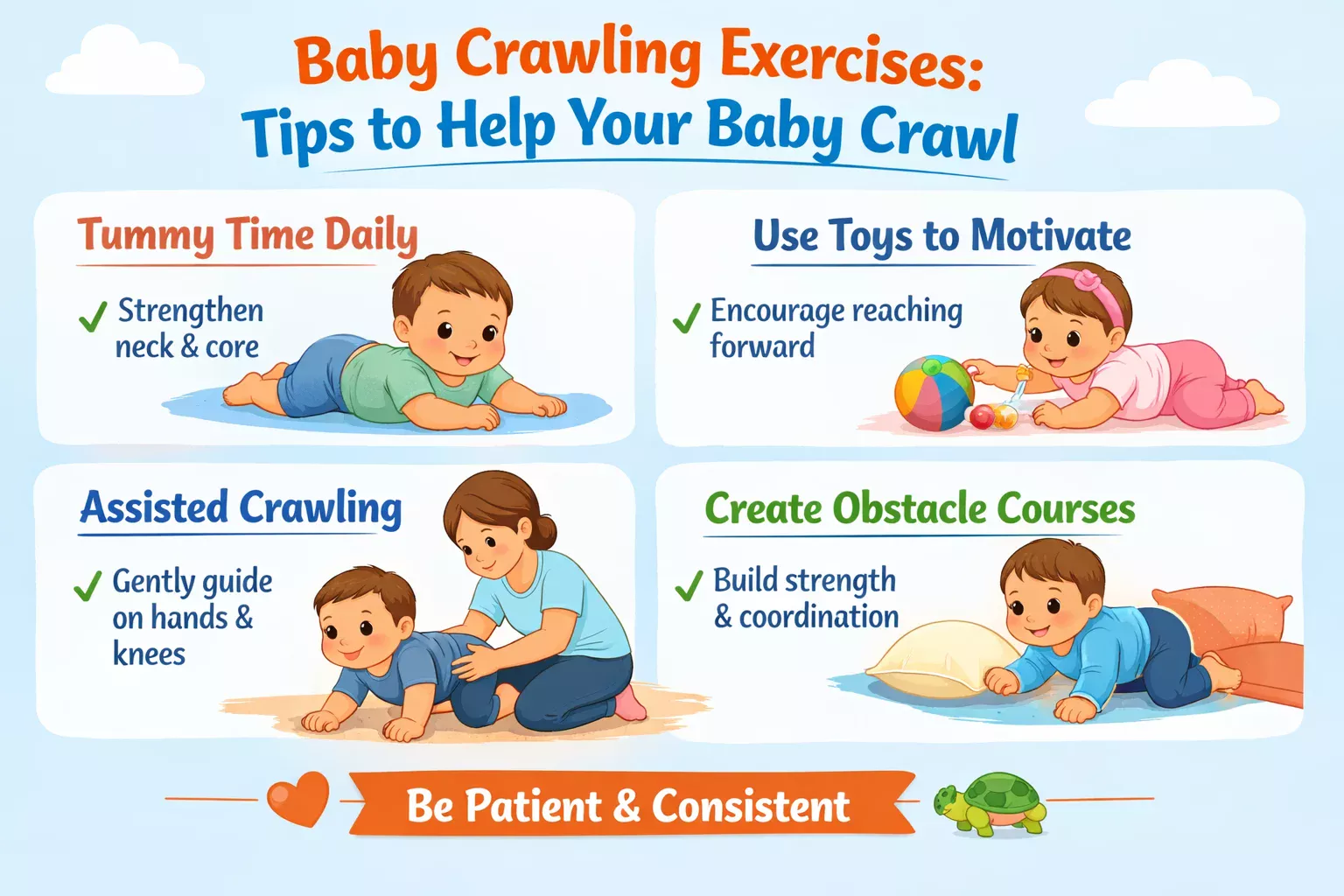
1. Tummy Time (Foundation Exercise)
Tummy time is the most important baby crawling exercise.
How to do it:
- Place baby on their stomach
- Start with 2–3 minutes, gradually increase
- Use toys or mirrors for engagement
Why it works:
Builds neck, arm, and shoulder strength.
2. Reach & Grab Game
Encourages forward movement.
Steps:
- Place a toy slightly out of reach
- Let baby stretch toward it
- Gradually increase distance
3. Assisted Crawling
Guide your baby into crawling position.
Steps:
- Position baby on hands and knees
- Support their belly with your hand
- Gently move them forward
4. Rolling Practice
Rolling helps coordination.
Steps:
- Encourage rolling side-to-side
- Use toys or your voice to guide
5. Pillow Obstacle Course
Creates a fun challenge.
Steps:
- Place soft pillows in path
- Let baby climb over
6. Mirror Play
Babies love seeing themselves.
Steps:
- Place mirror in front
- Encourage movement toward reflection
7. Crawl Tunnel
Use a tunnel or create one with blankets.
8. Leg Push Support
Gently support baby’s feet to push forward.
9. Toy Tracking Exercise
Move toys slowly to encourage crawling direction.
10. Parent Interaction Crawling
Call your baby from a short distance.
Daily Routine for Baby Crawling Exercises
Consistency matters more than intensity.
Sample Routine:
- Morning: 10 mins tummy time
- Afternoon: Reach & grab game
- Evening: Assisted crawling + play
How Often Should You Do Baby Crawling Exercises?
- 2–3 sessions daily
- 10–15 minutes each
- Always follow baby’s mood and comfort
Exercise Comparison Table
| Exercise | Difficulty | Age Suitability | Key Benefit |
|---|---|---|---|
| Tummy Time | Easy | 0–6 months | Core strength |
| Assisted Crawling | Medium | 6–9 months | Movement coordination |
| Reach & Grab | Easy | 5–8 months | Motivation to move |
| Obstacle Course | Medium | 7–10 months | Strength & balance |
| Mirror Play | Easy | 5–9 months | Visual stimulation |
Real-Life Parenting Situations
Situation 1: Baby Hates Tummy Time
Solution:
- Start with short sessions
- Use toys or music
- Lie down face-to-face
Situation 2: Baby Rolls But Doesn’t Crawl
Solution:
- Encourage forward reaching
- Use assisted crawling
Situation 3: Baby Seems Delayed
Solution:
- Practice daily baby crawling exercises
- Consult pediatrician if no progress by 10 months
Common Mistakes Parents Make
- Skipping tummy time
- Forcing baby to crawl
- Comparing with other babies
- Using walkers too early
- Not providing floor time
Expert Tips for Faster Crawling
- Practice on firm surfaces
- Limit screen exposure
- Use interactive toys
- Encourage barefoot movement
- Be patient and consistent
Safety & Health Notes
Based on guidelines from WHO, CDC, and Mayo Clinic:
- Always supervise baby
- Avoid hard or slippery floors
- Keep choking hazards away
- Use soft mats
- Stop if baby shows discomfort
FAQ Section
What are the best baby crawling exercises?
Tummy time, assisted crawling, and reach games are the most effective baby crawling exercises.
When should I start baby crawling exercises?
You can start as early as 2–3 months with tummy time.
How long should baby crawling exercises last?
10–15 minutes per session, 2–3 times daily.
Can baby crawling exercises help delayed babies?
Yes, consistent exercises can improve strength and coordination.
Is it normal if my baby skips crawling?
Some babies skip crawling, but exercises still support development.
Are baby crawling exercises safe?
Yes, when done under supervision and on soft surfaces.
Do toys help in baby crawling exercises?
Yes, toys motivate babies to move and explore.
What if my baby cries during exercises?
Reduce duration and try engaging activities.
Can I use walkers instead of exercises?
Walkers are not recommended; they may delay development.
How do I know baby crawling exercises are working?
You’ll notice improved strength, movement attempts, and coordination.
Read Also
- Baby Development 3 Months Guide: Amazing Milestones Every Parent Should Know
- Safe baby monitor placement
- Newborn sleep training guide
- Baby motor skills milestones
- 7 Safe Spots: Where to Put Baby Monitor Correctly
External Authority Sources
- World Health Organization (WHO)
- Centers for Disease Control and Prevention (CDC)
- Mayo Clinic
- American Academy of Pediatrics (AAP)
- American College of Obstetricians and Gynecologists (ACOG)
Conclusion
Incorporating baby crawling exercises into your daily routine can significantly improve your baby’s physical strength, coordination, and confidence. With patience, consistency, and the right techniques, you can support your baby’s natural development without pressure.
Remember, every baby grows at their own pace. Focus on encouragement, safety, and engagement rather than comparison. These exercises not only help your baby crawl but also build a strong foundation for walking and lifelong mobility.
Medical Disclaimer
This article is for informational purposes only and does not replace professional medical advice. Always consult a pediatrician for concerns about your baby’s development.