
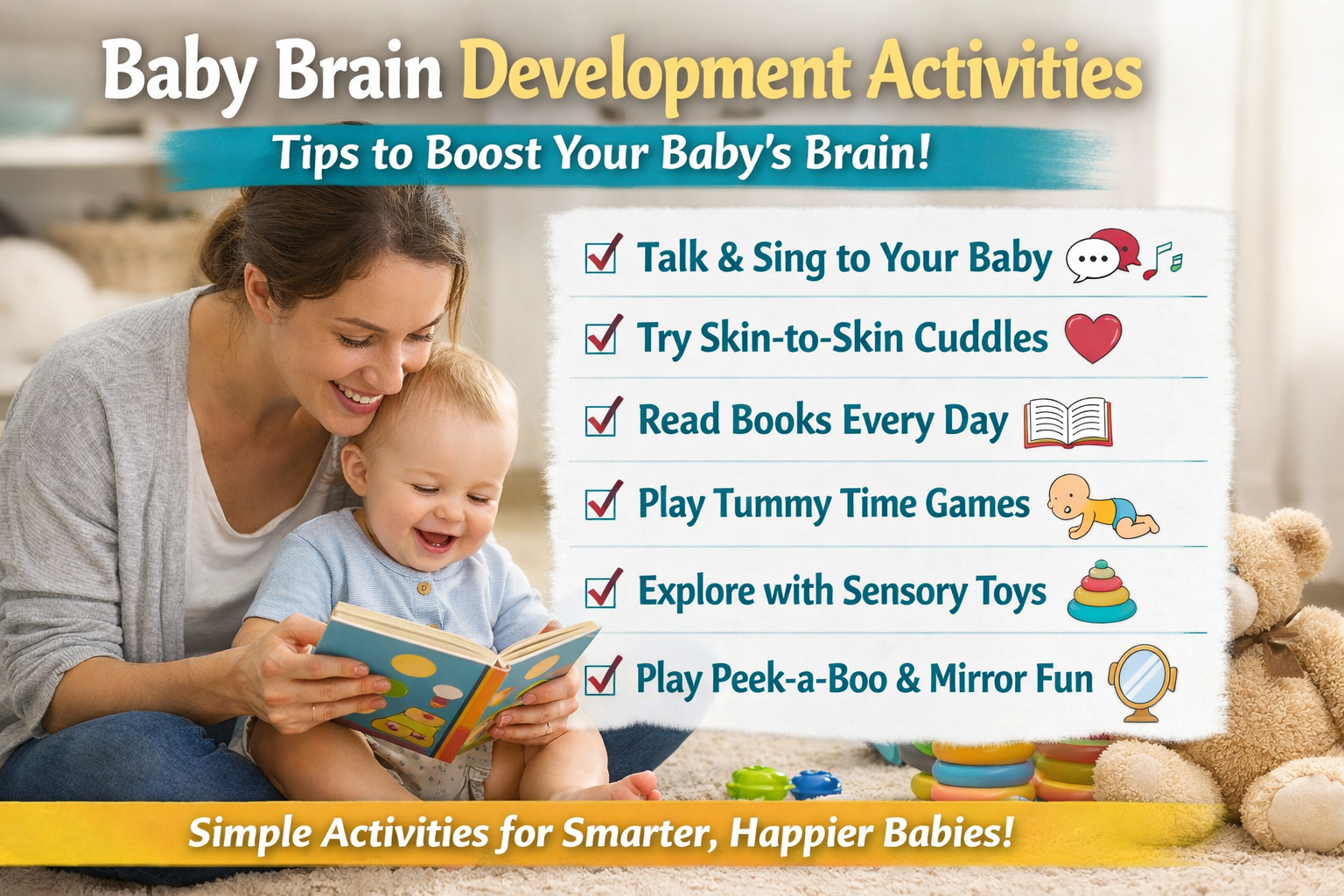
Baby Brain Development Activities: A Complete Guide for Parents
Baby brain development activities play a critical role in shaping your child’s intelligence, emotional skills, and learning ability from pregnancy through the first year of life. A baby’s brain grows faster in the first 12 months than at any other time in life, forming over one million neural connections every second.
The good news for parents is that boosting brain development doesn’t require expensive toys or complicated techniques. Simple daily interactions—talking, singing, cuddling, and playing—can significantly strengthen your baby’s cognitive growth.
Research from organizations such as the American Academy of Pediatrics (AAP) and the World Health Organization (WHO) shows that responsive parenting and early stimulation dramatically improve language development, emotional regulation, and problem-solving abilities.
In this complete guide, you’ll discover the most effective baby brain development activities, including what to do during pregnancy, from 0–3 months, at 6 months, and at 12 months. Each activity is backed by developmental science and designed to help parents nurture smarter, happier babies.
Quick Answer Box
What are the best baby brain development activities?
The best baby brain development activities include:
• Talking and singing to your baby
• Skin-to-skin contact
• Reading books daily
• Tummy time play
• Sensory exploration
• Mirror play
• Music and rhythm games
• Peek-a-boo interaction
• Safe exploration of new environments
These activities stimulate neural connections, improve memory, and support emotional bonding during a baby’s first year.
Why Baby Brain Development Matters
A newborn’s brain contains around 100 billion neurons. However, these neurons need stimulation to form strong connections.
Positive experiences during infancy help build:
• Memory skills
• Emotional intelligence
• Language development
• Social skills
• Problem-solving ability
According to the CDC early childhood development program, responsive parenting and play-based learning improve cognitive outcomes later in school.
Brain stimulation doesn’t mean structured lessons. It simply means engaging your baby in loving, responsive interaction.
Baby Brain Development Activities During Pregnancy
Many parents are surprised to learn that baby brain development activities during pregnancy can already support cognitive growth.
By the third trimester, babies can hear sounds and respond to voices.
Simple prenatal brain-boosting activities
1. Talk to your baby
Babies recognize their mother’s voice before birth. Speaking regularly helps build early language familiarity.
2. Play gentle music
Soft classical or instrumental music may stimulate auditory pathways.
3. Read stories aloud
Reading develops rhythm and language patterns that babies remember after birth.
4. Eat brain-supporting nutrients
Important nutrients include:
• DHA
• Iron
• Folate
• Choline
• Omega-3 fatty acids
The American College of Obstetricians and Gynecologists (ACOG) recommends prenatal nutrition to support fetal brain growth.
5. Manage stress
High maternal stress may affect fetal neurological development.
Relaxation activities include:
• prenatal yoga
• breathing exercises
• gentle walking
Baby Brain Development Activities 0 to 3 Months
The newborn stage focuses mainly on sensory stimulation and bonding.
1. Skin-to-skin contact
Skin contact stabilizes a baby’s heartbeat, temperature, and emotional security while strengthening neural connections.
2. Face-to-face talking
Babies love studying facial expressions.
Parents should:
• maintain eye contact
• exaggerate expressions
• speak slowly
3. High-contrast visual cards
Newborns see best in black and white patterns.
These stimulate visual processing.
4. Gentle singing
Music activates both hemispheres of the brain.
5. Tummy time
Tummy time strengthens neck muscles and promotes motor development.
Experts from the American Academy of Pediatrics recommend starting with 3–5 minutes per day.
Baby Brain Development Activities 6 Months
At six months, babies become curious explorers.
These baby brain development activities 6 months encourage learning through movement and discovery.
1. Mirror play
Babies enjoy seeing their reflection.
Benefits include:
• self-awareness
• visual recognition
• emotional engagement
2. Peek-a-boo games
This teaches object permanence, a key cognitive milestone.
3. Sensory basket
Create a basket containing safe items like:
• soft fabrics
• silicone spoons
• wooden rings
• textured balls
4. Name objects around the house
Example:
“Here is the spoon.”
“This is your teddy bear.”
Language exposure builds vocabulary foundations.
5. Reading colorful books
Board books with bright pictures encourage early literacy.
Baby Brain Development Activities 12 Months
By 12 months, babies are learning through imitation and movement.
These baby brain development activities 12 months promote cognitive and language development.
1. Simple puzzle toys
Large shape puzzles help babies understand spatial relationships.
2. Stacking blocks
Stacking improves problem solving and hand-eye coordination.
3. Action songs
Songs like clap hands and pat-a-cake develop rhythm and memory.
4. Naming body parts
Example:
“Where is your nose?”
This builds language comprehension.
5. Outdoor exploration
Nature stimulates curiosity and sensory development.
Baby Brain Development Activities Free at Home
Parents do not need expensive toys. Many baby brain development activities free are already part of everyday life.
Free activities include:
• storytelling
• singing lullabies
• dancing with baby
• household object exploration
• mirror play
• outdoor walks
• talking during diaper changes
The most powerful stimulation is parent interaction.
Brain Development Milestones Table
| Age | Brain Development Skill | Helpful Activities |
|---|---|---|
| Pregnancy | Auditory learning | talking, music |
| 0–3 months | visual focus, bonding | eye contact, tummy time |
| 3–6 months | sensory exploration | textured toys |
| 6–9 months | memory formation | peek-a-boo |
| 9–12 months | problem solving | stacking toys |
Common Mistakes Parents Make
1. Overstimulating the baby
Too many toys or loud environments can overwhelm infants.
2. Relying on screen time
Experts from the American Academy of Pediatrics recommend no screen time under 18 months.
3. Ignoring talking interaction
Some parents underestimate the power of conversation.
Talking constantly helps language growth.
4. Comparing babies
Every baby develops at a different pace.
5. Buying too many “educational toys”
Brain development depends more on interaction than toys.
Expert Tips for Boosting Brain Growth
Child development specialists recommend:
• Respond quickly when babies cry
• Talk throughout daily routines
• Maintain eye contact
• Encourage safe exploration
• Read at least one book per day
Consistent routines also support emotional security, which enhances learning.
Safety & Health Notes
When practicing baby brain development activities, parents should keep safety in mind.
Important guidelines:
• Use only age-appropriate toys
• Avoid small choking hazards
• Supervise tummy time
• Maintain safe sleep practices
• Avoid loud noises near infants
The Mayo Clinic recommends keeping stimulation gentle and developmentally appropriate.
Frequently Asked Questions
What are the best baby brain development activities?
Talking, reading, singing, tummy time, and sensory play are the most effective baby brain development activities.
Do baby brain development activities really work?
Yes. Research from the CDC and AAP shows that early stimulation strengthens neural connections.
When should parents start baby brain development activities?
Activities can begin during pregnancy and continue daily after birth.
What are baby brain development activities 0 to 3 months?
Eye contact, tummy time, singing, and high-contrast visuals.
What are baby brain development activities 6 months?
Mirror play, peek-a-boo, sensory baskets, and object naming.
What are baby brain development activities 12 months?
Stacking blocks, puzzles, action songs, and imitation games.
Are expensive toys necessary?
No. Many baby brain development activities free involve talking and playing.
How much playtime does a baby need?
Short play sessions throughout the day work best.
Does music help baby brain development?
Yes. Music stimulates memory, rhythm recognition, and language development.
Can screen time help brain development?
Experts recommend avoiding screen exposure under 18 months.
Read Also
Future articles for Parentnest:
- The Ultimate Survival Guide: How to Take Care of Newborn Baby Alone with Confidence and Calm
- The Ultimate Guide to Baby Growth Month by Month During Pregnancy: A Powerful, Reassuring Breakdown for Expecting Parents
- How to build a baby daily routine
- Baby language development stages
- Best Montessori toys for babies
- Tummy time guide for new parents
Conclusion
The first year of life offers a powerful opportunity to shape your child’s future learning potential. Simple baby brain development activities like talking, singing, reading, and playing can build millions of neural connections that support intelligence, emotional health, and creativity.
Parents do not need expensive tools or complicated programs. What babies need most is love, interaction, and consistent stimulation from caregivers.
By incorporating these science-backed activities from pregnancy through the first year, families can give babies the strongest foundation for lifelong learning.
Medical Disclaimer
This article is for educational purposes only and does not replace professional medical advice. Always consult a pediatrician or qualified healthcare provider regarding your baby’s development or health concerns.